

SpringAOP
1.传统事务处理
- 创建java项目,导入坐标
<?xml version="1.0" encoding="UTF-8"?>
<project xmlns="http://maven.apache.org/POM/4.0.0"
         xmlns:xsi="http://www.w3.org/2001/XMLSchema-instance"
         xsi:schemaLocation="http://maven.apache.org/POM/4.0.0 http://maven.apache.org/xsd/maven-4.0.0.xsd">
    <modelVersion>4.0.0</modelVersion>

    <groupId>org.example</groupId>
    <artifactId>springtransfer</artifactId>
    <version>1.0-SNAPSHOT</version>

    <dependencies>
    <dependency>
        <groupId>mysql</groupId>
        <artifactId>mysql-connector-java</artifactId>
        <version>5.1.47</version>
    </dependency>
    <dependency>
        <groupId>com.alibaba</groupId>
        <artifactId>druid</artifactId>
        <version>1.1.15</version>
    </dependency>
    <dependency>
        <groupId>commons-dbutils</groupId>
        <artifactId>commons-dbutils</artifactId>
        <version>1.6</version>
    </dependency>
    <dependency>
    <groupId>org.springframework</groupId>
        <artifactId>spring-context</artifactId>
        <version>5.1.5.RELEASE</version>
    </dependency>
        <dependency>
            <groupId>org.springframework</groupId>
            <artifactId>spring-test</artifactId>
            <version>5.1.5.RELEASE</version>
        </dependency>
        <dependency>
            <groupId>junit</groupId>
            <artifactId>junit</artifactId>
            <version>4.12</version>
        </dependency>
    </dependencies>

</project>
- 编写Account实体类
package com.domain;

public class Account {
    private int id;
    private String name;
    private double money;

    @Override
    public String toString() {
        return "Account{" +
                "id=" + id +
                ", name='" + name + '\'' +
                ", money=" + money +
                '}';
    }

    public int getId() {
        return id;
    }

    public void setId(int id) {
        this.id = id;
    }

    public String getName() {
        return name;
    }

    public void setName(String name) {
        this.name = name;
    }

    public double getMoney() {
        return money;
    }

    public void setMoney(double money) {
        this.money = money;
    }
}
- 编写AccountDao接口和实现类
package com.dao.impl;

import com.dao.AccountDao;
import com.utils.ConnectionUtils;
import org.apache.commons.dbutils.QueryRunner;
import org.springframework.beans.factory.annotation.Autowired;
import org.springframework.stereotype.Repository;

import java.sql.SQLException;

@Repository("accountDao")
public class AccountDaoImp implements AccountDao {
    @Autowired
    private QueryRunner queryRunner;

// 转出操作
    public void outAccout(String outUser, double money){
        String sql="update account set money = money - ?  where name = ?";
        try {
            queryRunner.update(sql,money,outUser);
        } catch (SQLException e) {
            e.printStackTrace();
        }
    }
    // 转入操作
    public void inAccout(String inUser, double money){
        String sql="update account set money = money + ?  where name = ?";
        try {
            queryRunner.update(sql,money,inUser);
        } catch (SQLException e) {
            e.printStackTrace();
        }
    }
}
- 编写AccountService接口和实现类
@Service("accountService")
public class AccountServiceImp implements AccountService {
    @Autowired
    private AccountDao accountDao;

    public void transfer(String outUser, String inUser, double money) {

            accountDao.outAccout(outUser,money);
            int i=1/0;
            accountDao.inAccout(inUser,money);

    }
}
- 编写spring核心配置文件
<?xml version="1.0" encoding="UTF-8"?>
<beans xmlns="http://www.springframework.org/schema/beans"
       xmlns:xsi="http://www.w3.org/2001/XMLSchema-instance"
       xmlns:context="http://www.springframework.org/schema/context"
       xsi:schemaLocation="
http://www.springframework.org/schema/beans
http://www.springframework.org/schema/beans/spring-beans.xsd
http://www.springframework.org/schema/context
http://www.springframework.org/schema/context/spring-context.xsd">


<!-- 导入配置文件-->
    <context:property-placeholder location="classpath:jdbc.properties"></context:property-placeholder>

<!-- 开启注解扫描-->
    <context:component-scan base-package="com"></context:component-scan>

<!--datasource-->
<bean id="dataSource" class="com.alibaba.druid.pool.DruidDataSource">
    <property name="driverClassName" value="${jdbc.driver}"></property>
    <property name="url" value="${jdbc.url}"></property>
    <property name="username" value="${jdbc.username}"></property>
    <property name="password" value="${jdbc.password}"></property>
</bean>

<!--QueryRunner-->
    <bean id="queryRunner" class="org.apache.commons.dbutils.QueryRunner">
        <constructor-arg name="ds" ref="dataSource"></constructor-arg>
    </bean>

</beans>
- 编写测试代码
@RunWith(SpringJUnit4ClassRunner.class)
@ContextConfiguration("classpath:SpringContext.xml")
public class testTransfer {
    @Autowired
    private AccountService accountService;
    @Test
    public void test(){
        //未用到事务
        accountService.transfer("tom", "jerry", 100d);
    }
}
问题: 应该把业务逻辑控制在一个事务中,所以应该将事务挪到service层
解决方案:
- 编写线程绑定工具类
package com.utils;

import org.springframework.beans.factory.annotation.Autowired;
import org.springframework.stereotype.Component;

import javax.sql.DataSource;
import java.sql.Connection;
import java.sql.SQLException;

@Component
public class ConnectionUtils {

    //先初始化
    private ThreadLocal<Connection> threadLocal=new ThreadLocal<>();

    @Autowired
    private DataSource dataSource;

//获取线程连接,让他们处于同一个连接池
    public Connection getThreadConnection(){
        Connection connection = threadLocal.get();
        if(connection==null){
            try {
                connection = dataSource.getConnection();
                threadLocal.set(connection);
            } catch (SQLException e) {
                e.printStackTrace();
            }
        }
        return connection;
    }

// 接触连接绑定
    public void removeThreadConnection(){
        threadLocal.remove();
    }

}
- 编写事务管理器
package com.utils;

import org.springframework.beans.factory.annotation.Autowired;
import org.springframework.stereotype.Component;

import java.sql.Connection;
import java.sql.SQLException;

@Component
public class TransactionManager {
    //事务管理器
    @Autowired  //   自动生成线程管理实例
    private ConnectionUtils connectionUtils;

    // 实现开启事务
    public void startTransaction() {
        Connection connection = connectionUtils.getThreadConnection();
        try {
            connection.setAutoCommit(false);
        } catch (SQLException e) {
            e.printStackTrace();
        }
    }

    // 实现事务提交
    public void commit() {
        Connection connection = connectionUtils.getThreadConnection();
        try {
            connection.commit();
        } catch (SQLException e) {
            e.printStackTrace();
        }
    }

    // 实现事务回滚
    public void rollback() {
        Connection connection = connectionUtils.getThreadConnection();
        try {
            connection.rollback();
        } catch (SQLException e) {
            e.printStackTrace();
        }
    }

    // 设置事务属性,释放资源
    public void close() {
        Connection connection = connectionUtils.getThreadConnection();
        try {
            connection.setAutoCommit(true);// 改回自动提交事务
            connection.close();// 归还到连接池
            connectionUtils.removeThreadConnection();// 解除线程绑定
        } catch (SQLException e) {
            e.printStackTrace();
        }
    }
}
- 修改service层代码
package com.dao.impl;

import com.dao.AccountDao;
import com.utils.ConnectionUtils;
import org.apache.commons.dbutils.QueryRunner;
import org.springframework.beans.factory.annotation.Autowired;
import org.springframework.stereotype.Repository;

import java.sql.SQLException;

@Repository("accountDao")
public class AccountDaoImp implements AccountDao {
    @Autowired
    private QueryRunner queryRunner;

// 处理事务时应该以连接池的方式,这样第一次使用时就会设置线程
    @Autowired
    private ConnectionUtils connectionUtils;
    // 转出操作
    public void outAccout(String outUser, double money){
        String sql="update account set money = money - ?  where name = ?";
        try {
            queryRunner.update(connectionUtils.getThreadConnection(),sql,money,outUser);
        } catch (SQLException e) {
            e.printStackTrace();
        }
    }
    // 转入操作
    public void inAccout(String inUser, double money){
        String sql="update account set money = money + ?  where name = ?";
        try {
            queryRunner.update(connectionUtils.getThreadConnection(),sql,money,inUser);
        } catch (SQLException e) {
            e.printStackTrace();
        }
    }
}
- 修改dao层代码
@Service("accountService")
public class AccountServiceImp implements AccountService {
    @Autowired
    private AccountDao accountDao;
    @Autowired
    private TransactionManager transactionManager;


    public void transfer(String outUser, String inUser, double money) {
        try {
            transactionManager.startTransaction();

            accountDao.outAccout(outUser,money);
            int i=1/0;

            accountDao.inAccout(inUser,money);
            transactionManager.commit();
        } catch (Exception e) {
            transactionManager.rollback();
            e.printStackTrace();
        }finally {
            transactionManager.close();
        }
    }
}
问题:业务层代码繁杂,重复代码多,业务层与事务控制方法耦合度高,违背了面向对象的开发思想
解决方案:代理模式,将业务代码和事务代码进行拆分,通过动态代理的方式,对业务方法进行事务的增强
- JDK动态代理: 基于接口的动态代理技术,目标对象必须实现了接口,与目标对象同级,实现拦截器invocationHandler加上反射机制生成一个代理接口的匿名类,在调用具体方法前会调用InvokeHandler来处理,实现方法的增强
package com.proxy;

import com.service.AccountService;
import com.utils.TransactionManager;
import org.springframework.beans.factory.annotation.Autowired;
import org.springframework.stereotype.Component;

import java.lang.reflect.InvocationHandler;
import java.lang.reflect.InvocationTargetException;
import java.lang.reflect.Method;
import java.lang.reflect.Proxy;

@Component
public class JdkProxyFactory {
    // JDK实现动态代理
    @Autowired
    private AccountService accountService;
    @Autowired
    private TransactionManager transactionManager;


    public AccountService createAccountServiceProxy() {
        AccountService accountServiceProxy = null;
        // 参数1: 要加载的类的类加载器
        // 要加载类的接口
        // InvocationHandler实现类
        accountServiceProxy = (AccountService) Proxy.newProxyInstance(accountService.getClass().getClassLoader(), accountService.getClass().getInterfaces(), new InvocationHandler() {
            //proxy 当前的代理对象  method对应的业务层方法    args传入的参数
            @Override
            public Object invoke(Object proxy, Method method, Object[] args) throws Throwable {
                Object result = null;
                try {
                    //开启事务
                    transactionManager.startTransaction();
                    result = method.invoke(accountService, args);
                    //提交事务
                    transactionManager.commit();
                } catch (Exception e) {
                    //回滚事务
                    transactionManager.rollback();
                    e.printStackTrace();
                } finally {
                    //释放资源
                    transactionManager.close();
                }
                return result;

            }
        });
    // 返回代理对象
        return accountServiceProxy;
    }

}
 @Test
    public void testJDK() {
        AccountService accountServiceProxy = jdkProxyFactory.createAccountServiceProxy();
        accountServiceProxy.transfer("tom", "jerry", 100d);
    }
- Cglib代理模式:基于父类的动态代理技术,动态的生成一个要代理的子类,子类重写要代理的类的所有不是final的方法,因此目标对象也不能是final类。子类中采用方法拦截技术拦截所有的父类方法的调用,顺势植入横切逻辑,对方法进行增强
package com.proxy;

import com.service.AccountService;
import com.utils.TransactionManager;
import org.springframework.beans.factory.annotation.Autowired;
import org.springframework.cglib.proxy.Enhancer;
import org.springframework.cglib.proxy.MethodInterceptor;
import org.springframework.cglib.proxy.MethodProxy;
import org.springframework.stereotype.Component;

import java.lang.reflect.Method;
import java.lang.reflect.Proxy;

@Component
public class CglibProxyFactory {
    @Autowired
    private AccountService accountService;
    @Autowired
    private TransactionManager transactionManager;


    public AccountService createAccountServiceProxy(){
        AccountService accountServiceProxy = null;
        //参数一:目标对象的字节码对象
        //参数二:动作类,实现增强功能
        accountServiceProxy = (AccountService) Enhancer.create(accountService.getClass(), new MethodInterceptor() {
            @Override
            //o 代表生成的代理对象  method代表调用方法的引用  objects 传入的参数  methodProxy代理方法
            public Object intercept(Object o, Method method, Object[] objects, MethodProxy methodProxy) throws Throwable {
                Object result = null;
                try {
                    //开启事务
                    transactionManager.startTransaction();
                    result = method.invoke(accountService, objects);
                    //提交事务
                    transactionManager.commit();
                } catch (Exception e) {
                    //回滚事务
                    transactionManager.rollback();
                    e.printStackTrace();
                } finally {
                    //释放资源
                    transactionManager.close();
                }
                return result;
            }
        });
        return accountServiceProxy;

    }

}
 @Autowired
    private CglibProxyFactory cglibProxyFactory;
    @Test
    public void testCglib() {
        AccountService accountServiceProxy = cglibProxyFactory.createAccountServiceProxy();
        accountServiceProxy.transfer("tom", "jerry", 100d);
    }
    public void transfer(String outUser, String inUser, double money) {

            accountDao.outAccout(outUser,money);
            //int i=1/0;

            accountDao.inAccout(inUser,money);

    }
2.AOP
利用AOP可以对业务逻辑的各个部分进行隔离,从而使得业务逻辑各部分之间的耦合度降低,提高程序的可重用性,同时提高了开发的效率
AOP 的底层是通过 Spring 提供的的动态代理技术实现的。在运行期间,Spring通过动态代理技术动态的生成代理对象,代理对象方法执行时进行增强功能的介入,在去调用目标对象的方法,从而完成功能的增强
- 优点
- 在程序运行期间,在不修改源码的情况下对方法进行功能增强
- 逻辑清晰,开发核心业务的时候,不必关注增强业务的代码
- 减少重复代码,提高开发效率,便于后期维护
- 常用术语
- Target(目标对象):代理的目标对象
- Proxy (代理):一个类被 AOP 织入增强后,就产生一个结果代理类
- Joinpoint(拦截点):所谓连接点是指那些可以被拦截到的点。在spring中,这些点指的是方法,因为spring只支持方法类型的连接
- Pointcut(切入点):所谓切入点是指我们要对哪些 Joinpoint 进行拦截的定义
- Advice(通知/ 增强):所谓通知是指拦截到 Joinpoint 之后所要做的事情就是通知分类:前置通知、后置通知、异常通知、最终通知、环绕通知
- Aspect(切面):是切入点和通知(引介)的结合
- Weaving(织入):是指把增强应用到目标对象来创建新的代理对象的过程。spring采用动态代理织入,而AspectJ采用编译期织入和类装载期织入
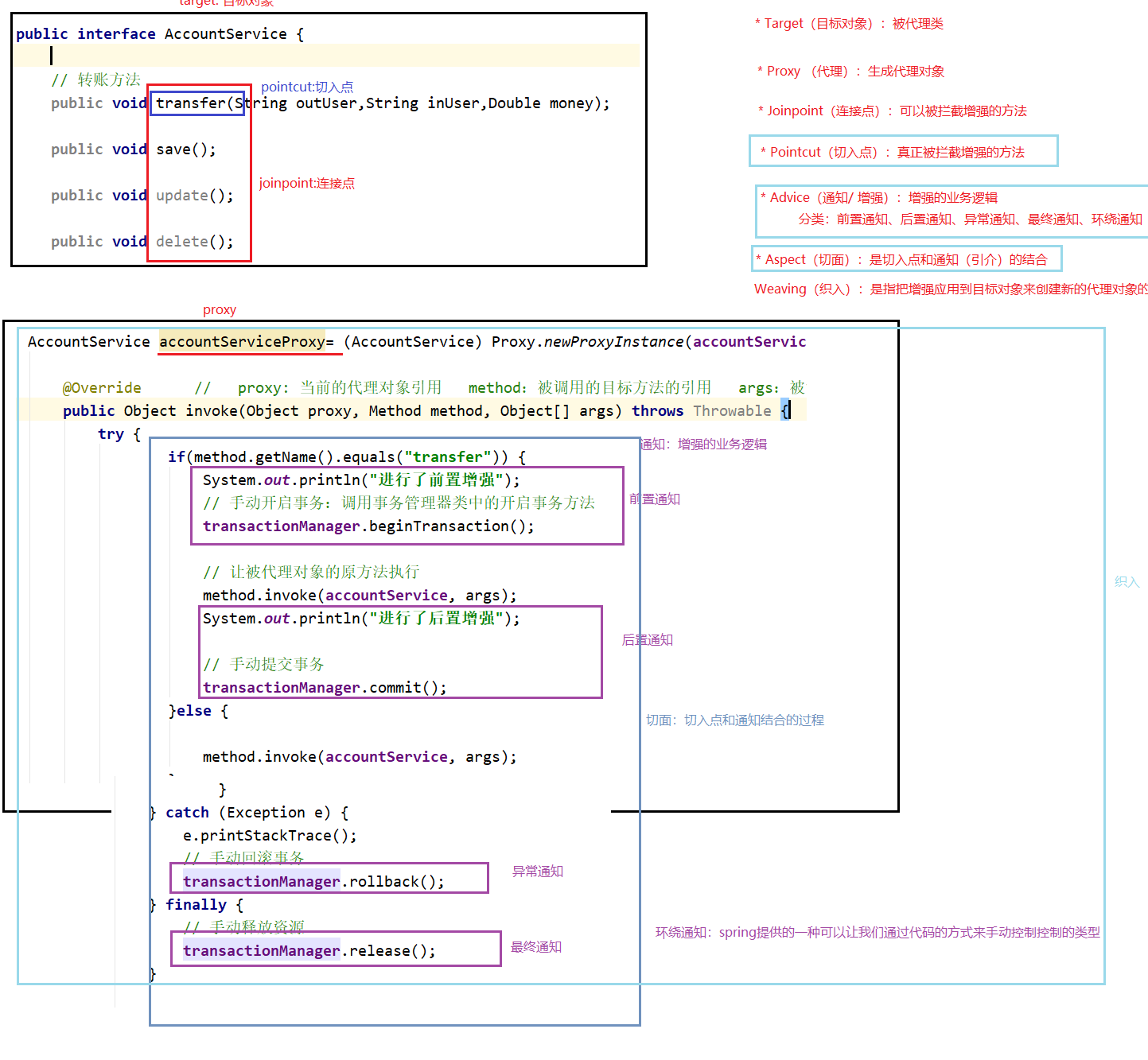
- AOP开发事项
- 开发阶段: 编写核心业务代码(目标类的目标方法) 切入点; 把公用代码抽取出来,制作成通知(增强功能方法) 通知; 在配置文件中,声明切入点与通知间的关系即切面
- 运行阶段(Spring框架完成的):Spring 框架监控切入点方法的执行。一旦监控到切入点方法被运行,使用代理机制,动态创建目标对象的代理对象,根据通知类别,在代理对象的对应位置,将通知对应的功能织入,完成完整的代码逻辑运行
- 底层代理实现:在 Spring 中,框架会根据目标类是否实现了接口来决定采用哪种动态代理的方式。当bean实现接口时,会用JDK代理模式;当bean没有实现接口,用cglib实现( 可以强制使用cglib(在spring配置中加入<aop:aspectjautoproxy proxyt-target-class=”true”/>)
<!-- aspectj的织入(切点表达式需要用到该jar包) -->
<dependency>
<groupId>org.aspectj</groupId>
<artifactId>aspectjweaver</artifactId>
<version>1.8.13</version>
</dependency>
<?xml version="1.0" encoding="UTF-8"?>
<beans xmlns="http://www.springframework.org/schema/beans"
xmlns:xsi="http://www.w3.org/2001/XMLSchema-instance"
xmlns:aop="http://www.springframework.org/schema/aop"
xsi:schemaLocation="http://www.springframework.org/schema/beans
http://www.springframework.org/schema/beans/spring-beans.xsd
http://www.springframework.org/schema/aop
http://www.springframework.org/schema/aop/spring-aop.xsd">
<!--目标类交给IOC容器-->
<bean id="accountService" class="com.lagou.service.impl.AccountServiceImpl">
</bean>
<!--通知类交给IOC容器-->
<bean id="myAdvice" class="com.lagou.advice.MyAdvice"></bean>
<aop:config>
<!--引入通知类-->
<aop:aspect ref="myAdvice">
<!--配置目标类的transfer方法执行时,使用通知类的before方法进行前置增强-->
<aop:before method="before"
pointcut="execution(public void
com.lagou.service.impl.AccountServiceImpl.transfer())"></aop:before>
</aop:aspect>
</aop:config>
</beans>
- xml切点表达式execution([修饰符] 返回值类型 包名.类名.方法名(参数))
- 访问修饰符可以省略
- 返回值类型、包名、类名、方法名可以使用星号 * 代替,代表任意
- 包名与类名之间一个点 . 代表当前包下的类,两个点 .. 表示当前包及其子包下的类
- 参数列表可以使用两个点 .. 表示任意个数,任意类型的参数列表
- 切点表达式的抽取
<aop:config>
<!--抽取的切点表达式-->
<aop:pointcut id="myPointcut" expression="execution(* com.lagou.service..*.*
(..))"> </aop:pointcut>
<aop:aspect ref="myAdvice">
<aop:before method="before" pointcut-ref="myPointcut"></aop:before>
</aop:aspect>
</aop:config>
- xml通知类<aop:通知类型 method=“通知类中方法名” pointcut=“切点表达式"></aop:通知类型>
- 执行顺序 before==>afterreturning/afterthrowing==>after
- afterReturning与fterThrowing只有一个会出现
| 名称 | 标签 | 说明 |
| 前置通知 | <aop:before> | 用于配置前置通知。指定增强的方法在切入点方法之前执行 |
| 后置通知 | <aop:afterReturning> | 用于配置后置通知。指定增强的方法在切入点方法之后执行 |
| 异常通知 | <aop:afterThrowing> | 用于配置异常通知。指定增强的方法出现异常后执行 |
| 最终通知 | <aop:after> | 用于配置最终通知。无论切入点方法执行时是否有异常, 都会执行 |
| 环绕通知 | <aop:around> | 用于配置环绕通知。开发者可以手动控制增强代码在什么时候执行,通常独立使用 |
@Component
@Aspect
public class MyAdvice {
@Before("execution(* com.lagou..*.*(..))")
public void before() {
System.out.println("前置通知...");
}
}
<!--组件扫描-->
<context:component-scan base-package="com.lagou"/>
<!--aop的自动代理-->
<aop:aspectj-autoproxy></aop:aspectj-autoproxy
- 注解形式 切点表达式抽取
@Component
@Aspect
public class MyAdvice {
@Pointcut("execution(* com.lagou..*.*(..))")
public void myPoint(){}
@Before("MyAdvice.myPoint()")
public void before() {
System.out.println("前置通知...");
}
- 注解形式通知类型:执行顺序@Before -> @After -> @AfterReturning(如果有异常:@AfterThrowing)
| 名称 | 标签 | 说明 |
| 前置通知 | @Before | 用于配置前置通知。指定增强的方法在切入点方法之前执行 |
| 后置通知 | @AfterReturning | 用于配置后置通知。指定增强的方法在切入点方法之后执行 |
| 异常通知 | @AfterThrowing | 用于配置异常通知。指定增强的方法出现异常后执行 |
| 最终通知 | @After | 用于配置最终通知。无论切入点方法执行时是否有异常,都会 执行 |
| 环绕通知 | @Around | 用于配置环绕通知。开发者可以手动控制增强代码在 |
@Configuration
@ComponentScan("com.lagou")
@EnableAspectJAutoProxy //替代 <aop:aspectj-autoproxy />
public class SpringConfig {
}

 浙公网安备 33010602011771号