[Python入门学习]-正则表达式
一.什么是正则表达式
'''
什么是正则表达式:记录文本规则的代码
是一个特殊的字符序列
普通字符和元字符组成的,其实就是对元字符的学习
'''

import re
reg_string = "hello9527python@wanghellocai.@!:xiaoqiang"
reg = "hello"

result = re.findall(reg, reg_string)
print(result)

二.元字符
'''
元字符
. 匹配除换行符外的任意字符
\w 匹配字母或数字或下划线或汉字
\s 匹配任意的空白符
\d 匹配数字
\b 匹配单词的开始或结束
^ 匹配字符串的开始
$ 匹配字符串的结束
'''
reg_string = "hello9527python@wanghellocai.@!:xiaoqiang"
reg = "\d"
s = re.findall(reg, reg_string)
print(s)

reg = "^hello"
s = re.findall(reg, reg_string)
print(s)

reg_string = "hello9527python@wang旺财hellocai.@!:xiaoqiang"
reg = "\w"
s = re.findall(reg, reg_string)
print(s)

三.反义代码
\W 匹配任意不是字母、数字、下划线、汉字的字符
\S 匹配任意不是空白符的字符
\D 非数字
\B 匹配不是单词开头或结束的位置
[^a] 匹配除了a以外的任意字符
[^abcd] 匹配除了a、b、c、d以外的任意字符
四.限定符
'''
限定符
* 重复零次或多次
+ 重复一次或多次
? 重复零次或一次
{n} 重复n次
{n,} 重复n次或更多次数
{n,m} 重复n到m次 {1,3}
'''
reg_string = "hello9527python@wang旺财hellocai.@!:xiaoqiang"
reg = "\d{4}"
result = re.findall(reg, reg_string)
print(result)

reg = "[0-9a-z]{4}"
result = re.findall(reg, reg_string)
print(result)

五.练习
#
ip = "this is ip:192.168.1.123:172.138.2.15"
reg = "\d{3}.\d+.\d+.\d+"
result = re.findall(reg,ip)
print(result)

#search
ip = "this is ip:192.168.1.123 : 172.138.2.15"
reg = "(\d{1,3}.){3}\d{1,3}"
result = re.search(reg, ip)
print(result)

result = re.search(reg, ip)[0]
print(result)

'''
search和findall
search只匹配第一个
findall匹配所有
'''

六.组匹配
'''
组匹配
'''
s = "this is phone:13888888888 and this is my postcode:012345"
reg = "this is phone:(\d{11}) and this is my postcode:(\d{6})"
result = re.search(reg, s)
print(result)

result = re.search(reg, s).group(0)
print(result)
result = re.search(reg, s).group(1)
print(result)
result = re.search(reg, s).group(2)
print(result)

#match 只匹配开头的
reg_string = "HelloPythonHelloString"
reg = "Hello"
result = re.match(reg, reg_string).group()
print(result)

#re.I是忽略大小写的作用
reg_string = "helloPythonHelloString"
reg = "Hello"
result = re.match(reg, reg_string,re.I).group()
print(result)

七.贪婪与非贪婪
'''
贪婪与非贪婪 贪婪与懒惰
什么是贪婪:尽可能多的匹配
非贪婪:尽可能少的匹配
非贪婪操作符:?
这个操作符是用在* + ?后面的,要求正则匹配的越少越好
* 重复零次或更多次 ?
+ 重复一次或更多次 ?
? 重复零次或一次 ?
'''
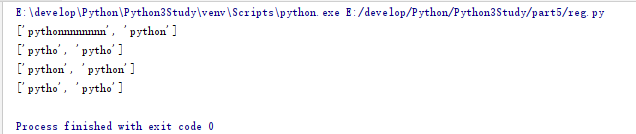
reg_string = "pythonnnnnnnnpythonHelloPytho"
#贪婪
reg = "python*"
result = re.findall(reg, reg_string)
print(result)

#非贪婪
reg = "python*?"
result = re.findall(reg, reg_string)
print(result)

#
reg = "python+?"
result = re.findall(reg, reg_string)
print(result)

reg = "python??"
result = re.findall(reg, reg_string)
print(result)
八.练习手机号码验证
'''
练习部分 手机号码验证
移动:
139 138 137 136 135 134
150 151 152 157 158 159
182 183 187 188 147
联通:
130 131 132 185 186 145
电信:
133 153 180 189
'''
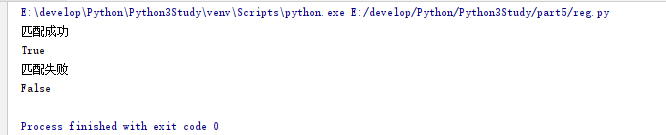
def checkCellphone(cellphone):
    regex = "^((13[0-9])|(14[5|7])|(15([0-3]|[5-9]))|(18[0,5-9]))\d{8}$"
    result = re.findall(regex, cellphone)
    if result:
        print("匹配成功")
        return True
    else:
        print("匹配失败")
        return False

cellphone = "13887656789"
print(checkCellphone(cellphone))

cellphone = "138876567891"
print(checkCellphone(cellphone))
posted on 2019-04-07 11:54 bijian1013 阅读(92) 评论(0) 收藏 举报


 浙公网安备 33010602011771号