
POJ 2488 A Knight's Journey(DFS)
A Knight's Journey
| Time Limit: 1000MS | Memory Limit: 65536K | |
| Total Submissions: 55239 | Accepted: 18788 |
Description
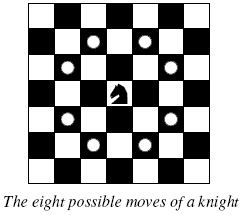 Background
 The knight is getting bored of seeing the same black and white squares again and again and has decided to make a journey
around the world. Whenever a knight moves, it is two squares in one direction and one square perpendicular to this. The world of a knight is the chessboard he is living on. Our knight lives on a chessboard that has a smaller area than a regular 8 * 8 board, but it is still rectangular. Can you help this adventurous knight to make travel plans?
Problem
Find a path such that the knight visits every square once. The knight can start and end on any square of the board.
Input
The input begins with a positive integer n in the first line. The following lines contain n test cases. Each test case consists of a single line with two positive integers p and q, such that 1 <= p * q <= 26. This represents a p * q chessboard, where p describes how many different square numbers 1, . . . , p exist, q describes how many different square letters exist. These are the first q letters of the Latin alphabet: A, . . .
Output
The output for every scenario begins with a line containing "Scenario #i:", where i is the number of the scenario starting at 1. Then print a single line containing the lexicographically first path that visits all squares of the chessboard with knight moves followed by an empty line. The path should be given on a single line by concatenating the names of the visited squares. Each square name consists of a capital letter followed by a number.
If no such path exist, you should output impossible on a single line.
If no such path exist, you should output impossible on a single line.
Sample Input
3
1 1
2 3
4 3
Sample Output
Scenario #1:
A1

Scenario #2:
impossible

Scenario #3:
A1B3C1A2B4C2A3B1C3A4B2C4
Source
TUD Programming Contest 2005, Darmstadt, Germany
题意:
给定一个棋盘N*M(1<=N*M<=26),从任意位置出发,如果有路径能够把棋盘上每一个点走一遍,输出字典序最小的路径,如果没有输出impossible。
解题思路:
给的列使用字母表示,行用数字表示,
要想使得找到的路径字母序是最小的,说明要列优先查找
搜索的方向也有限制:应该从出发点最左上的方向先找,然后左下,右上,右下
故方向数组Move[8][2] = {{-1,-2},{1,-2},{-2,-1},{-2,1},{-2,1},{2,1},{-1,2},{1,2}}
剪枝:
1.过滤掉访问过的,出界的格子
2.如果在搜索过程中找到路径直接返回//因为是列优先查找并且搜索的方向也是有大小顺序的,第一次找到的路径一定是字母序最小的
#include <iostream>
#include<cstdio>
using namespace std;

int N,M;
int Move[8][2] = {{-1,-2},{1,-2},{-2,-1},{2,-1},{-2,1},{2,1},{-1,2},{1,2}};
int visit[26][26];//访问标志 1*26,26*1
int a[27][2];//记录路径
bool check(int x,int y){//检查是否走过或者出界
    return !visit[x][y]&&x>=0&&x<N&&y>=0&&y<M;
}

char convert(int num){
    return char(num+65);
}
bool DFS(int x,int y,int time){
    if(time == N*M) {//说明整个棋盘都遍历结束了
        return true;
    }
    bool flag = false;
    for(int i=0;i<8;i++){
        int nx = x + Move[i][0];
        int ny = y + Move[i][1];
        if(check(nx,ny)){
            visit[nx][ny] = 1;
            a[time+1][0] = nx;
            a[time+1][1] = ny;
            flag = DFS(nx,ny,time+1);
            if(flag) return flag;//若过找到提前直接返回
            visit[nx][ny] = 0;
        }
    }
    return flag;
}
//行是数字,列是字母
int main(){
    int Case;
    scanf("%d",&Case);
    int first = 1;
    for(int k = 1;k<=Case;k++){
        if(first){
            first = 0;
        }else{
            printf("\n");
        }
        scanf("%d%d",&N,&M);
        for(int i=0;i<N;i++){
            for(int j=0;j<M;j++){
                visit[i][j] = 0;
            }
        }
        bool flag = false;
        for(int j=0;j<M;j++){//列优先搜索
            for(int i=0;i<N;i++){
                if(!visit[i][j]){
                    visit[i][j] = 1;
                    a[1][0] = i;
                    a[1][1] = j;
                    flag = DFS(i,j,1);
                    if(flag) break;
                    visit[i][j] = 0;
                }
            }
            if(flag) break;
        }
        printf("Scenario #%d:\n",k);
        if(flag){
            for(int i=1;i<=N*M;i++){
                printf("%c%d",convert(a[i][1]),a[i][0]+1);
            }
        }
        else
            printf("impossible");
        printf("\n");
    }
    return 0;
}

 浙公网安备 33010602011771号