
pytorch 识别 MNIST 数据集实现数字识别
pytorch 识别 MNIST 数据集实现数字识别
零、导入数据集
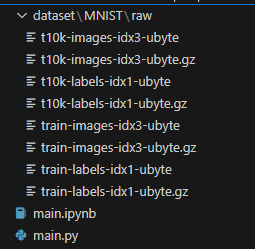
结构如下:
import torch
import torchvision
from torch.utils.data import DataLoader
# 都是在0~1的喵
train_data = torchvision.datasets.MNIST(
    root='dataset',
    train=True,
    transform=torchvision.transforms.ToTensor(),
    download=False
)
test_data  = torchvision.datasets.MNIST(
    root='dataset',
    train=False,
    transform=torchvision.transforms.ToTensor(),
    download=False
)

train_loader = DataLoader(train_data, batch_size=64, shuffle=True)
test_loader  = DataLoader(test_data,  batch_size=1000)
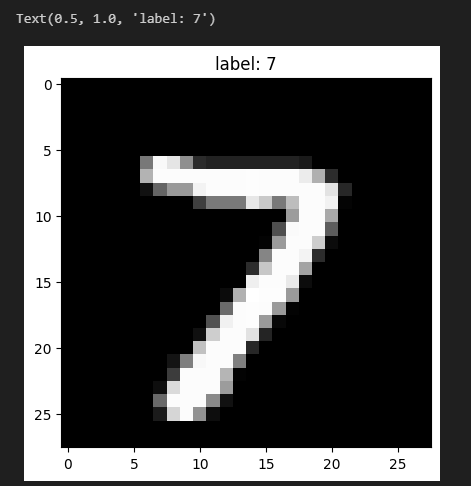
如何查看数据集?
# 显示训练集的图片

import matplotlib.pyplot as plt

id = 4000
features = train_data.data[id]
label =  train_data.train_labels[id]
plt.imshow(features,cmap="gray")
plt.title(f"label: {label}")
效果如下:
一、搭建网络
默认的网络结构如下,在文章后面还会提供 CNN 版本的进行进阶替换。
from torch import nn

class Net(nn.Module):
    def __init__(self):
        super().__init__()
        self.net = nn.Sequential(
            nn.Flatten(),
            nn.Linear(28*28, 128),
            nn.ReLU(),
            nn.Linear(128, 10)
        )
    def forward(self, x): return self.net(x)
二、训练
import torch, torch.nn as nn, torch.optim as optim
from torchvision import datasets, transforms


device = 'cuda' if torch.cuda.is_available() else 'cpu'


model = Net().to(device)
criterion = nn.CrossEntropyLoss()
optimizer = optim.Adam(model.parameters(), lr=1e-3)

for epoch in range(1, 5+1):
    # 训练
    model.train()
    for x, y in train_loader:
        x, y = x.to(device), y.to(device)
        optimizer.zero_grad()
        out = model(x)
        loss = criterion(out, y)
        loss.backward()
        optimizer.step()
    # 测试
    model.eval()
    correct, total = 0, 0
    with torch.no_grad():
        for x, y in test_loader:
            x, y = x.to(device), y.to(device)
            pred = model(x).argmax(1)
            total += y.size(0)
            correct += (pred == y).sum().item()
    print(f'Epoch {epoch}:  test acc = {correct/total:.4f}')
三、其它
1. 关于优化器
1.1 SGD
非常感谢 AI,使用这个参数的 SGD 真的可以让学习率达到很高很高
optimizer = optim.SGD(model.parameters(),    lr=0.1,        # ① 足够大
                            momentum=0.9,  # ② 冲量
                            weight_decay=5e-4)  # ③ L2
Epoch 1:  test acc = 0.9572
Epoch 2:  test acc = 0.9683
Epoch 3:  test acc = 0.9692
Epoch 4:  test acc = 0.9735
Epoch 5:  test acc = 0.9705
1.2 Adam
其实一开始是用 Adam
optimizer = optim.Adam(model.parameters(), lr=1e-3)
Epoch 1:  test acc = 0.9464
Epoch 2:  test acc = 0.9615
Epoch 3:  test acc = 0.9687
Epoch 4:  test acc = 0.9714
Epoch 5:  test acc = 0.9729
2. 关于网络的结构的改造
默认情况下是这样的:
from torch import nn

class Net(nn.Module):
    def __init__(self):
        super().__init__()
        self.net = nn.Sequential(
            nn.Flatten(),
            nn.Linear(28*28, 128),
            nn.ReLU(),
            nn.Linear(128, 10)
        )
    def forward(self, x): return self.net(x)
我希望加入部分 CNN 的内容。然后我把网络替换成的内容。
from torch import nn

class Net(nn.Module):
    def __init__(self):
        super().__init__()
        self.features = nn.Sequential(
            # 28x28 → 24x24 → 12x12
            nn.Conv2d(1, 32, 5, padding=0),  # 5x5 kernel
            nn.ReLU(inplace=True),
            nn.MaxPool2d(2),

            # 12x12 → 8x8 → 4x4
            nn.Conv2d(32, 64, 5),
            nn.ReLU(inplace=True),
            nn.MaxPool2d(2),
        )
        self.classifier = nn.Sequential(
            nn.Flatten(),          # 64*4*4 = 1024
            nn.Linear(64*4*4, 128),
            nn.ReLU(inplace=True),
            nn.Dropout(0.5),
            nn.Linear(128, 10)
        )

    def forward(self, x):
        x = self.features(x)
        return self.classifier(x)
Epoch 1:  test acc = 0.9828
Epoch 2:  test acc = 0.9890
Epoch 3:  test acc = 0.9906
Epoch 4:  test acc = 0.9911
Epoch 5:  test acc = 0.9914

 浙公网安备 33010602011771号