

实验3
实验任务1
#include <stdio.h>
#include <stdlib.h>
#include <time.h>
#include <windows.h>
#define N 80

void print_text(int line, int col, char text[]);  // 函数声明
void print_spaces(int n);  // 函数声明
void print_blank_lines(int n); // 函数声明

int main() {
    int line, col, i;
    char text[N] = "hi, April~";

    srand(time(0)); // 以当前系统时间作为随机种子

    for(i = 1; i <= 10; ++i) {
        line = rand() % 25;
        col =  rand() % 80;
        print_text(line, col, text);
        Sleep(1000);  // 暂停1000ms
    }

    return 0;
}

// 打印n个空格
void print_spaces(int n) {
    int i;

    for(i = 1; i <= n; ++i)
        printf(" ");
}

// 打印n行空白行
void print_blank_lines(int n) {
    int i;

    for(i = 1; i <= n; ++i)
        printf("\n");
 }

// 在第line行第col列打印一段文本
void print_text(int line, int col, char text[]) {
    print_blank_lines(line-1);      // 打印(line-1)行空行
    print_spaces(col-1);            // 打印(col-1)列空格
    printf("%s", text);         // 在第line行、col列输出text中字符串
}
功能:在屏幕上的随机位置输出十次hi,April~,且输出时间间隔相同。
实验任务2
// 利用局部static变量的特性,计算阶乘

#include <stdio.h>
long long fac(int n); // 函数声明

int main() {
    int i, n;

    printf("Enter n: ");
    scanf("%d", &n);

    for (i = 1; i <= n; ++i)
        printf("%d! = %lld\n", i, fac(i));

    return 0;
}

// 函数定义
long long fac(int n) {
    static long long p = 1;

    p = p * n;
    printf("p=%lld\n",p);
    return p;
}
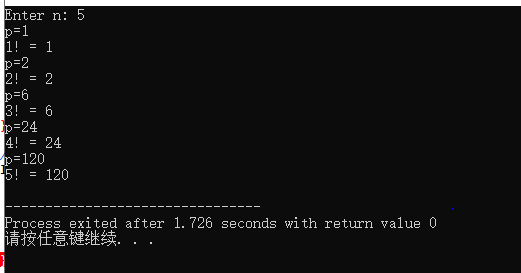
// 练习:局部static变量特性

#include <stdio.h>
int func(int, int);        // 函数声明

int main() {
    int k = 4, m = 1, p1, p2;

    p1 = func(k, m);    // 函数调用
    p2 = func(k, m);    // 函数调用
    printf("%d, %d\n", p1, p2);

    return 0;
}

// 函数定义
int func(int a, int b) {
    static int m = 0, i = 2;

    i += m + 1;
    m = i + a + b;

    return m;
}
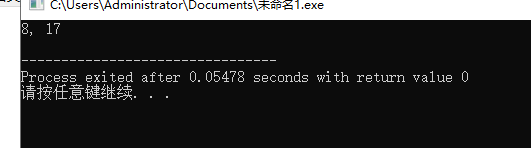
局部static变量的特性:在程序执行到时被首次初始化,以后的函数调用不再初始化。
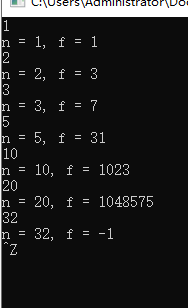
实验任务3
#include <stdio.h>
long long func(int n); // 函数声明

int main() {
    int n;
    long long f;

    while (scanf("%d", &n) != EOF) {
        f = func(n); // 函数调用
        printf("n = %d, f = %lld\n", n, f);
    }

    return 0;
}

// 函数定义
// 待补足。。。
long long func(int n){
    int m=1,t=0;
    while(n>0)
    {
        m=m*2;
        t=m-1;
        n--;
     }
    return t;
}
实验任务4
#include <stdio.h>
int func(int n,int m);
int main()
{
    int n,m;
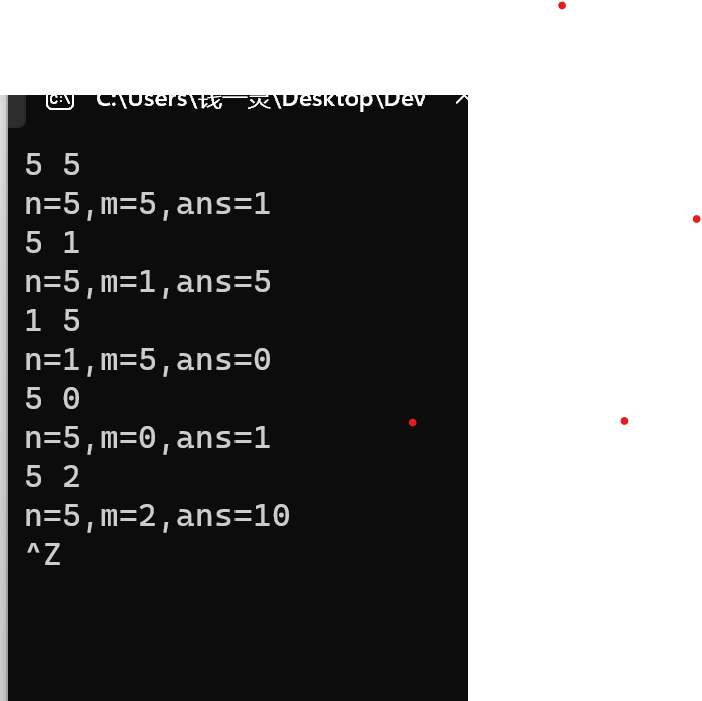
    while(scanf("%d%d",&n,&m)!=EOF)
    printf("n=%d,m=%d,ans=%d\n",n,m,func(n,m));
    return 0;
 }

 int func(int n, int m)
 {
     if(m==n||m==0)
     return 1;
     if(m>n)
     return 0;
     else
     return(func(n-1,m)+func(n-1,m-1));
 }
实验任务5
#include <stdio.h>
#include<stdlib.h>
double mypow(int x, int y);

int main()
{
    int x, y;
    double ans;

    while(scanf("%d%d", &x, &y) != EOF)
    {
        ans = mypow(x, y);
        printf("%d的%d次方 : %g\n\n", x, y, ans);
    }
    system("pause");
    return 0;
}
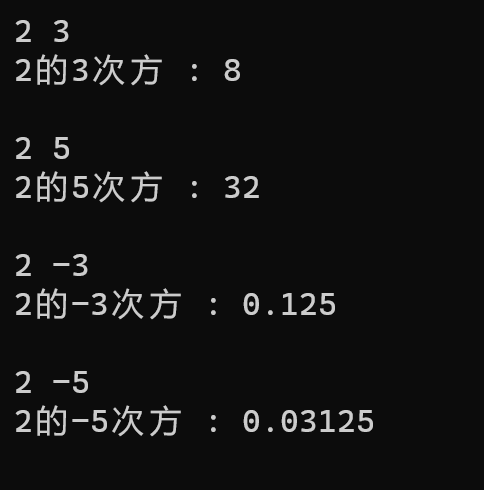
double mypow(int x,int y)
{
    int i, j;
    double s=1;
    if(y>=0)
    for(i=1;i<=y;i++)
    {
    s=s*x;}
    else
    for(j=1;j<=-y;j++)
    {
        s=s/x;
    }
    return s;
}
#include <stdio.h>
#include<stdlib.h>
double mypow(int x, int y);

int main()
{
    int x, y;
    double ans;

    while(scanf("%d%d", &x, &y) != EOF)
    {
        ans = mypow(x, y);
        printf("%d的%d次方 : %g\n\n", x, y, ans);
    }
    system("pause");
    return 0;
}
double mypow(int x,int y)
{
    if(y==0)
    return 1;
    if(y>0)
    return(x*mypow(x,y-1));
    if(y<0)
    return(1/mypow(x,-y));
}
实验任务6
#include <stdio.h>
#include <stdlib.h>
void hanoi(unsigned int n,char from,char temp,char to);
void moveplate(unsigned int n,char from,char to);
unsigned int i = 0;
int main()
{
    unsigned int n;
    while(scanf("%u",&n)!=EOF)
    {
    i = 0;
    hanoi(n,'A','B','C');
    printf("一共移动了%u次\n",i);
}
    system ("pause");
    return 0;
}
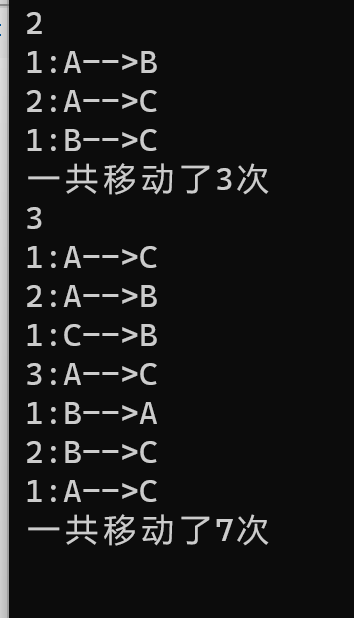
void hanoi(unsigned int n,char from,char temp,char to)
{
    if(n==1)
    moveplate(n,from,to);
    else
    {
        hanoi(n-1,from,to,temp);
        moveplate(n,from,to);
        hanoi(n-1,temp,from,to);
    }
}
void moveplate(unsigned int n,char from,char to)
{
    printf("%u:%c-->%c\n",n,from,to);
    i++;
}
实验任务7
#include<stdio.h>
#include<math.h>
#include<stdlib.h>
int is_prime(int x);
int main()
{
    int m,n;
    while(scanf("%d",&m)!=EOF){
    for(n=2;n<=m*1.0/2;n++)
    {
        if(is_prime(n)&&is_prime(m-n)){
        printf("%d = %d + %d\n",m,n,m-n);
        break;
        }
    }
}
    system("pause");
    return 0;
}

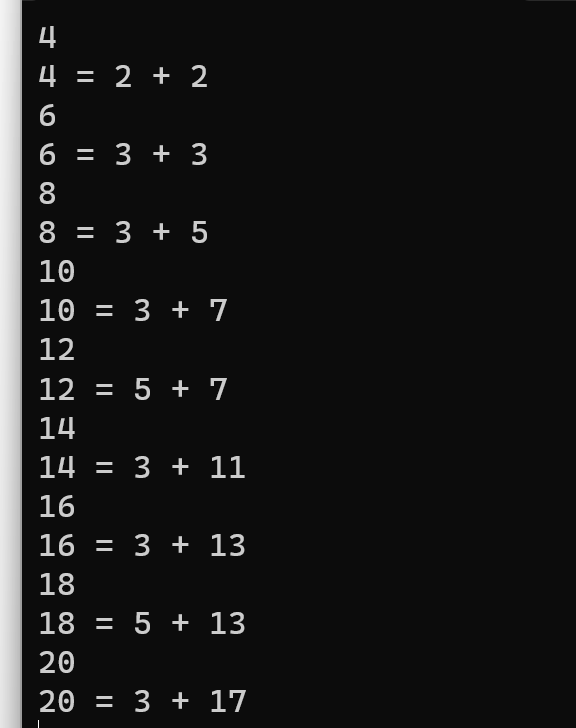
int is_prime(int x)
{
    int i,j;
    j = sqrt(1.0*x);
    for(i=2;i<=j;i++)
    if(x%i==0)
        return 0;
        if(i>j)
            return 1;
}
实验任务8
#include <stdio.h>
#include <math.h>
long func(long s);
int main()
{
    long s,t;
    printf("Enter a number: ");
    while (scanf("%ld",&s)!=EOF)
    {
        t=func(s);
        printf("new number is:%ld\n\n",t);
        printf("Enter a number:");
    }
    return 0;
}
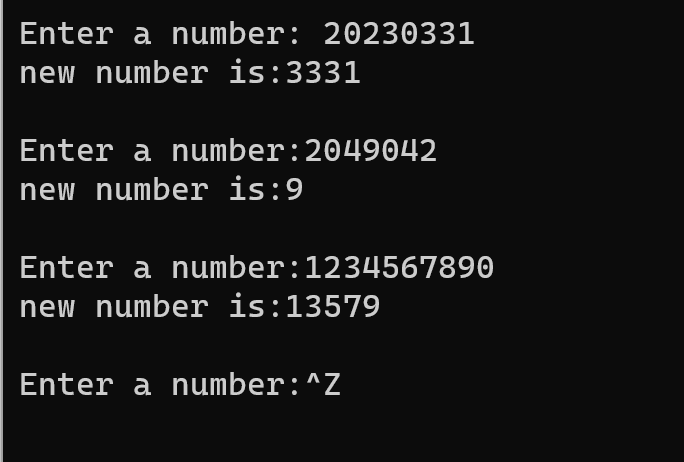
long func(long s){
    int t,p=0,i=0;
    while(s!=0)
    {
        t=s%10;
        if(t%2!=0)
        {p+=pow(10,i)*t;
        i++;}
        s=s/10;
    }
    return p;
}

 浙公网安备 33010602011771号