高等数学笔记02:函数与极限 映射与函数
1 函数的概念
设存在数据集\(D,R_f\subset R\),对于任一变量\(x \in D\),总存在一个变量\(y \in R_f\)按照一定的法则\(f\)与之对应,则称\(x\)是\(y\)的函数,记为:\(y=f(x)\)。
称:\(x\)是自变量,\(y\)是因变量,\(D\)是定义域,\(R_f\)是值域
且有:
\[\tag{1}
R_f = f(D) = \{{y|y=f(x)},x\in D\}
\]
2 函数的几种特性
2.1 有界性
2.1.1 函数的有界性
\[函数的有界性
\begin{cases}
(1)函数有上界:\forall x \in D,f(x)\leq M \\\\
(2)函数有下界:\forall x \in D,f(x)\geq M \\\\
(3)函数有界:\forall x \in D,|f(x)|\leq M \\\\
(4)函数无界:\forall M >0,\exist x\in D,|f(x)|\geq M
\end{cases}
\]
2.1.2 常见的有界三角函数
\[常见的有界三角函数
\begin{cases}
(1)|sin\;x|\leq1 \\\\
(2)|cos\;x|\leq1 \\\\
(3)|arcsin\;x|\leq \frac{\pi}{2} \\\\
(4)|arctan\;x| < \frac{\pi}{2} \\\\
(5)|arccos\;x| \leq \pi
\end{cases}
\]
2.2 单调性
(1)单调增:\(\forall x_1,x_2 \in I,当x_1<x_2 时恒有 f(x_1)<f(x_2)\)
(2)单调减:\(\forall x_1,x_2 \in I,当x_1<x_2时 恒有f(x_1)>f(x_2)\)
2.3 奇偶性
2.3.1 奇函数
\(\forall x \in D,f(-x)=-f(x)\),奇函数关于坐标原点对称
特别地,若\(f(0)=0\),则\(f(x)\)是奇函数
\[常见的奇函数
\begin {cases}
(1)sin\;x \\
(2)tan\;x \\
(3)arcsin\;x \\
(4)arctan\;x \\
(5)ln\;\frac{1-x}{1+x} \\
(6)ln\;(x+\sqrt{1+x^2}) \\
(7)\frac{e^x-1}{e^x+1} \\
(8)f(x)-f(-x)
\end {cases}
\]
2.3.2 偶函数
\(\forall x \in D,f(-x)=f(x)\),偶函数关于坐标y轴对称
\[常见的偶函数
\begin {cases}
(1)cos\;x \\
(2)x^2 \\
(3)|x| \\
(4)f(x)+f(-x)
\end{cases}
\]
2.3.3 奇偶函数运算
\[奇偶函数的运算规则
\begin {cases}
(1)奇\pm奇=奇\\
(2)偶\pm偶=偶\\
(3)奇(偶)\pm 偶(奇) =非奇非偶\\
(3)奇*奇=偶(除法同理)\\
(4)偶*偶=偶(除法同理)\\
(5)奇*偶=奇(除法同理)\\
\end{cases}
\]
\[(口诀:加减需相同,乘除有不同)
\]
2.4 周期性
\(\forall x \in D,\exist T \in R且T>0\),使\(f(x+T)=f(x)\),则称\(f(x)\)是周期函数,\(T\)为最小正周期,
简称\(T\)为\(f(x)\)的周期
\[注:
\]
\[(1)sin\;x、cos\;x的周期是2\pi;sin\;2x、|sin\;x|周期是\pi
\]
\[(2)若函数f(x)以T为周期,则复合函数f(ax+b)以\frac{T}{|a|}为周期
\]
3 反函数与复合函数
3.1 反函数
设存在函数\(y=f(x)\),且对于任一$ y \in R_f\(,存在唯一\)x\(与之对应,则记\)x=f^{-1}(y)\(为\)f(x)$的反函数。
\[反函数的相关性质
\begin{cases}
(1)对于y=f(x)中的任一y \in R_f,需存在唯一x与之对应,才会存在反函数x=f^{-1}(y)\\
(2)单调函数一定有反函数,反之则不然。\\
(3)在同一个直角坐标系中,y=f(x)与x=f^{-1}(y)的图像重合。\\
(4)在同一个直角坐标系中,y=f(x)与y=f^{-1}(x)的图像关于直线y=x对称。\\
(5)f^{-1}(f(x))=x;f(f^{-1}(x))=x
\end{cases}
\]
3.2 复合函数
设存在函数\(y=f(u),u=g(x)\),其定义域分别为\(D_f,D_g\),值域分别为\(R_f,R_g\)
则当$D_f \cap R_g \neq \phi $时,称函数
\[y=f[g(x)]
\]
为\(y=f(u),u=g(x)\)的复合函数,且其定义域满足:
\[\{{x|x\in D_g,g(x) \in D_f}\}
\]
3.3 函数的运算
\[\begin{cases}
(f\pm g)(x) = f(x)\pm g(x),x\in D_f\cap D_g\\\\
(f\cdot g)(x) = f(x) \cdot g(x),x \in D_f \cap D_g\\\\
(\frac{f}{g})(x) = \frac{f(x)}{g(x)},x\in D_f \cap D_g,g(x) \neq 0
\end{cases}
\]
函数的运算例题:
\[设函数f(x)的定义域为(-l,l)
\]
\[证明:必存在(-l,l)上的偶函数g(x)和奇函数h(x),使f(x)=h(x)+g(x)
\]
\[解:设存在奇函数h(x),偶函数g(x),且x\in (-l,l),则有:
\]
\[\begin{cases}
f(x) = h(x) + g(x)\\
f(-x) = -h(x) + g(x)
\end{cases}
\Rightarrow
\begin{cases}
g(x)=\frac{1}{2} [f(x)+f(-x)]\\
h(x)=\frac{1}{2}[f(x) - f(-x)]
\end{cases}
\]
\[\Rightarrow
\begin{cases}
g(-x) = g(x)\\
h(-x) = -h(x)
\end{cases}
\]
4 初等函数
4.1 基本初等函数
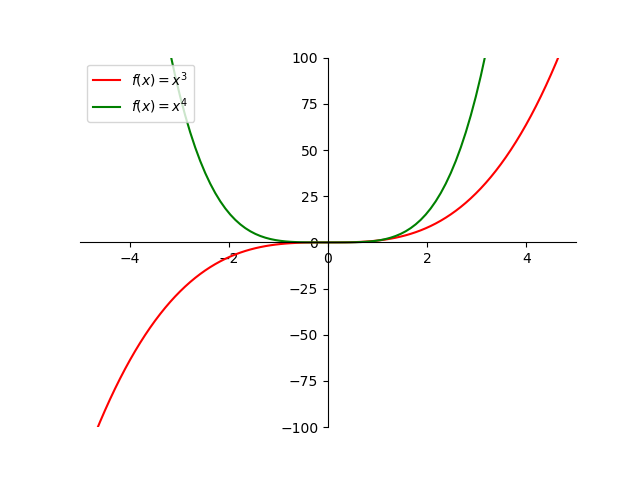
4.1.1 幂函数
\[y=x^{\mu}\quad (\mu为实数)
\]
4.1.2 指数函数
\[y=a^x \quad (0<a<1)
\]
\[y=a^x \quad (a>1)
\]
4.1.3 对数函数
\[y=log_ax (a>0,a\neq 1)
\]
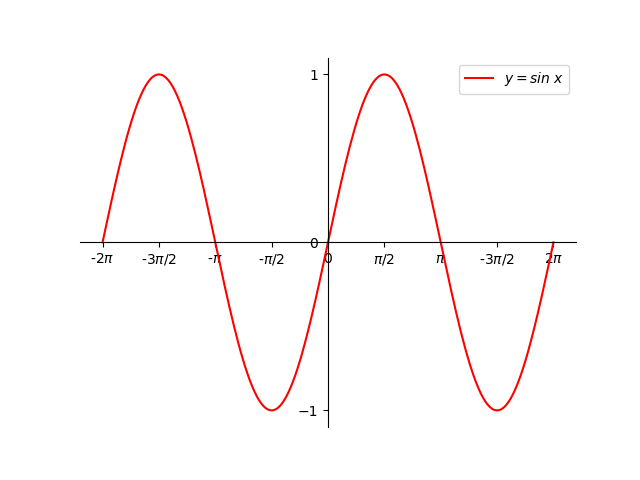
4.1.4 三角函数(正弦)
\[y=sin\;x
\]
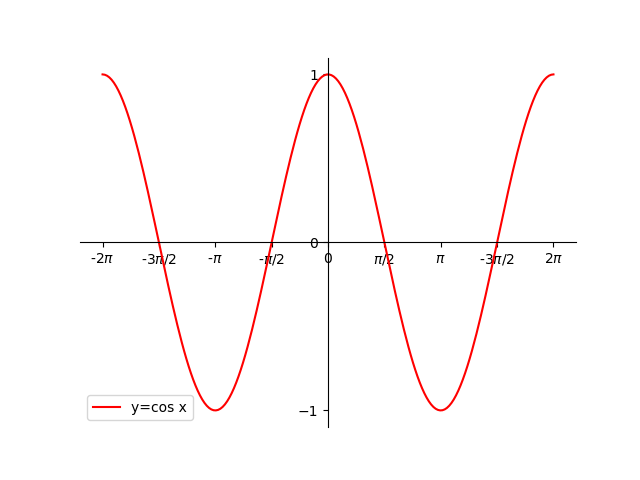
4.1.5 三角函数(余弦)
\[y=cos\;x
\]
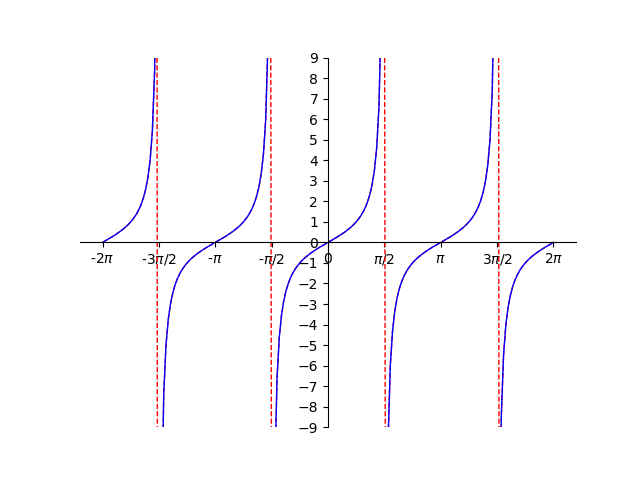
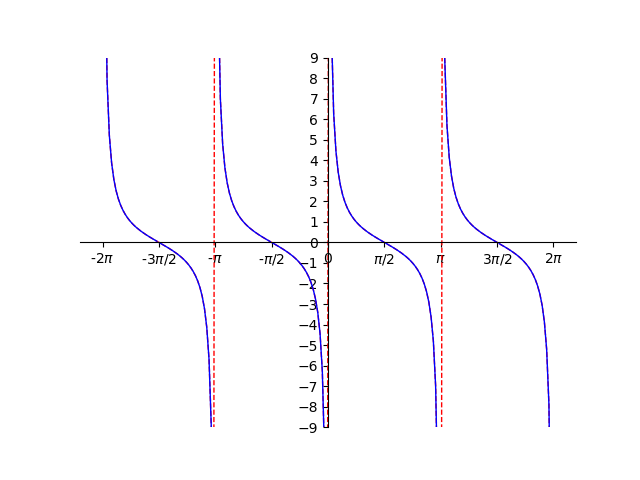
4.1.6 三角函数(正切)
\[y=tan\;x
\]
4.1.7 三角函数(余切)
\[y=cot\;x
\]
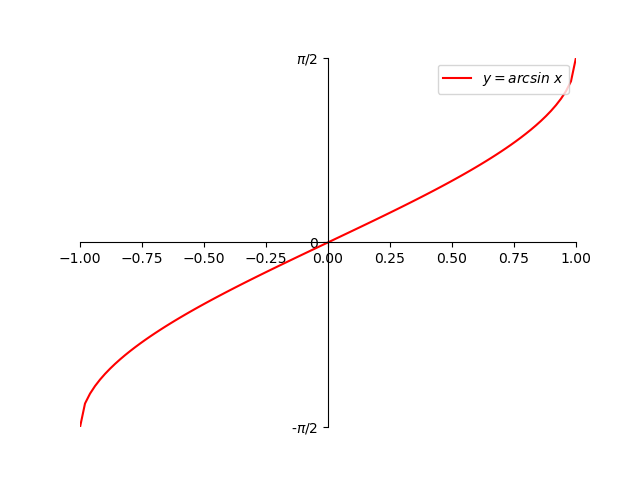
4.1.8 反三角函数(反正弦)
\[y=arcsin\;x
\]
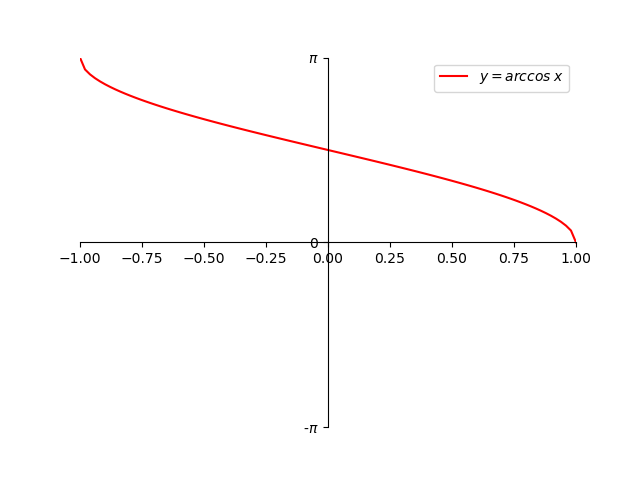
4.1.9 反三角函数(反余弦)
\[y=arccos\;x
\]
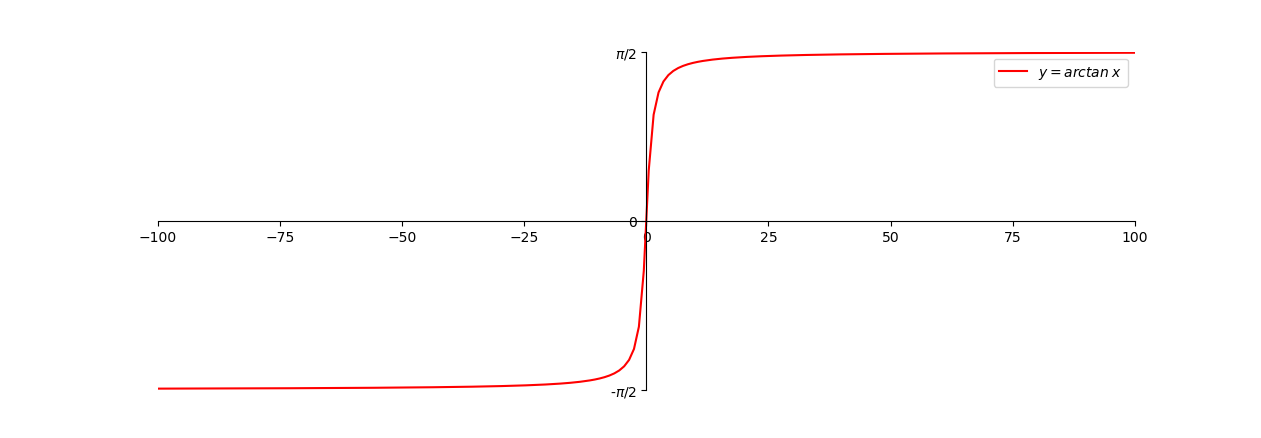
4.1.10 反三角函数(反正切)
\[y=arctan\;x
\]
4.2 初等函数
定义:初等函数是由常数和基本初等函数经过有限次的加减乘除以及复合所得到的,且初等函数须由一个解析式进行表示。
5 特殊函数示例
5.1 绝对值函数
\[f(x)=|x|=
\begin {cases}
-x,x<0\\
x,x\geq 0\\
\end {cases}
\]
5.2 符号函数
\[f(x) = sgn x=
\begin {cases}
-1,x<0\\
0,x=0\\
1,x>0
\end {cases}
\]
特别地,\(x=|x|\cdot sgnx\)
5.3 取整函数
对于任一\(x \in D\),存在一个不超过\(x\)的最大整数,记为\([x]\),\(y=[x]\)称为取整函数。
其中:
\[y=[x]=
\begin{cases}
|[x]| \leq |x|,x>0\\
|[x]| \geq |x|,x<0
\end{cases}
\]
5.4 狄利克雷函数
\[D(x)=
\begin {cases}
1,x\in Q\\
0,x \in Q^c
\end {cases}
\]
其中\(Q\)为有理数,\(Q^c\)为无理数,则任意大于0的有理数都可作为此函数的周期,且此函数无最小正周期
6 经典例题
6.1 函数有界性例题
证明:函数\(f(x)=x\cdot sin\;x\)是无界函数
\[解:
\]
\[由sin(2k\pi+\frac{\pi}{2})=1(k\in(-\infty,+\infty))\;得:
\]
\[f(2k\pi+\frac{\pi}{2})=2k\pi+\frac{\pi}{2}
\]
\[则对于任意M>0,存在x=2k\pi+\frac{\pi}{2},使|f(x)| > M
\]
\[故,函数f(x)=x\cdot sin\;x是无界函数。
\]
6.2 函数奇偶性例题
证明:\(f(x)=ln(x+\sqrt{1+x^2})\)是奇函数。
\[解:由题意,f(-x)=ln(\sqrt{1+x^2}-x)
\]
\[\Rightarrow f(-x)=ln(\frac{(1+x^2)-x^2}{\sqrt{1+x^2}+x})
\]
\[f(-x)=ln(\frac{1}{\sqrt{1+x^2}+x})
\]
\[\qquad\qquad\qquad=ln\;1-ln(\sqrt{1+x^2}+x)
\]
\[\qquad\qquad=-ln(x+\sqrt{1+x^2})
\]
\[故f(x)=ln(x+\sqrt{1+x^2})是奇函数。
\]
6.3 反函数的例题
求函数\(y=sh\;x=\frac{e^x-e^{-x}}{2}\)的反函数。
\[解:
y=\frac{e^x-e^{-x}}{2}
\]
\[\qquad\qquad\qquad\quad\Rightarrow 2y\cdot e^x=(e^x-e^{-x})\cdot e^x
\]
\[e^{2x}-2ye^x-1=0
\]
\[\Rightarrow e^x = \frac{2y\pm\sqrt{4y^2+4}}{2}=y\pm \sqrt{y^2+1}
\]
\[由e^x \in (0,+\infty)可得:e^x=y+\sqrt{y^2+1}
\]
\[\qquad\qquad\qquad\qquad\qquad\Rightarrow x=ln(y+\sqrt{y^2+1})
\]
\[则:函数y=\frac{e^x-e^{-x}}{2}的反函数为:y=ln(x+\sqrt{x^2+1})
\]
6.4 复合函数例题
设:
\[g(x)=
\begin {cases}
2-x,x\leq0\\
x+2,x>0
\end {cases}
\]
\[f(x)=
\begin {cases}
x^2,x<0\\
-x,x\geq0
\end {cases}
\]
求\(g[f(x)]、f[g(x)]\)。
\[解:由题意,g[f(x)]=
\begin{cases}
f(x)+2,x<0\\
2-f(x),x\geq0
\end{cases}
=
\begin{cases}
x^2+2,x<0\\
2+x,x\geq0
\end{cases}
\]
\[f[g(x)]=
\begin{cases}
-g(x),x\leq0\\
-g(x),x>0
\end{cases}
=
\begin{cases}
-(2-x),x\leq0\\
-(x+2),x>0
\end{cases}
\]




 浙公网安备 33010602011771号