
迭代加深,剪枝
五大剪枝:
①优化搜索顺序:先搜答案数较小的分支,这样有很大概率能将后续的分支剪去
②排除等效冗余:例如1 2 3 4 要枚举这四个数的和,那么1 + 4和 2 + 3就只需要枚举一次就够了。
③可行性剪枝:在搜索过程中对当前状态进行检查,如果发现分支已经无法达到递归边界,就执行回溯。
④最优性剪枝:在搜索过程中对当前状态进行检查,如果发现分支已经比目前得知的最佳状态差,就执行回溯。
⑤记忆化:可以记录每个状态的搜索结果,在重复遍历一个状态时直接检索并返回。
https://www.acwing.com/activity/content/problem/content/1486/1/
acwing 166 数独
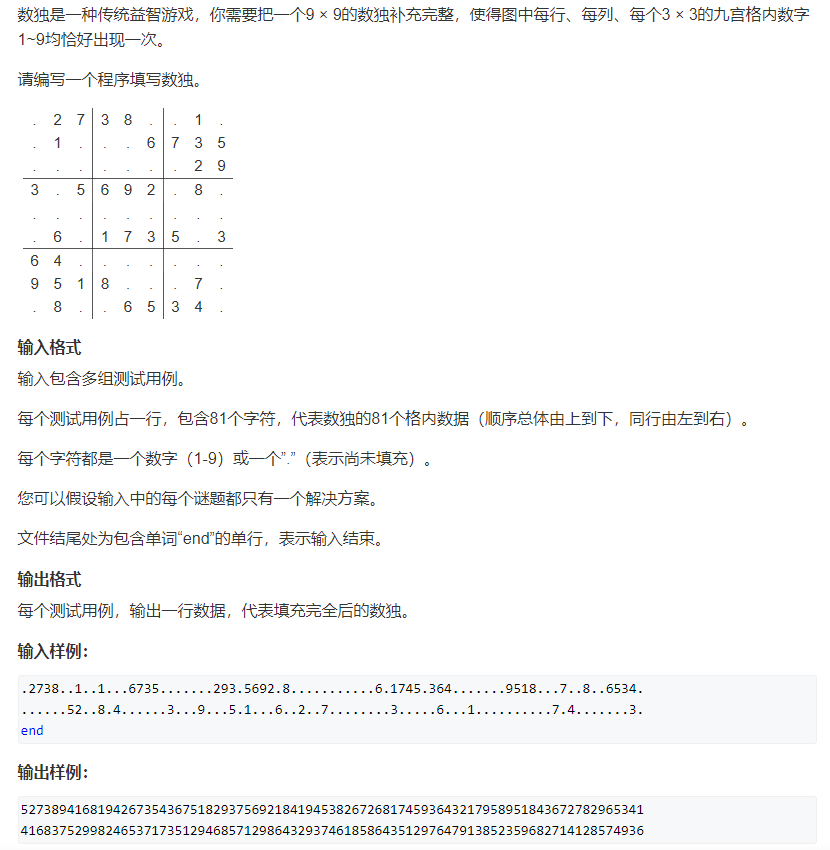
这题是81的数独且行,列,九宫格都有互斥关系,所以需要的状态很多,考虑使用二进制来表示数字的使用与否,用$row,col,cell$三个数组分别存储行,列,九宫格在这个点位所能使用的数字。
例如000000001就表示只有1可以使用。其次因为使用的是二进制来表示这个数,所以还要建立一个$map$来映射这个二进制数是十进制的什么数字。
这题的搜索空间很大,考虑优化搜索顺序,从分支较少的点开始进行填数,也就是可填的数字最少的点,所以我们还需要预处理一下所有二进制数中1的个数,用$ones$数组存储下来。
 1 #include <iostream>
 2 #include <algorithm>
 3 #include <cstring>
 4
 5 using namespace std;
 6
 7 const int N = 9, M = 1 << N;
 8
 9 int ones[M], map[M];
10 int row[N], col[N], cell[3][3];
11 char str[100];
12
13 void init()
14 {
15     for(int i = 0 ; i < N ; i ++)row[i] = col[i] = (1 << N) - 1;
16     for(int i = 0 ; i < 3 ; i ++)
17         for(int j = 0 ; j < 3 ; j ++)
18             cell[i][j] = (1 << N) - 1;
19 }
20
21 void draw(int x, int y, int t, bool is_set)
22 {
23     if(is_set)str[x * N + y] = '1' + t;
24     else str[x * N + y] = '.';
25
26     int v = 1 << t;
27     if(!is_set)v = -v;
28     row[x] -= v;
29     col[y] -= v;
30     cell[x / 3][y / 3] -= v;
31 }
32
33 int lowbit(int x)
34 {
35     return x & -x;
36 }
37
38 int get(int x, int y)
39 {
40     return row[x] & col[y] & cell[x / 3][y / 3];
41 }
42
43 bool dfs(int cnt)
44 {
45     if(!cnt)return true;
46
47     int minv = 10;
48     int x, y;
49     for(int i = 0 ; i < N ; i ++)
50         for(int j = 0 ; j < N ; j ++)
51             if(str[i * N + j] == '.')
52             {
53                 int state = get(i, j);
54                 if(ones[state] < minv)
55                 {
56                     minv = ones[state];
57                     x = i;
58                     y = j;
59                 }
60             }
61     int state = get(x, y);
62     for(int i = state ; i ; i -= lowbit(i))
63     {
64         int t = map[lowbit(i)];
65         draw(x, y, t, true);
66         if(dfs(cnt - 1))return true;
67         draw(x, y, t, false);
68     }
69
70     return false;
71
72 }
73
74 int main(){
75     for(int i = 0 ; i < N ; i ++)map[1 << i] = i;
76     for(int i = 0 ; i < 1 << N ; i ++)
77         for(int j = 0 ; j < N ; j ++)
78             ones[i] += i >> j & 1;
79
80     while(cin >> str, str[0] != 'e')
81     {
82         init();
83
84         int cnt = 0;
85         for(int i = 0, k = 0 ; i < N ; i ++)
86             for(int j = 0 ; j < N ; j ++, k ++)
87                 if(str[k] != '.')
88                 {
89                     int t = str[k] - '1';
90                     draw(i, j, t, true);
91                 }
92                 else cnt ++;
93
94         dfs(cnt);
95
96         puts(str);
97     }
98     return 0;
99 }
迭代加深搜索:当搜索的答案树很深,但是答案在比较浅的位置时适合使用。
https://www.acwing.com/problem/content/172/
acwing 170 加成序列
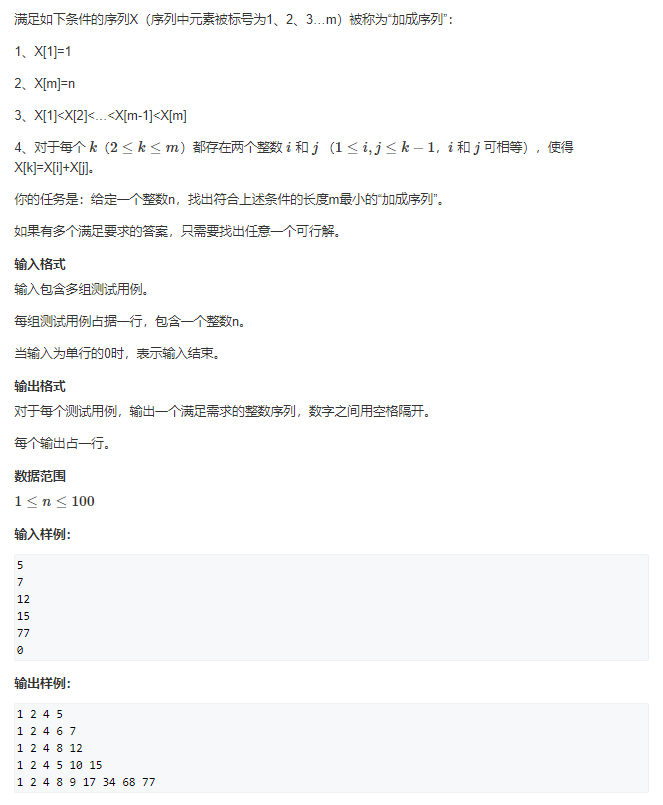
按题目要求,序列可以为$1 \;2\; 4\; 8\; 16\; \cdot \cdot \cdot$每次倍增,所以最短的结果必然在比较浅层内,而搜索树又很大,所以考虑使用迭代加深,一层一层往下搜索。
 1 #include <iostream>
 2 #include <algorithm>
 3 #include <cstring>
 4
 5 using namespace std;
 6
 7 const int N = 110;
 8 int path[N];
 9 int n;
10
11 bool dfs(int u, int depth)
12 {
13     if(u > depth)return false;
14     if(path[u - 1] == n)return true;
15
16     bool st[N] = {0};
17     for(int i = u - 1 ; i >= 0 ; i --)
18         for(int j = i ; j >= 0 ; j --)
19         {
20             int s = path[i] + path[j];
21             if(st[s] || s <= path[u - 1] || s > n)continue;
22             st[s] = true;
23             path[u] = s;
24             if(dfs(u + 1, depth))return true;;
25         }
26     return false;
27 }
28
29 int main(){
30     while(cin >> n, n)
31     {
32         int depth = 1;
33         path[0] = 1;
34         while(!dfs(1, depth))depth ++;
35
36         for(int i = 0 ; i < depth ; i ++)
37             cout << path[i] << " ";
38         cout << endl;
39     }
40     return 0;
41 }
https://www.acwing.com/problem/content/173/
acwing 171 送礼物
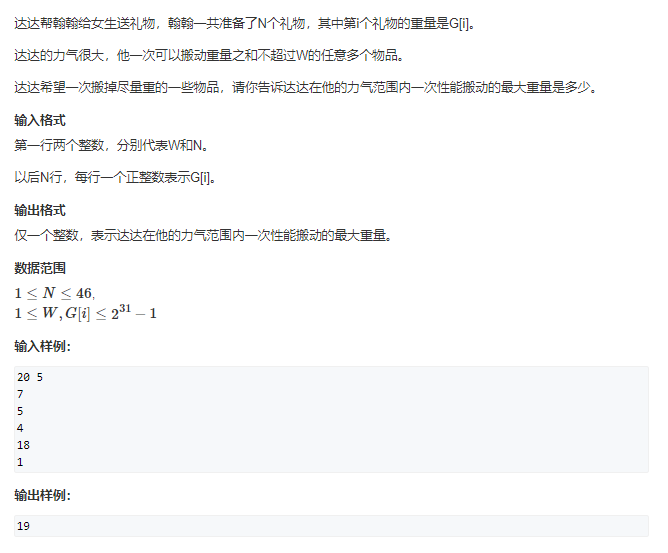
典型的双向深搜。对于这题来说,$M$的范围有$2^{31}$,$N$ 是 $46$,如果采用背包问题的求解,时间复杂度是$O(NM)$过大,考虑到$N$很小,所以可以用爆搜。
但是如果直接爆搜,复杂度有$2^{46}$。也是过大,所以考虑使用双向深搜,这样就可以吧复杂度降到$2^{\frac{N}{2}}+\frac{N}{2}2^{\frac{N}{2}}$。为了更均衡一下,可以使得$N = 25$,这样,复杂度就降的比较低。
所以最后先爆搜前$\frac{n}{2} + 2$个部分,预处理出结果,剩下的部分再进行爆搜。
 1 #include <iostream>
 2 #include <algorithm>
 3 #include <cstring>
 4
 5 using namespace std;
 6
 7 typedef long long LL;
 8
 9 const int N = 46;
10
11 int w[N], cnt = 1;
12 int weights[1 << 25];
13 int n, m;
14 int ans, k;
15
16 void dfs1(int u, int s)
17 {
18     if(u == k)
19     {
20         weights[cnt ++] = s;
21         return;
22     }
23     dfs1(u + 1, s);
24     if((LL)s + w[u] <= m)dfs1(u + 1, s + w[u]);
25 }
26
27 void dfs2(int u, int s)
28 {
29     if(u == n)
30     {
31         int l = 0, r = cnt - 1;
32         while(l < r)
33         {
34             int mid = l + r + 1 >> 1;
35             if((LL)s + weights[mid] <= m)l = mid;
36             else r = mid - 1;
37         }
38         ans = max(ans, weights[l] + s);
39         return;
40     }
41     dfs2(u + 1, s);
42     if((LL)s + w[u] <= m)dfs2(u + 1, s + w[u]);
43 }
44
45 int main(){
46     cin >> m >> n;
47
48     for(int i = 0 ; i < n ; i ++)cin >> w[i];
49
50     sort(w, w + n);
51     reverse(w, w + n);
52
53     k = n / 2 + 2;
54
55     dfs1(0, 0);
56
57     sort(weights, weights + cnt);
58     cnt = unique(weights, weights + cnt) - weights;
59
60     dfs2(k, 0);
61
62     cout << ans << endl;
63     return 0;
64 }

 浙公网安备 33010602011771号