手写 Promise 源码之禁止循环调用
手写 Promise 源码之禁止循环调用
场景
演示错误的 promise 循环调用
<!DOCTYPE html>
<html lang="en">
<head>
  <meta charset="UTF-8">
  <meta http-equiv="X-UA-Compatible" content="IE=edge">
  <meta name="viewport" content="width=device-width, initial-scale=1.0">
  <title>Promise 测试</title>
</head>
<body>
  <script>
    var promise = new Promise(function(resolve, reject) {
      resolve(100)
    })

    var p1 = promise.then(function(value) {
      console.log(value)
      return p1
    })

    p1.then(function() {}, function(reason) {
      console.log(reason)
    })
  </script>
</body>
</html>
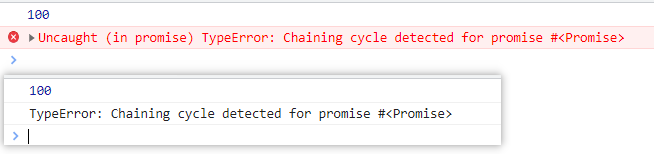
代码实现
// resolvePromise()
 // then 链式调用,promise 对象返回其自己(循环调用)
  if (promise2 === x) {
    return  reject(new TypeError('Chaining cycle detected for promise #<Promise>'))
  }
const PENDING = 'pengding' // 等待
const FULFILLED = 'fulfilled' // 成功
const REJECTED = 'rejected' /// 失败

class MyPromise {
  constructor(exectuor) {
    exectuor(this.resolve, this.reject)
  }

  // promise 状态
  status = PENDING

  // 成功之后的值
  value = undefined

  // 失败之后的原因
  reason = undefined

  // 成功回调
  successCallback = []

  // 失败回调
  failCallback = []

  //  此处的箭头函数是为了使 this 指向该函数的实例对象
  resolve = value => {
    // 如果状态不是等待,阻止程序向下执行
    if (this.status !== PENDING) return
    // 将状态更改为成功
    this.status = FULFILLED
    // 保存成功之后的值
    this.value = value
    // 判断成功回调是否存在,如果存在就调用
    // this.successCallback && this.successCallback(this.value)
    while (this.successCallback.length) {
      this.successCallback.shift()(this.value)
    }
  }

  reject = reason => {
    // 如果状态不是等待,阻止程序向下执行
    if (this.status !== PENDING) return
    // 将状态更改为失败
    this.status = REJECTED
    // 保存失败后的原因
    this.reason = reason
    // 判断失败回调是否存在,如果存在就调用
    // this.failCallback && this.failCallback(this.reason)
    while (this.failCallback.length) {
      this.failCallback.shift()(this.reason)
    }
  }

  then(successCallback, failCallback) {
    // 实现链式调用
    let promise2 = new MyPromise((resolve, reject) => {
      // 判断状态
      if (this.status === FULFILLED) {
        // 解决 resolvePromise(promise2, x, resolve, reject) 获取不到 promise2 的问题
        setTimeout(() => {
          let x = successCallback(this.value)
          // 判断 X 的值是普通值还是 promise 对象
          // 如果是普通值,直接调用 resolve
          // 如果是 promise 对象,查看 promise 对象返回的结果
          // 再根据 promise 对象返回的结果,决定调用 resolve 还是调用 reject
          resolvePromise(promise2, x, resolve, reject)
        }, 0)
      } else if (this.status === REJECTED) {
        failCallback(this.reason)
      } else {
        // 等待
        // 将成功回调和失败回调存储起来
        this.successCallback.push(successCallback)
        this.failCallback.push(failCallback)
      }
    })

    return promise2
  }
}

function resolvePromise(promise2, x, resolve, reject) {
  // then 链式调用,promise 对象返回其自己(循环调用)
  if (promise2 === x) {
    return  reject(new TypeError('Chaining cycle detected for promise #<Promise>'))
  }
  if (x instanceof MyPromise) {
    // promise 对象
    // x.then(value => resolve(value), reason => reject(reason))
    // 简化成如下代码
    x.then(resolve, reject)
  } else {
    // 普通值
    resolve(x)
  }
}

// node 环境下导出
module.exports = MyPromise
测试
const MyPromise = require('./myPromise')

let promise = new MyPromise((resolve, reject) => {
  // setTimeout(() => {
  //   resolve('成功 ......')
  // }, 2000)

  resolve('成功')

  // reject('失败')
})

function other() {
  return new MyPromise((resolve, rejct) => {
    resolve('other')
  })
}

let p1 = promise.then(value => {
  console.log(value)
  return p1
})


p1.then(value => {
  console.log(value)
}, reason => {
  console.log(reason.message)
})

 浙公网安备 33010602011771号