
爬虫
爬虫简介
概述

近年来,随着网络应用的逐渐扩展和深入,如何高效的获取网上数据成为了无数公司和个人的追求,在大数据时代,谁掌握了更多的数据,谁就可以获得更高的利益,而网络爬虫是其中最为常用的一种从网上爬取数据的手段。
网络爬虫,即Web Spider,是一个很形象的名字。如果把互联网比喻成一个蜘蛛网,那么Spider就是在网上爬来爬去的蜘蛛。网络蜘蛛是通过网页的链接地址来寻找网页的。从网站某一个页面(通常是首页)开始,读取网页的内容,找到在网页中的其它链接地址,然后通过这些链接地址寻找下一个网页,这样一直循环下去,直到把这个网站所有的网页都抓取完为止。如果把整个互联网当成一个网站,那么网络蜘蛛就可以用这个原理把互联网上所有的网页都抓取下来。
爬虫的价值
互联网中最有价值的便是数据,比如天猫商城的商品信息,链家网的租房信息,雪球网的证券投资信息等等,这些数据都代表了各个行业的真金白银,可以说,谁掌握了行业内的第一手数据,谁就成了整个行业的主宰,如果把整个互联网的数据比喻为一座宝藏,那我们的爬虫课程就是来教大家如何来高效地挖掘这些宝藏,掌握了爬虫技能, 你就成了所有互联网信息公司幕后的老板,换言之,它们都在免费为你提供有价值的数据。
爬虫的基本流程
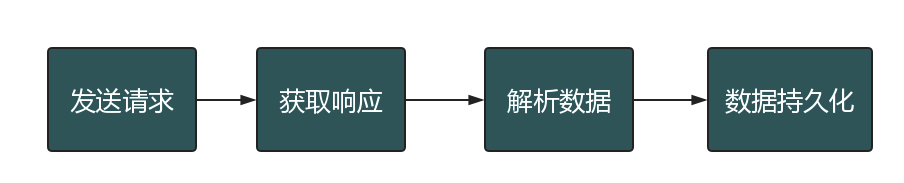
预备知识
requests模块
基本语法
requests模块支持的请求:
|
1
2
3
4
5
6
7
|
import requestsrequests.get("http://httpbin.org/get")requests.post("http://httpbin.org/post")requests.put("http://httpbin.org/put")requests.delete("http://httpbin.org/delete")requests.head("http://httpbin.org/get")requests.options("http://httpbin.org/get") |
get请求
1 基本请求
|
1
2
3
4
5
|
import requestsresponse=requests.get('https://www.jd.com/',)with open("jd.html","wb") as f: f.write(response.content) |
2 含参数请求
|
1
2
3
|
import requestsresponse=requests.get('https://s.taobao.com/search?q=手机')response=requests.get('https://s.taobao.com/search',params={"q":"美女"}) |
3 含请求头请求
示例1:
|
1
2
3
4
5
6
|
import requestsresponse=requests.get('https://dig.chouti.com/', headers={ 'User-Agent':'Mozilla/5.0 (Windows NT 6.1; WOW64) AppleWebKit/537.36 (KHTML, like Gecko) Chrome/62.0.3202.75 Safari/537.36', } ) |
示例2:

import requests

res=requests.post('https://www.lagou.com/jobs/positionAjax.json',
             headers={
                    'Referer':"https://www.lagou.com/jobs/list_python",
                     'User-Agent': 'Mozilla/5.0 (Windows NT 6.1; WOW64) AppleWebKit/537.36 (KHTML, like Gecko) Chrome/63.0.3239.132 Safari/537.36',

             },
             data={
                 'first':True,
                 'pn':2,
                 'kd':'java高级开发'
             },
             params={
                 'gj': '3年及以下',
                 'px': 'default',
                 'yx': '25k-50k',
                 'city': '北京',
                 'needAddtionalResult': False,
                 'isSchoolJob': 0
             }
             )

comapines_list=r6.json()

print(comapines_list)
4 含cookies请求
|
1
2
3
4
5
6
7
8
|
import uuidimport requestsurl = 'http://httpbin.org/cookies'cookies = dict(sbid=str(uuid.uuid4()))res = requests.get(url, cookies=cookies)print(res.json()) |
5 request.session()
|
1
2
3
4
5
6
7
8
9
|
import requests# res=requests.get("https://www.zhihu.com/explore")# print(res.cookies.get_dict())session=requests.session()res1=session.get("https://www.zhihu.com/explore")print(session.cookies.get_dict())res2=session.get("https://www.zhihu.com/question/30565354/answer/463324517",cookies={"abs":"123"} |
post请求
1 data参数
requests.post()用法与requests.get()完全一致,特殊的是requests.post()多了一个data参数,用来存放请求体数据
|
1
|
response=requests.post("http://httpbin.org/post",params={"a":"10"}, data={"name":"yuan"}) |
2 发送json数据
|
1
2
3
4
5
6
|
import requests<br>res1=requests.post(url='http://httpbin.org/post', data={'name':'yuan'}) #没有指定请求头,#默认的请求头:application/x-www-form-urlencoedprint(res1.json())res2=requests.post(url='http://httpbin.org/post',json={'age':"22",}) #默认的请求头:application/json)print(res2.json()) |
response对象
(1) 常见属性
|
1
2
3
4
5
6
7
8
9
10
11
12
13
|
import requestsrespone=requests.get('https://sh.lianjia.com/ershoufang/')# respone属性print(respone.text)print(respone.content)print(respone.status_code)print(respone.headers)print(respone.cookies)print(respone.cookies.get_dict())print(respone.cookies.items())print(respone.url)print(respone.history)print(respone.encoding) |
(2) 编码问题
|
1
2
3
4
5
|
import requestsresponse=requests.get('http://www.autohome.com/news')#response.encoding='gbk' #汽车之家网站返回的页面内容为gb2312编码的,而requests的默认编码为ISO-8859-1,如果不设置成gbk则中文乱码with open("res.html","w") as f: f.write(response.text) |
(3) 下载二进制文件(图片,视频,音频)
|
1
2
3
4
5
6
|
import requestsresponse=requests.get('http://bangimg1.dahe.cn/forum/201612/10/200447p36yk96im76vatyk.jpg')with open("res.png","wb") as f: # f.write(response.content) # 比如下载视频时,如果视频100G,用response.content然后一下子写到文件中是不合理的 for line in response.iter_content(): f.write(line) |
(4) 解析json数据
|
1
2
3
4
5
6
7
|
import requestsimport jsonresponse=requests.get('http://httpbin.org/get')res1=json.loads(response.text) #太麻烦res2=response.json() #直接获取json数据print(res1==res2) |
(5) Redirection and History
默认情况下,除了 HEAD, Requests 会自动处理所有重定向。可以使用响应对象的 history 方法来追踪重定向。Response.history 是一个 Response 对象的列表,为了完成请求而创建了这些对象。这个对象列表按照从最老到最近的请求进行排序。
|
1
2
3
4
5
6
7
|
>>> r = requests.get('http://github.com')>>> r.url'https://github.com/'>>> r.status_code200>>> r.history[<Response [301]>] |
另外,还可以通过 allow_redirects 参数禁用重定向处理:
|
1
2
3
4
5
|
>>> r = requests.get('http://github.com', allow_redirects=False)>>> r.status_code301>>> r.history[] |
应用案例
1、模拟GitHub登录,获取登录信息


import requests
import re

#请求1:
r1=requests.get('https://github.com/login')
r1_cookie=r1.cookies.get_dict() #拿到初始cookie(未被授权)
authenticity_token=re.findall(r'name="authenticity_token".*?value="(.*?)"',r1.text)[0] #从页面中拿到CSRF TOKEN
print("authenticity_token",authenticity_token)
#第二次请求:带着初始cookie和TOKEN发送POST请求给登录页面,带上账号密码
data={
    'commit':'Sign in',
    'utf8':'✓',
    'authenticity_token':authenticity_token,
    'login':'yuanchenqi0316@163.com',
    'password':'yuanchenqi0316'
}

#请求2:
r2=requests.post('https://github.com/session',
             data=data,
             cookies=r1_cookie,
             # allow_redirects=False
             )
print(r2.status_code)      #200
print(r2.url)              #看到的是跳转后的页面:https://github.com/
print(r2.history)          #看到的是跳转前的response:[<Response [302]>]
print(r2.history[0].text)  #看到的是跳转前的response.text

with open("result.html","wb") as f:

    f.write(r2.content)
2、爬取豆瓣电影信息
import requests

import re
import json
import time
from concurrent.futures import ThreadPoolExecutor
pool=ThreadPoolExecutor(50)

def getPage(url):

    response=requests.get(url)
    return response.text

def parsePage(res):

    com=re.compile('<div class="item">.*?<div class="pic">.*?<em .*?>(?P<id>\d+).*?<span class="title">(?P<title>.*?)</span>'
                   '.*?<span class="rating_num" .*?>(?P<rating_num>.*?)</span>.*?<span>(?P<comment_num>.*?)评价</span>',re.S)

    iter_result=com.finditer(res)

    return iter_result

def gen_movie_info(iter_result):
    for i in iter_result:
        yield {
            "id":i.group("id"),
            "title":i.group("title"),
            "rating_num":i.group("rating_num"),
            "comment_num":i.group("comment_num"),
        }

def stored(gen):
        with open("move_info.txt","a",encoding="utf8") as f:
            for line in gen:
                data=json.dumps(line,ensure_ascii=False)
                f.write(data+"\n")


def spider_movie_info(url):
    res=getPage(url)
    iter_result=parsePage(res)
    gen=gen_movie_info(iter_result)
    stored(gen)

def main(num):

    url='https://movie.douban.com/top250?start=%s&filter='%num
    pool.submit(spider_movie_info,url)
    #spider_movie_info(url)


if __name__ == '__main__':
    before=time.time()
    count=0
    for i in range(10):
        main(count)
        count+=25
    after=time.time()

    print("总共耗费时间:",after-before)
BeautifulSoup
一 简介
简单来说,Beautiful Soup是python的一个库,最主要的功能是从网页抓取数据。官方解释如下:
'''
Beautiful Soup提供一些简单的、python式的函数用来处理导航、搜索、修改分析树等功能。
它是一个工具箱,通过解析文档为用户提供需要抓取的数据,因为简单,所以不需要多少代码就可以写出一个完整的应用程序。
'''
Beautiful Soup 是一个可以从HTML或XML文件中提取数据的Python库.它能够通过你喜欢的转换器实现惯用的文档导航,查找,修改文档的方式.Beautiful Soup会帮你节省数小时甚至数天的工作时间.你可能在寻找 Beautiful Soup3 的文档,Beautiful Soup 3 目前已经停止开发,官网推荐在现在的项目中使用Beautiful Soup 4。
安装
|
1
|
pip3 install beautifulsoup4 |
解析器
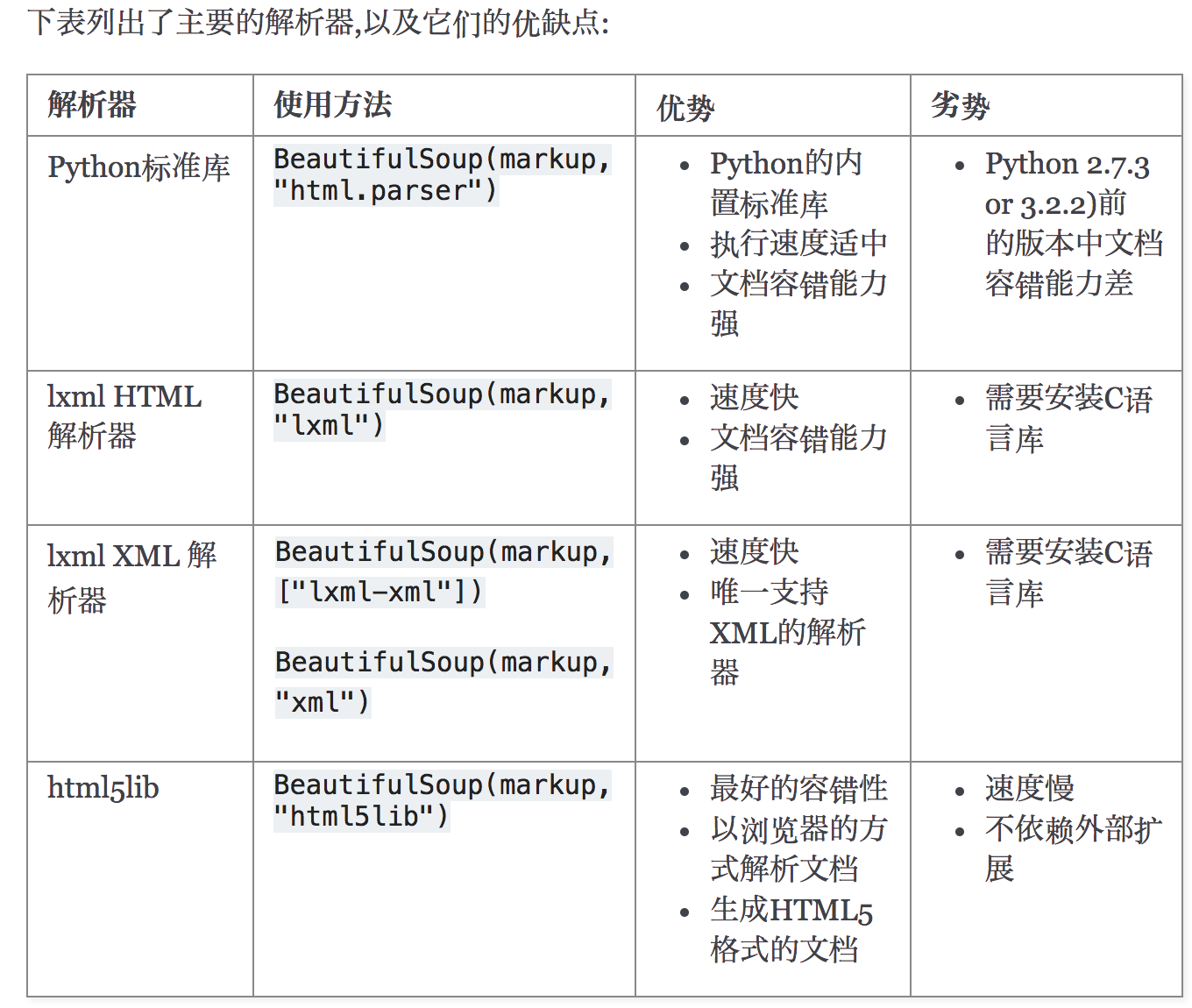
Beautiful Soup支持Python标准库中的HTML解析器,还支持一些第三方的解析器,如果我们不安装它,则 Python 会使用 Python默认的解析器,lxml 解析器更加强大,速度更快,推荐安装。
|
1
|
pip3 install lxml |
另一个可供选择的解析器是纯Python实现的 html5lib , html5lib的解析方式与浏览器相同,可以选择下列方法来安装html5lib:
pip install html5lib
解析器对比:
简单使用
下面的一段HTML代码将作为例子被多次用到.这是 爱丽丝梦游仙境的 的一段内容(以后内容中简称为 爱丽丝 的文档):
html_doc = """
<html><head><title>The Dormouse's story</title></head>
<body>
<p class="title"><b>The Dormouse's story</b></p>

<p class="story">Once upon a time there were three little sisters; and their names were
<a href="http://example.com/elsie" class="sister" id="link1">Elsie</a>,
<a href="http://example.com/lacie" class="sister" id="link2">Lacie</a> and
<a href="http://example.com/tillie" class="sister" id="link3">Tillie</a>;
and they lived at the bottom of a well.</p>

<p class="story">...</p>
"""
使用BeautifulSoup解析这段代码,能够得到一个 BeautifulSoup 的对象
from bs4 import BeautifulSoup
soup = BeautifulSoup(html_doc, 'html.parser')
从文档中找到所有<a>标签的链接:
|
1
2
|
for link in soup.find_all('a'): print(link.get('href')) |
从文档中获取所有文字内容:
print(soup.get_text())
二 标签对象
通俗点讲就是 HTML 中的一个个标签,Tag 对象与XML或HTML原生文档中的tag相同:
soup = BeautifulSoup('<b class="boldest">Extremely bold</b>')
tag = soup.b
type(tag)
# <class 'bs4.element.Tag'>
Tag的名字
soup对象再以爱丽丝梦游仙境的html_doc为例,操作文档树最简单的方法就是告诉它你想获取的tag的name.如果想获取 <head> 标签,只要用 soup.head :
soup.head
# <head><title>The Dormouse's story</title></head>

soup.title
# <title>The Dormouse's story</title>
这是个获取tag的小窍门,可以在文档树的tag中多次调用这个方法.下面的代码可以获取<body>标签中的第一个<b>标签:
soup.body.b
# <b>The Dormouse's story</b>
通过点取属性的方式只能获得当前名字的第一个tag:
soup.a
# <a class="sister" href="http://example.com/elsie" id="link1">Elsie</a>
如果想要得到所有的<a>标签,或是通过名字得到比一个tag更多的内容的时候,就需要用到 Searching the tree 中描述的方法,比如: find_all()
soup.find_all('a')
# [<a class="sister" href="http://example.com/elsie" id="link1">Elsie</a>,
#  <a class="sister" href="http://example.com/lacie" id="link2">Lacie</a>,
#  <a class="sister" href="http://example.com/tillie" id="link3">Tillie</a>]
我们可以利用 soup加标签名轻松地获取这些标签的内容,注意,它查找的是在所有内容中的第一个符合要求的标签。
Tag的name和attributes属性
Tag有很多方法和属性,现在介绍一下tag中最重要的属性: name和attributes
每个tag都有自己的名字,通过.name 来获取:

tag.name
# u'b'

tag['class']
# u'boldest'

tag.attrs
# {u'class': u'boldest'}
tag的属性可以被添加,删除或修改. 再说一次, tag的属性操作方法与字典一样
tag['class'] = 'verybold'
tag['id'] = 1
tag
# <blockquote class="verybold" id="1">Extremely bold</blockquote>

del tag['class']
del tag['id']
tag
# <blockquote>Extremely bold</blockquote>

tag['class']
# KeyError: 'class'
print(tag.get('class'))
# None
标签对象的文本获取
#4、获取标签的内容
print(soup.p.string) # p下的文本只有一个时,取到,否则为None
print(soup.p.strings) #拿到一个生成器对象, 取到p下所有的文本内容
print(soup.p.text) #取到p下所有的文本内容
for line in soup.stripped_strings: #去掉空白
    print(line)


'''
如果tag包含了多个子节点,tag就无法确定 .string 方法应该调用哪个子节点的内容, .string 的输出结果是 None,如果只有一个子节点那么就输出该子节点的文本,比如下面的这种结构,soup.p.string 返回为None,但soup.p.strings就可以找到所有文本
<p id='list-1'>
    哈哈哈哈
    <a class='sss'>
        <span>
            <h1>aaaa</h1>
        </span>
    </a>
    <b>bbbbb</b>
</p>
'''
三 遍历文档树
#1、嵌套选择
print(soup.head.title.string)
print(soup.body.a.string)


#2、子节点、子孙节点
print(soup.p.contents) #p下所有子节点
print(soup.p.children) #得到一个迭代器,包含p下所有子节点

for i,child in enumerate(soup.p.children):
    print(i,child)

print(soup.p.descendants) #获取子孙节点,p下所有的标签都会选择出来
for i,child in enumerate(soup.p.descendants):
    print(i,child)

#3、父节点、祖先节点
print(soup.a.parent) #获取a标签的父节点
print(soup.a.parents) #找到a标签所有的祖先节点,父亲的父亲,父亲的父亲的父亲...


#4、兄弟节点
print('=====>')
print(soup.a.next_sibling) #下一个兄弟
print(soup.a.previous_sibling) #上一个兄弟

print(list(soup.a.next_siblings)) #下面的兄弟们=>生成器对象
print(soup.a.previous_siblings) #上面的兄弟们=>生成器对象
四 搜索文档树
BeautifulSoup定义了很多搜索方法,这里着重介绍2个: find() 和 find_all() .其它方法的参数和用法类似
1、五种过滤器
#搜索文档树:BeautifulSoup定义了很多搜索方法,这里着重介绍2个: find() 和 find_all() .其它方法的参数和用法类似
html_doc = """
<html><head><title>The Dormouse's story</title></head>
<body>
<p id="my p" class="title"><b id="bbb" class="boldest">The Dormouse's story</b>
</p>

<p class="story">Once upon a time there were three little sisters; and their names were
<a href="http://example.com/elsie" class="sister" id="link1">Elsie</a>,
<a href="http://example.com/lacie" class="sister" id="link2">Lacie</a> and
<a href="http://example.com/tillie" class="sister" id="link3">Tillie</a>;
and they lived at the bottom of a well.</p>

<p class="story">...</p>
"""


from bs4 import BeautifulSoup
soup=BeautifulSoup(html_doc,'lxml')

#1、五种过滤器: 字符串、正则表达式、列表、True、方法
#1.1、字符串:即标签名
print(soup.find_all('b'))

#1.2、正则表达式
import re
print(soup.find_all(re.compile('^b'))) #找出b开头的标签,结果有body和b标签

#1.3、列表:如果传入列表参数,Beautiful Soup会将与列表中任一元素匹配的内容返回.下面代码找到文档中所有<a>标签和<b>标签:
print(soup.find_all(['a','b']))

#1.4、True:可以匹配任何值,下面代码查找到所有的tag,但是不会返回字符串节点
print(soup.find_all(True))
for tag in soup.find_all(True):
    print(tag.name)

#1.5、方法:如果没有合适过滤器,那么还可以定义一个方法,方法只接受一个元素参数 ,如果这个方法返回 True 表示当前元素匹配并且被找到,如果不是则反回 False
def has_class_but_no_id(tag):
    return tag.has_attr('class') and not tag.has_attr('id')

print(soup.find_all(has_class_but_no_id))
2、find_all()
#2、find_all( name , attrs , recursive , text , **kwargs )
#2.1、name: 搜索name参数的值可以使任一类型的 过滤器 ,字符窜,正则表达式,列表,方法或是 True .
print(soup.find_all(name=re.compile('^t')))

#2.2、keyword: key=value的形式,value可以是过滤器:字符串 , 正则表达式 , 列表, True .
print(soup.find_all(id=re.compile('my')))
print(soup.find_all(href=re.compile('lacie'),id=re.compile('\d'))) #注意类要用class_
print(soup.find_all(id=True)) #查找有id属性的标签

# 有些tag属性在搜索不能使用,比如HTML5中的 data-* 属性:
data_soup = BeautifulSoup('<div data-foo="value">foo!</div>','lxml')
# data_soup.find_all(data-foo="value") #报错:SyntaxError: keyword can't be an expression
# 但是可以通过 find_all() 方法的 attrs 参数定义一个字典参数来搜索包含特殊属性的tag:
print(data_soup.find_all(attrs={"data-foo": "value"}))
# [<div data-foo="value">foo!</div>]

#2.3、按照类名查找,注意关键字是class_,class_=value,value可以是五种选择器之一
print(soup.find_all('a',class_='sister')) #查找类为sister的a标签
print(soup.find_all('a',class_='sister ssss')) #查找类为sister和sss的a标签,顺序错误也匹配不成功
print(soup.find_all(class_=re.compile('^sis'))) #查找类为sister的所有标签

#2.4、attrs
print(soup.find_all('p',attrs={'class':'story'}))

#2.5、text: 值可以是:字符,列表,True,正则
print(soup.find_all(text='Elsie'))
print(soup.find_all('a',text='Elsie'))

#2.6、limit参数:如果文档树很大那么搜索会很慢.如果我们不需要全部结果,可以使用 limit 参数限制返回结果的数量.效果与SQL中的limit关键字类似,当搜索到的结果数量达到 limit 的限制时,就停止搜索返回结果
print(soup.find_all('a',limit=2))

#2.7、recursive:调用tag的 find_all() 方法时,Beautiful Soup会检索当前tag的所有子孙节点,如果只想搜索tag的直接子节点,可以使用参数 recursive=False .
print(soup.html.find_all('a'))
print(soup.html.find_all('a',recursive=False))

'''
像调用 find_all() 一样调用tag
find_all() 几乎是Beautiful Soup中最常用的搜索方法,所以我们定义了它的简写方法. BeautifulSoup 对象和 tag 对象可以被当作一个方法来使用,
这个方法的执行结果与调用这个对象的 find_all() 方法相同,下面两行代码是等价的:

soup.find_all("a")
soup("a")

这两行代码也是等价的:

soup.title.find_all(text=True)
soup.title(text=True)

'''
3、find()
#3、find( name , attrs , recursive , text , **kwargs )
find_all() 方法将返回文档中符合条件的所有tag,尽管有时候我们只想得到一个结果.比如文档中只有一个<body>标签,那么使用 find_all() 方法来查找<body>标签就不太合适, 使用 find_all 方法并设置 limit=1 参数不如直接使用 find() 方法.下面两行代码是等价的:

soup.find_all('title', limit=1)
# [<title>The Dormouse's story</title>]
soup.find('title')
# <title>The Dormouse's story</title>

唯一的区别是 find_all() 方法的返回结果是值包含一个元素的列表,而 find() 方法直接返回结果.
find_all() 方法没有找到目标是返回空列表, find() 方法找不到目标时,返回 None .
print(soup.find("nosuchtag"))
# None

soup.head.title 是 tag的名字 方法的简写.这个简写的原理就是多次调用当前tag的 find() 方法:

soup.head.title
# <title>The Dormouse's story</title>
soup.find("head").find("title")
# <title>The Dormouse's story</title>
4、其他方法
#见官网:https://www.crummy.com/software/BeautifulSoup/bs4/doc/index.zh.html#find-parents-find-parent
5、css选择器
我们在写 CSS 时,标签名不加任何修饰,类名前加点,id名前加 #,在这里我们也可以利用类似的方法来筛选元素,用到的方法是 soup.select(),返回类型是 list
(1)通过标签名查找
print(soup.select("title"))  #[<title>The Dormouse's story</title>]
print(soup.select("b"))      #[<b>The Dormouse's story</b>]
(2)通过类名查找
print(soup.select(".sister"))

'''
[<a class="sister" href="http://example.com/elsie" id="link1">Elsie</a>,
<a class="sister" href="http://example.com/lacie" id="link2">Lacie</a>,
<a class="sister" href="http://example.com/tillie" id="link3">Tillie</a>]

'''
(3)通过 id 名查找
print(soup.select("#link1"))
# [<a class="sister" href="http://example.com/elsie" id="link1">Elsie</a>]
(4)组合查找
组合查找即和写 class 文件时,标签名与类名、id名进行的组合原理是一样的,例如查找 p 标签中,id 等于 link1的内容,二者需要用空格分开
print(soup.select("p #link2"))

#[<a class="sister" href="http://example.com/lacie" id="link2">Lacie</a>]
直接子标签查找
print(soup.select("p > #link2"))
# [<a class="sister" href="http://example.com/lacie" id="link2">Lacie</a>]
(5)属性查找
查找时还可以加入属性元素,属性需要用中括号括起来,注意属性和标签属于同一节点,所以中间不能加空格,否则会无法匹配到。
print(soup.select("a[href='http://example.com/tillie']"))
#[<a class="sister" href="http://example.com/tillie" id="link3">Tillie</a>]
select 方法返回的结果都是列表形式,可以遍历形式输出,然后用 get_text() 方法来获取它的内容:
for title in soup.select('a'):
    print (title.get_text())

'''
Elsie
Lacie
Tillie
'''
五 修改文档树
xpath
xpath简介
XPath在Python的爬虫学习中,起着举足轻重的地位,对比正则表达式 re两者可以完成同样的工作,实现的功能也差不多,但XPath明显比re具有优势,在网页分析上使re退居二线。
XPath介绍
是什么? 全称为XML Path Language 一种小型的查询语言
说道XPath是门语言,不得不说它所具备的优点:
- 可在XML中查找信息
- 支持HTML的查找
- 通过元素和属性进行导航
python开发使用XPath条件: 由于XPath属于lxml库模块,所以首先要安装库lxml。
XPath的简单调用方法:
from lxml import etree

selector=etree.HTML(源码) #将源码转化为能被XPath匹配的格式

selector.xpath(表达式) #返回为一列表
Xpath语法
查询
html_doc = """
<!DOCTYPE html>
<html lang="en">
<head>
    <meta charset="UTF-8">
    <title>Title</title>
</head>
<body>

<div class="d1">
    <div class="d2">
            <p class="story">
                <a href="http://example.com/elsie" class="sister" id="link1">Elsie</a>,
                <a href="http://example.com/lacie" class="sister" id="link2">Lacie</a> and
                <a href="http://example.com/tillie" id="link3">Tillie</a>
            </p>
    </div>
    <div>
        <p id="p1">ALex is dsb</p>
        <p id="p2">Egon too</p>
    </div>
</div>

<div class="d3">
    <a href="http://www.baidu.com">baidu</a>
    <p>百度</p>
</div>

</body>
</html>
"""

from lxml import etree
selector=etree.HTML(html_doc) # 将源码转化为能被XPath匹配的格式


'''
一、选取节点

nodename     选取nodename节点的所有子节点         xpath(‘//div’)         选取了所有div节点
/            从根节点选取                        xpath(‘/div’)          从根节点上选取div节点
//           选取所有的当前节点,不考虑他们的位置    xpath(‘//div’)         选取所有的div节点
.            选取当前节点                        xpath(‘./div’)         选取当前节点下的div节点
..           选取当前节点的父节点                 xpath(‘..’)            回到上一个节点
@            选取属性                           xpath(’//@calss’)     选取所有的class属性

'''

ret=selector.xpath("//div")
ret=selector.xpath("/div")
ret=selector.xpath("./div")
ret=selector.xpath("//p[@id='p1']")
ret=selector.xpath("//div[@class='d1']/div/p[@class='story']")


'''
二、谓语

表达式                                         结果
xpath(‘/body/div[1]’)                     选取body下的第一个div节点
xpath(‘/body/div[last()]’)                选取body下最后一个div节点
xpath(‘/body/div[last()-1]’)              选取body下倒数第二个div节点
xpath(‘/body/div[positon()<3]’)           选取body下前两个div节点
xpath(‘/body/div[@class]’)                选取body下带有class属性的div节点
xpath(‘/body/div[@class=”main”]’)         选取body下class属性为main的div节点
xpath(‘/body/div[@price>35.00]’)           选取body下price元素值大于35的div节点

'''

ret=selector.xpath("//p[@class='story']//a[2]")
ret=selector.xpath("//p[@class='story']//a[last()]")


'''
通配符 Xpath通过通配符来选取未知的XML元素

表达式                 结果
xpath(’/div/*’)     选取div下的所有子节点
xpath(‘/div[@*]’)    选取所有带属性的div节点


'''

ret=selector.xpath("//p[@class='story']/*")
ret=selector.xpath("//p[@class='story']/a[@class]")

'''
四、取多个路径
使用“|”运算符可以选取多个路径

表达式                         结果
xpath(‘//div|//table’)    选取所有的div和table节点


'''

ret=selector.xpath("//p[@class='story']/a[@class]|//div[@class='d3']")
print(ret)

'''


五、Xpath轴
轴可以定义相对于当前节点的节点集

轴名称                      表达式                                  描述
ancestor                xpath(‘./ancestor::*’)              选取当前节点的所有先辈节点(父、祖父)
ancestor-or-self        xpath(‘./ancestor-or-self::*’)      选取当前节点的所有先辈节点以及节点本身
attribute               xpath(‘./attribute::*’)             选取当前节点的所有属性
child                   xpath(‘./child::*’)                 返回当前节点的所有子节点
descendant              xpath(‘./descendant::*’)            返回当前节点的所有后代节点(子节点、孙节点)
following               xpath(‘./following::*’)             选取文档中当前节点结束标签后的所有节点
following-sibing        xpath(‘./following-sibing::*’)      选取当前节点之后的兄弟节点
parent                  xpath(‘./parent::*’)                选取当前节点的父节点
preceding               xpath(‘./preceding::*’)             选取文档中当前节点开始标签前的所有节点

preceding-sibling       xpath(‘./preceding-sibling::*’)     选取当前节点之前的兄弟节点
self                    xpath(‘./self::*’)                  选取当前节点


六、功能函数
使用功能函数能够更好的进行模糊搜索

函数                  用法                                                               解释
starts-with         xpath(‘//div[starts-with(@id,”ma”)]‘)                        选取id值以ma开头的div节点
contains            xpath(‘//div[contains(@id,”ma”)]‘)                           选取id值包含ma的div节点
and                 xpath(‘//div[contains(@id,”ma”) and contains(@id,”in”)]‘)    选取id值包含ma和in的div节点
text()              xpath(‘//div[contains(text(),”ma”)]‘)                        选取节点文本包含ma的div节点

'''
Element对象
from lxml.etree import _Element
for obj in ret:
    print(obj)
    print(type(obj))  # from lxml.etree import _Element

'''
Element对象

class xml.etree.ElementTree.Element(tag, attrib={}, **extra)

  tag:string,元素代表的数据种类。
  text:string,元素的内容。
  tail:string,元素的尾形。
  attrib:dictionary,元素的属性字典。

  #针对属性的操作
  clear():清空元素的后代、属性、text和tail也设置为None。
  get(key, default=None):获取key对应的属性值,如该属性不存在则返回default值。
  items():根据属性字典返回一个列表,列表元素为(key, value)。
  keys():返回包含所有元素属性键的列表。
  set(key, value):设置新的属性键与值。

  #针对后代的操作
  append(subelement):添加直系子元素。
  extend(subelements):增加一串元素对象作为子元素。#python2.7新特性
  find(match):寻找第一个匹配子元素,匹配对象可以为tag或path。
  findall(match):寻找所有匹配子元素,匹配对象可以为tag或path。
  findtext(match):寻找第一个匹配子元素,返回其text值。匹配对象可以为tag或path。
  insert(index, element):在指定位置插入子元素。
  iter(tag=None):生成遍历当前元素所有后代或者给定tag的后代的迭代器。#python2.7新特性
  iterfind(match):根据tag或path查找所有的后代。
  itertext():遍历所有后代并返回text值。
  remove(subelement):删除子元素。


'''

 浙公网安备 33010602011771号