

算法笔试题面试题
算法笔试面试
十大排序算法:冒泡排序,选择排序,插入排序,归并排序,堆排序,快速排序、希尔排序、计数排序,基数排序,桶排序。
ps:重点在理解原理,写代码的时候要由里往外写。
冒泡排序:
思想:两个相邻的元素比较并交换。
 public static void bubbleSort(int[] arr) {
        if(arr.length == 0){
            return;
        }

        // 一共进行元素-1次排序
        for (int i = 0; i < arr.length -1; i++) {
            // 只需要对没有排序的进行排序
            for (int j = 0; j < arr.length - 1 - i; j++) {
                //将前一个比后一个大的两元素进行交换
                if (arr[j+1] < arr[j]) {
//                    int tmp = arr[j+1];
//                    arr[j+1] = arr[j];
//                    arr[j] = tmp;
                    int tmp = arr[j];
                    arr[j] = arr[j+1];
                    arr[j+1] = tmp;
                }
            }
        }

    }

    public static void main(String[] args) {
        int arr[] = {5, 8, 6, 3, 9, 2, 1, 7};
        bubbleSort(arr);
        System.out.println(Arrays.toString(arr));
    }
public class Test {

    public static void main(String[] args) {
        int[] nums = {1, 3, 4, 7, 2, 9};
        for (int i = 0; i < nums.length; i++) {
            for(int j = i + 1; j < nums.length; j++){
                if(nums[i] < nums[j]){ //降序排列
                    int temp = nums[i];
                    nums[i] = nums[j];
                    nums[j] = temp;
                }
            }
        }

        Arrays.stream(nums).forEach(System.out::println);
    }
}
选择排序
思想:每次从剩余元素中找最大(最小)元素进行交换。
选择排序可以看做是冒泡排序的一种优化。
public class Solution {

    public int[] choiceSort(int[] nums){
        if(nums.length == 0){
            return nums;
        }

        for (int i = 0; i < nums.length; i++) {
            // 最小数的下标,每个循环开始总是假设第一个数最小
            int minIndex = i;
            for (int j = i; j < nums.length; j++) {
                if(nums[j] < nums[minIndex]){
                    minIndex = j;
                }
            }
            // 进行元素的交换
            int temp = nums[minIndex];
            nums[minIndex] = nums[i];
            nums[i] = temp;
        }

        return nums;
    }


    public static void main(String[] args) {
        int arr[] = {5, 8, 6, 3, 9, 2, 1, 7};
        Solution solution = new Solution();
        int[] ret = solution.choiceSort(arr);
        Arrays.stream(ret).forEach(System.out::println);

    }

}
插入排序
思想:就是将要待排序的元素,在已经排好序的序列中找到合适的位置进行插入即可。
对于基本有序的数组来说最好用。
思想:就好像是打麻将或者是玩扑克牌。只不过略微有点区别。
public static void insertSort(int[] arr) {
    if(arr.length == 0){
        return;
    }

    for (int i = 1; i < arr.length; i++) {


        for (int j = i ; j >0; j--) {

            if(arr[j ] < arr[j - 1]){
                int tmp = arr[j];
                arr[j] =  arr[j - 1];
                arr[j - 1] = tmp;

            }

        }
        System.out.println(Arrays.toString(arr));
    }

}

public static void main(String[] args) {
    int arr[] = {5, 8, 6, 3, 9, 2, 1, 7};
    insertSort(arr);
    System.out.println(Arrays.toString(arr));

}
第二种写法:// TODO 待理解
public class Solution {

    public int[] insertSort(int[] nums){
        // 健壮性校验
        if(nums.length == 0){
            return nums;
        }

        // 当前待排序数据,该元素之前的元素均已被排序过
        int currentValue;
        for (int i = 0; i < nums.length -1; i++) {
            // 已被排序数据的索引
            int preIndex = i;
            currentValue = nums[preIndex + 1];

            // 在已被排序过数据中倒序寻找合适的位置,如果单管待排序数据比比较的元素要小,将比较的元素后移一位
            while (preIndex >= 0 && currentValue < nums[preIndex]){
                // 将当前元素后移一位
                nums[preIndex + 1] = nums[preIndex];
                preIndex--;
            }

            // while循环结束时,说明已经找到了当前待排序数据的合适位置,插入
            nums[preIndex + 1] = currentValue;
        }

        return nums;
    }


    public static void main(String[] args) {
        int arr[] = {5, 8, 6, 3, 9, 2, 1, 7};
        Solution solution = new Solution();
        int[] ret = solution.insertSort(arr);
        Arrays.stream(ret).forEach(System.out::println);

    }

}
快速排序
思想:首先选择一个基准数,然后将数组中剩余的数据依次和基准数进行比较,所有比基准数小的放到基准数前面,所有比基准数大的元素放到基准数后面,这样就将整个数组分成了两部分,然后再将这每一部分分别进行快速排序,说白了就是运用了一种分而治之的思想。
视频地址:https://www.bilibili.com/video/BV1Ey4y1k7s1/?spm_id_from=333.337.search-card.all.click&vd_source=273847a809b909b44923e3af1a7ef0b1
public class Solution {


    /**
     * 快速排序
     * @param arr 待排序数组
     * @param left 左指针
     * @param right 右指针
     * @return
     */
    public int[] quickSort(int[] arr, int left, int right) {
        // 健壮性校验
        if (arr.length == 0) {
            return arr;
        }

        int l = left;
        int r = right;
        // 基准值
        int pivot = arr[(left+right)/2];

        while (l<r){
            // 如果左指针位置的数字小于基准值,就让左指针往后移动
            while (arr[l]< pivot){
                l++;
            }
            // 如果右指针位置的数字大于基准值,就让右指针往前移动
            while (arr[r] > pivot){
                r--;
            }
            // 特殊情况:如果左指针大于右指针的话,就跳出循环
            if(l >= r){
                break;
            }
            // 如果pivot轴左右指针位置对应的数字,左指针对应的数字大于右指针对应的数字,就将这两个位置的数字进行交换
            int temp = arr[r];
            arr[r] = arr[l];
            arr[l] = temp;

            // 还会有两种特殊情况,就是左指针对应的数字等于pivot值,右指针对应的数字等于pivot值
            if(arr[l] == pivot){
                r--;
            }
            if(arr[r] == pivot){
                l++;
            }
        }
        if(l == r){
            l++;
            r--;
        }
        if(left<r){
            quickSort(arr,left,r);
        }
        if(l<right){
            quickSort(arr,l,right);
        }

        return arr;
    }


    public static void main(String[] args) {
        int arr[] = {5, 8, 6, 3, 9, 2, 1, 7};
        Solution solution = new Solution();
        int[] ret = solution.quickSort(arr, 0, arr.length-1);
        Arrays.stream(ret).forEach(System.out::println);

    }

}
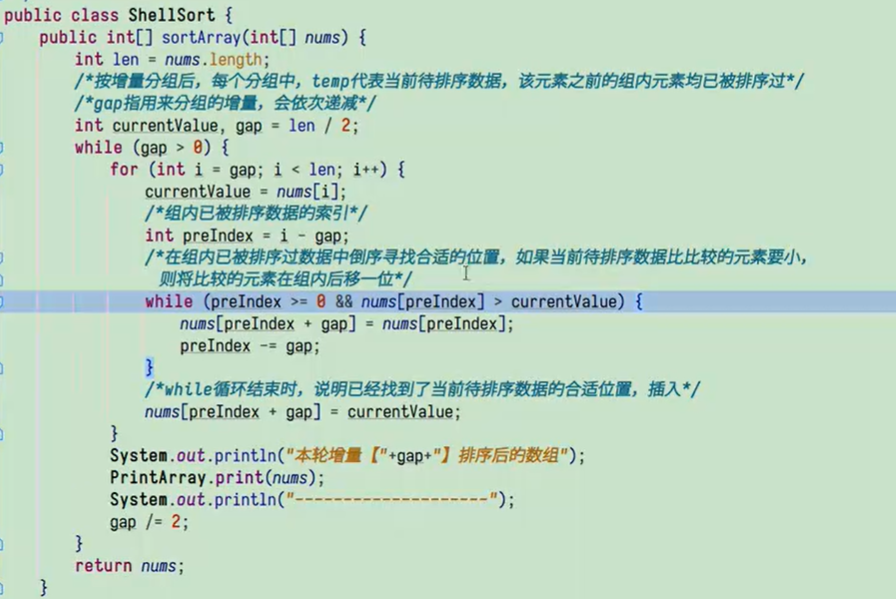
希尔排序
希尔排序是一种基于插入排序的算法,通过将整个数组分成多个子序列进行插入排序来提高排序的效率。说白了就是分成gap组。
一开始将整个待排序列分成gap= nums.length/2组,接着会分成gap= gap/2组,直到最后分成一组,将整个待排序数组进行一次插入排序就好了。
归并排序
思想:采用的是先分再治的思想,就是将待排序数组分成两块,然后每一块再进行划分,直到划分的每一块都只有一个元素的时候,这个时候再进行合并,当然合并的过程中要进行排序。
堆排序
适用场景:比方说我们有一个待排序数组,但是我们可能只是想要其中的最大值或者最小值,也就是说没有必要将整个数组都排好序,这个时候我们就可以使用堆排序了。
底层使用到了二叉树。
计数排序
计数排序是一种不比较元素大小的排序算法。
计数排序对一定范围内的整数排序时候的速度非常快,一般快于其他排序算法。但是计数排序局限性比较大,只限于对整数进行排序,而且待排序元素值分布较连续、跨度小的情况。
如果一个数组里面所有元素都是整数,而且都在0-k以内,那对于数组里每个元素来说,如果能知道数组里有多少项小于或等于该元素,就能够准确地给出该元素在排序后的数组中的位置。
除了待排序数组之外,还需要引入一个计数数组。
桶排序
桶排序是计数排序的升级版。
工作原理:假设输入数据服从均匀分布,将数据分到有限数量的桶里,每个桶再分别排序(有可能再使用别的排序算法或是以递归方式继续使用桶排序)。
基数排序
原理:利用个位、十位、百位的方式进行排序,说白了就是个位安排0-9个桶,十位也是,百位也是,等等。
leecode 二分查找
二分查找要求数组必须是有序的。
方式一:使用循环的方式
public class Solution {


    /**
     * 二分查找
     *
     * @return
     */
    public int binarySearch(int[] arr, int target) {

        int start = 0;
        int end = arr.length - 1;

        // 循环查找
        while (start <= end) {
            int mid = (start + end) / 2;

            if (target > arr[mid]) {
                start = mid + 1;
            } else if (target < arr[mid]) {
                end = mid - 1;
            } else { // 表示找到了
                return mid;
            }
        }

        // -1 表示没有查找到
        return -1;
    }


    public static void main(String[] args) {
        int arr[] = {1, 2, 3, 4, 5, 6, 7, 8, 9, 10};
        int target = 7;
        Solution solution = new Solution();
        int ret = solution.binarySearch(arr, target);
        System.out.println(ret);

    }

}
// TODO 方式二,采用递归方式。
爬楼梯
方法一:递归解法
public static int climbStairs(int n) {
    if(n == 0){return 0;}
    if(n == 1){return 1;}
    if(n == 2){return 2;}
    return climbStairs(n-1) + climbStairs(n-2);
}

public static void main(String[] args) {
    System.out.println(climbStairs(3));

}
以上的解法存在重复计算的问题,我们可以使用hashmap集合来保存我们已经计算过的结果。
private static HashMap<Integer,Integer> map = new HashMap();

public static int climbStairs2(int n) {
    if(n == 0){return 0;}
    if(n == 1){return 1;}
    if(n == 2){return 2;}

    if(null != map.get(new Integer(n))){
        return map.get(new Integer(n));
    }

    int reslut = climbStairs(n-1) + climbStairs(n-2);
    map.put(new Integer(n),reslut);

    return reslut;
}
## 合并两个排序的链表
输入两个递增排序的链表,合并后的这两个链表中的节点仍然是递增排序的。
public class Test {

    private static class ListNode<E>{
        E val;
        ListNode<E> next;

        public ListNode(E val){
            this.val = val;
        }

        public ListNode(E val,ListNode<E> next){
            this.val = val;
            this.next = next;
        }
    }

    private static void print(ListNode head){
        while (null != head){
            System.out.print("\t" + head.val);
            head = head.next;
        }
    }

    private ListNode<Integer> mergeTwoLists(ListNode<Integer> head1, ListNode<Integer> head2){

        ListNode<Integer> dummy = new ListNode<>(-1);
        ListNode<Integer> pre = dummy;

        while(head1 != null && head2 != null){

            if(head1.val <= head2.val){
                pre.next = head1;
                head1 = head1.next;
            }else {
                pre.next = head2;
                head2 = head2.next;
            }

            pre = pre.next;
        }

        if(null == head1){
            pre.next = head2;
        }
        if(null == head2){
            pre.next = head1;
        }

        return dummy.next;
    }


    public static void main(String[] args) {

        ListNode<Integer> list1 = new ListNode<>(1);
        ListNode<Integer> list2 = new ListNode<>(3);
        ListNode<Integer> list3 = new ListNode<>(5);
        ListNode<Integer> list4 = new ListNode<>(7);
        ListNode<Integer> list5 = new ListNode<>(9);
        list1.next = list2;
        list2.next = list3;
        list3.next = list4;
        list4.next = list5;

        ListNode<Integer> l1 = new ListNode<>(2);
        ListNode<Integer> l2 = new ListNode<>(4);
        ListNode<Integer> l3 = new ListNode<>(6);
        ListNode<Integer> l4 = new ListNode<>(8);
        ListNode<Integer> l5 = new ListNode<>(10);
        l1.next = l2;
        l2.next = l3;
        l3.next = l4;
        l4.next = l5;

        Test test = new Test();
        ListNode<Integer> reslut = test.mergeTwoLists(list1, l1);
        print(reslut);

    }
}
请写出Java代码实现如下功能:读取一篇文章,输出其中出现次数最多的单词。
public class Test {
    public static void main(String[] args) {
        List<String> words = new ArrayList<>();

        words.add("hello");
        words.add("world");
        words.add("goods");
        words.add("world");
        words.add("world");
        words.add("world");
        words.add("world");

        Map<String, Integer> countMap = new HashMap<>();
        for (int i = 0; i < words.size(); i++) {

            if(countMap.get(words.get(i)) == null){
                countMap.put(words.get(i), 1);
            }else {
                countMap.put(words.get(i), countMap.get(words.get(i)) + 1);
            }

        }

        int maxCount = 0;
        String maxCountWord = null;
        // 遍历map
        for(Map.Entry<String, Integer> entry : countMap.entrySet()){
            if(maxCount < entry.getValue()){
                maxCount = entry.getValue();
                maxCountWord = entry.getKey();
            }
        }

        System.out.println("出现次数最多的单词是:"+ maxCountWord + "出现次数:" + maxCount);

    }
}
请写代码实现s=1+2-3+4-5+6-7...n请编写一个函数int calc(int n),传入参数n,返回s的值.
public class Test {

    public static int calc(int n){
        int sum = 1;

        for (int i = 2; i <= n; i++) {
            if(i % 2 == 0){
                sum += i;
            }else {
                sum -= i;
            }
        }

        return sum;
    }

    public static void main(String[] args) {

        System.out.println(Test.calc(5));
    }
}
请写出Java代码,实现从一个无序数组中找到最大的5个元素
// 总体思路是先进行冒泡排序,之后再找出前五个元素。
public class Test {

    public static int[] calc(int[] arr) {

        for (int j = 0; j  < arr.length; j ++) {
            for (int i = 0; i < arr.length - 1 - j; i++) {
                int temp = 0;
                if (arr[i] < arr[i + 1]) {
                    temp = arr[i];
                    arr[i] = arr[i + 1];
                    arr[i + 1] = temp;
                }
            }
        }


        return arr;
    }

    public static void main(String[] args) {
        int[] arr = {5, 8, 2, 3, 9, 7, 4, 6, 10};

        Test.calc(arr);

        for (int i = 0; i < 5; i++) {
            System.out.print("\t" + arr[i]);
        }
    }
}
找出两数之和的下标
给定一个整数数组 nums 和一个整数目标值 target,请你在该数组中找出何为目标值的那两个整数,并返回他们的数组下标。
你可以假设每种输入只会对应一个答案。但是,数组中的同一个元素不能使用两遍。
你可以按任意顺序返回答案。
方法一:使用暴力枚举
public class Test {

    // 方法一:使用暴力枚举
    public static int[] twoSum(int[] nums, int target) {
        for (int i = 0; i < nums.length; i++) {
            for (int j = i + 1; j < nums.length ; j++) {
                if(nums[i] + nums[j] == target){
                    System.out.println(nums[i] + " + " + nums[j] + " = " + (nums[i] + nums[j]));
                    return new int[]{i, j};
                }
            }
        }

        // 如果没有找到就返回0
        return new int[]{0};
    }


    public static void main(String[] args) {

        int[] nums = {2,7,11,15};
        int target = 9;
        // 输出结果:[0,1]
        Arrays.stream(twoSum(nums, target)).forEach(System.out::println);
    }
}
public class Test {


    // 方法二:使用map进行映射
    public static int[] twoSum(int[] nums, int target) {
        Map<Integer, Integer> map = new HashMap<Integer, Integer>();
        int[] result = new int[2];

        for (int i = 0; i < nums.length; i++) {
            map.put(nums[i], i);
        }

        for (int i = 0; i < nums.length; i++) {
            // map.get(target - nums[i]) != i 也就是说找到的另外一个元素一定不能是第一个元素
            if(map.containsKey(target - nums[i]) && map.get(target - nums[i]) != i){
                result[0] = i;
                result[1] = map.get(target - nums[i]);
            }
            return result;
        }

        // 如果没有找到就返回0
        return new int[]{0};
    }


    public static void main(String[] args) {

        int[] nums = {2, 7, 11, 15};
        int target = 9;
        // 输出结果:[0,1]
        Arrays.stream(twoSum(nums, target)).forEach(System.out::println);
    }
}
public class Test {


    // 方法三:还是使用map进行映射,只不过在第二种的基础上进行了简化。
    public static int[] twoSum(int[] nums, int target) {
        Map<Integer, Integer> map = new HashMap<Integer, Integer>();
        int[] result = new int[2];

        for (int i = 0; i < nums.length; i++) {
            if (map.containsKey(target - nums[i])) {
                result[0] = i;
                result[1] = map.get(target - nums[i]);
                return result;
            }
            map.put(nums[i], i);
        }


        // 如果没有找到就返回0
        return new int[]{0};
    }


    public static void main(String[] args) {

        int[] nums = {2, 7, 11, 15};
        int target = 9;
        // 输出结果:[0,1]
        Arrays.stream(twoSum(nums, target)).forEach(System.out::println);
    }
}
找出所有的两数之和的下标
package com.xs.designs.suanfa;

import java.util.*;

public class TwoSum {
    public static List<List<Integer>> findTwoSumIndices(int[] nums, int target) {
        // 存储结果(去重)
        Set<List<Integer>> resultSet = new HashSet<>();
        // 哈希表:key=元素值,value=元素下标
        Map<Integer, Integer> map = new HashMap<>();

        for (int i = 0; i < nums.length; i++) {
            int complement = target - nums[i];
            // 检查补数是否在哈希表中
            if (map.containsKey(complement)) {
                // 取出补数的下标 j
                int j = map.get(complement);
                // 存储下标对(按升序排列,避免重复)
                List<Integer> pair = new ArrayList<>();
                pair.add(Math.min(i, j));
                pair.add(Math.max(i, j));
                resultSet.add(pair);
            }
            // 将当前元素存入哈希表(值 -> 下标)
            map.put(nums[i], i);
        }

        // 转换为 List 并返回
        return new ArrayList<>(resultSet);
    }

    public static void main(String[] args) {
        // 测试用例
        int[] nums = {2, 7, 11, 15, 3, 6};
        int target = 9;
        List<List<Integer>> result = findTwoSumIndices(nums, target);
        System.out.println(result); // 输出:[[0, 1], [4, 5]]
    }
}
链表翻转
第一种方式:通过改动指针的方式
public class Test {

    // 定义链表节点和指针
    static class ListNode{
        int val;
        ListNode next;

        ListNode(int val){
            this.val = val;
        }

        ListNode(int val, ListNode next){
            this.val = val;
            this.next = next;
        }
    }

    public static void print(ListNode head){
        while(head != null){
            System.out.print("\t" + head.val);
            head = head.next;
        }

    }

    public static ListNode iterate(ListNode head){
        ListNode prev = null;
        ListNode next = null;

        while(head != null){
            next = head.next; // 先将当前节点的下一个节点保存到next变量中
            head.next = prev; // 将当前节点的下一个节点指向前一个节点
            prev = head;
            head = next;
        }
        return prev;

    }

    public static void main(String[] args) {
        ListNode listNode1 = new ListNode(1);
        ListNode listNode2 = new ListNode(2);
        ListNode listNode3 = new ListNode(3);
        ListNode listNode4 = new ListNode(4);
        ListNode listNode5 = new ListNode(5);
        listNode1.next = listNode2;
        listNode2.next = listNode3;
        listNode3.next = listNode4;
        listNode4.next = listNode5;

        ListNode head = iterate(listNode1);

        print(head);
    }

}
public class Test {

    // 定义链表节点和指针
    static class ListNode{
        int val;
        ListNode next;

        ListNode(int val){
            this.val = val;
        }

        ListNode(int val, ListNode next){
            this.val = val;
            this.next = next;
        }
    }

    public static void print(ListNode head){
        while(head != null){
            System.out.print("\t" + head.val);
            head = head.next;
        }

    }

    // 使用递归的方式
    public static ListNode recursion(ListNode head){

        if(head == null || head.next == null){
            return head;
        }

        ListNode newhead = recursion(head.next);
        head.next.next = head;
        head.next  = null;

        return newhead;

    }
    public static void main(String[] args) {
        ListNode listNode1 = new ListNode(1);
        ListNode listNode2 = new ListNode(2);
        ListNode listNode3 = new ListNode(3);
        ListNode listNode4 = new ListNode(4);
        ListNode listNode5 = new ListNode(5);
        listNode1.next = listNode2;
        listNode2.next = listNode3;
        listNode3.next = listNode4;
        listNode4.next = listNode5;

        ListNode head = recursion(listNode1);

        print(head);
    }

}
数组中三个数的最大乘积
思路,先对数组进行排序,排完序之后,在进行计算前三个或者是后三个数的乘积值。
public class Test {

    public static int multiMost(int[] nums) {
        // 先对数组进行排序,先手写一遍冒泡排序吧
        for (int i = 0; i < nums.length; i++) {
            for (int j = 0 + i; j < nums.length; j++) {
                if (nums[i] > nums[j]) {
                    int temp = nums[i];
                    nums[i] = nums[j];
                    nums[j] = temp;
                }
            }
        }
        // 如果想偷懒直接使用 Arrays.sort(nums);

        return Math.max(nums[0] * nums[1] * nums[2], nums[nums.length - 1] * nums[nums.length - 2] * nums[nums.length - 3]);
    }

    public static void main(String[] args) {

        int[] arr = {1, 2, 3, 4, 5, 6};
        int result = multiMost(arr);
        System.out.println(result);


    }

}
TODO:还有另外一种算法,待看。
求斐波那契数列的第N为的值是多少
方法一:使用暴力递归算法
public class Test {

    public static int calculate(int num) {

        if(0 == num){
            return 0;
        }
        if(1 == num){
            return 1;
        }

        return calculate(num-1) + calculate(num -2);
    }

    public static void main(String[] args) {

        System.out.println(calculate(10));

    }

}
// TODO 还有两种算法待看
排列硬币
public class Test {

    /**
     *
     * @param n 一共有的硬币数
     * @return
     */
    public static int arrangeCoins(int n) {

        // i 表示第几层
        for (int i = 1; i <= n; i++) {
            n = n -i;
            if(n <= i){
                return i;
            }
        }

        return 0;
    }

    public static void main(String[] args) {

        System.out.println(arrangeCoins(10));

    }

}
// TODO 还有另外两种算法,待看
判断链表中是否有环
方式一:使用set集合
public class Test {

    private static class ListNode<E>{
        E val;
        ListNode<E> next;

        public ListNode(E val){
            this.val = val;
        }

        public ListNode(E val,ListNode<E> next){
            this.val = val;
            this.next = next;
        }
    }

    private static void print(ListNode head){
        while (null != head){
            System.out.print("\t" + head.val);
            head = head.next;
        }
    }

    private static boolean hasCycle(ListNode<Integer> head){
        Set<ListNode> set = new HashSet<ListNode>();

        while(head != null){
            if(!set.add(head)){
                return true;
            }
            head = head.next;
        }

        return false;
    }


    public static void main(String[] args) {

        ListNode<Integer> list1 = new ListNode<>(1);
        ListNode<Integer> list2 = new ListNode<>(3);
        ListNode<Integer> list3 = new ListNode<>(5);
        ListNode<Integer> list4 = new ListNode<>(7);
        ListNode<Integer> list5 = new ListNode<>(9);
        list1.next = list2;
        list2.next = list3;
        list3.next = list4;
        list4.next = list5;

        // 模拟存在环
        list5.next = list3;


        System.out.println(hasCycle(list1));

    }
}
方式二:使用快慢指针的方式
private static boolean hasCycle(ListNode head){

        if(null == head){
        return false;
        }

        // 使用快慢指针进行判断
        ListNode slowPtr = head, fastPtr = head;
        while (slowPtr.next != null && fastPtr.next.next != null){
        if(slowPtr.next == fastPtr.next.next){
        return true;
        }
        slowPtr = slowPtr.next;
        fastPtr = fastPtr.next.next;
        }

        return false;
}
质数的最大距离
public class Test {

    public static boolean isPremium(int x) {

        if (x == 1) {
            return false;
        }
        if (x == 2) {
            return true;
        }

        boolean flag = true; // true:是质数 false:不是质数
        for (int i = 2; i < x; i++) {
            if (x % i == 0) {
                flag = false;
                break;
            }
        }

        return flag;
    }

    public static int maxDistance(int[] nums) {
        // TODO 待完善边界条件
        // 一个从前遍历,一个从后遍历
        // 查找第一个质数
        for (int i = 0; ; i++) {
            if (isPremium(nums[i])) {
                // 查找第二个质数
                for (int j = nums.length - 1; ; j--) {
                    if (isPremium(nums[j])) {
                        return j - i;
                    }
                }
            }
        }
    }


    public static void main(String[] args) {

//        int[] nums = new int[]{4, 2, 9, 5, 3};
        int[] nums = new int[]{10};
        int distance = maxDistance(nums);
        System.out.println(distance);


    }
}
方式二:写一种给人看的
public static int maxDistance(int[] nums){
        if(null == nums){
            return -1;
        }

        int i,j;
        for (i = 0; i < nums.length -1; i++) {
            if(isPreim(nums[i])){
                break;
            }
        }

        for (j = nums.length - 1; j > 0; j--) {
            if (isPreim(nums[j])){
                break;
            }
        }

        return j - i;
    }
环形链表 II
public class Solution {

    private static class ListNode<E> {
        E val;
        ListNode<E> next;

        public ListNode(E val) {
            this.val = val;
        }

        public ListNode(E val, ListNode<E> next) {
            this.val = val;
            this.next = next;
        }
    }

    private static void print(ListNode head) {
        while (null != head) {
            System.out.print("\t" + head.val);
            head = head.next;
        }
    }

    private static ListNode hasCycle(ListNode head) {

        if (null == head) {
            return null;
        }

        // 使用快慢指针进行判断
        // 慢指针每次只移动一个单位,快指针每次移动两个单位
        ListNode slowPtr = head, fastPtr = head;
        boolean isCycle = false;
        while (slowPtr.next != null && fastPtr.next.next != null) {
            slowPtr = slowPtr.next;
            fastPtr = fastPtr.next.next;
            if (slowPtr == fastPtr) {
                isCycle = true;
                break;
            }
        }


        if (isCycle) {
            // 如果存在环的话,就让慢指针指指回到头结点,并且快慢指针往后移动相同的单位
            slowPtr = head;
            while (slowPtr != fastPtr) {
                slowPtr = slowPtr.next;
                fastPtr = fastPtr.next;
            }
            return slowPtr;

        }
        return null;
    }


    public static void main(String[] args) {
        ListNode<Integer> list1 = new ListNode<>(1);
        ListNode<Integer> list2 = new ListNode<>(2);
        ListNode<Integer> list3 = new ListNode<>(3);
        ListNode<Integer> list4 = new ListNode<>(4);
        ListNode<Integer> list5 = new ListNode<>(5);
        list1.next = list2;
        list2.next = list3;
        list3.next = list4;
        list4.next = list2;

        ListNode node = hasCycle(list1);
        System.out.println(node.val);
    }
}
TODO 现在还有点理解不了,下来再好好看看 求环形链表的入环点
// 寻找环形链表的入环点
    public static ListNode detectCycle(ListNode head) {
        if (head == null) {
            return null;
        }
        ListNode slow = head;
        ListNode fast = head;

        // 快慢指针同时移动,快指针每次移动两步
        while (fast!= null && fast.next!= null) {
            slow = slow.next;
            fast = fast.next.next;

            // 快慢指针相遇,说明存在环
            if (slow == fast) {
                ListNode ptr = head;
                // 让一个指针从链表头开始,另一个从相遇点开始,以相同速度移动,再次相遇点就是入环点
                while (ptr!= slow) {
                    ptr = ptr.next;
                    slow = slow.next;
                }
                return ptr;
            }
        }
        // 不存在环
        return null;
    }
合并两个有序数组
方式一:使用jdk自带的工具类进行排序
public class Test {

    public static int[] merge(int[] arr1, int num1, int[] arr2, int num2){
        for (int i = 0; i < arr2.length; i++) {
            arr1[num1 + i] = arr2[i];
        }

        // 利用jdk自带的工具类进行排序
        Arrays.sort(arr1);
        return arr1;
    }

    public static void main(String[] args) {

        int[] nums1 = {1, 2, 3, 0, 0, 0};
        int m = 3;
        int[] nums2 = {2, 5, 6};
        int n = 3;

        int[] result = merge(nums1, m, nums2, n);

        Arrays.stream(result).forEach(System.out::println);

    }
}
方式二:使用双指针的方式
public class Test {

    // 方式二:使用双指针进行排序
    public static int[] merge(int[] nums1, int m, int[] nums2, int n) {

        int k = m + n;
        int[] temp = new int[k];

        int num1index = 0;
        int num2index = 0;
        for (int index = 0; index < k; index++) {

            if (num1index >= m) { // nums1数组已经取完,完全取nums2数组的值即可
                temp[index] = nums2[num2index++];
            }else if(num2index >= n){ // nums2数组已经取完,完全取nums1数组的值即可
                temp[index] = nums1[num1index++];
            }else if(nums1[num1index] < nums2[num2index]){ // nums1数组元素中的值小于nums2数组中元素的值,就取nums1数组元素中的值
                temp[index] = nums1[num1index++];
            }else { // nums2数组元素中的值小于nums1数组中元素的值,就取nums2数组元素中的值
                temp[index] = nums2[num2index++];
            }

        }

        // 将temp数组中的元素
        for(int i = 0; i < temp.length; i++){
            nums1[i] = temp[i];
        }


        return nums1;
    }

    public static void main(String[] args) {

        int[] nums1 = {1, 2, 3, 0, 0, 0};
        int m = 3;
        int[] nums2 = {2, 5, 6};
        int n = 3;

        int[] result = merge(nums1, m, nums2, n);

        Arrays.stream(result).forEach(System.out::println);

    }
}
// TODO 还有另外一种方法,待看
判断两个链表有无相交
public class Test {

    // 定义链表节点和指针
    static class ListNode {
        int val;
        ListNode next;

        ListNode(int val) {
            this.val = val;
        }

        ListNode(int val, ListNode next) {
            this.val = val;
            this.next = next;
        }
    }

    public static ListNode getIntersectionNode(ListNode headA, ListNode headB) {

        int lenA = 0, lenB = 0;
        ListNode pl = headA, ps = headB;

        while (pl != null) {
            lenA++;
            pl = pl.next;
        }
        while (ps != null) {
            lenB++;
            ps = ps.next;
        }

        // 因为你上面遍历了一下,所以需要重新指向
        pl = headA;
        ps = headB;

        int len = lenA - lenB;
        if (len < 0) {
            pl = headB;
            ps = headA;
            len = lenA - lenB;
        }

        // 一定是pl指向的是最长的单链表
        for (int i = 0; i < len; i++) {
            pl = pl.next;
        }

        // ps 和 pl一定是在同一个起跑线上了
        while (ps != pl && null != pl && null != ps) {
            ps = ps.next;
            pl = pl.next;
        }

        if(ps == pl && null != pl && null != ps){
            return pl;
        }

        return null; // 如果没有相交就返回null
    }

    public static void main(String[] args) {
        ListNode listNode1 = new ListNode(1);
        ListNode listNode2 = new ListNode(2);
        ListNode listNode3 = new ListNode(3);
        ListNode listNode4 = new ListNode(4);
        ListNode listNode5 = new ListNode(5);
        listNode1.next = listNode2;
        listNode2.next = listNode3;
        listNode3.next = listNode4;
        listNode4.next = listNode5;


        ListNode node1 = new ListNode(1);
        ListNode node2 = new ListNode(2);
        ListNode node3 = new ListNode(3);
        ListNode node4 = new ListNode(4);
        ListNode node5 = new ListNode(5);
        node1.next = node2;
        node2.next = node3;
        node3.next = listNode4;

        // 注意两个链表相交一定是Y型的,不可能是X型的

        ListNode intersectionNode = getIntersectionNode(listNode1, node1);
        System.out.println(intersectionNode);


    }
}
方式二:使用双指针的方式
private static ListNode getIntersectionNode(ListNode head1, ListNode head2) {

    if (head1 == null || head2 == null) {
        return null;
    }

    // 使用双指针的方式
    ListNode ptr1 = head1;
    ListNode ptr2 = head2;

    while (ptr1 != ptr2) {

        ptr1 = ptr1 == null ? head2 : ptr1.next;
        ptr2 = ptr2 == null ? head1 : ptr2.next;
    }
    return ptr1;
}
链表中的节点每K个一组进行翻转
public class Solution {


    public static class ListNode {
        int val;
        ListNode next;

        ListNode() {
        }

        ListNode(int val) {
            this.val = val;
        }

        ListNode(int val, ListNode next) {
            this.val = val;
            this.next = next;
        }
    }

    public static void print(ListNode head) {
        while (head != null) {
            System.out.print("\t" + head.val);
            head = head.next;
        }
    }


    public ListNode reverseKGroup(ListNode head, int k) {
        // 先设置一个虚拟头结点
        ListNode dummy = new ListNode(-1);
        // 虚拟节点的next指针要指向head节点
        dummy.next = head;

        // pre表示每次要翻转的链表的头结点【上一个节点】
        ListNode pre = dummy;
        // end表示每次要翻转的链表的尾节点
        ListNode end = dummy;

        while(end.next != null){
            // 通过for循环,找到每一组翻转链表的尾部
            for (int i = 0; i < k && end != null; i++) {
                end = end.next;
            }

            // 如果发现end == null,说明此时反转的额链表的节点数小于K,保持原有的顺序就可以了
            if(end == null){
                break;
            }

            ListNode next =  end.next;
            end.next = null;
            ListNode start = pre.next;
            pre.next = null;
            pre.next = reverseList(start);
            start.next = next;
            pre = start;
            end = start;
        }

       return dummy.next;
    }

    /**
     * 翻转链表
     * @param head
     */
    // 使用递归的方式
    public static ListNode reverseList(ListNode head){

        if(head == null || head.next == null){
            return head;
        }

        ListNode newhead = reverseList(head.next);
        head.next.next = head;
        head.next  = null;

        return newhead;

    }

    public static void main(String[] args) {
			// TODO 这个题目目前自己还不是很懂,下来再好好看看吧!!!
    }
}
移动0
使用双指针 i 用来遍历数组中的每一个元素; j用来记录数组中0元素的个数
public class Solution {


    public static void moveZero(int[] nums){
        if(null == nums){
            return;
        }

        // 使用双指针
        int j = 0;
        for (int i = 0; i < nums.length; i++) {
            if(0 != nums[i]){
                nums[j++] = nums[i];
            }
        }

        for (int i = j; i < nums.length; i++) {
            nums[i] = 0;
        }

    }


    public static void main(String[] args) {
        int[] arr = {0,1,0,3,12};
        moveZero(arr);
        Arrays.stream(arr).forEach(System.out::println);
    }
}
找到数组中所有消失的元素
public class Solution {


    public List<Integer> findDisappearedNumbers(int[] nums) {
        for (int i = 0; i < nums.length; i++) {
            while (i != nums[i] - 1 && nums[i] != nums[nums[i] - 1]) {
                swap(nums, i, nums[i] - 1);
            }
        }

        List<Integer> res = new ArrayList<>();
        for (int i = 0; i < nums.length; i++) {
            if(i + 1 != nums[i]){
                res.add(i + 1);
            }
        }

        return res;
    }


    // 两数交换
    public void swap(int[] nums, int i, int j) {
        int temp = nums[i];
        nums[i] = nums[j];
        nums[j] = temp;
    }


    public static void main(String[] args) {
        int[] nums = {4,3,2,1,8,2,3,7};
        Solution solution = new Solution();
        List<Integer> result = solution.findDisappearedNumbers(nums);
        System.out.println(result);
    }
}
// TODO 还有另外一种算法,待看
删除排序列表中的重复元素
public class Solution {

    private static class ListNode<E>{
        E val;
        ListNode<E> next;

        public ListNode(E val){
            this.val = val;
        }

        public ListNode(E val,ListNode<E> next){
            this.val = val;
            this.next = next;
        }
    }

    private static void print(ListNode head){
        while (null != head){
            System.out.print("\t" + head.val);
            head = head.next;
        }
    }

    private static ListNode delDuplicateNode(ListNode head){

        if(null == head){
            return head;
        }

        ListNode curr = head;
        while (curr.next != null){
            if(curr.val == curr.next.val){
                curr.next = curr.next.next;
            }else{
                curr = curr.next;
            }

        }

        return head;
    }


    public static void main(String[] args) {
        ListNode<Integer> list1 = new ListNode<>(1);
        ListNode<Integer> list2 = new ListNode<>(3);
        ListNode<Integer> list3 = new ListNode<>(3);
        ListNode<Integer> list4 = new ListNode<>(5);
        ListNode<Integer> list5 = new ListNode<>(5);
        list1.next = list2;
        list2.next = list3;
        list3.next = list4;
        list4.next = list5;

        ListNode listNode = delDuplicateNode(list1);
        print(listNode);
    }
}
回文链表
public class Solution {

    private static class ListNode<E> {
        E val;
        ListNode<E> next;

        public ListNode(E val) {
            this.val = val;
        }

        public ListNode(E val, ListNode<E> next) {
            this.val = val;
            this.next = next;
        }
    }

    private static void print(ListNode head) {
        while (null != head) {
            System.out.print("\t" + head.val);
            head = head.next;
        }
    }

    // 判断是否是回文链表 true:表示是回文链表 false:表示不是回文链表
    private static boolean isPalindrome(ListNode head) {

        // 使用快慢指针进行判断
        ListNode slowPtr = head;
        ListNode fastPtr = head;

        while (slowPtr != null && fastPtr.next != null){
            slowPtr = slowPtr.next;
            fastPtr = fastPtr.next.next;
        }

        // 如果是奇数个节点
        if(fastPtr != null){
            slowPtr = slowPtr.next;
        }

        fastPtr = head; // 将快指针重新移动到链表的头部
        slowPtr = reverse(slowPtr); // 将慢指针进行翻转

        while (slowPtr != null){
            if(slowPtr.val != fastPtr.val){
                return false;
            }
            slowPtr = slowPtr.next;
            fastPtr = fastPtr.next;
        }

        return true;

    }

    // 链表翻转
    private static ListNode reverse(ListNode head){
        if(head == null || head.next == null){
            return head;
        }

        ListNode newNode = reverse(head.next);

        head.next.next = head;
        head.next = null;

        return newNode;
    }


    public static void main(String[] args) {
        ListNode listNode1 = new ListNode(1);
        ListNode listNode2 = new ListNode(2);
        ListNode listNode3 = new ListNode(3);
        ListNode listNode4 = new ListNode(2);
        ListNode listNode5 = new ListNode(2);
        listNode1.next = listNode2;
        listNode2.next = listNode3;
        listNode3.next = listNode4;
        listNode4.next = listNode5;


        boolean flag = isPalindrome(listNode1);
        System.out.println(flag);
    }
}
找到链表的中间节点
public class Solution {

    private static class ListNode<E> {
        E val;
        ListNode<E> next;

        public ListNode(E val) {
            this.val = val;
        }

        public ListNode(E val, ListNode<E> next) {
            this.val = val;
            this.next = next;
        }
    }

    private static void print(ListNode head) {
        while (null != head) {
            System.out.print("\t" + head.val);
            head = head.next;
        }
    }


    private static ListNode findMidNode(ListNode head) {

        // 使用快慢指针
        ListNode slowPtr = head;
        ListNode fastPtr = head;

        while (slowPtr != null && fastPtr.next != null){
            slowPtr = slowPtr.next;
            fastPtr = fastPtr.next.next;
        }

        return slowPtr;

    }


    public static void main(String[] args) {
        ListNode listNode1 = new ListNode(1);
        ListNode listNode2 = new ListNode(2);
        ListNode listNode3 = new ListNode(3);
        ListNode listNode4 = new ListNode(2);
        ListNode listNode5 = new ListNode(2);
        listNode1.next = listNode2;
        listNode2.next = listNode3;
        listNode3.next = listNode4;
        listNode4.next = listNode5;


        ListNode node = findMidNode(listNode1);
        System.out.println(node.val);
    }
}
求环形链表中环的长度
/**
 * 求环形链表中环的长度
 */
public class Solution {

    private static class ListNode {
        int val;
        ListNode next;

        public ListNode(int val) {
            this.val = val;
        }

        public ListNode(int val, ListNode next) {
            this.val = val;
            this.next = next;
        }
    }

    public int cycleLength(ListNode head) {

        if (null == head) {
            return -1;
        }

        // 先判断链表有没有环
        ListNode slow = head;
        ListNode fast = head;
        int length = 0; // 统计环的长度

        while (null != slow.next && null != fast.next.next) {

            slow = slow.next;
            fast = fast.next.next;

            // 说明链表有环
            if (slow == fast) {

                ListNode ptr = slow;

                do {
                    ptr = ptr.next;
                    length++;
                } while (ptr != slow);

                break;
            }
        }

        return length;
    }

    public static void main(String[] args) {

        ListNode list1 = new ListNode(1);
        ListNode list2 = new ListNode(3);
        ListNode list3 = new ListNode(5);
        ListNode list4 = new ListNode(7);
        ListNode list5 = new ListNode(9);
        list1.next = list2;
        list2.next = list3;
        list3.next = list4;
        list4.next = list5;

        // 模拟存在环
        list5.next = list2;

        Solution solution = new Solution();

        System.out.println(solution.cycleLength(list1));

    }

}
找到链表的倒数第K个节点
public class Solution {

    private static class ListNode<E> {
        E val;
        ListNode<E> next;

        public ListNode(E val) {
            this.val = val;
        }

        public ListNode(E val, ListNode<E> next) {
            this.val = val;
            this.next = next;
        }
    }

    private static void print(ListNode head) {
        while (null != head) {
            System.out.print("\t" + head.val);
            head = head.next;
        }
    }


    private static ListNode findNodeFromEnd(ListNode head,int k) {
        if(head == null || k < 0){
            return head;
        }

        // 使用快慢指针
        ListNode slowPtr = head;
        ListNode fastPtr = head;

        // 先让快指针提前走K步
        for (int i = 0; i < k; i++) {
            if(fastPtr == null){
                return null;
            }
            fastPtr = fastPtr.next;
        }

        // 然后快慢指针一起走
        while (slowPtr != null && fastPtr != null){
            slowPtr = slowPtr.next;
            fastPtr = fastPtr.next;
        }

        return slowPtr;

    }


    public static void main(String[] args) {
        ListNode listNode1 = new ListNode(1);
        ListNode listNode2 = new ListNode(2);
        ListNode listNode3 = new ListNode(3);
        ListNode listNode4 = new ListNode(4);
        ListNode listNode5 = new ListNode(5);
        listNode1.next = listNode2;
        listNode2.next = listNode3;
        listNode3.next = listNode4;
        listNode4.next = listNode5;

        int k = 2;
        ListNode node = findNodeFromEnd(listNode1, k);
        System.out.println(node.val);
    }
}
一个有序int数组。只有一个元素会出现一次。其他都会出现两次。找出这个int。
public class Test {

    public int findSingleNum(int[] nums){
        if(null == nums || nums.length == 0){
            return Integer.MAX_VALUE;
        }

        Set<Integer> set = new HashSet<>();

        for (int i = 0; i < nums.length; i++) {
            if(!set.contains(nums[i])){
                set.add(nums[i]);
            }else {
                set.remove(nums[i]);
            }
        }

        return set.stream().findFirst().get();
    }
    public static void main(String[] args) {

        int[] nums = {1,1,2,3,3,4,4};

        Test test = new Test();

        int result = test.findSingleNum(nums);

        System.out.println(result);

    }

}
判断某个数字是不是2的次幂
第一种方式:
/**
 * 算法题:判断某个数字是不是2的幂
 */
public class Test2 {

    private boolean is2power(int num) {

        while (num / 2 != 0 && num % 2 == 0) {

            num = num / 2;
        }

        return num == 1;
    }

    public static void main(String[] args) {
        int num = 16;

        Test2 test2 = new Test2();
        System.out.println(test2.is2power(num));
    }

}
第二种方式:
package com.example.demo02.test;


/**
 * 判断一个正整数是否是2的次幂
 */
public class Solution {

    /**
     * 定义一个变量temp,每次通过乘以2,都来和目标值进行判断,如果相等,则是2的次幂,如果大于目标值,则不是2的次幂。
     * @param num 目标值
     * @return true: 是2的次幂 false:不是
     */
    public boolean is2Power(int num){
        // 边界条件判断
        if(num == 0 || num == 1){
            return false;
        }

        int temp = 1;
        boolean is2Power;

        while (true){
            temp = temp * 2;
            if(temp == num){
                is2Power = true;
                break;
            }else if(temp > num){
                is2Power = false;
                break;
            }
        }

        return is2Power;
    }

    public static void main(String[] args) {
        int num = 16;
        Solution solution = new Solution();
        boolean power = solution.is2Power(num);
        System.out.println(power);
    }

}
输入一个字符串,将这个字符串中的非字母去除后,不考虑大小写的情况下判断这个字符串是否是前后对称的(AbcECba)果
/**
 * 算法题:输入一个字符串,将这个字符串中的非字母去除后,不考虑大小写的情况下判断这个字符串是否是前后对称的(AbcECba)果
 */
public class Test2 {

    public static boolean isMinorChar(String content) {

        if (null == content || 0 == content.length()) {
            return true;
        }

        String[] arr = content.split("");
        List<String> list = Arrays.asList(arr);
        List<String> modifiableList = new ArrayList<>(list);
        Iterator<String> iterator = modifiableList.iterator();// 注意这里必须再包一次,否则会报错

        while (iterator.hasNext()) {
            String str = iterator.next();
            if (!Character.isLetter(str.charAt(0))) {
                iterator.remove();
            }
        }

        // 判断是否对称
        int half = list.size() / 2;
        int length = list.size();

        for (int i = 0; i < half; i++) {
            if (!list.get(i).equalsIgnoreCase(list.get(length - i - 1))) {
                return false;
            }
        }

        return true;
    }

    public static void main(String[] args) {
        String str = "abc5cbad";
        boolean flag = isMinorChar(str);
        System.out.println(flag);
    }
}
字母排序
/**
 * 算法题:输入一个字符串,将这个字符串中的非字母去除后,不考虑大小写的情况下判断这个字符串是否是前后对称的(AbcECba)果
 */
public class Test2 {

    private final static Object OBJECT = new Object();

    // 字母排序
    public static String sort(String content) {
        if (null == content || 0 == content.length()) {
            return "";
        }

        String[] arr = content.split("");
        TreeMap<String, Object> treeMap = new TreeMap();

        for (int i = 0; i < arr.length; i++) {
            treeMap.put(arr[i], OBJECT);
        }

        StringBuffer buffer = new StringBuffer();
        treeMap.forEach((k,v) -> buffer.append(k));

        return buffer.toString();

    }

    // 字母排序
    public static String sort2(String content) {
        if (null == content || 0 == content.length()) {
            return "";
        }

        String[] arr = content.split("");
        Arrays.sort(arr);
        String result = Arrays.toString(arr);
        return result;
    }

    public static void main(String[] args) {
        String content = "bdca";
        String result = sort2(content);
        System.out.println(result);
    }
}
在数组指定位置插入元素
/**
 * 算法题:在数组指定位置插入元素
 */
public class Test2 {

    public static void main(String[] args) {

        int[] arr = new int[5];

        for (int i = 0; i < 5; i++) {
            arr[i] = i + 1;
        }

        System.out.println(Arrays.toString(arr));

        int element = 10;
        int index = 3;
        int[] arrNew = new int[arr.length + 1]; // 需要新创建一个数组

        // 分两个步骤进行
        for (int i = 0; i < index; i++) {
            arrNew[i] = arr[i];
        }

        arrNew[index] = element;

        for (int i = index + 1; i < arrNew.length; i++) {
            arrNew[i] = arr[i - 1];
        }

        System.out.println(Arrays.toString(arrNew));
    }

}
字符串版本号
package com.coding;

/**
 * 示例 1:
 * 输入: version1 = "1.01", version2 = "1.001"
 * 输出: 0
 * 解释:忽略前导零,"01" 和 "001" 都表示相同的整数 "1"
 * <p>
 * 示例 2:
 * 输入: version1 = "1.0", version2 = "1.0.0"
 * 输出: 0
 * 解释: version1 没有指定下标为 2 的修订号,即视为 "0"
 * <p>
 * 示例 3:
 * 输入: version1 = "0.1", version2 = "1.1"
 * 输出: -1
 * 解释: version1 中下标为 0 的修订号是 "0",version2 中下标为 0 的修订号是 "1" 。0 < 1,所以 version1 < version2
 */
public class Test7 {

    public static int compareVersion(String v1, String v2) {
        // 将传入的两个字符串按照.进行拆分
        String[] ss1 = v1.split("\\."), ss2 = v2.split("\\.");
        // 得到每个拆分后数组的长度
        int n = ss1.length, m = ss2.length;
        // 对两个数组进行遍历,只要遍历完其中的任何一个就可以了
        int i = 0, j = 0;
        while (i < n || j < m) {
            // 获取每一位上面的数字
            int a = 0, b = 0;
            if (i < n) {
                a = Integer.parseInt(ss1[i++]);
            }
            if (j < m) {
                b = Integer.parseInt(ss2[j++]);
            }
            // 进行判断,返回结果
            if (a != b) {
                return a > b ? 1 : -1;
            }
        }
        return 0; // 表示两个字符串的版本号相等
    }


    public static void main(String[] args) {
        String version1 = "1.01";
        String version2 = "1.001";

        int result = compareVersion(version1, version2);

        System.out.println(result);
    }

}


 浙公网安备 33010602011771号