
实验1
实验任务二
1.源码
#include <iostream>
using std::cout;
using std::endl;
class Point {
public:
  Point(int x0 = 0, int y0 = 0);
  Point(const Point&p );
  ~Point() = default;

  int get_x() const { return x; }
  int get_y() const { return y; }
  void show() const;


private:
  int x, y;
};
Point::Point(int x0, int y0): x{x0}, y{y0} {
 cout << "constructor called." << endl;
}
Point::Point(const Point& p): x{p.x}, y{p.y} {
 cout << "copy constructor called." << endl;
}
void Point::show() const {
  cout << "(" << x << ", "
        << y << ")" << endl;
}
int main() {
  Point p1(4, 5);
  p1.show();


  Point p2 = p1;
  p2.show();


  Point p3{p2};
  p3.show();
  cout << p3.get_x() << endl;
}
2.测试截图
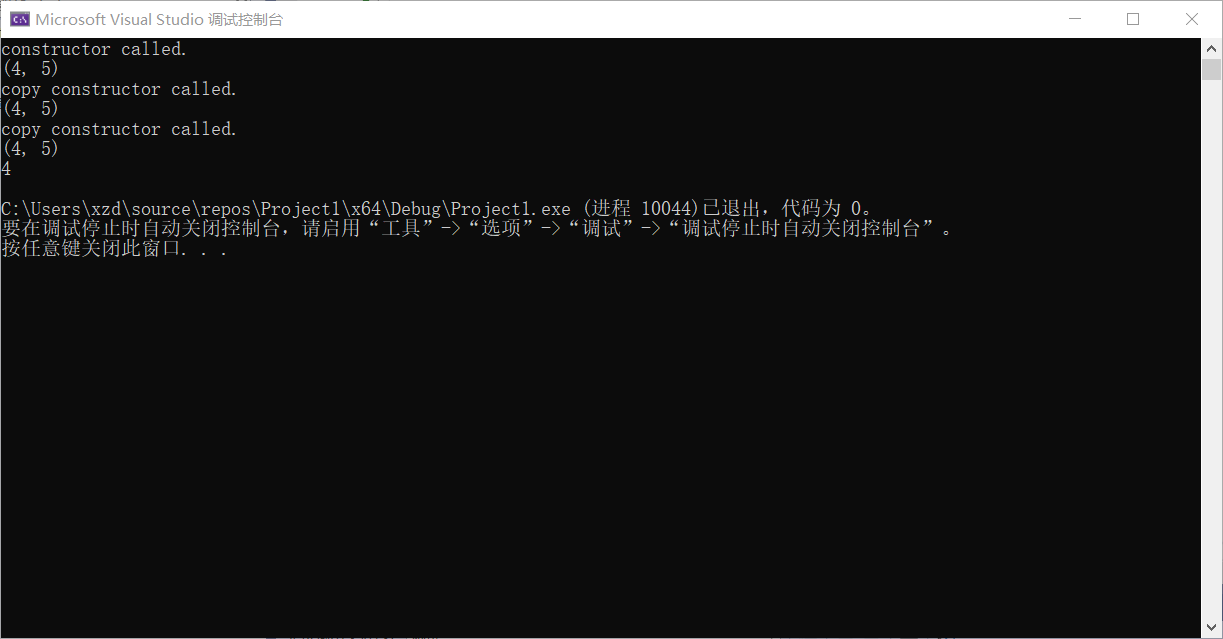
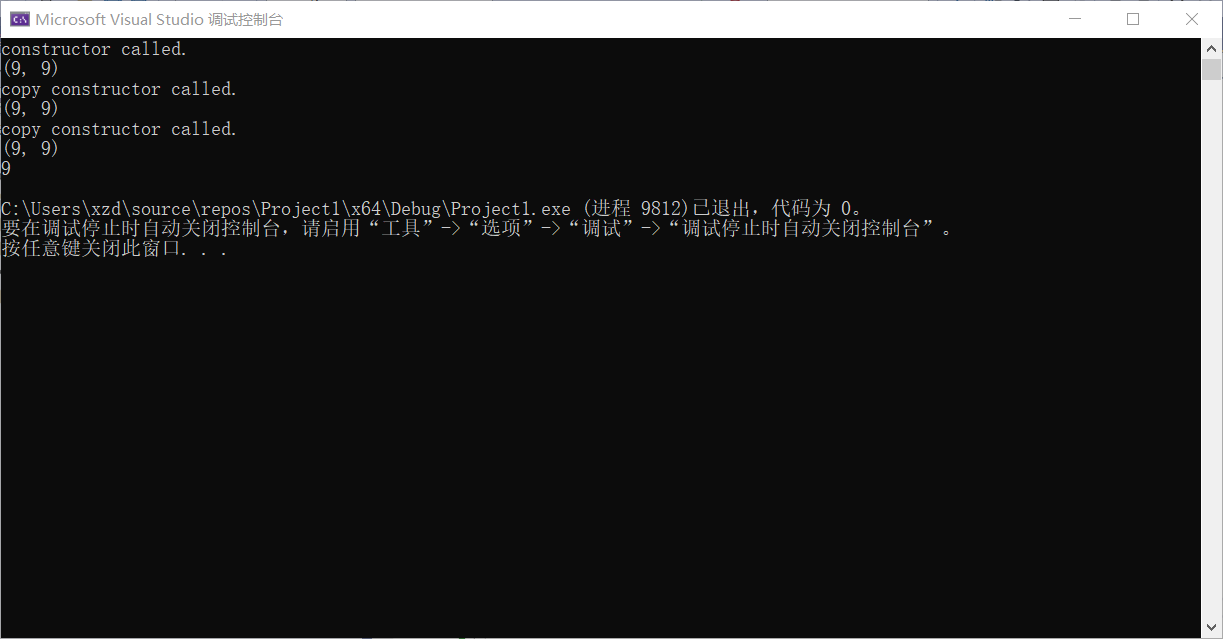
实验任务三
1.源码
#include<iostream>
#include<iomanip>
using namespace std;

class Clock {
public:
    Clock(int h = 0, int m = 0, int s = 0);
    Clock(const Clock& t);
    ~Clock()=default;
    void setTime(int h, int m = 0, int s = 0);
    void showTime()const;
private:
    int hour, minute, second;
};

Clock::Clock(int h, int m, int s) :hour(h), minute(m), second(s) { cout << "constructor called" << endl; }
Clock::Clock(const Clock& t) : hour(t.hour), minute(t.minute), second(t.second) { cout << "Copy constructor called" << endl; }

void Clock::setTime(int h, int m, int s) {
    hour = h;
    minute = m;
    second = s;
}
void Clock::showTime() const {
    cout << setfill('0') << setw(2) << hour << ":" << setw(2) << minute << ":" << setw(2) << second << endl;
}

Clock reset() {
    return Clock(0, 0, 0);
}
int main() {
    Clock c1(12, 0, 5);
    c1.showTime();

    c1= reset();
    c1.showTime();

    Clock c2(c1);
    c2.setTime(6);
    c2.showTime();
}
2.测试截图
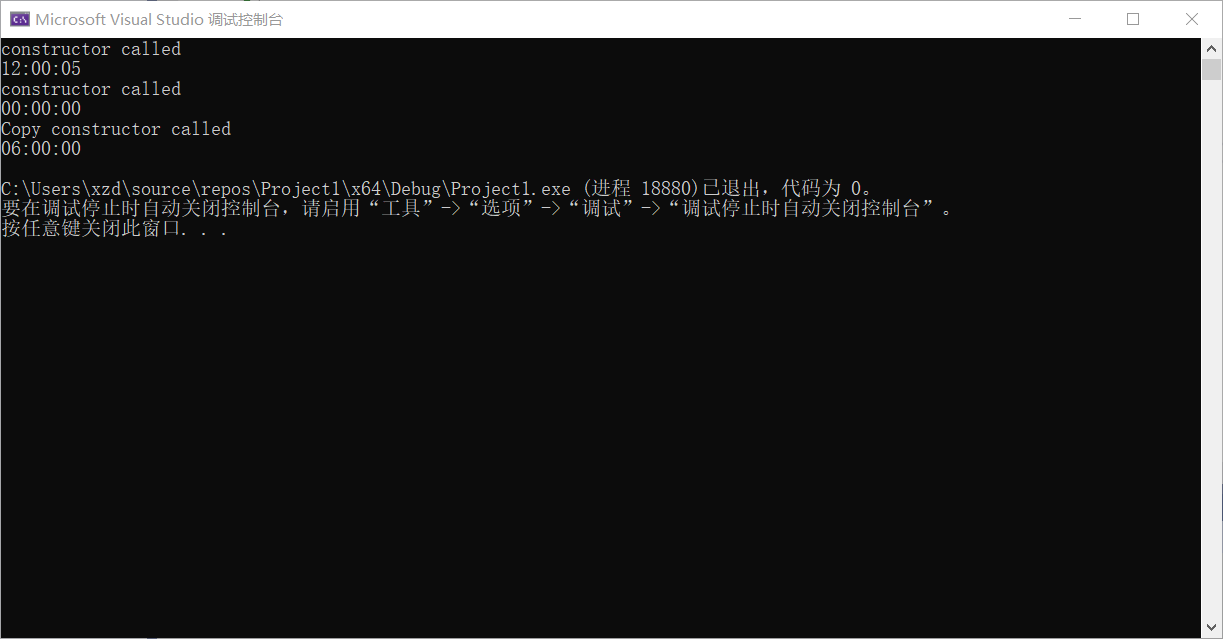
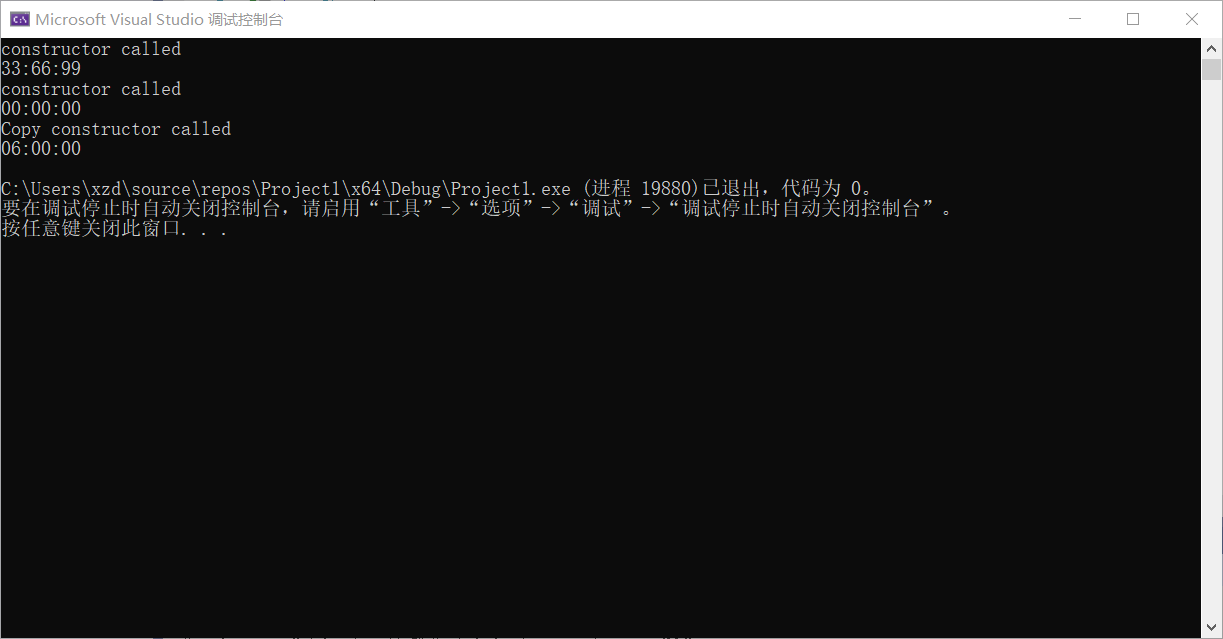
实验任务四
1.源码
#include<iostream>
using namespace std;

class X {
public:
    X();
    ~X();
    X(int m);
    X(const X& obj);
    X(X&& obj)noexcept;
    void show()const;
private:
    int data;
};

X::X() :data(42) { cout << "default constructor called.\n"; }
X::~X() { cout << "destructor called.\n"; }
X::X(int m) : data(m) { cout << "constructor called.\n"; }
X::X(const X& obj) : data(obj.data) { cout << "copy constructor called.\n"; }
X::X(X&&obj)noexcept:data(obj.data) { cout << "move constructor called.\n"; }
void X::show()const { cout << data << endl; }

int main() {
    X x1;
    x1.show();

    X x2{ 2049 };
    x2.show();

    X x3(x1);
    x3.show();

    X x4(move(x2));
    x4.show();
}
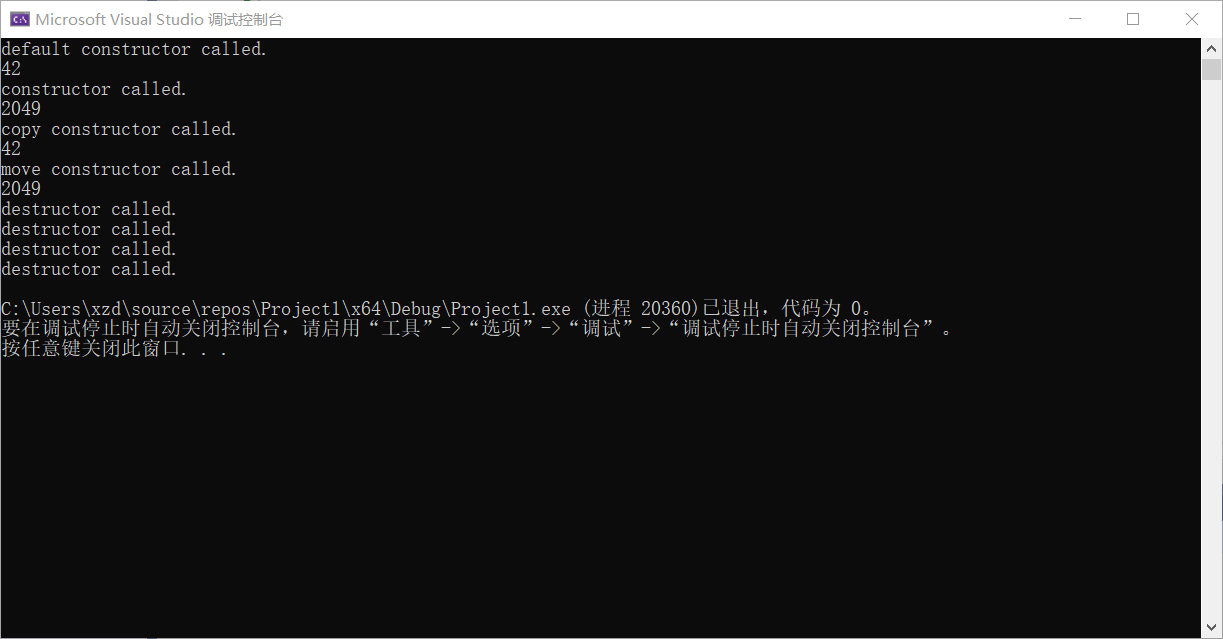
2.测试截图
3.分析
在执行line24时,默认构造器被调用。
调用了line16,在执行line27时,line18含参构造函数被调用。
在执行line30时,line19复制构造函数被调用。
在执行line33时line20移动构造函数被调用。
当程序执行到line35的 ,析构函数被编译器自动调用,析构函数在最后程序结束前被调用了。
实验任务五
1.源码
#include<iostream>
#include<iomanip>
using namespace std;
class Rectangle {
public:
    Rectangle(double length = 2.0, double width = 1.0);
    Rectangle(const Rectangle& r);
    ~Rectangle();

    double len() { return length; };
    double wide() { return width; };
    double area() { return length*width; };
    double circumference() { return(width + length) * 2; };
    void resize(int m);
    void resize(int m,int n);

private:
    double length, width;
};

Rectangle::Rectangle(double l, double w) :length(l), width(w) {};
Rectangle::Rectangle(const Rectangle& r) :length(r.length), width(r.width) {};
Rectangle::    ~Rectangle() {};
void Rectangle::resize(int m) { length *= m; width *= m; };
void Rectangle::resize(int m,int n) { length *= m; width *= n; };

void output(Rectangle& rect) {
    cout << "矩形信息: \n";
    cout << fixed << setprecision(2) << "长:    " << rect.len() << endl << "宽:    " << rect.wide()
        << endl << "面积:  " << rect.area() << endl << "周长:  " << rect.circumference() << endl << endl;

}
int main(){
        Rectangle rect1;
        output(rect1);
        Rectangle rect2(10, 5);
        output(rect2);
        Rectangle rect3(rect1);
        rect3.resize(2);
        output(rect3);
        rect3.resize(5, 2);
        output(rect3);
    }
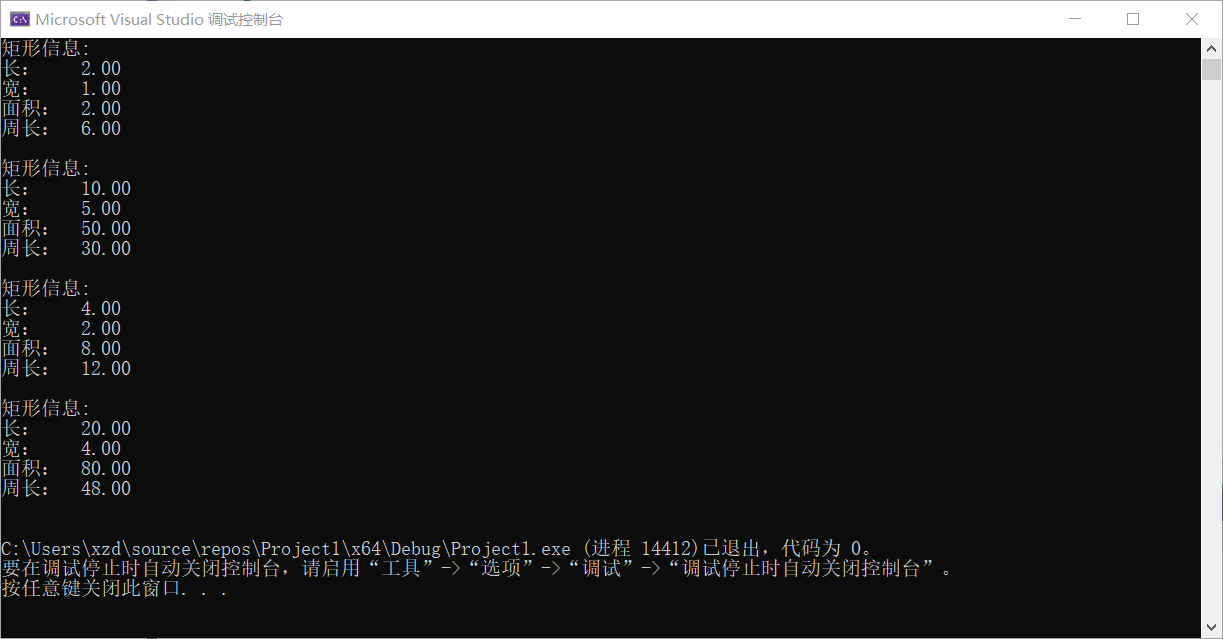
2.测试截图

 浙公网安备 33010602011771号