

基于.NET平台的分层架构实战(四)——实体类的设计与实现
实体类是现实实体在计算机中的表示。它贯穿于整个架构,负担着在各层次及模块间传递数据的职责。一般来说,实体类可以分为“贫血实体类”和“充血实体类 ”,前者仅仅保存实体的属性,而后者还包含一些实体间的关系与逻辑。我们在这个Demo中用的实体类将是“贫血实体类”。
大多情况下,实体类和数据库中的表(这里指实体表,不包括表示多对多对应的关系表)是一一对应的,但这并不是一个限制,在复杂的数据库设计中,有可能出现 一个实体类对应多个表,或者交叉对应的情况。在本文的Demo中,实体类和表是一一对应的,并且实体类中的属性和表中的字段也是对应的。
在看实体类的代码前,先看一下系统的工程结构。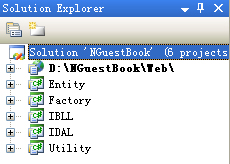
 AdminInfo
 using System;
2
3namespace NGuestBook.Entity
4 {
{
5 /// <summary>
6 /// 实体类-管理员
7 /// </summary>
8 [Serializable]
9 public class AdminInfo
10 {
11 private int id;
12 private string name;
13 private string password;
14
15 public int ID
16 {
17 get { return this.id; }
18 set { this.id = value; }
19 }
20
21 public string Name
22 {
23 get { return this.name; }
24 set { this.name = value; }
25 }
26
27 public string Password
28 {
29 get { return this.password; }
30 set { this.password = value; }
31 }
32 }
33 }
}
34
MessageInfousing System;
2
3namespace NGuestBook.Entity
4{
5 /// <summary>
6 /// 实体类-留言
7 /// </summary>
8 [Serializable]
9 public class MessageInfo
10 {
11 private int id;
12 private string guestName;
13 private string guestEmail;
14 private string content;
15 private DateTime time;
16 private string reply;
17 private string isPass;
18
19 public int ID
20 {
21 get { return this.id; }
22 set { this.id = value; }
23 }
24
25 public string GuestName
26 {
27 get { return this.guestName; }
28 set { this.guestName = value; }
29 }
30
31 public string GuestEmail
32 {
33 get { return this.guestEmail; }
34 set { this.guestEmail = value; }
35 }
36
37 public string Content
38 {
39 get { return this.content; }
40 set { this.content = value; }
41 }
42
43 public DateTime Time
44 {
45 get { return this.time; }
46 set { this.time = value; }
47 }
48
49 public string Reply
50 {
51 get { return this.reply; }
52 set { this.reply = value; }
53 }
54
55 public string IsPass
56 {
57 get { return this.isPass; }
58 set { this.isPass = value; }
59 }
60 }
61}
62
CommentInfousing System;
2
3namespace NGuestBook.Entity
4{
5 /// <summary>
6 /// 实体类-评论
7 /// </summary>
8 [Serializable]
9 public class CommentInfo
10 {
11 private int id;
12 private string content;
13 private DateTime time;
14 private int message;
15
16 public int ID
17 {
18 get { return this.id; }
19 set { this.id = value; }
20 }
21
22 public string Content
23 {
24 get { return this.content; }
25 set { this.content = value; }
26 }
27
28 public DateTime Time
29 {
30 get { return this.time; }
31 set { this.time = value; }
32 }
33
34 public int Message
35 {
36 get { return this.message; }
37 set { this.message = value; }
38 }
39 }
40}
41
大多情况下,实体类和数据库中的表(这里指实体表,不包括表示多对多对应的关系表)是一一对应的,但这并不是一个限制,在复杂的数据库设计中,有可能出现 一个实体类对应多个表,或者交叉对应的情况。在本文的Demo中,实体类和表是一一对应的,并且实体类中的属性和表中的字段也是对应的。
在看实体类的代码前,先看一下系统的工程结构。
如上图所示,在初始阶段,整个系统包括6个工程,它们的职责是这样的:
Web——表示层
Entity——存放实体类
Factory——存放和依赖注入及IoC相关的类
IBLL——存放业务逻辑层接口族
IDAL——存放数据访问层接口族
Utility——存放各种工具类及辅助类
这只是一个初期架构,主要是将整个系统搭一个框架,在后续开发中,将会有其他工程被陆陆续续添加进来。
我们的实体类将放在Entity工程下,这里包括三个文件:AdminInfo.cs,MessageInfo.cs,CommentInfo.cs,分别是管理员实体类、留言实体类和评论实体类。具体代码如下:
AdminInfo.cs:
AdminInfousing System;2
3
namespace NGuestBook.Entity4
{5
/// <summary>
6
/// 实体类-管理员7
/// </summary>8
[Serializable]9
public class AdminInfo10
{11
private int id;12
private string name;13
private string password;14
15
public int ID16
{17
get { return this.id; }18
set { this.id = value; }19
}20
21
public string Name22
{23
get { return this.name; }24
set { this.name = value; }25
}26
27
public string Password28
{29
get { return this.password; }30
set { this.password = value; }31
}32
}33
}34
MessageInfo.cs:
MessageInfousing System;2
3
namespace NGuestBook.Entity4
{5
/// <summary>6
/// 实体类-留言7
/// </summary>8
[Serializable]9
public class MessageInfo10
{11
private int id;12
private string guestName;13
private string guestEmail;14
private string content;15
private DateTime time;16
private string reply;17
private string isPass;18
19
public int ID20
{21
get { return this.id; }22
set { this.id = value; }23
}24
25
public string GuestName26
{27
get { return this.guestName; }28
set { this.guestName = value; }29
}30
31
public string GuestEmail32
{33
get { return this.guestEmail; }34
set { this.guestEmail = value; }35
}36
37
public string Content38
{39
get { return this.content; }40
set { this.content = value; }41
}42
43
public DateTime Time44
{45
get { return this.time; }46
set { this.time = value; }47
}48
49
public string Reply50
{51
get { return this.reply; }52
set { this.reply = value; }53
}54
55
public string IsPass56
{57
get { return this.isPass; }58
set { this.isPass = value; }59
}60
}61
}62
CommentInfo.cs:
CommentInfousing System;2
3
namespace NGuestBook.Entity4
{5
/// <summary>6
/// 实体类-评论7
/// </summary>8
[Serializable]9
public class CommentInfo10
{11
private int id;12
private string content;13
private DateTime time;14
private int message;15
16
public int ID17
{18
get { return this.id; }19
set { this.id = value; }20
}21
22
public string Content23
{24
get { return this.content; }25
set { this.content = value; }26
}27
28
public DateTime Time29
{30
get { return this.time; }31
set { this.time = value; }32
}33
34
public int Message35
{36
get { return this.message; }37
set { this.message = value; }38
}39
}40
}41
大家可以看出,实体类的代码很简单,仅仅是负责实体的表示和数据的传递,不包含任何逻辑性内容。下篇将介绍接口的设计。

 浙公网安备 33010602011771号