
最优贸易
题目地址
题意
给定一个图,找到一条从1~n的路径,使得路径上能选出两个点p,q(先经过p在经过q)并且节点q的节点减去节点p的权值最大。
做法
1.先以1为起点,跑一遍spfa,求出数组\(D[x]\)表示从节点 1 到节点 x 的所有路径中,能过经过的权值最小的节点的权值,\(D[x]\) 与求最短路类似,只需把最短路中用 \(D[x] + w[w,y]\)更新 \(D[y]\) 改成 \(D[y] = min(D[x],price[y])\) 其中\(price[i]\) 表示第i个节点的权值,\(w[x,y]\) 表示最短路中,从x走到y的权值(此处不会用到)。
2.在以n为起点,在反向图中,跑一遍spfa,求出数组\(F[x]\)这里表示从节点 n 到节点 x 的所有路径中,能经过的权值最大的节点的权值,\(F[y] = max(F[x],price[y]\)。
3.最后枚举每个节点x,用\(F[x] - D[x]\)更新答案。
参考代码
#include <iostream>
#include <algorithm>
#include <cstdio>
#include <cstring>
#include <queue>
using namespace std;
const int N = 100010, M = 500010 * 4;
int h[N],rh[N],e[M],ne[M],idx;
int d1[N],d2[N];
int w[N];
int n,m;
bool st[N];
void add(int h[],int a,int b)
{
e[idx] = b,ne[idx] = h[a],h[a] = idx ++;
}
// flag: true表示正向图, false表示反向图
void spfa(int h[],int dist[],int start,bool flag)
{
memset(st,false,sizeof st);
queue<int> q;
dist[start] = w[start];
q.push(start);
while(q.size())
{
int t = q.front();q.pop();
st[t] = false;
for(int i = h[t]; ~ i; i = ne[i])
{
int j = e[i];
if((flag && dist[j] > min(dist[t],w[j])) || (! flag && dist[j] < max(dist[t],w[j]))) // 满足其中一个就行
{
if(flag) dist[j] = min(dist[t],w[j]); // 根据flag的值来赋值。
else dist[j] = max(dist[t],w[j]);
if(! st[j])
{
st[j] = true;
q.push(j);
}
}
}
}
}
int main()
{
scanf("%d%d",&n,&m);
memset(h,-1,sizeof h);
memset(rh,-1,sizeof rh);
for(int i = 1; i <= n; i ++) scanf("%d",&w[i]);
for(int i = 1; i <= m; i ++)
{
int a,b,c;
scanf("%d%d%d",&a,&b,&c);
add(h,a,b);
add(rh,b,a); // 建立反向边
if(c == 2) add(h,b,a),add(rh,a,b);
}
memset(d1,0x3f,sizeof d1); // 求最小值,数组初始化无穷大
spfa(h,d1,1,true); // 第一步求出 D[x],这里使用d1
spfa(rh,d2,n,false); // 第二步求出 F[x],这里使用d2
int res = 0;
// 对应上面第三步
for(int i = 1; i <= n; i ++){
//cout << d1[i] << " " << d2[i] << endl;
res = max(res,d2[i] - d1[i]);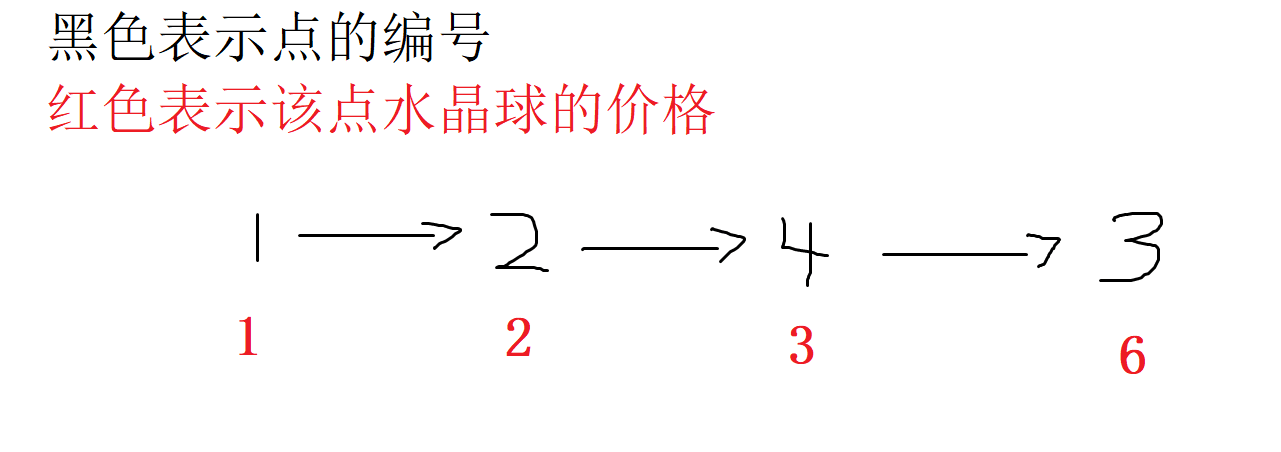
}
cout << res <<endl;
}
特别说明
本题不能使用dijkstra,因为dijkstra本身就是基于贪心,第一次选取的点即为最小点,如果不是最小点,就会出错,比如有两个点:1和2,价格分别是2和1,一共有两条边:1->2,和2->1,那么最初优先队列中只有一个点1,此时1被弹出,它的最小价格是2,但2并不是最终的最小值。所以dijkstra算法是不适用的。
为什么求最大值不能在原图跑???
因为并不是所有点都可以到达终点,必须保证,从1走到x号点的同时还要保证x能走到n号点,例如下面:
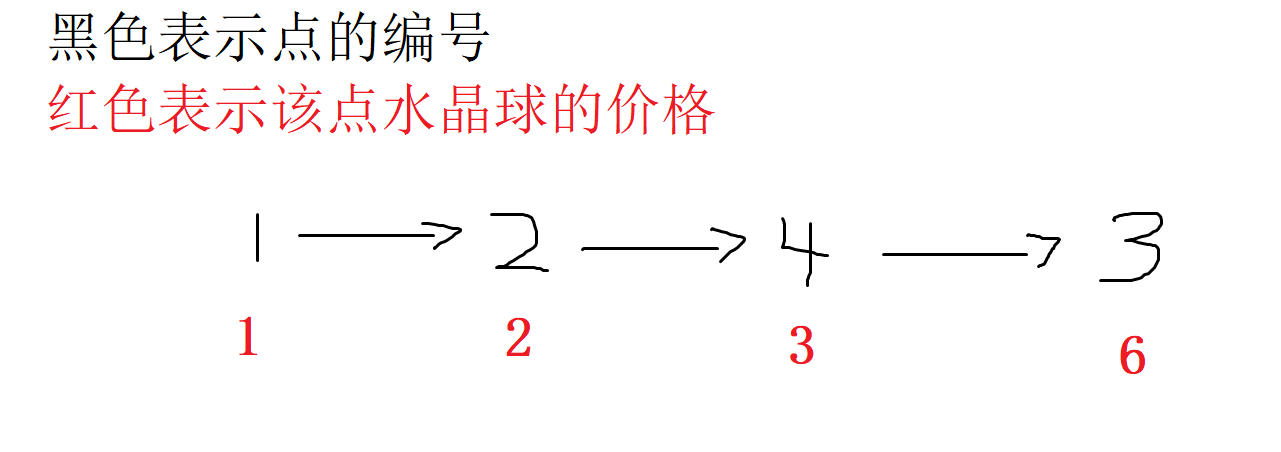
如果正向求一边,发现最大值是 F[3] - D[3] = 6 - 1 = 5 ,但是这不满足要求,因为3最后不能走到4,正确的答案应该是 F[4] - D[4] = 3 - 1 = 2
所以我们需要从反向图求最大值,即4压根都走不到3,F[3] = 0,D[3] = 6,我们在求答案的时候 res = max(res,F[3] - D[3]) 是不会更新res的,因为res初始为0。

 浙公网安备 33010602011771号