
2023年--Brouvka算法
SOl
1:认为每个点最开始时都是一个点集
2:不断进行更新操作-----进行点集的合并
如何合并呢?
本质则个贪心算法,即每个点集都会找出一条自己“伸”出去的最短边与别人合并
当然对于某条边,可能同时是A集合伸出去的最短边,也是B集合伸出去的。
例如下图的右边,标箭头的就是这个点集伸出去的最短边
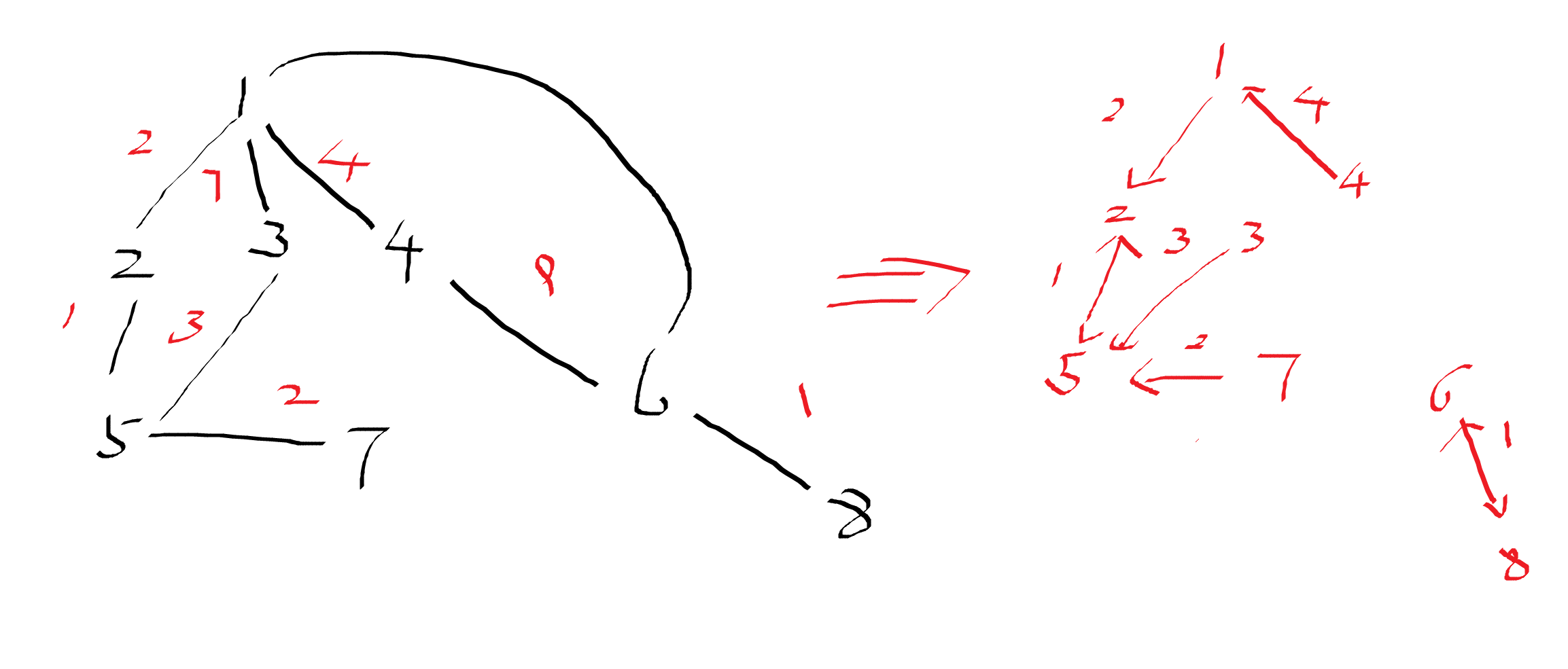
3:找出最短边后,枚举点集,是枚举点集哟。
针对这个点集伸出去的边,如果存在,并且没在MST中的话
则这条边的左右端点所代表的点集,就能合并。
#include<bits/stdc++.h>
using namespace std;
const int maxn=1e5+50,maxm=2e5+5;
const int MaxN = 5000 + 5, MaxM = 200000 + 5;
int N, M;
int U[MaxM], V[MaxM], W[MaxM],Best[maxn];
bool used[MaxM];
int  father[maxn];
void init(int n)
{
	for(int i=1;i<=n;i++)
	    father[i]=i;
}
int find(int x){return x==father[x]?x:father[x]=find(father[x]);}
void unionSet(int x,int y)
{
        int xx=find(x),yy=find(y);
        if(xx==yy) return;
        father[xx]=yy;
}
inline bool Better(int x, int y)
{
    if (y == 0) return true;
     //y代表某个点集所伸出去的那条边的编号,如果为0,则说明当前的第x条就是这个点集伸出去的边
     //否则,则说明这个点集有多条边伸出去,于是取其是最短的。
    if (W[x] != W[y])
         return W[x] < W[y];
    return x < y;
}

void Boruvka()
{
    init(N);
    int merged = 0, sum = 0;
    bool update = true;
    while (update)
    {
        update = false;
        memset(Best, 0, sizeof Best);
        //将每个点集清空
        for (int i = 1; i <= M; ++i)
        //枚举所有的边
        {
            if (used[i] == true)
            //如果这个边已在MST中,就不管
			   continue;
            int p = find(U[i]), q = find(V[i]);
            //看边的两个点,分别在哪个集合
            if (p == q)
			    continue;
            if (Better(i, Best[p]) == true)
            //看下第i条边的长度,是否比p这个集合伸出来的边,要更优
                 Best[p] = i;
            if (Better(i, Best[q]) == true)
                Best[q] = i;
        }
        for (int i = 1; i <= N; ++i)
        //枚举所有的点集
            if (Best[i] != 0 && used[Best[i]] == false)
            //如果这个点集有边伸出来了,并且这条边没在MST中
            {
                update = true;
                //说明有更新操作
                merged++;
                //加了多少条边
                sum += W[Best[i]];
                //代价加起来
                used[Best[i]] = true;
                //这个边在MST中
                unionSet(U[Best[i]],V[Best[i]]);
                //把这两个集合合并
            }
    }

    if (merged == N - 1)
         printf("%d\n", sum);
    else
         puts("orz");
}

int main() {
    scanf("%d %d", &N, &M);
    for (int i = 1; i <= M; ++i)
        scanf("%d%d%d", &U[i], &V[i], &W[i]);
    Boruvka();
    return 0;
}
https://www.cnblogs.com/glq-Blog/p/16581535.html
https://www.zsbeike.com/technology/8e75f8083e.html
https://www.luogu.com.cn/blog/ETHANK/boruvka-xiao-ji

 浙公网安备 33010602011771号