
about position velocity diagram
https://casa.nrao.edu/Release4.1.0/doc/UserMan/UserManse42.html
PV diagrams are generated by placing a “slicing” a datacube through the RA/DEC planes. The “slit” can have a width defined by halfwidth and the averaged values across the slit are then stored in a new image with position and velocity as the two axes. The slit podition is specified by a start and end pixel in the RA/DEC plane of the data cube. An angular unit can be set to define what is stored in the resulting pV image.
通过在RA/DEC平面上放置一个“切片”数据立方体来生成PV图。 “狭缝”可以有一个由半宽定义的宽度,然后将横过狭缝的平均值存储在一个新的图像中,以位置和速度作为两个轴。 狭缝吊点由数据立方体的RA/DEC平面中的开始和结束像素指定。 可以设置一个角单位来定义在生成的pV图像中存储的内容。
In practice, images like this is made by using a grism which disperses the light according to its wavelength, together with a slit placed along the galactic plane, such that you block the light from the rest of the field. This is called slit spectroscopy, in contrast to "normal" spectroscopy where you block all light except for a little hole placed on some object (e.g. a star), or integral field spectroscopy, where you get the whole spectrum behind every pixel in an image.
在实践中,像这样的图像是通过使用网格来制作的,该网格根据光的波长分散光,并沿星系平面放置一个狭缝,这样你就可以阻止光从场的其余部分。 这被称为狭缝光谱,与“正常”光谱形成对比,在这种光谱中,除了在某些物体上放置一个小洞外,你可以阻挡所有的光(例如。 恒星),或积分场光谱,其中你得到了图像中每个像素后面的整个光谱。

http://www.astrosen.unam.mx/shape/v4/manual/v4.0/theory.html
In many astrophysical environments there is a quite well defined relation between the velocity vector field and the position vectors. Examples are the surfaces of rotating stars or accretion disk governed by gravity. In both types of objects the rotation determines the direction of the vectors and in the accretion disk gravity provides the magnitude as a function of distance.
In explosive events, like a supernova or ejecta from other stellar events, the gas motion is often radial, just like the position vector with respect to the star. Furthermore, if the ejection is ballistic and from a short event, then the material soon will be sorted according to its speed: the further away, the faster it moves, resulting in a proportionality between the position and velocity vectors.
If sufficient constraints exist, such relationsships between position and velocity vectors can be applied to reconstruct the 3D structure of an object by measuring the projected position vectors in an image and deriving the position along the line of sight from the Doppler-shift in sprectroscopic observations.
In addition to images, spectroscopic observations of the velocity along the line of sight are one of the key elements for 3D reconstructions using Shape. The first type of spectroscopic information that was produced in Shape to be directly compared with observations where position-velocity (p-v) diagrams (see the illustrations on the right). P-V diagrams are still the most common type of observation for 3D reconstructions in Shape.
在许多天体物理环境中,速度矢量场与位置矢量之间存在着相当明确的关系。 例子是由重力控制的旋转恒星或吸积盘的表面。 在这两种类型的物体中,旋转决定矢量的方向,在吸积盘中,重力提供了大小作为距离的函数。
在爆炸事件中,就像超新星或其他恒星事件的喷射物一样,气体运动通常是径向的,就像相对于恒星的位置矢量一样。 此外,如果弹射是弹道的,而且是从一个短事件开始的,那么很快就会根据它的速度对材料进行排序:越远,它移动得越快,导致位置和速度矢量之间的比例关系。
如果存在足够的约束,则可以应用位置矢量和速度矢量之间的这种关系来重建物体的三维结构,方法是测量图像中的投影位置矢量,并从螺旋观测中的多普勒频移中导出沿视线的位置。
除了图像外,沿视线速度的光谱观测是利用形状进行三维重建的关键因素之一。 第一种光谱信息是在形状中产生的,直接与位置速度(p-v)图中的观测结果进行比较(见右边的插图)。 P-V图仍然是形状三维重建中最常见的观测类型。
光谱学可能是天体物理学中最强大的诊断工具。 摄谱仪将物体中的光分解成波长的函数,就像彩虹一样。 当使用光通过的狭长狭缝时,在无运动物体中,谱线是直线。
然而,例如,如果一个星云正在迅速膨胀,那么气体的频率和波长就会向光谱的红色或蓝色一侧移动,这取决于它们是后退还是接近观察者。 一个粗略的球形膨胀产生一个椭球谱线形状
如果我们分离一条直线,并垂直地显示沿狭缝的方向和水平地显示波长,那么我们就得到了所谓的位置速度图,或者,简而言之,p-v图。 在这里,波长偏移被沿视线的等效速度所取代
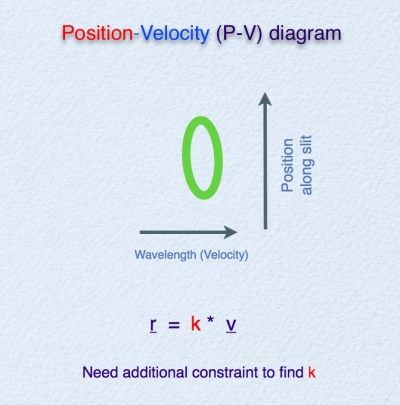
如果我们现在发现速度是如何与位置相关的,我们可以通过相应的位置重新标度速度轴,从而通过星云获得切片的空间重建。 当大量这样的观测可用时,可以构建完整的三维地图。
相邻的p-v图序列可以叠加在一起,生成一个“数据立方体”,具有两个空间维度和一个波长或速度维度。 如果位置和速度之间存在线性关系,则适当缩放的数据立方体表示该谱线发射的空间分布的直接重建。 每个p-v图都是对象的“切片。
一个位置速度图(顶部)的例子和从其中得到p-v图的对象的图像。 摄谱仪的狭缝位置在图像中被标记为一条穿过星云的黑暗水平线。 在p-v图中的水平位置沿狭缝排列在图像中的相同位置。 在p-v图中,垂直位置对应于从谱线的多普勒频移确定的沿视线的速度。 通常,p-v图是以沿水平和沿垂直轴的位置的速度显示的。 这是形状的惯例。
图片:Meaburn等人,2005年(AJ,130,2303-2311)。 看到在形状网站上的出版物,看到这个蝴蝶星云的重建。
用astropy来提取pv图

 浙公网安备 33010602011771号