
实验四 继承
task2.cpp
#include <iostream>
#include <typeinfo>

// definitation of Graph
class Graph
{
public:
    virtual void draw() { std::cout << "Graph::draw() : just as an interface\n"; }
};

// definition of Rectangle, derived from Graph
class Rectangle : public Graph
{
public:
    void draw() { std::cout << "Rectangle::draw(): programs of draw a rectangle\n"; }
};

// definition of Circle, derived from Graph
class Circle : public Graph
{
public:
    void draw() { std::cout << "Circle::draw(): programs of draw a circle\n"; }
};

// definitaion of fun(): as a call interface
void fun(Graph *ptr)
{
    std::cout << "pointer type: " << typeid(ptr).name() << "\n";
    std::cout << "RTTI type: " << typeid(*ptr).name() << "\n";
    ptr->draw();
}

// test
int main()
{
    Graph g1;
    Rectangle r1;
    Circle c1;

    // call by object name
    g1.draw();
    r1.draw();
    c1.draw();

    std::cout << "\n";

    // call by object name, and using the scope resolution operator::
    r1.Graph::draw();
    c1.Graph::draw();

    std::cout << "\n";

    // call by pointer to Base class
    fun(&g1);
    fun(&r1);
    fun(&c1);
}
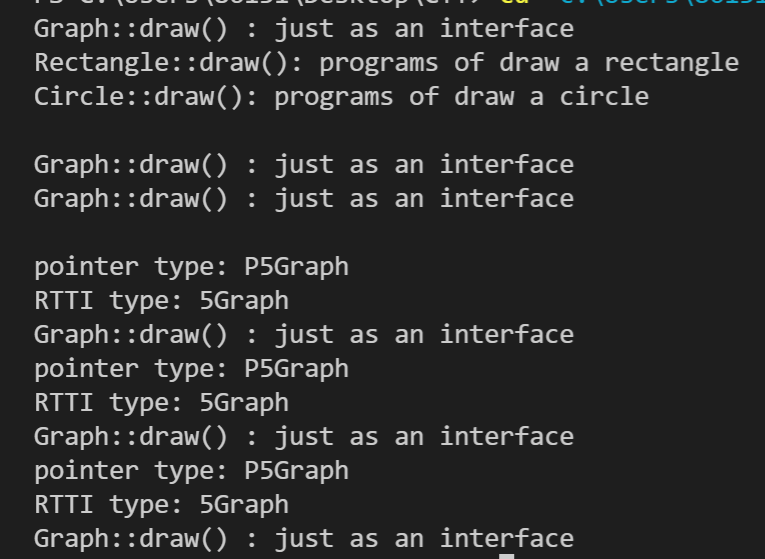
改动前的结果:
改动后的结果:
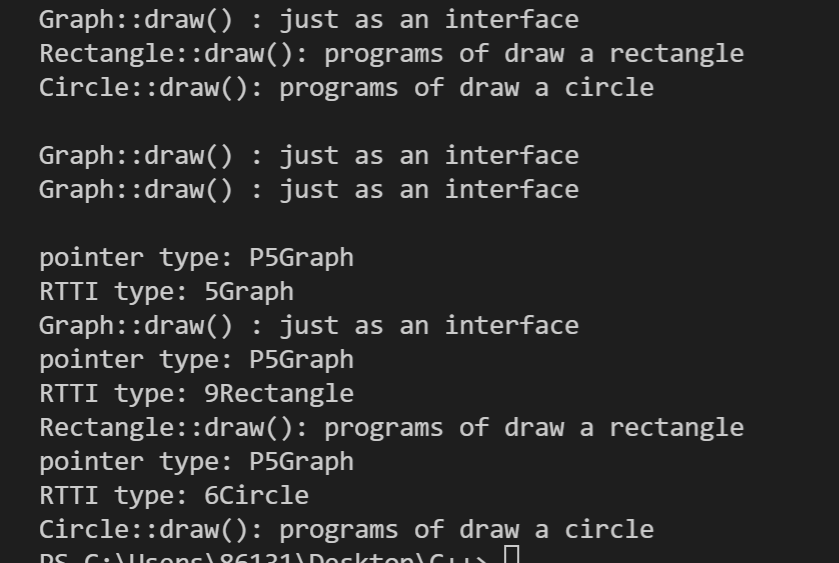
同名覆盖原则:派生类与基类中有相同成员时,若未强行指明,则通过派生类对象使用的是派生类的同名成员;如果要通过派生类的对象访问基类被覆盖的同名成员,则需要加对象名.基类名::同名成员来限定;
二元作用域分辨符:在多重继承的情况下,如果两个基类中存在相同的变量名,可以使用作用域运算符来进行区分;
类型兼容原则:指在需要基类对象的任何地方,都可以使用公有派生类的对象来替代。通过公有继承,派生类得到了基类中除构造函数、析构函数之外的所有成员。
task3:
battery.hpp
#include <iostream>
using namespace std;

class battery
{
public:
    battery(int ca = 70) : capacity(ca){};
    int get_capacity()
    {
        return capacity;
    }

private:
    int capacity;
};
car.hpp
#include <iostream>
#include <string>
#include <iomanip>
using namespace std;

class car
{
public:
    car(string n_maker, string n_model, int n_year, int n_odometers = 0) : maker(n_maker), model(n_model), year(n_year), odometers(n_odometers){};
    void info()
    {
        // cout << setiosflags(ios::left);
        cout << "maker:\t\t" << maker << endl;
        cout << "model:\t\t" << model << endl;
        cout << "year:\t\t" << year << endl;
        cout << "odometers:\t" << odometers << endl;
    }
    void update_odometers(int n)
    {
        if (n < odometers)
            cout << "更新数值有误!" << endl;
        else
            odometers = n;
    }

private:
    string maker;
    string model;
    int year;
    int odometers;
};
electricCar.hpp
#include <iostream>
#include "car.hpp"
#include "battery.hpp"
using namespace std;

class electricCar : public car
{
public:
    electricCar(string n_maker, string n_model, int n_year, int n_odometers = 0, battery b = 70) : car(n_maker, n_model, n_year, n_odometers), Battery(b){};
    void info()
    {
        car::info();
        cout << "capacity:\t" << Battery.get_capacity() << endl;
    }

private:
    battery Battery;
};
task3.cpp
#include <iostream>
#include "electricCar.hpp"

int main()
{
    using namespace std;

    // test class of Car
    car oldcar("car1", "a7", 1999);
    cout << "--------oldcar's info--------" << endl;
    oldcar.update_odometers(18000);
    oldcar.info();

    cout << endl;

    // test class of ElectricCar
    electricCar newcar("Tesla", "model s", 2016);
    newcar.update_odometers(2500);
    cout << "\n--------newcar's info--------\n";
    newcar.info();
}
运行结果:

task4
pets.hpp
#include <iostream>
#include <string>
using namespace std;

class MachinePets
{
public:
    MachinePets(const string s) : nickname(s){};
    virtual string talk() = 0;
    string get_nickname() const
    {
        return nickname;
    }

private:
    string nickname;
};

class PetCats : public MachinePets
{
public:
    PetCats(const string s) : MachinePets(s){};
    string talk()
    {
        return "miao wu~";
    }
};

class PetDogs : public MachinePets
{
public:
    PetDogs(const string s) : MachinePets(s){};
    string talk()
    {
        return "wang wang~";
    }
};
task4.cpp
#include <iostream>
#include "pets.hpp"

void play(MachinePets *ptr)
{
    std::cout << ptr->get_nickname() << " says " << ptr->talk() << std::endl;
}

int main()
{
    PetCats cat("miku");
    PetDogs dog("da huang");

    play(&cat);
    play(&dog);
}
运行结果:


 浙公网安备 33010602011771号