
实验3 类和对象Ⅱ
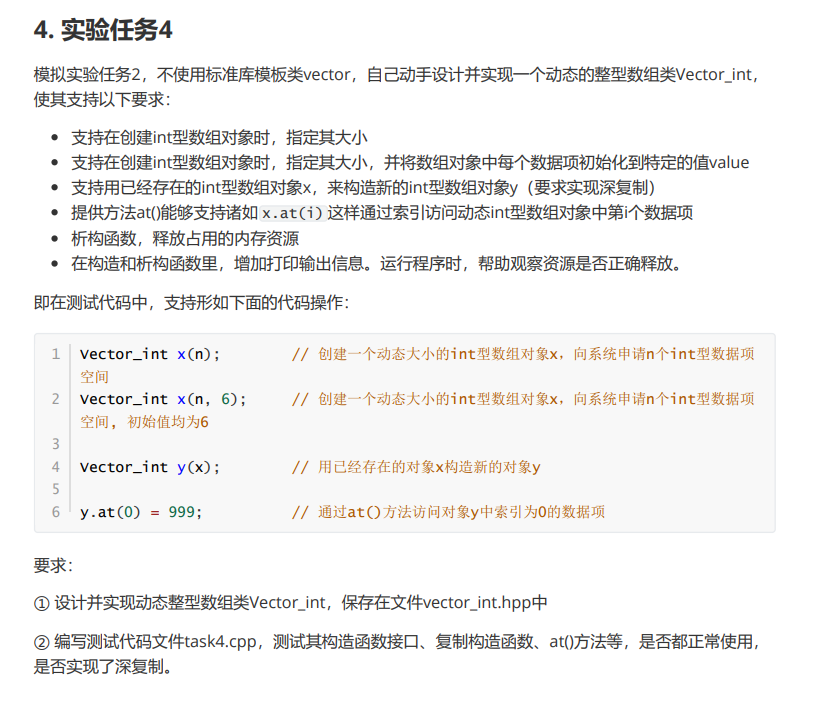
Vector_int.hpp源代码
#ifndef Vector_int_hpp
#define Vector_int_hpp
#include<iomanip>
using namespace std;
class Vector_int {
public:
	Vector_int(int n);
	Vector_int(int n, int m = 6);
	Vector_int(const Vector_int& x);
	~Vector_int();
	int &at(int j);
	void output() {
		for (int i=0;i<size;i++)
			cout << setw(5)<<p[i]<<"  ";
		cout << endl;
	}
private:
	int size;
	int* p;
};
Vector_int::Vector_int(int n) :size(n) {
	p = new int[n];
}
Vector_int::Vector_int(int n,int m) : size(n) {
	p = new int[n];
	for (int k = 0; k < n; k++)
		p[k] = m;
}
Vector_int::Vector_int(const Vector_int& x) : size(x.size) {
	p = new int[size];
	for (auto i = 0; i < size; ++i)
		p[i] = x.p[i];
}
Vector_int::~Vector_int()
{
	delete[] p;
}
int &Vector_int::at(int j)
{
	assert(j >= 0 && j < size);
	return p[j];
}
#endif
task4.cpp文件源码
#include<iostream>
#include<cassert>
#include"Vector_int.hpp"
int main()
{
	using namespace std;
	int n;
	cout << "请输入整数n:";
	cin >> n;
	Vector_int x(n,6);
	cout << "x:";
	x.output();
	Vector_int y(x);
	cout << "y:";
	y.at(0) = 999;
	y.output();
	cout << "x:";
	x.output();
}
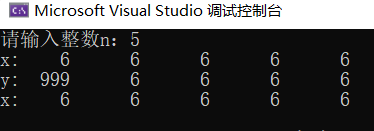
测试截图
![]()
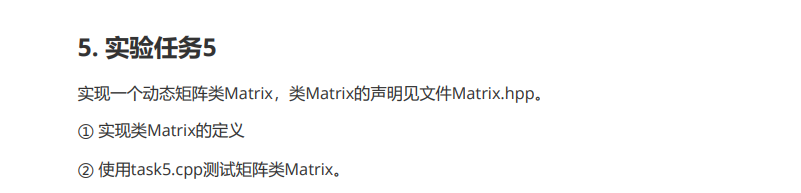
Matrix.hpp文件源码
#ifndef MATRIX_H
#define MATRIX_H
#include <iostream>
#include <cassert>
#include<iomanip>
using namespace std;
class Matrix
{
public:
    Matrix(int n);                     // 构造函数,构造一个n*n的矩阵
    Matrix(int n, int m);              // 构造函数,构造一个n*m的矩阵
    Matrix(const Matrix& X);           // 复制构造函数,使用已有的矩阵X构造
    ~Matrix();                         //析构函数
    void set(const double* pvalue);     // 用pvalue指向的连续内存块数据为矩阵赋值
    void set(int i, int j, int value); //设置矩阵第i行第j列元素值为value
    double& at(int i, int j);          //返回矩阵第i行第j列元素的引用
    double at(int i, int j) const;     // 返回矩阵第i行第j列元素的值
    int get_lines() const;             //返回矩阵行数
    int get_cols() const;              //返回矩列数
    void print() const;                // 按行打印输出矩阵
private:
    int lines; // 矩阵行数
    int cols;  // 矩阵列数
    double* p; // 指向存放矩阵数据的内存块的首地址
};
Matrix::Matrix(int n) :lines(n), cols(n) {
    p = new double[lines*cols];
}
Matrix::Matrix(int n,int m) : lines(n), cols(m) {
    p = new double[lines*cols];
}
Matrix::Matrix(const Matrix& X) : lines(X.lines), cols(X.cols) {
    p = new double[lines * cols];
    for (int i = 0; i < lines * cols; ++i)
        p[i] = X.p[i];
}

Matrix::~Matrix() {
    delete[] p;
}

void Matrix::set(const double* pvalue) {
    for (int i = 0; i < lines * cols; ++i)
        p[i] = pvalue[i];
}

void Matrix::set(int i, int j, int value) {
    p[i * cols + j] = value;
}

double& Matrix::at(int i, int j) {
    return p[i * cols + j];
}

double Matrix::at(int i, int j) const {
    return p[i * cols + j];
}

int Matrix::get_lines() const {
    return lines;
}

int Matrix::get_cols() const {
    return cols;
}

void Matrix::print() const {
    int k = 0;
    for (int i = 0; i < lines; ++i) {
        for (int j = 0; j < cols; ++j, ++k)
            cout <<left<<setw(3)<<p[k] << " ";
        cout << "\b\b \n";

    }
}

#endif
task5.cpp文件源码
#include <iostream>
#include "matrix.hpp"

int main()
{
    using namespace std;

    double x[] = { 1, 2, 3, 4, 5, 6, 7, 8, 9, 10, 11, 12 };

    Matrix m1(4, 3);    // 创建一个3×2的矩阵
    m1.set(x);          // 用一维数组x的值按行为矩阵m1赋值
    m1.print();         // 打印矩阵m1的值
    cout << "the first line is: " << endl;
    cout << m1.at(0, 0) << " " << m1.at(0, 1) << " "<< m1.at(0, 2)<<endl;
    cout << endl;

    Matrix m2(2, 3);
    m2.set(x);
    m2.print();
    cout << "the first line is: " << endl;
    cout << m2.at(0, 0) << " " << m2.at(0, 1) << " " << m2.at(0, 2) << endl;
    cout << endl;

    Matrix m3(m2);
    m3.set(1, 1, 777);
    m3.print();
}
测试截图
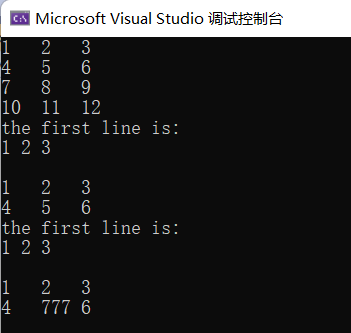
实验总结:
1、复习熟悉了模板类的相关用法
2、理解了指针和引用的联系和区别
3、理解了深复制和浅复制
4、掌握了new和delete的用法

 浙公网安备 33010602011771号