day04_数组_多维数组_冒泡排序_稀疏数组
1、java数组


package array;

public class 数组 {
    //变量的类型     变量的名字   =   变量的值
    //数组类型
    public static void main(String[] args) {
        int[] nums;     //1.声明一个数组
        //int nums2[];不常用
        //静态初始化:创建  +   赋值  花括号固定了只有8个元素
        int[] a = {1,2,3,4,5,6,7,8};
        nums = new int[10]; //2.创建一个数组

        //声明和创建一个数组组合
        int[] nums2 = new int[10];
        //3.给数组元素中赋值
        nums[0] = 1;
        nums[1] = 2;
        nums[2] = 3;
        nums[3] = 4;
        nums[4] = 5;
        nums[5] = 6;
        nums[6] = 7;
        nums[7] = 8;
        nums[8] = 9;
        nums[9] = 10;

        //计算所有数值
        int sum = 0;
        for (int i = 0; i < nums.length; i++) {
            sum+=nums[i];
        }
        System.out.println("数组的和是:"+sum);
    }
}
数组两种初始方法
package array;

public class 数组两种初始方法 {
    public static void main(String[] args) {
        //静态初始化:创建  +   赋值  花括号固定了只有8个元素
        int[] a = {1,2,3,4,5,6,7,8};

        //动态初始化:包含默认初始化
        int[] b  = new int[10];
        b[0] = 10;
        b[1] = 10;
        System.out.println(b[0]);      //结果是:10
        System.out.println(b[1]);      //结果是:10
        System.out.println(b[2]);      //结果是:未设置值,默认是0
        System.out.println(b[3]);      //结果是:未设置值,默认是0
    }
}
数组的四个基本特点
◆其长度是确定的。数组一旦被创建,它的大小就是不可以改变的
◆其元素必须是相同类型不允许出现混合类型
◆数组中的元素可以是任何数据类型,包括基本类型和引用类型
◆数组变量属引用类型,数组也可以看成是对象,数组中的每个元素相当于该对象的成员变量数组本身就是对象,Java中对象是在堆中的,因此数组无论保存原始类型还是其他对象类型,数组对象本身是在堆中的
数组边界
◆下标的合法区间:[0, length-1],如果越界就会报错;
package array;

public class 边界 {
    public static void main(String[] args) {
        int[] b = new int[2];
        System.out.println(b[2]);
    }
}
结果是: ArraylndexOutofBounds Exception:数组下标越界异常!
package array;

public class 数组练习 {
    public static void main(String[] args) {
        int[] arrays = {1,2,3,4,5};

        //遍历数组
        for (int i = 0; i < arrays.length; i++) {
            System.out.println(arrays[i]);
        }
        System.out.println("=================");

        //计算数组的和
        int sum = 0;
        for (int i = 0; i < arrays.length; i++) {
            sum += arrays[i];
        }
        System.out.println(sum);

        System.out.println("=================");

        //查找max元素
        int max = arrays[0];
        for (int i = 1; i < arrays.length; i++) {
            if (arrays[i]>max){
                max = arrays[i];
            }
        }
        System.out.println(max);
    }
}
package array;

public class 增强for循环 {
    public static void main(String[] args) {
        int[] arrays = {1,2,3,4,5};

        //JDK1.5后支持,没有下标
        //遍历数组每个元素
        for (int array : arrays) {
            System.out.println(array);
        }
    }
}
数组作方法入参
package array;

public class 数组作方法入参 {
    public static void main(String[] args) {
        int[] arrays = {1,2,3,4,5};
        printArray(arrays);
    }
    public static void printArray(int[] arrays){
        for (int i = 0; i < arrays.length; i++) {
            System.out.print(arrays[i]+" ");
        }
    }
}
package array;

public class 数组作返回值 {
    public static void main(String[] args) {
        int[] arrays = {1,2,3,4,5};
        int[] reverse = reverse(arrays);
        printArray(reverse);
    }

    //定义数组方法作返回值
    public static int[] reverse(int[] arrays){
        int[] result = new int[arrays.length];
        for (int i = 0, j=result.length -1; i < arrays.length; i++,j--) {
            result[j] = arrays[i];
        }
        return result;
    }

    //数组作方法入参
    public static void printArray(int[] arrays){
        for (int i = 0; i < arrays.length; i++) {
            System.out.print(arrays[i]+" ");
        }
    }
}
2、多维数组
package array;

public class 多维数组 {
    public static void main(String[] args) {
        //有点类似坐标
        int[][]  array = {{1,2},{2,3},{3,4},{4,5}};
        for (int i = 0; i < array.length; i++) {
            for (int i1 = 0; i1 < array[i].length; i1++) {
                System.out.print(array[i][i1]+" ");
            }
            System.out.println();
        }
    }
}
/*输出结果是:
1 2
2 3
3 4
4 5
*/
1、联系:打印数组
package array;

import java.util.Arrays;

public class 打印数组 {
    public static void main(String[] args) {
        int[] a = {1, 2, 3, 4, 9898, 31231, 543, 21, 3, 23};
        System.out.println(a);      //输出结果是:[I@10f87f48
        Arrays.sort(a); //数组进行排序:升序
        System.out.println(Arrays.toString(a));     //输出结果是:[1, 2, 3, 4, 9898, 31231, 543, 21, 3, 23]

        //应用给自定义方法,同样的结果:[1, 2, 3, 4, 9898, 31231, 543, 21, 3, 23]
        printArrays(a);
    }

    //自定义toString()方法,重复造轮子
    public static void printArrays(int[] a){
        for (int i = 0; i < a.length; i++) {
            if (i==0){
                System.out.print("[");
            }
            if (i==a.length-1){
                System.out.print(a[i]+"]");
            }else {
                System.out.print(a[i]+", ");
            }
        }
        System.out.println();
    }
}
package array;

import java.util.Arrays;

public class 数组fill方法 {
    public static void main(String[] args) {
        int[] a = {1, 2, 3, 4, 9898, 31231, 543, 21, 3, 23};
        Arrays.sort(a);     //排序:升序
        System.out.println(Arrays.toString(a));     //输出结果是:[1, 2, 3, 3, 4, 21, 23, 543, 9898, 31231]
        Arrays.fill(a,2,4,0);                       //fill方法是:从2到4之间的index数换成给定的0值
        System.out.println(Arrays.toString(a));     //输出结果是:[1, 2, 0, 0, 4, 21, 23, 543, 9898, 31231]
    }
}
3、冒泡排序
package array;

import java.util.Arrays;

public class 冒泡排序 {
    //比较数组中, 两个相邻的元素, 如果第一个数比第二个数大, 我们就交换他们位置
    //每一次比较, 对会产生一个最大的值, 或者最小的数字
    //下一轮则可以少一次排序
    //依次循环, 直到结束
    public static void main(String[] args) {
        int[] a = {1, 4, 5, 6, 72, 2, 2, 2, 25, 6, 7};
//        Arrays.sort(a);
//        System.out.println(Arrays.toString(a));
        sort(a);
        System.out.println(Arrays.toString(a));
    }

    public static int[] sort(int[] arrays){
        //临时变量
        int temp = 0;

        //外层循环,判断我们这个要走多少次
        for (int i = 0; i < arrays.length - 1; i++) {
            boolean flag = false; //通过flag标识位减少没有意义的比较
            ///内层循环,比价判断两个数,如果第一个数,比第二个数大,则交换位置
            for (int i1 = 0; i1 < arrays.length - 1 - i; i1++) {
                if (arrays[i1+1]<arrays[i1]){
                    temp = arrays[i1];
                    arrays[i1] = arrays[i1+1];
                    arrays[i1+1] = temp;
                    flag = true;
                }
            }
            if (flag == false){
                break;
            }
        }
        return arrays;
    }
}
4、稀疏数组
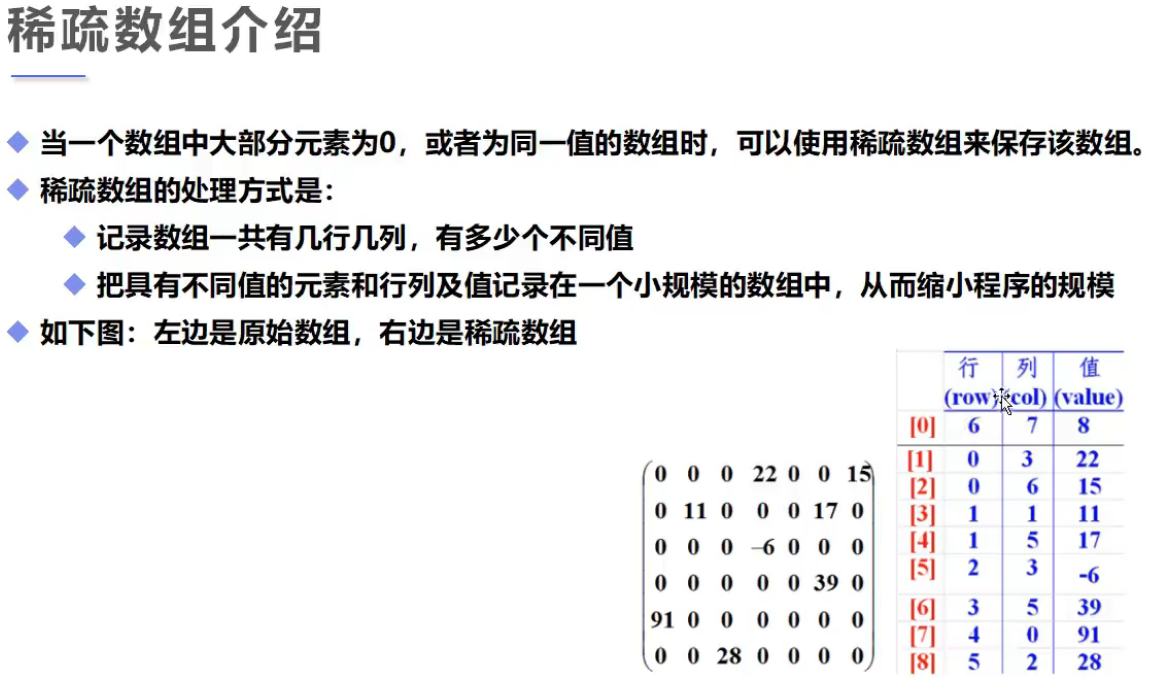
练习:稀疏数组
package array;

public class 稀疏数组 {

    public static void main(String[] args){
        //1.创建一个二维数组11*11    0:没有棋子,1:黑棋  2:白棋
        int[][] array1 = new int[11][11];
        array1[1][2]=1;
        array1[2][3]=2;
        // 翰出原始的数组
        System.out.println("输出原始的数组");
        for (int[] ints :array1){
            for (int anInt : ints){
                System.out.print(anInt+"\t");
            }
            //转换为稀疏数组保存
            System.out.println();
        }

        //转换为稀疏数组保存
        //获取有效值的个数
        int sum = 0;
        for (int i = 0; i < 11; i++) {
            for (int j = 0; j < 11; j++) {
                if (array1[i][j]!=0){
                    sum++;
                }
            }
        }
        System.out.println("有效值的个数: "+sum);
        System.out.println("=====================");

        //2.创建一个稀疏数组的数组
        int[][] array2 = new int[sum+1][3];
        array2[0][0] = 11;      //第一例
        array2[0][1] = 11;      //第二列
        array2[0][2] = sum;     //第三列

        //遍历二维数组,将非零的值,存放稀疏数组中
        int count = 0;
        for (int i = 0; i < array1.length; i++) {
            for (int j = 0; j < array1[i].length; j++) {
                if (array1[i][j]!=0){
                    count++;
                    array2[count][0]=i;     //第一列
                    array2[count][1]=j;     //第二列
                    array2[count][2]=array1[i][j];      //第三列
                }
            }
        }

        //输出稀疏数组
        System.out.println("输出稀疏数组");

        for (int i = 0; i < array2.length; i++) {
            System.out.println(array2[i][0]+"\t"
                    +array2[i][1]+"\t"
                    +array2[i][2]+"\t");
        }
        System.out.println("=====================");

        //1.读取稀疏数组
        int[][] array3 = new int[array2[0][0]][array2[0][1]];

        //2.给其中的元素还原它的值
        for (int i = 1; i < array2.length; i++) {
            array3[array2[i][0]][array2[i][1]] = array2[i][2];
        }

        //3.打印
        System.out.println("输出还原的数组");
        for (int[] ints :array3){
            for (int anInt : ints){
                System.out.print(anInt+"\t");
            }
            //转换为稀疏数组保存
            System.out.println();
        }

    }
}
/*
输出原始的数组
0    0    0    0    0    0    0    0    0    0    0
0    0    1    0    0    0    0    0    0    0    0
0    0    0    2    0    0    0    0    0    0    0
0    0    0    0    0    0    0    0    0    0    0
0    0    0    0    0    0    0    0    0    0    0
0    0    0    0    0    0    0    0    0    0    0
0    0    0    0    0    0    0    0    0    0    0
0    0    0    0    0    0    0    0    0    0    0
0    0    0    0    0    0    0    0    0    0    0
0    0    0    0    0    0    0    0    0    0    0
0    0    0    0    0    0    0    0    0    0    0
有效值的个数: 2
=====================
输出稀疏数组
11    11    2
1    2    1
2    3    2
=====================
输出还原的数组
0    0    0    0    0    0    0    0    0    0    0
0    0    1    0    0    0    0    0    0    0    0
0    0    0    2    0    0    0    0    0    0    0
0    0    0    0    0    0    0    0    0    0    0
0    0    0    0    0    0    0    0    0    0    0
0    0    0    0    0    0    0    0    0    0    0
0    0    0    0    0    0    0    0    0    0    0
0    0    0    0    0    0    0    0    0    0    0
0    0    0    0    0    0    0    0    0    0    0
0    0    0    0    0    0    0    0    0    0    0
0    0    0    0    0    0    0    0    0    0    0

进程已结束,退出代码 0
*/


 浙公网安备 33010602011771号