
AlexNet实现
- 端到端:神经网络可以直接基于图像的原始像素进行分类。这种称为端到端(end-to-end)的方法节省了很多中间步骤
- 特征分级表示:多层神经网络中,图像的第一级的表示可以是在特定的位置和⻆度是否出现边缘;而第二级的表示说不定能够将这些边缘组合出有趣的模式,如花纹;在第三级的表示中,也许上一级的花纹能进一步汇合成对应物体特定部位的模式。这样逐级表示下去,最终,模型能够较容易根据最后一级的表示完成分类任务。需要强调的是,输入的逐级表示由多层模型中的参数决定,而这些参数都是学出来的。
缺乏要素:1、数据 2、硬件
Alex2012
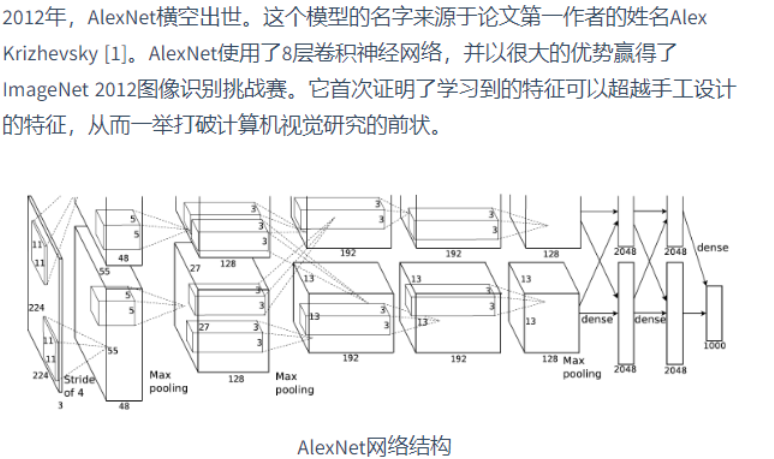
简化实现
import time
import torch
from torch import nn,optim
import torchvision

import sys
sys.path.append('./Dive-into-DL-PyTorch-master/Dive-into-DL-PyTorch-master/code/')
import d2lzh_pytorch as d2l
device = torch.device('cuda' if torch.cuda.is_available() else 'cpu')

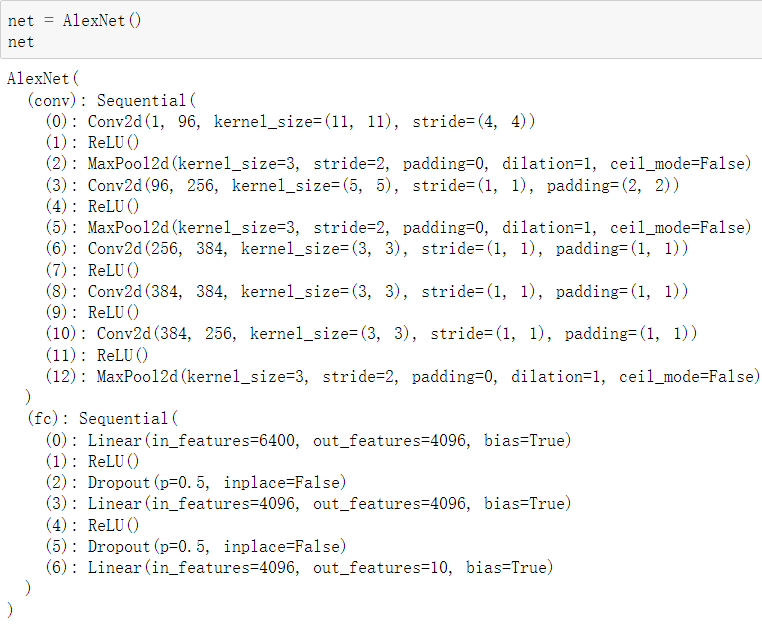
class AlexNet(nn.Module):
    def __init__(self):
        super(AlexNet,self).__init__()
        # in_channels, out_channels, kernel_size, stride, padding
        self.conv = nn.Sequential(nn.Conv2d(1,96,11,4),
                                   nn.ReLU(),
                                   # kernel_size,stride
                                   nn.MaxPool2d(3,2),
        # 减小卷积窗口,使用填充为2来使得输入与输出的高和宽一致,且增大输出通道数
                                   nn.Conv2d(96,256,5,1,2),
                                   nn.ReLU(),
                                   nn.MaxPool2d(3,2),
     # 连续3个卷积层,且使用更小的卷积窗口。除了最后的卷积层外,进一步增大了输出通道数。
     # 前两个卷积层后不使用池化层来减小输入的高和宽
                                   nn.Conv2d(256,384,3,1,1),
                                   nn.ReLU(),
                                   nn.Conv2d(384,384,3,1,1),
                                   nn.ReLU(),
                                   nn.Conv2d(384,256,3,1,1),
                                   nn.ReLU(),
                                   nn.MaxPool2d(3,2)
                                   )
     # 这里全连接层的输出个数比LeNet中的大数倍。使用丢弃层来缓解过拟合
        self.fc = nn.Sequential(nn.Linear(256*5*5,4096),
                               nn.ReLU(),
                               nn.Dropout(0.5),
                               nn.Linear(4096,4096),
                               nn.ReLU(),
                               nn.Dropout(0.5),
     # 输出层。由于这里使用Fashion-MNIST,所以用类别数为10,而非论文中的1000
                               nn.Linear(4096, 10),
                               )

    def forward(self,img):
        feature = self.conv(img) # 特征提取
        output = self.fc(feature.view(img.shape[0],-1))
        return output
# 本函数已保存在d2lzh_pytorch包中方便以后使用
def load_data_fashion_mnist(batch_size, resize=None, root='./data/FashionMNIST/'):
    """Download the fashion mnist dataset and then load into memory."""
    trans = []
    if resize:
        # 重新排列尺寸
        trans.append(torchvision.transforms.Resize(size=resize))
    trans.append(torchvision.transforms.ToTensor())

    # compose 相当于pipple 把数据操作装入管道
    transform = torchvision.transforms.Compose(trans)
    mnist_train = torchvision.datasets.FashionMNIST(root=root, train=True,
                                                    download=True, transform=transform)
    mnist_test = torchvision.datasets.FashionMNIST(root=root, train=False,
                                                   download=True, transform=transform)

    train_iter = torch.utils.data.DataLoader(mnist_train, batch_size=batch_size,
                                             shuffle=True, num_workers=4)
    test_iter = torch.utils.data.DataLoader(mnist_test, batch_size=batch_size,
                                            shuffle=False, num_workers=4)

    return train_iter, test_iter

batch_size = 128
# 如出现“out of memory”的报错信息,可减小batch_size或resize
train_iter, test_iter = load_data_fashion_mnist(batch_size, resize=224)

 浙公网安备 33010602011771号