
自定义持久层框架
自定义持久层框架
1、 JDBC的弊端
我们话不多说,直接看一段JDBC代码。想必学过Java的人一看下面的代码都已经非常熟悉了吧,毕竟JDBC怎么写都是那样了。
public static void main(String[] args) {
 Connection connection = null;
 PreparedStatement preparedStatement = null;
 ResultSet resultSet = null;
 try {
    //加载驱动类
 Class.forName("com.mysql.jdbc.Driver");
 // 获取连接
 connection =
DriverManager.getConnection("jdbc:mysql://localhost:3306/mybatis?
characterEncoding=utf-8", "root", "root");
 // 定义sql语句
 String sql = "select * from user where username = ?";
 // ឴预处理对象
 preparedStatement = connection.prepareStatement(sql);
 // 设置参数,尤其注意下标从1开始
 preparedStatement.setString(1, "tom");
 // 执行语句
 resultSet = preparedStatement.executeQuery();
 // 封装结果集
 while (resultSet.next()) {
 int id = resultSet.getInt("id");
 String username = resultSet.getString("username");
 // 封装User
 user.setId(id);
 user.setUsername(username);
 }
 System.out.println(user);
 }
 } catch (Exception e) {
 e.printStackTrace();
 } finally {
 // 释放资源
 if (resultSet != null) {
 try {resultSet.close();
 } catch (SQLException e) {
 e.printStackTrace();
 }
 }
 if (preparedStatement != null) {
 try {
 preparedStatement.close();
 } catch (SQLException e) {
 e.printStackTrace();
 }
 }
 if (connection != null) {
 try {
 connection.close();
 } catch (SQLException e) {
 e.printStackTrace();
 }
 }
 }
想必上面的代码,大家是不是非常熟悉了呢?
那么这样的代码有没有问题?答案是肯定有的,不然为啥会有框架呢?那么有什么问题?
JDBC问题分析:
- 我们每次使用jdbc是不是都要自己去创建连接,最后都要去手动关闭连接。想一想,如果我在100个地方都要执行增删改查jdbc操作那么我每次都要去创建资源,然后释放资源。是不是非常耗时间且浪费资源。思考一下,数据库连接频繁创建释放有什么解决办法?
- sql语句是硬编码,如果我的项目需要改变一个需求,我不查询User了,我要查询Product,那么你就得回来改这个java代码,再重新编译。是不是非常麻烦?
- 同样的道理,使用预编译传参数也是硬编码,如果我要查询的id不是1了而是2,或者我不按照id查询了,我按照name查询,那么你又得改代码。哎,心累是不是?
- 继续这个逻辑不要停,我查询出来这个结果集是不是硬编码?我的id和name都自己写的,只有两个字段还能接受吧,如果有20个字段,那么你很有可能就写掉了一个也是可能的。
JDBC问题解决:
- 频繁创建数据库连接是不是可以用连接池。
- sql语句和预编译硬编码,是不是可以启动配置文件。
- 手动封装结果集,是不是可以反射来自动封装。
2、自定义框架设计
咱们先来捋一捋平时是怎么用框架的。以mybatis为例,是不是得有这么几个步骤:
- 添加mybatis坐标
- 创建对应数据库表的实体类
- 得有一个mapper.xml
- 得有一个配置数据源的sqlMapConfig.xml
那么设计这个框架,咱们是不是也得分两个部分:使用端和框架端。使用端导入框架,可以拿来使用,框架端封装jdbc。
2.1 框架端
2.1.1 Configuration配置
mybatis中sqlSessionFactoryBuilder就根据这样的解析配置来生成sqlsessionfactory从而产生sqlsession。
关于这几个类我们在后面会基础到,继续往下。
public class Configuration {
    //  数据源
    private DataSource dataSource;

    /**
     * key: statementId (唯一标识: namespace + id)
     * value: 封装好的mappedstatement对象
     */
    Map<String,MappedStatement> mappedStatementMap = new HashMap<>();

    // 省略get set 方法
}
2.1.2 MappedStatement
对应mapper.xml中的各种属性,包括id,resultType,parameterType,和sql语句。
public class MappedStatement {

    // id标识
    private String id;
    // 返回值类型
    private String resultType;
    // 参数值类型
    private String paramterType;
    // sql语句
    private String sql;
    // 省略get set 方法
}
2.1.3 SqlSessionFactoryBuilder
建造者模式。
提供一个build方法,根据xml的输入字节流来根据不同的配置来建造不同的sqlSessionfactory工厂。
public class SqlSessionFactoryBuilder {
    public SqlSessionFactory build(InputStream in) throws PropertyVetoException, DocumentException {
        // 第一:使用dom4j解析配置文件,将解析出来的内容封装到Configuration
        XmlConfigBuilder xmlConfigBuilder = new XmlConfigBuilder();
        Configuration configuration = xmlConfigBuilder.parseConfig(in);
        // 第二: 创建sqlSessionFactory对象:工厂类:生产sqlSession
        DefaultSqlSessionFactory defaultSqlSessionFactory = new DefaultSqlSessionFactory(configuration);
        return defaultSqlSessionFactory;
    }
}
2.1.4 XMLConfigBuilder
主要功能就是对配置文件进行解析,然后封装到configuration
public class XmlConfigBuilder {

    private Configuration configuration;

    public XmlConfigBuilder() {
        this.configuration = new Configuration();
    }

    /**
     * 该方法就是使用dom4j对配置文件进行解析,封装成configuration的方法
     * @param inputStream
     * @return
     */
    public Configuration parseConfig(InputStream inputStream) throws DocumentException, PropertyVetoException {
        Document document = new SAXReader().read(inputStream);
        Element rootElement = document.getRootElement();
        // 匹配所有property的节点
        List<Element> list = rootElement.selectNodes("//property");
        Properties properties = new Properties();
        // 遍历获取他们的属性值封装到 properties
        for (Element element : list) {
            String name = element.attributeValue("name");
            String value = element.attributeValue("value");
            properties.setProperty(name,value);
        }
        // c3p0连接池
        ComboPooledDataSource comboPooledDataSource = new ComboPooledDataSource();
        comboPooledDataSource.setDriverClass(properties.getProperty("driverClass"));
        comboPooledDataSource.setJdbcUrl(properties.getProperty("jdbcUrl"));
        comboPooledDataSource.setUser(properties.getProperty("username"));
        comboPooledDataSource.setPassword(properties.getProperty("password"));
        configuration.setDataSource(comboPooledDataSource);
        // maper.xml解析 --- 拿到路径---字节输入流--dom4j进行解析
        List<Element> mapperList = rootElement.selectNodes("//mapper");
        for (Element element : mapperList) {
            String mapperPath = element.attributeValue("resource");
            InputStream resourceAsStream = Resources.getResourceAsStream(mapperPath);
            // 解析mapper.xml
            XmlMapperBuilder xmlMapperBuilder = new XmlMapperBuilder(configuration);
            xmlMapperBuilder.parse(resourceAsStream);
        }
        return configuration;
    }
}
2.1.5 XMLMapperBuilder
主要对mapper.xml进行解析
public class XmlMapperBuilder {
    private Configuration configuration;
    public XmlMapperBuilder(Configuration configuration) {
        this.configuration = configuration;
    }

    public  void  parse(InputStream inputStream) throws DocumentException {
        Document document = new SAXReader().read(inputStream);
        Element rootElement = document.getRootElement();
        // 获取命名空间值
        String namespace = rootElement.attributeValue("namespace");
        // 获取select节点
        List<Element> list = rootElement.selectNodes("//select");
        for (Element element : list) {
            String id = element.attributeValue("id");
            String resultType = element.attributeValue("resultType");
            String paramterType = element.attributeValue("paramterType");
            String sqlText = element.getTextTrim();
            // 将select的id,返回类型,参数类型都封装到mappedStatement
            MappedStatement mappedStatement = new MappedStatement();
            mappedStatement.setId(id);
            mappedStatement.setResultType(resultType);
            mappedStatement.setParamterType(paramterType);
            mappedStatement.setSql(sqlText);
            String key = namespace+"."+id;
            configuration.getMappedStatementMap().put(key,mappedStatement);
        }
    }
}
2.1.6 sqlSessionFactoryളݗ݊DefaultSqlSessionFactory实现类
public interface SqlSessionFactory {
    public SqlSession openSession();
}

public class DefaultSqlSessionFactory implements SqlSessionFactory {

    private Configuration configuration;

    public DefaultSqlSessionFactory(Configuration configuration) {
        this.configuration = configuration;
    }

    @Override
    public SqlSession openSession() {
        return new DefaultSqlSession(configuration);
    }
}
2.1.7 sqlSessionളݗ݊DefaultSqlSession实现类
public interface SqlSession {
    // 查询所有
    <E> List<E> selectList(String statementId,Object... param) throws SQLException, IllegalAccessException, IntrospectionException, InstantiationException, NoSuchFieldException, NoSuchMethodException, InvocationTargetException, ClassNotFoundException;
    //  根据条件查询单个
    <T> T selectOne(String statementId,Object... param) throws SQLException, IllegalAccessException, InvocationTargetException, IntrospectionException, InstantiationException, ClassNotFoundException, NoSuchMethodException, NoSuchFieldException;

    // 为dao接口生成代理实现类
    <T> T getMapper(Class<?> mapperClass);
}


public class DefaultSqlSession implements SqlSession {
    private Configuration configuration;

    public DefaultSqlSession(Configuration configuration) {
        this.configuration = configuration;
    }

    @Override
    public <E> List<E> selectList(String statementId, Object... param) throws SQLException, IllegalAccessException, IntrospectionException, InstantiationException, NoSuchFieldException, NoSuchMethodException, InvocationTargetException, ClassNotFoundException {
        // 完成对simpleExecutor的query方法调用
        SimpleExecutor simpleExecutor = new SimpleExecutor();
        Map<String, MappedStatement> mappedStatementMap = configuration.getMappedStatementMap();
        MappedStatement mappedStatement = mappedStatementMap.get(statementId);
        List<Object> list = simpleExecutor.query(configuration, mappedStatement, param);
        return (List<E>) list;
    }

    @Override
    public <T> T selectOne(String statementId, Object... param) throws SQLException, IllegalAccessException, InvocationTargetException, IntrospectionException, InstantiationException, ClassNotFoundException, NoSuchMethodException, NoSuchFieldException {
        List<Object> objects = selectList(statementId, param);
        if (objects.size() == 1){
            return (T) objects.get(0);
        }else {
            throw new RuntimeException("查询结果为空或者返回结果过多");
        }
    }

    @Override
    public <T> T getMapper(Class<?> mapperClass) {
        // 使用jdk动态代理来为dao接口生成代理对象并返回
        Object proxyInstance = Proxy.newProxyInstance(DefaultSqlSession.class.getClassLoader(), new Class[]{mapperClass},
                new InvocationHandler() {
                    @Override
                    public Object invoke(Object proxy, Method method, Object[] args) throws Throwable {
                        // 底层还是jdbc代码
                        // 根据不同情况,来调用selectOne或者selectList
                        // 准备参数。1. statementId: sql 语句的唯一标识符: namespace.id = 接口全限定名.方法名
                        String methodName = method.getName();
                        String className = method.getDeclaringClass().getName();
                        String statementId = className + "." + methodName;
                        // 准备参数 2. params:args
                        // 获取被调用方法的返回值类型
                        Type genericReturnType = method.getGenericReturnType();
                        // 判断是否进行了 泛型类型参数化
                        if (genericReturnType instanceof ParameterizedType){
                            List<Object> objects = selectList(statementId, args);
                            return objects;
                        }
                        return selectOne(statementId,args);
                    }
                });

        return (T) proxyInstance;
    }
}
2.1.8 Executor和SimpleExecutor实现类
public interface Excutor {
    <E> List<E> query(Configuration configuration,MappedStatement mappedStatement,Object... params) throws SQLException, ClassNotFoundException, NoSuchFieldException, IllegalAccessException, IntrospectionException, InstantiationException, InvocationTargetException, NoSuchMethodException;
}


public class SimpleExecutor implements Excutor {
    @Override
    public <E> List<E> query(Configuration configuration, MappedStatement mappedStatement, Object... params) throws SQLException, ClassNotFoundException, NoSuchFieldException, IllegalAccessException, IntrospectionException, InstantiationException, InvocationTargetException, NoSuchMethodException {
        // 1.注册驱动,获取连接
        Connection connection = configuration.getDataSource().getConnection();
        // 2. 获取sql语句   select * from user where id = #{id} and username = #{username}
           // 转换sql语句     select * from user where id = ? and username = ?
        // 转换的过程中还需要对#{}的值进行解析存储
        String sql = mappedStatement.getSql();
        BoundSql boundSql = getBoundSql(sql);
        // 3. 获取预处理对象 preparestatement
        PreparedStatement preparedStatement = connection.prepareStatement(boundSql.getSqlText());
        // 4. 设置参数
        List<ParameterMapping> parameterMappingList = boundSql.getParameterMappingList();
        String paramterType = mappedStatement.getParamterType();
        Class<?> paramterTypeClass = getClassType(paramterType);
        for (int i = 0; i < parameterMappingList.size(); i++) {
            ParameterMapping parameterMapping = parameterMappingList.get(i);
            String content = parameterMapping.getContent();
            // 反射
            Field declaredField = paramterTypeClass.getDeclaredField(content);
            // 设置暴力访问
            declaredField.setAccessible(true);
            Object o = declaredField.get(params[0]);
            preparedStatement.setObject(i+1,o);
        }
        //  5. 执行sql
        ResultSet resultSet = preparedStatement.executeQuery();
        String resultType = mappedStatement.getResultType();
        Class<?> resultTypeClass = getClassType(resultType);

        ArrayList<Object> objects = new ArrayList<>();
        // 6. 封装返回结果集
        while (resultSet.next()){
            Object o = resultTypeClass.getDeclaredConstructor().newInstance();
            // 元数据
            ResultSetMetaData metaData = resultSet.getMetaData();
            for (int i = 1; i <= metaData.getColumnCount(); i++) {
                // 获取到字段名
                String columnName = metaData.getColumnName(i);
                // 字段的值
                Object value = resultSet.getObject(columnName);
                // 使用反射根据数据库表和实体的对应关系完成封装
                PropertyDescriptor propertyDescriptor = new PropertyDescriptor(columnName, resultTypeClass);
                Method writeMethod = propertyDescriptor.getWriteMethod();
                writeMethod.invoke(o,value);
            }
            objects.add(o);
        }
        return (List<E>) objects;
    }

    private Class<?> getClassType(String paramterType) throws ClassNotFoundException {
        if (paramterType != null){
            Class<?> aClass = Class.forName(paramterType);
            return aClass;
        }
        return null;
    }

    /**
     * 完成对#{}的解析工作,
     * 1. 将#{} 使用 ?  进行代替
     * 2. 将#{} 立面的值进行存储
     * @param sql
     * @return
     */
    private BoundSql getBoundSql(String sql) {
        // 标记处理类,配置标记解析器来完成对占位符的解析处理工作
        ParameterMappingTokenHandler parameterMappingTokenHandler = new ParameterMappingTokenHandler();
        GenericTokenParser genericTokenParser = new GenericTokenParser("#{", "}", parameterMappingTokenHandler);
       // 解析出来的sql
        String parseSql = genericTokenParser.parse(sql);
        // #{} 里面解析出来的参数名称
        List<ParameterMapping> parameterMappings = parameterMappingTokenHandler.getParameterMappings();
        BoundSql boundSql = new BoundSql(parseSql,parameterMappings);
        return boundSql;
    }
}
2.1.9 BoundSql
包含解析后的sql和参数列表。
解析过后的参数?比如:mybatis写法 select * from user where id = #{}
解析为jdbc能认识的 select * from user where id = ?
然后再把参数填入? 完成执行
public class BoundSql {

    // 解析过后的sql
    private String sqlText;

    private List<ParameterMapping> parameterMappingList = new ArrayList<>();

    public BoundSql(String sqlText, List<ParameterMapping> parameterMappingList) {
        this.sqlText = sqlText;
        this.parameterMappingList = parameterMappingList;
    }
    // 省略get  set
}
2.2 使用端
在写好了框架端后,maven install打包,然后依赖到使用端就可以使用了。
2.2.1 sqlMapConfig.xml
<configuration>
    <!-- 数据库配置信息 -->
    <dataSource>
        <property name ="driverClass"  value="com.mysql.jdbc.Driver"></property>
        <property name ="jdbcUrl"  value="jdbc:mysql:///zdy_mybatis"></property>
        <property name = "username" value="root"></property>
        <property name ="password"  value="123456"></property>
    </dataSource>
    <!-- 存放mapper.xml全路径-->
    <mapper resource="UserMapper.xml"></mapper>
</configuration>
2.2.2 UserMapper.xml
<mapper namespace="com.lagou.dao.IUserDao">
    <!-- sql的唯一标识:namespace.id来组成 : statementId-->
    <select id="findAll" resultType="com.lagou.pojo.User">
        select * from user
    </select>
    <!--
    User user = new User()
    user.setId(1);
    user.setUsername("zhangsan")
    -->
    <select id="findByCondition"  resultType="com.lagou.pojo.User" paramterType="com.lagou.pojo.User">
        select * from user where id = #{id} and username = #{username}
    </select>
</mapper>
2.2.3 IUserDao
public interface IUserDao {
    // 查询所有用户
    List<User> findAll() throws IllegalAccessException, IntrospectionException, InstantiationException, NoSuchFieldException, SQLException, NoSuchMethodException, InvocationTargetException, ClassNotFoundException, PropertyVetoException, DocumentException;

    // 根据条件进行查询
    public User findByCondition(User user) throws IllegalAccessException, IntrospectionException, InstantiationException, NoSuchFieldException, SQLException, NoSuchMethodException, InvocationTargetException, ClassNotFoundException, PropertyVetoException, DocumentException;
}
2.2.4 User
public class User {
    private Integer id;
    private String username;
    // 省略 get  set  toString
}
2.2.5 Test
public class IPersistenceTest {

    @Test
    public void test() throws PropertyVetoException, DocumentException, SQLException, IllegalAccessException, IntrospectionException, InstantiationException, NoSuchFieldException, NoSuchMethodException, InvocationTargetException, ClassNotFoundException {
        InputStream resourceAsStream = Resources.getResourceAsStream("sqlMapConfig.xml");
        SqlSessionFactory sqlSessionFactory = new SqlSessionFactoryBuilder().build(resourceAsStream);
        SqlSession sqlSession = sqlSessionFactory.openSession();
        // 调用
        User user = new User();
        user.setId(1);
        user.setUsername("张三");
        // 返回代理对象
        //IUserDao userDao = sqlSession.getMapper(IUserDao.class);
        User condition = userDao.findByCondition(user);
        System.out.println(condition);
        List<User> all = userDao.findAll();
        for (User user1 : all) {
            System.out.println(user1);
        }
    }
}
3、总结
通过这个小案例学到了工厂设计模式,代理设计模式,建造者设计模式,解析XML方法,反射和内省技术。
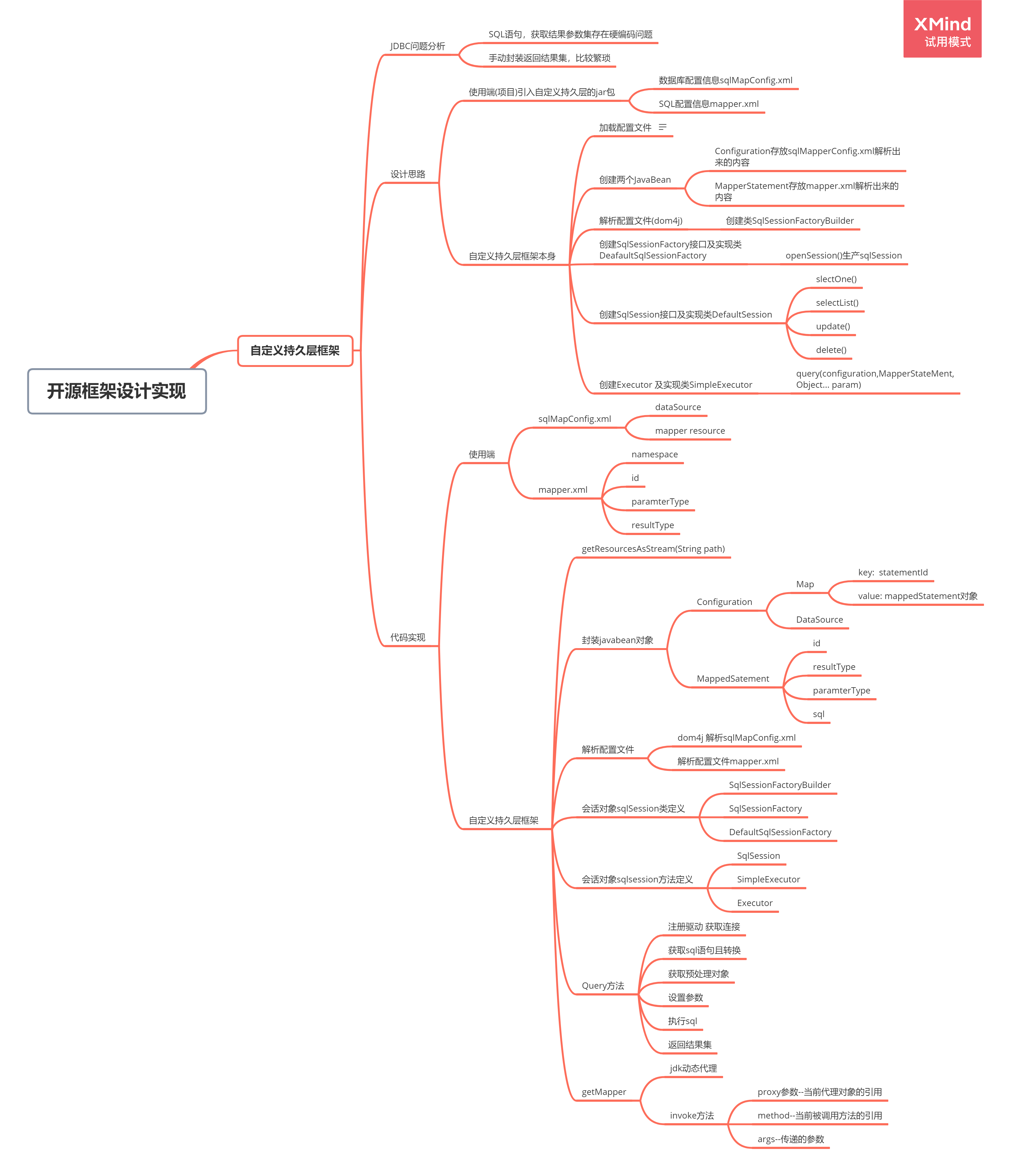
总的来说,收获非常大。最后附上一张xmind思维导图有助于理解整个demo。

 浙公网安备 33010602011771号