
【CFP】IEEE iCaMaL 2026 Special Session “AI-Driven Systems for Next-Generation Industrial Automation”
我们在IEEE iCaMaL 2026上组织了Special Session “AI-Driven Systems for Next-Generation Industrial Automation”详见: https://www.icamal2026.com/index/page.html?id=1887#ss7 ,所有的录用论文会被EI检索,部分优秀论文将被推荐至IEEE-TITS、IEEE-TASE、FSMJ,其中IEEE TASE的特刊已经被批准,详情请见 https://www.ieee-ras.org/publications/t-ase/special-issues-t-ase/ ,欢迎各位专家学者赐稿~
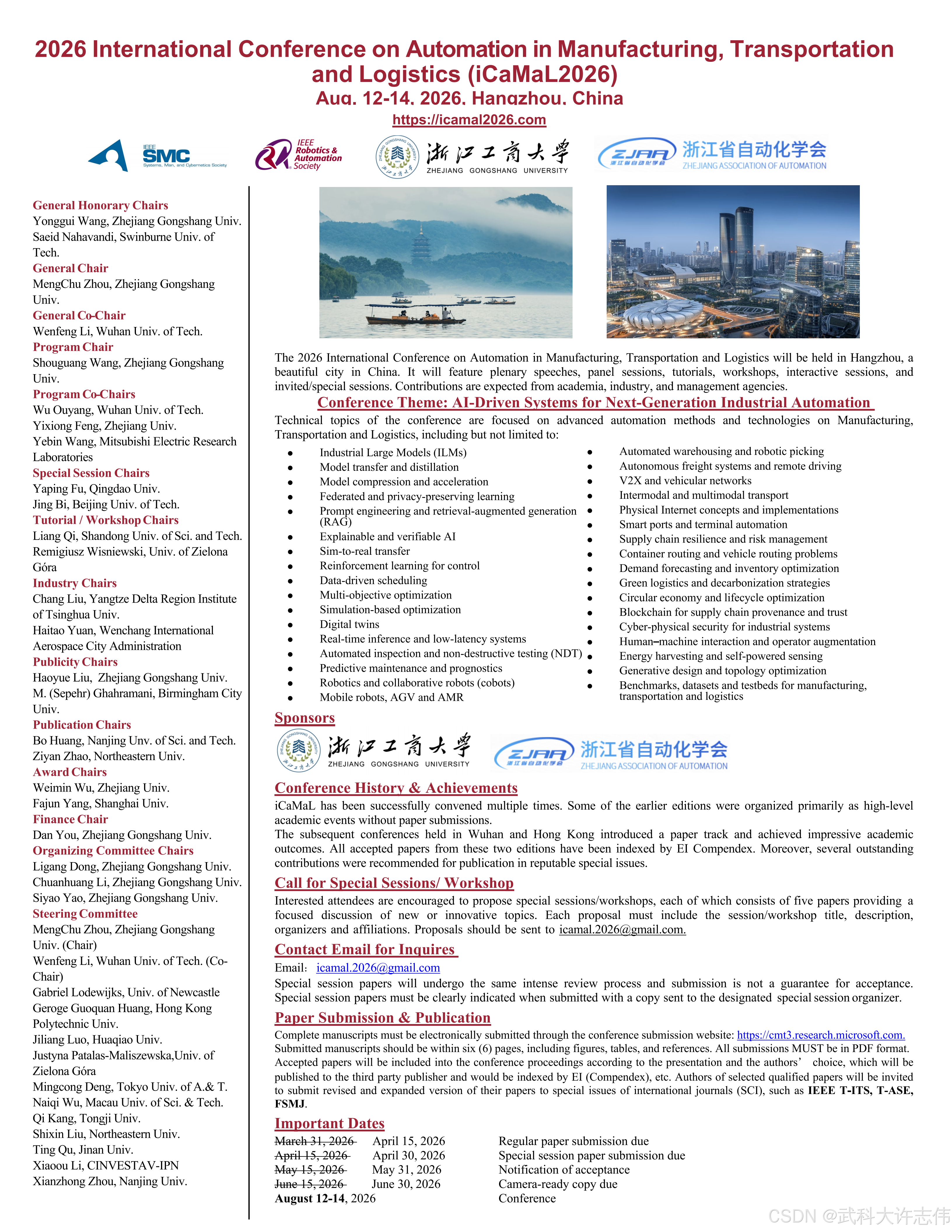
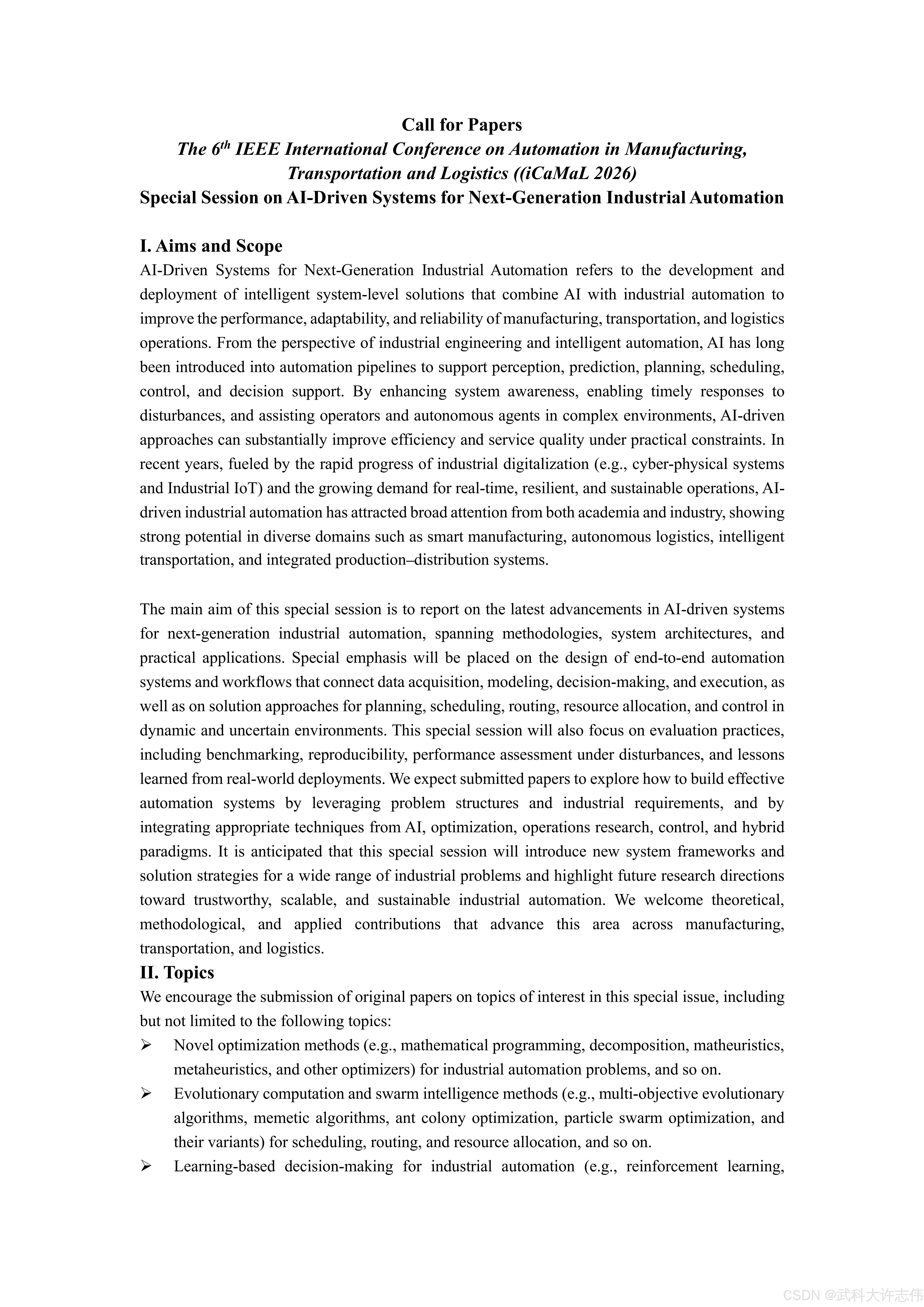
Call for Papers
The 6th IEEE International Conference on Automation in Manufacturing, Transportation and Logistics ((iCaMaL 2026)
Special Session on AI-Driven Systems for Next-Generation Industrial Automation
I. Aims and Scope
AI-Driven Systems for Next-Generation Industrial Automation refers to the development and deployment of intelligent system-level solutions that combine AI with industrial automation to improve the performance, adaptability, and reliability of manufacturing, transportation, and logistics operations. From the perspective of industrial engineering and intelligent automation, AI has long been introduced into automation pipelines to support perception, prediction, planning, scheduling, control, and decision support. By enhancing system awareness, enabling timely responses to disturbances, and assisting operators and autonomous agents in complex environments, AI-driven approaches can substantially improve efficiency and service quality under practical constraints. In recent years, fueled by the rapid progress of industrial digitalization (e.g., cyber-physical systems and Industrial IoT) and the growing demand for real-time, resilient, and sustainable operations, AI-driven industrial automation has attracted broad attention from both academia and industry, showing strong potential in diverse domains such as smart manufacturing, autonomous logistics, intelligent transportation, and integrated production–distribution systems.
The main aim of this special session is to report on the latest advancements in AI-driven systems for next-generation industrial automation, spanning methodologies, system architectures, and practical applications. Special emphasis will be placed on the design of end-to-end automation systems and workflows that connect data acquisition, modeling, decision-making, and execution, as well as on solution approaches for planning, scheduling, routing, resource allocation, and control in dynamic and uncertain environments. This special session will also focus on evaluation practices, including benchmarking, reproducibility, performance assessment under disturbances, and lessons learned from real-world deployments. We expect submitted papers to explore how to build effective automation systems by leveraging problem structures and industrial requirements, and by integrating appropriate techniques from AI, optimization, operations research, control, and hybrid paradigms. It is anticipated that this special session will introduce new system frameworks and solution strategies for a wide range of industrial problems and highlight future research directions toward trustworthy, scalable, and sustainable industrial automation. We welcome theoretical, methodological, and applied contributions that advance this area across manufacturing, transportation, and logistics.
II. Topics
We encourage the submission of original papers on topics of interest in this special issue, including but not limited to the following topics:
- Novel optimization methods (e.g., mathematical programming, decomposition, matheuristics, metaheuristics, and other optimizers) for industrial automation problems, and so on.
- Evolutionary computation and swarm intelligence methods (e.g., multi-objective evolutionary algorithms, memetic algorithms, ant colony optimization, particle swarm optimization, and their variants) for scheduling, routing, and resource allocation, and so on.
- Learning-based decision-making for industrial automation (e.g., reinforcement learning, predictive modeling, learning-augmented optimization, transfer and generalization across scenarios), and so on.
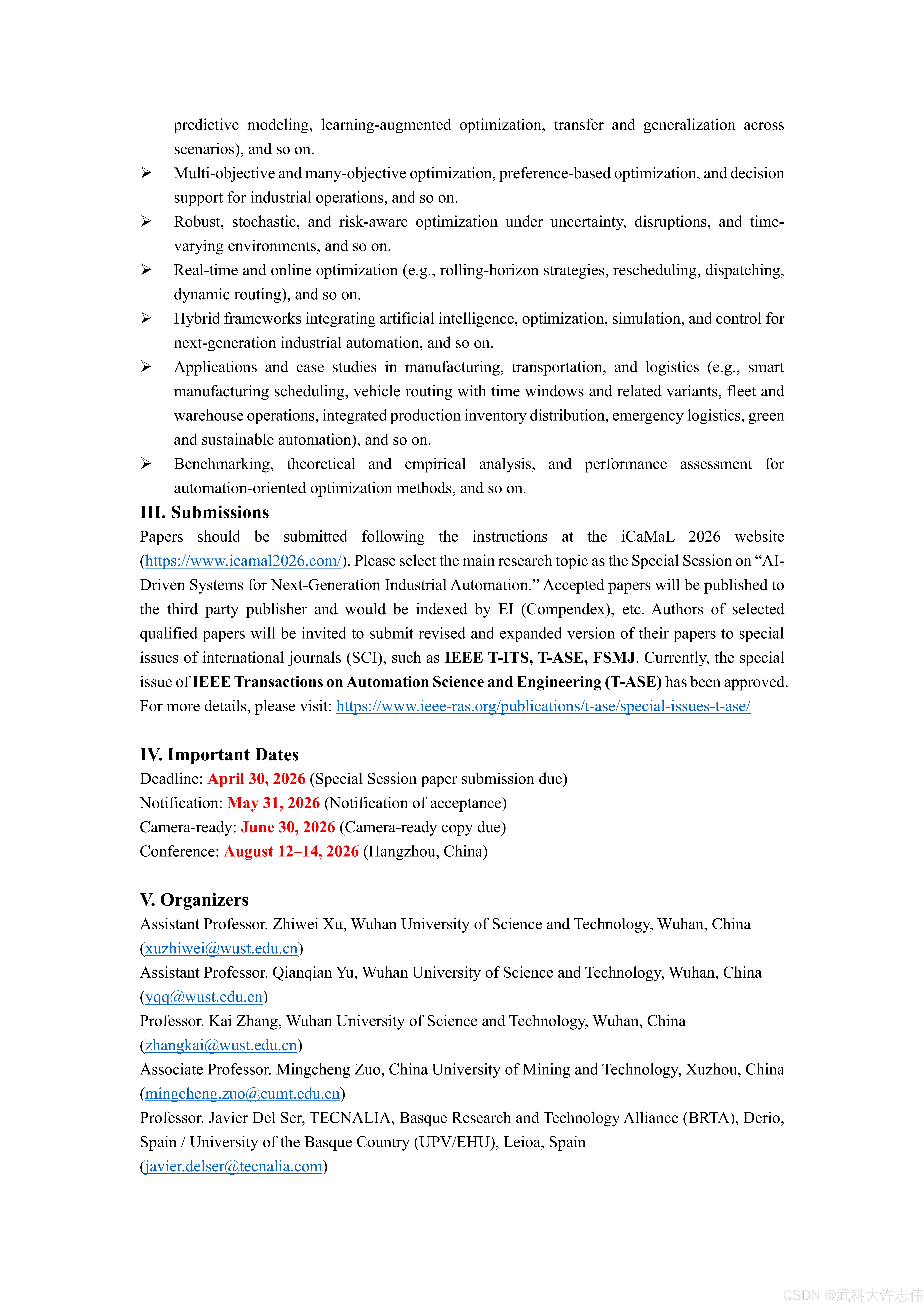
- Multi-objective and many-objective optimization, preference-based optimization, and decision support for industrial operations, and so on.
- Robust, stochastic, and risk-aware optimization under uncertainty, disruptions, and time-varying environments, and so on.
- Real-time and online optimization (e.g., rolling-horizon strategies, rescheduling, dispatching, dynamic routing), and so on.
- Hybrid frameworks integrating artificial intelligence, optimization, simulation, and control for next-generation industrial automation, and so on.
- Applications and case studies in manufacturing, transportation, and logistics (e.g., smart manufacturing scheduling, vehicle routing with time windows and related variants, fleet and warehouse operations, integrated production inventory distribution, emergency logistics, green and sustainable automation), and so on.
- Benchmarking, theoretical and empirical analysis, and performance assessment for automation-oriented optimization methods, and so on.
III. Submissions
Papers should be submitted following the instructions at the iCaMaL 2026 website (https://www.icamal2026.com/). Please select the main research topic as the Special Session on “AI-Driven Systems for Next-Generation Industrial Automation.” Accepted papers will be published to the third party publisher and would be indexed by EI (Compendex), etc. Authors of selected qualified papers will be invited to submit revised and expanded version of their papers to special issues of international journals (SCI), such as IEEE T-ITS, T-ASE, FSMJ. Currently, the special issue of IEEE Transactions on Automation Science and Engineering (T-ASE) has been approved. For more details, please visit: https://www.ieee-ras.org/publications/t-ase/special-issues-t-ase/
IV. Important Dates
- Deadline: April 30, 2026 (Special Session paper submission due)
- Notification: May 31, 2026 (Notification of acceptance)
- Camera-ready: June 30, 2026 (Camera-ready copy due)
- Conference: August 12–14, 2026 (Hangzhou, China)
V. Organizers
- Assistant Professor. Zhiwei Xu, Wuhan University of Science and Technology, Wuhan, China (xuzhiwei@wust.edu.cn)
- Assistant Professor. Qianqian Yu, Wuhan University of Science and Technology, Wuhan, China (yqq@wust.edu.cn)
- Professor. Kai Zhang, Wuhan University of Science and Technology, Wuhan, China (zhangkai@wust.edu.cn)
- Associate Professor. Mingcheng Zuo, China University of Mining and Technology, Xuzhou, China (mingcheng.zuo@cumt.edu.cn)
- Professor. Javier Del Ser, TECNALIA, Basque Research and Technology Alliance (BRTA), Derio, Spain / University of the Basque Country (UPV/EHU), Leioa, Spain (javier.delser@tecnalia.com)

 浙公网安备 33010602011771号