
构造器引用(和方法引用一样,构造器本质上也是一个方法 <init> 方法)
2016年的 OneNote 笔记迁移到 博客园
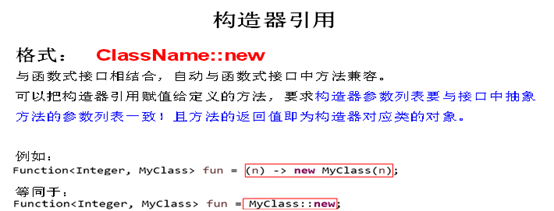
构造方法引用和其他方法引用是一样的,和方法引用中 类 ::实例方法 一样
@Test
public void test1() {
  Function<Integer, Person> f1 = new Function<Integer, Person>() {
    @Override
    public Person apply(Integer t) {
      return new Person(t);
    }
  };

  // ----------------------------lambda表达式------------------------------
  Function<Integer, Person> f2 = t -> new Person(t);
  // -----------------------------构造器的引用-----------------------------
  Function<Integer, Person> f3 = Person::new;
}
解释:
Apply()方法中第一个泛型是形参类型,第二个泛型是返回值返回值类型,所以构造器引用时,将返回类型的对象new,将第一个参数作为形参

/**
 * 数组引用
 */
@Test
public void test2() {
  Function<Integer, Person[]> f1 = new Function<Integer, Person[]>() {
    @Override
    public Person[] apply(Integer t) {
      return new Person[t];
    }
  };

  // ---------------------------------lambda表达式------------------------------
  Function<Integer, Person[]> f2 = t -> new Person[t];

  // ---------------------------------数组的引用------------------------------
  Function<Integer, Person[]> f3 = Person[]::new;
  // 调用
  Person[] apply = f3.apply(10);
}
解释:
Apply()方法中第一个泛型是形参类型,第二个泛型是返回值返回值的数组类型,所以构造器引用时,将返回类型的对象new,将第一个参数作为返回数组的长度
使用案例:
List<String> newStrList = Arrays.asList(1,2,3,4,5).stream().map(String::new).collect(Collectors.toList());
本文来自博客园,作者:Vermeer,转载请注明原文链接:https://www.cnblogs.com/chxlay/p/15056753.html

 浙公网安备 33010602011771号