实验4
实验4
实验4.1源码
#include<stdio.h>
#include<stdlib.h>
#define N 4

void test1() {
    int a[N] = {1, 9, 8, 4};
    int i;

    // 输出数组a占用的内存字节数
    printf("sizeof(a) = %d\n", sizeof(a));

    // 输出int类型数组a中每个元素的地址、值
    for (i = 0; i < N; ++i)
        printf("%p: %d\n", &a[i], a[i]);

    // 输出数组名a对应的值
    printf("a = %p\n", a);
}

void test2() {
    char b[N] = {'1', '9', '8', '4'};
    int i;

    // 输出数组b占用的内存字节数
    printf("sizeof(b) = %d\n", sizeof(b));

    // 输出char类型数组b中每个元素的地址、值
    for (i = 0; i < N; ++i)
        printf("%p: %c\n", &b[i], b[i]);

    // 输出数组名b对应的值
    printf("b = %p\n", b);
}

int main() {
    printf("测试1: int类型一维数组\n");
    test1();

    printf("\n测试2: char类型一维数组\n");
    test2();
    system("pause");
    return 0;
}
实验4.1运行结果
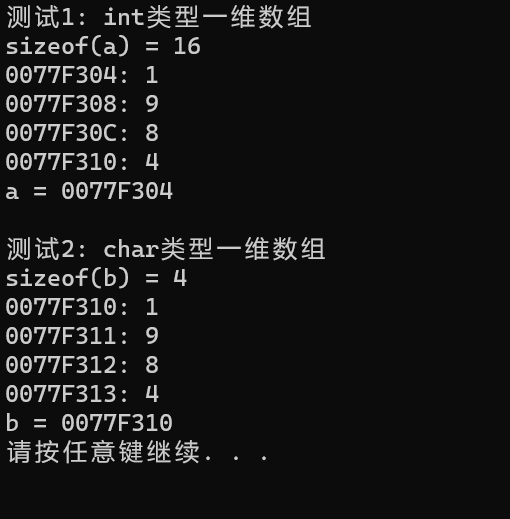
结论:数组内的元素在内存中是连续存放,数组名代表元素的首地址
实验4.2
实验4.2源码
#include<stdio.h>
#include<stdlib.h>
#define N 2
#define M 4

void test1() {
    int a[N][M] = {{1, 9, 8, 4}, {2, 0, 4, 9}};
    int i, j;

    // 输出int类型二维数组a占用的内存字节数
    printf("sizeof(a) = %d\n", sizeof(a));

    // 输出int类型二维数组a中每个元素的地址、值
    for (i = 0; i < N; ++i)
        for (j = 0; j < M; ++j)
            printf("%p: %d\n", &a[i][j], a[i][j]);
    printf("\n");

    // 输出int类型二维数组名a, 以及,a[0], a[1]的值
    printf("a = %p\n", a);
    printf("a[0] = %p\n", a[0]);
    printf("a[1] = %p\n", a[1]);
    printf("\n");
}

void test2() {
    char b[N][M] = {{'1', '9', '8', '4'}, {'2', '0', '4', '9'}};
    int i, j;

    // 输出char类型二维数组b占用的内存字节数
    printf("sizeof(b) = %d\n", sizeof(b));

    // 输出char类型二维数组b中每个元素的地址、值
    for (i = 0; i < N; ++i)
        for (j = 0; j < M; ++j)
            printf("%p: %c\n", &b[i][j], b[i][j]);
    printf("\n");

    // 输出char类型二维数组名b, 以及,b[0], b[1]的值
    printf("b = %p\n", b);
    printf("b[0] = %p\n", b[0]);
    printf("b[1] = %p\n", b[1]);
}

int main() {
    printf("测试1: int型两维数组");
    test1();

    printf("\n测试2: char型两维数组");
    test2();
    system("pause");
    return 0;
}
实验4.2运行结果
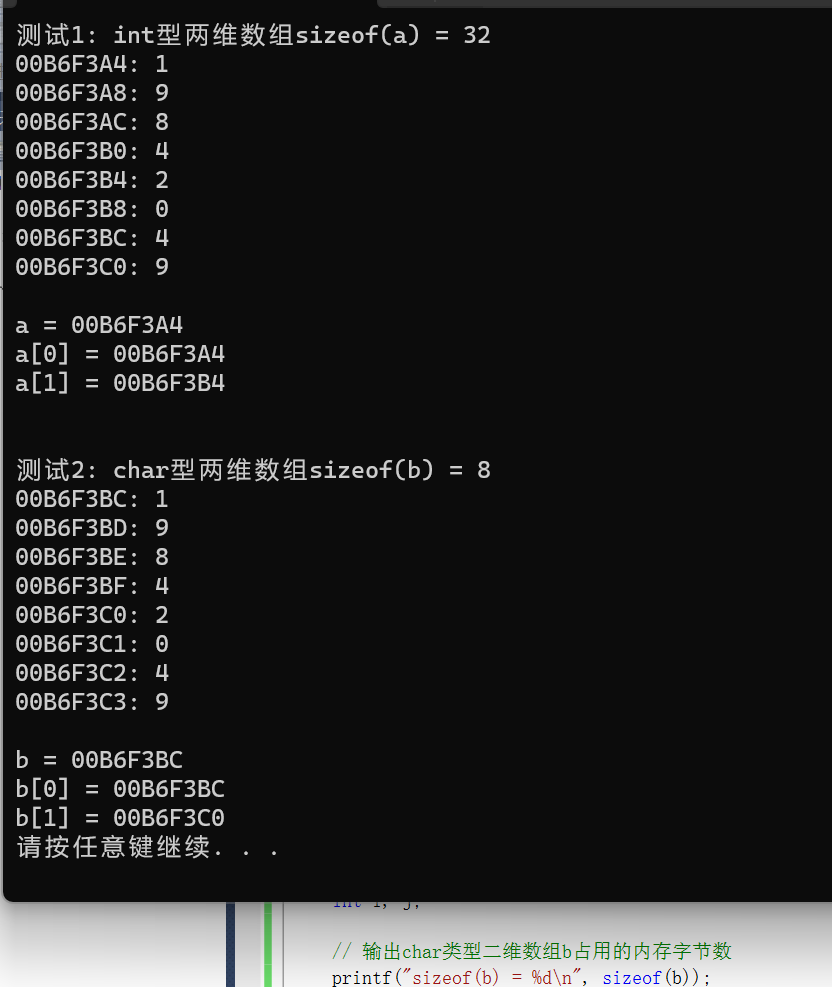
结论:二维数组中的元素在内存中连续存储,且二维数组名以及二维数组中第一个元素都代表了元素的起始地址
实验4.3
实验4.3源码
#include<stdio.h>
#include<stdlib.h>

#include<string.h>

#define N 80

void swap_str(char s1[N], char s2[N]);
void test1();
void test2();

int main() {
    printf("测试1: 用两个一维char数组,实现两个字符串交换\n");
    test1();

    printf("\n测试2: 用二维char数组,实现两个字符串交换\n");
    test2();
    system("pause");
    return 0;
}

void test1() {
    char views1[N] = "hey, C, I hate u.";
    char views2[N] = "hey, C, I love u.";

    printf("交换前: \n");
    puts(views1);
    puts(views2);

    swap_str(views1, views2);

    printf("交换后: \n");
    puts(views1);
    puts(views2);
}

void test2() {
    char views[2][N] = {"hey, C, I hate u.",
                        "hey, C, I love u."};

    printf("交换前: \n");
    puts(views[0]);
    puts(views[1]);

    swap_str(views[0], views[1]);

    printf("交换后: \n");
    puts(views[0]);
    puts(views[1]);
}

void swap_str(char s1[N], char s2[N]) {
    char tmp[N];

    strcpy(tmp, s1);
    strcpy(s1, s2);
    strcpy(s2, tmp);
}
实验4.3运行结果
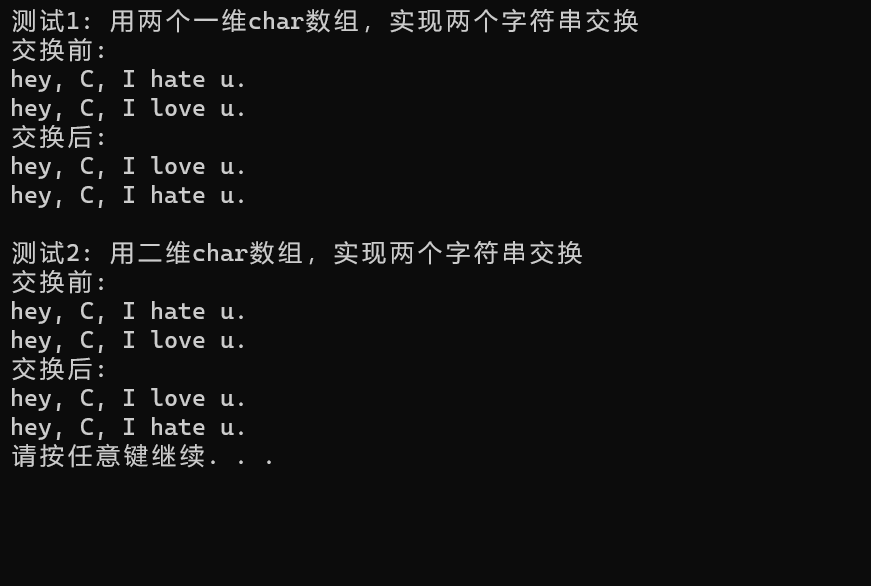
结论:如果一维数组加上[]就代表了元素,二维数组可以看成里面的元素是一维数组,所以加上[]就可以实现一维数组的交换
实验4.4
实验4.4源码
#include<stdio.h>
#include<stdlib.h>

#include<string.h>

#define N 80

void swap_str(char s1[N], char s2[N]);
void test1();
void test2();

int main() {
    printf("测试1: 用两个一维char数组,实现两个字符串交换\n");
    test1();

    printf("\n测试2: 用二维char数组,实现两个字符串交换\n");
    test2();
    system("pause");
    return 0;
}

void test1() {
    char views1[N] = "hey, C, I hate u.";
    char views2[N] = "hey, C, I love u.";

    printf("交换前: \n");
    puts(views1);
    puts(views2);

    swap_str(views1, views2);

    printf("交换后: \n");
    puts(views1);
    puts(views2);
}

void test2() {
    char views[2][N] = {"hey, C, I hate u.",
                        "hey, C, I love u."};

    printf("交换前: \n");
    puts(views[0]);
    puts(views[1]);

    swap_str(views[0], views[1]);

    printf("交换后: \n");
    puts(views[0]);
    puts(views[1]);
}

void swap_str(char s1[N], char s2[N]) {
    char tmp[N];

    strcpy(tmp, s1);
    strcpy(s1, s2);
    strcpy(s2, tmp);
}
#include<stdio.h>
#include<stdlib.h>
#define N 1000

int main() {
    char line[N];
    int word_len;   // 记录当前单词长度
    int max_len;    // 记录最长单词长度
    int end;        // 记录最长单词结束位置
    int i;

    while(gets(line) != NULL) {
        word_len = 0;
        max_len = 0;
        end = 0;

        i = 0;
        while(1) {
            // 跳过连续空格
            while(line[i] == ' ') {
                word_len = 0;  // 单词长度置0,为新单词统计做准备
                i++;
            }

            // 在一个单词中,统计当前单词长度
            while(line[i] != '\0' && line[i] != ' ') {
                word_len++;
                i++;
            }

            // 更新更长单词长度,并,记录最长单词结束位置
            if(max_len < word_len) {
                max_len = word_len;
                end = i;   // end保存的是单词结束的下一个坐标位置
            }

            // 遍历到文本结束时,终止循环
            if(line[i] == '\0')
                break;
        }

        // 输出最长单词
        printf("最长单词: ");
        for(i = end - max_len; i < end; ++i)
            printf("%c", line[i]);
        printf("\n\n");
    }
    system("pause");
    return 0;
}
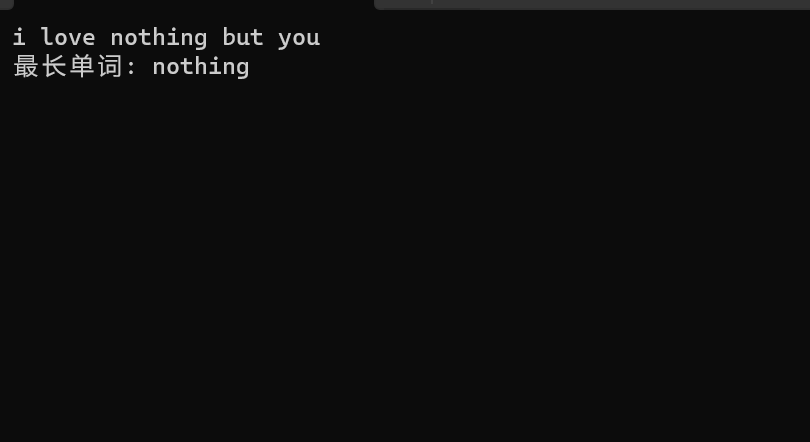
实验4.4运行结果
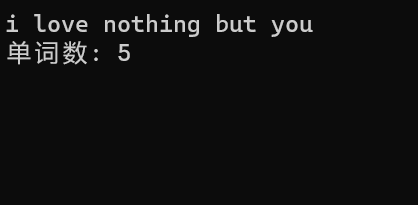
实验4.4
实验4.4源码
//把十进制数转化为n进制数
#include<stdio.h>
#include<stdlib.h>
void dec_to_n(int x,int n);
int main()
{
    int x;
    printf("请输入一个十进制整数:");
    while(scanf("%d",&x)!=EOF)
    {
        dec_to_n(x,2);
        dec_to_n(x,8);
        dec_to_n(x,16);
    }

    system("pause");
    return 0;
}
void dec_to_n(int x,int n)
{
    char a[100];
    int i;
    for(i=0;x>0;i++)
    {

        if(x%n>=0&&x%n<10)
        {a[i]=x%n+'0';}
        else
        {
        a[i]=x%n-10+'A';
        }
        x/=n;

    }
    for(i=i-1;i>=0;i--)
    {
        printf("%c",a[i]);
    }

    printf("\n");
}
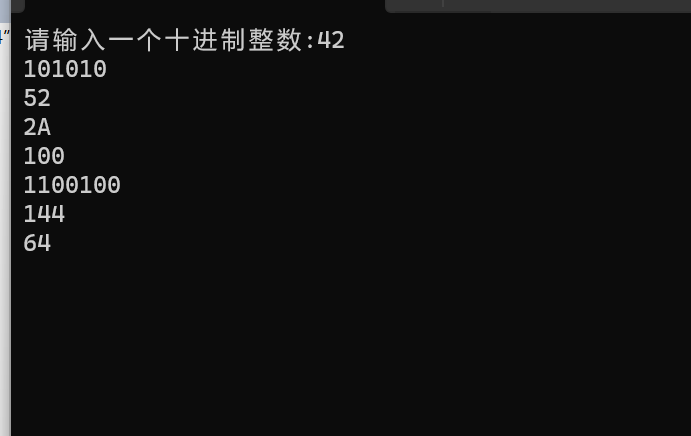
实验4.4运行结果
实验4.5
实验4.5源码
#include<stdio.h>
#include<stdlib.h>

#define N 5

// 函数声明
void input(int x[], int n);
void output(int x[], int n);
double average(int x[], int n);
void bubble_sort(int x[], int n);

int main() {
    int scores[N];
    double ave;

    printf("录入%d个分数:\n", N);
    input(scores, N);

    printf("\n输出课程分数: \n");
    output(scores, N);

    printf("\n课程分数处理: 计算均分、排序...\n");
    ave = average(scores, N);
    bubble_sort(scores, N);

    printf("\n输出课程均分: %.2f\n", ave);
    printf("\n输出课程分数(高->低):\n");
    output(scores, N);
    system("pause");
    return 0;
}

// 函数定义
// 输入n个整数保存到整型数组x中
void input(int x[], int n) {
    int i;

    for(i = 0; i < n; ++i)
        scanf("%d", &x[i]);
}

// 输出整型数组x中n个元素
void output(int x[], int n) {
    int i;

    for(i = 0; i < n; ++i)
        printf("%d ", x[i]);
    printf("\n");
}

// 计算整型数组x中n个元素均值,并返回
// 补足函数average()实现
// ×××

double average(int x[],int n)
{
    double sum=0,avg;
    int i;
    for(i=0;i<n;i++)
    {
        sum+=x[i];

    }
    avg=sum/n;
    return avg;

}

// 对整型数组x中的n个元素降序排序
// 补足函数bubble_sort()实现
// ×××
void bubble_sort(int x[],int n)
{
    int i,j,max;
    max=x[0];
    for(i=0;i<n-1;i++)
    {
        for(j=i+1;j<n-1;j++)
        {
            if(x[i]<x[j])
            {
                max=x[j];
                x[j]=x[i];
                x[i]=max;
            }
        }
    }

}
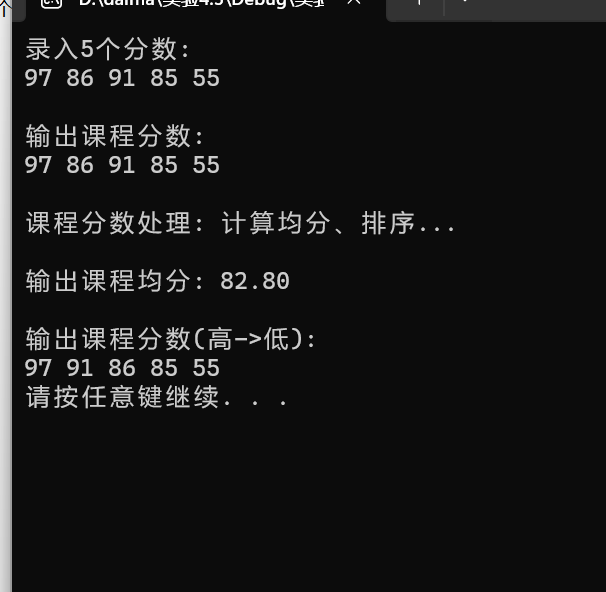
实验4.5运行结果
实验4.6
实验4.6源码
#include<stdio.h>
#include<stdlib.h>
#include<string.h>


#define N 5
#define M 20

// 函数声明
void output(char str[][M], int n);
void bubble_sort(char str[][M], int n);

int main() {
    char name[][M] = {"Bob", "Bill", "Joseph", "Taylor", "George"};
    int i;

    printf("输出初始名单:\n");
    output(name, N);

    printf("\n排序中...\n");
    bubble_sort(name, N);  // 函数调用

    printf("\n按字典序输出名单:\n");
    output(name, N);
    system("pause");
    return 0;
}

// 函数定义
// 功能:按行输出二维数组中的字符串
void output(char str[][M], int n) {
    int i;

    for(i = 0; i < n; ++i)
        printf("%s\n", str[i]);
}

// 函数定义
// 功能:使用冒泡排序算法对二维数组str中的n个字符串按字典序排序
// 补足函数bubble_sort()实现
// ×××
void bubble_sort(char str[][M],int n)
{
    int i,j;
    char t[M];
    for(i=0;i<n-1;i++)
    {
        for(j=0;j<n-i-1;j++)
        {
            if(strcmp(str[j],str[j+1])>0)
            {
                strcpy(t,str[j+1]);
                strcpy(str[j+1],str[j]);
                strcpy(str[j],t);
            }
        }
    }

}
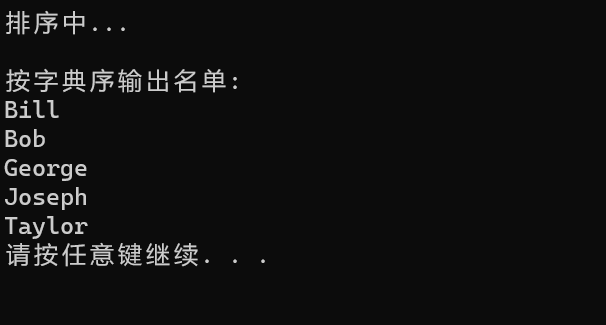
实验4.6运行结果
实验4.7
实验4.7源码
#include<stdio.h>
#include<stdlib.h>
#define N 10000
void cmp(char *a,int n);
int main()
{
    char a[N];
    while(gets(a)!=NULL)
    {
        cmp(a,N);
        puts(a);
    }
    system("pause");
    return 0;

}
void cmp(char *a,int n)
{
    int i,j;
    int flag=0;
    for(i=0;i<n&&a[i];i++)
    {
        for(j=i+1;j<n&&a[j];j++)
        {
            if(a[i]==a[j])
            flag=1;
        }
    }
    if(flag==1)
    {
        printf("YES\n");

    }
    else
        printf("NO\n");
}
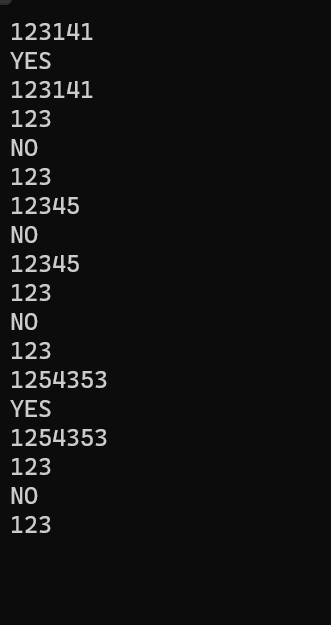
实验4.7运行结果
实验4.8
实验4.8源码
#include<stdio.h>
#include<stdlib.h>
#define N 100
#define M 4

// 函数声明
void output(int x[][N], int n);
void rotate_to_right(int x[][N], int n);


int main() {
    int t[][N] = {{21, 12, 13, 24},
                  {25, 16, 47, 38},
                  {29, 11, 32, 54},
                  {42, 21, 33, 10}};

    printf("原始矩阵:\n");
    output(t, M); // 函数调用

    rotate_to_right(t, M); // 函数调用

    printf("变换后矩阵:\n");
    output(t, M); // 函数调用
    system("pause");
    return 0;
}

// 函数定义
// 功能: 输出一个n*n的矩阵x
void output(int x[][N], int n) {
    int i, j;

    for (i = 0; i < n; ++i) {
        for (j = 0; j < n; ++j)
            printf("%4d", x[i][j]);

        printf("\n");
    }
}

// 待补足3:函数rotate_to_right()定义
// 功能: 把一个n*n的矩阵x,每一列向右移, 最右边被移出去的一列绕回左边
// xxx
void rotate_to_right(int x[][M],int n)
{
    int t;
    int i,j;
    for(i=0;i<n;i++)
    {   t=x[i][n-1];
        for(j=1;j<n-1;j++)
        {
            x[i][j+1]=x[i][j];
        }
        x[i][0]=t;
    }
}
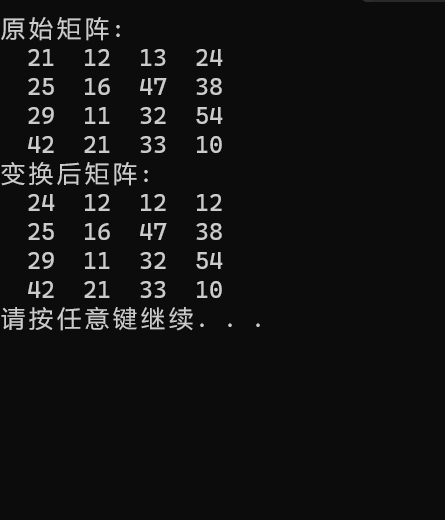
实验4.8运行结果
posted on 2023-11-13 20:33 Awayfyforever 阅读(24) 评论(0) 收藏 举报

 浙公网安备 33010602011771号