
python 入门第七课 面向对象进阶
静态方法:
@staticmethod,只是名义上归类管理,实际上在静态方法里访问不了类或者实例的任何属性
类方法:
@classmethod,只能访问类变量,不能访问实例变量
属性方法:
@property ,把一个方法变成一个静态属性
属性方法的应用如下: f.flight_status调用属性方法,.setter 进行修改,.deleter进行删除
__author__ = 'admin'
class Flight(object):
    def __init__(self,name):
        self.flight_name = name


    def checking_status(self):
        print("checking flight %s status " % self.flight_name)
        return  1


    @property
    def flight_status(self):
        status = self.checking_status()
        if status == 0 :
            print("flight got canceled...")
        elif status == 1 :
            print("flight is arrived...")
        elif status == 2:
            print("flight has departured already...")
        else:
            print("cannot confirm the flight status...,please check later")

    @flight_status.setter #修改
    def flight_status(self,status):
        status_dic = {
            0 : "canceled",
            1 :"arrived",
            2 : "departured"
        }
        print("\033[31;1mHas changed the flight status to \033[0m",status_dic.get(status) )

    @flight_status.deleter  #删除
    def flight_status(self):
        print("status got removed...")

f = Flight("CA980")
f.flight_status
f.flight_status =  2 #触发@flight_status.setter
del f.flight_status #触发@flight_status.deleter
运行结果如下:
checking flight CA980 status
flight is arrived...
Has changed the flight status to departured
status got removed...
类的特殊成员方法
1.1 1. __doc__ 表示类的描述信息
class Foo:
""" 描述类信息,这是用于看片的神奇 """
def func(self):
pass
print Foo.doc
输出:类的描述信息
1.2 module 和 class 表示当前操作的对象在那个模块 和表示当前操作的对象的类是什么
from lib.aa import C
obj = C()
print (obj.module ) # 输出 lib.aa,即:输出模块
print (obj.class ) # 输出 lib.aa.C,即:输出类
1.3. init 构造方法,通过类创建对象时,自动触发执行。
1.4. del 析构方法,当对象在内存中被释放时,自动触发执行。
1.5. call 对象后面加括号,触发执行。需要先定义__call__方法
class Foo:
def init(self):
pass
def call(self, *args, **kwargs):
print 'call'
obj = Foo() # 执行 init
obj() # 执行 call
1.6 . dict 查看类或对象中的所有成员
print(Foo.dict) 返回类的属性
print(obj.dict) 返回实例的属性
1.7 str 如果一个类中定义了__str__方法,那么在打印 对象 时,默认输出该方法的返回值。
class Foo:
def str(self):
return 'alex li'
obj = Foo()
print( obj )
输出:alex li
1.8.getitem、setitem、delitem 需要先定义它们的方法
class Foo(object):
def getitem(self, key):
print('getitem',key)
def setitem(self, key, value):
print('setitem',key,value)
def delitem(self, key):
print('delitem',key)
obj = Foo()
result = obj['k1'] # 自动触发执行 getitem
obj['k2'] = 'alex' # 自动触发执行 setitem
del obj['k1']
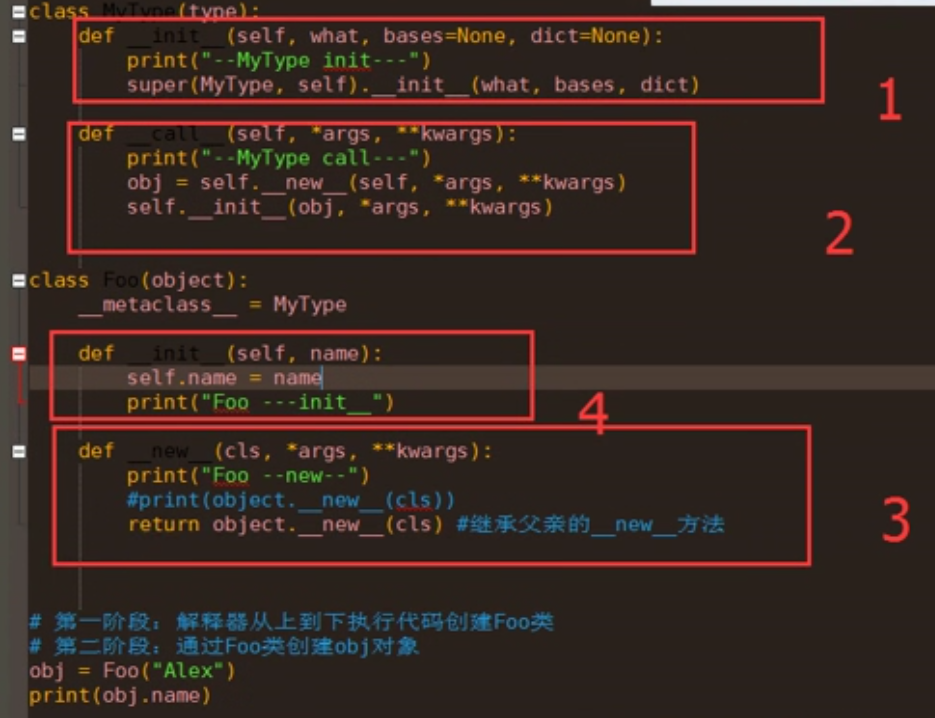
1.9 new \ metaclass #方法__new__用来实例化对象 , metaclass,其用来表示该类由 谁 来实例化创建,可以为 metaclass 设置一个type类的派生类,从而查看 类 创建的过程:类的生成 调用 顺序依次是 MyType.init -->MyType.call --> Foo.new --> Foo.init
类class Foo的特殊定义方法:
def func(self):
print 'hello wupeiqi'
Foo = type('Foo',(object,), {'func': func})
type第一个参数:类名
type第二个参数:当前类的基类
type第三个参数:类的成员
class MyType(type):
def init(self,*args,**kwargs):
print("Mytype init",*args,**kwargs)
def call(self, args, **kwargs):
print("Mytype call", args, **kwargs)
obj = self.new(self)
print("obj ",obj,args, **kwargs)
print(self)
self.init(obj,args, **kwargs)
return obj
def new(cls, args, **kwargs):
print("Mytype new",args,**kwargs)
return type.new(cls, *args, **kwargs)
print('here...')
class Foo(object,metaclass=MyType):
#metaclass = MyType
def init(self,name):
self.name = name
print("Foo init")
def new(cls, *args, **kwargs):
print("Foo new",cls, *args, **kwargs)
return object.new(cls)
f = Foo("Alex")
print("f",f)
print("fname",f.name)
1.10 反射
hasattr(obj,y) 判断对象是否有属性'y',返回True或False
getattr(obj,y) 获取对象方法y的地址或者属性y的值
setattr(obj,y,v) 设置对象的obj.y=v
delattr(obj,y) 删除对象的属性y
__author__ = 'admin'
def eat(self):
    print('eating')
class Foo(object):

    def __init__(self):
        self.name = 'wupeiqi'

    def func(self):
        return 'func'

choice = input('>>:').strip()
d = Foo()

if hasattr(d,choice):
    attr = getattr(d,choice)
    print(attr())
else:
    setattr(d,choice,eat)  #add new attr  'eat'
    getattr(d,choice)(d)   #将obj本身作为方法eat的参数进行调用
    # setattr(d,choice,"name1")   #新增属性 d.choice = 'name1'
    # print(hasattr(d,choice))
    # print(getattr(d,choice))     #getattr(d,choice)直接新增的属性的值
2 异常处理
2.1 异常提示
try:
    #s1 = 'hello'
    #int(s1)
    name = []
    name[2]
except IndexError as e:
    print(e)
except KeyError as e:
    print(e)
except ValueError as e:
    print(e)
except Exception as e :
    print(e)
else:
    print('unknown error')
finally:
    print(66)
2.2 自定义异常,主动触发
class WupeiqiException(Exception):

    def __init__(self, msg):
        self.message = msg

    def __str__(self):
        return self.message

try:
    raise WupeiqiException('我的异常')
except WupeiqiException as e:
    print(e)

 浙公网安备 33010602011771号