
java小白学习中03
3.类型转换
①java是强类型语言,进行运算时,需要用到类型转换
低---------------------------------高
byte,short,char->int->long->float->double
②注意:a.强制转换 (类型)变量名 由高向低转换;自动转换 由低向高转换
b.不能对布尔值进行转换
c.转换时可能存在内存溢出或精度问题
 1 public class Demo01 {
 2     public static void main(String[] args) {
 3         int i = 128;
 4         byte a = (byte)i;//内存溢出
 5         double b = i;
 6         //强制转换 (类型)变量名 高到低转换
 7         //自动转换  由低向高转换
 8         System.out.println(i);//128
 9         System.out.println(a);//-128(内存溢出)
10         System.out.println(b);//128.0
11         System.out.println((int)23.58);//23(精度问题)
12         System.out.println((int)-58.236F);//-58(精度问题)
13         /*
14         注意:
15         1.不能对布尔值进行转换
16         2.不能把转换对象换成不相干的类型
17         3.高容量转换成低容量时,需要强制转换
18         4.转换时可能存在内存溢出,或者精度问题
19          */
20         char c = 'A';
21         int d = c+1;
22         System.out.println(d);//66
23         System.out.println((char)d);//B
③常见问题:
public class Demo01 {
       public static void main(String[] args){
        /*常见问题:
        1.操作比较大的数时注意溢出问题
        2.数字之间可以用下划线分割开
         */
        int money = 10_0000_0000;
        int year = 20;
        int total = money*year;//-1474836480 ,计算时已经溢出
        long total1 = money*year;//默认是int,转化之前已经出现问题
        long total2 = ((long)money)*year;//20000000000
    }
}
4.变量
数据类型 变量名 = 值;可以用逗号隔开来声明多个同类型变量。
public class Demo03 {
    public static void main(String[] args) {
        //int a,b,c;
        //int a=1,b=2,c=3;程序可读性
        String name = "yunyan";
        char a = 'X';
        double b = 3.14;
    }
}
②
-
每个变量都有类型,包括基本类型和引用类型。
-
变量名必须是合法的标识符。
-
public class Demo04 {

    //类变量  static
    static double salary = 2500;

    //属性:变量

    /*实例变量:从属于对象;如果不自行初始化,默认为0 0.0 u0000
    布尔值:默认为flase ; 除了基本类型,其他都是null
     */
    String name;
    int age;

    //main方法
    public static void main(String[] args) {

        //局部变量,必须声明和初始化值
        int i = 10;
        System.out.println(i);//10

        //变量类型  变量名字= new Demo04();
        Demo04 Demo04 = new Demo04();//alt+enter自动补全
        System.out.println(Demo04.age);//0
        System.out.println(Demo04.name);//null
        System.out.println(salary);//2500.0
    }
    //其他方法  eg:add方法
    public void add(){

    }
}
④变量的命名规范
-
所有的变量,方法,类名:见名知意
-
类成员变量:首字母小写和驼峰原则:除第一个单词以外,后面的单词首字母大写 eg : lastName
-
局部变量:首字母小写和驼峰原则
-
常量:大写字母和下划线:MAX_VELUE
-
-
方法名:首字母小写和驼峰原则:run(),runRun()
5.常量:初始化后不能再改变的量;常量名一般使用大写符号。
final 常量名=值;
final double PI=3.14;
public class Demo03 {
    //static final 属于修饰符,不分前后顺序
    //常量名需要大写字母
    static final double PI = 3.14;

    public static void main(String[] args) {
        System.out.println(PI);
    }
}
6.运算符
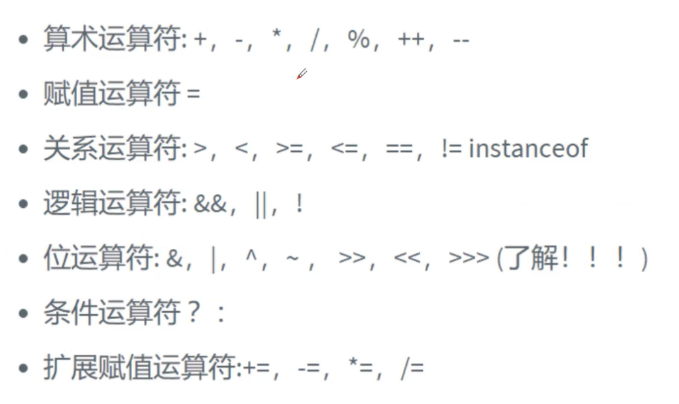
①基本运算符
%:表示取余;==:表示等于;!=:表示不等于;&&:与;||:或;!:非;
public class Demo01 {
    public static void main(String[] args) {
        //二元运算符
        int a = 10;
        int b = 20;
        int aa = 21;
        System.out.println(a+b);//30
        System.out.println(a-b);//-10
        System.out.println(a*b);//200
        System.out.println(a/b);//0
        System.out.println(a/(double)b);//0.5
        System.out.println(aa%a);//1  取余 模运算 aa / a = 2...1
        /*不同类型之间运算
        如果里面有long,结果为long类型;如果没有long,结果为int类型
         */
        long c = 12345678L;
        int d = 123;
        short e = 10;
        byte f = 8;
        System.out.println(c+d+e+f);//12345819 long类型
        System.out.println(d+e+f);//141 int类型
        System.out.println(e+f);//18  int类型

    }
}
public class Demo02 {
    public static void main(String[] args) {
        //关系运算符:结果只有true与false  布尔值
        //if
        int a = 10;
        int b = 20;
        System.out.println(a>b);//false
        System.out.println(a<b);//true
        System.out.println(a==b);//false
        System.out.println(a!=b);//true

    }
}
②自增自减运算符 ++ --
public class Demo03 {
    public static void main(String[] args) {
        //++ --  自增 自减 属于一元运算符
        int a = 10;
        int b = a++;//a++:a=a+1 执行这行代码前先赋值给b,然后再自增
        // a++ a = a+1;
        System.out.println(a);//11
        //++a a =a+1;
        int c = ++a;//++a:a=a+1 先自增,再赋值给c
        System.out.println(a);//12
        System.out.println(b);//10
        System.out.println(a);//12
        //幂运算 2*2*2=8 Math.pow(2,3) 使用工具类来操作
        double pow = Math.pow(2, 3);
        System.out.println(pow);//8.0
    }
}
③逻辑运算符 &&:与(and) ||:或(or) !:非(取反)
public class Demo04 {
    public static void main(String[] args) {
        /*逻辑运算符
        &&:与(and)  ||:或(or)  !:非(取反)
         */
        boolean a = true;
        boolean b = false;
        System.out.println("a && b:"+(a&&b));//false  逻辑与运算:一假全假
        System.out.println("a || b:"+(a||b));//true  逻辑或运算:一真全真
        System.out.println("!(a && b):"+!(a&&b));//true  如果是真,则为假;如果是假,则为真。
        //与运算举例  短路运算
        int c = 10;
        boolean d = (c<4)&&(c++<4);//若&&前面为假时,则直接为假,不用进行后面的程序
        System.out.println(d);//false
        System.out.println(c);//10
    }
}
④位运算符 & | ^ ~ << >>
public class Demo05 {
    public static void main(String[] args) {
        /*位运算 & | ^ ~ << >>
        A   = 0011 1100;  二进制
        B   = 0000 1101;
        ----------------------------------------
        A&B = 0000 1100 ; 上下对应有0则为0
        A|B = 0011 1101 ; 上下对应有1则为1
        A^B = 0011 0001 ; 同为0,异为1
        ~B  = 1111 0010 ; 取相反
         */
        /*
        << 左移 相当于*2
        >> 右移 相当于/2
        -------------------------------------------
        0000 0000  0     0  0  0  0     0 0 0 0
        0000 0001  1    128 64 32 16    8 4 2 0(1)
        0000 0010  2
        0000 0011  3
        0000 0100  4
        0000 0101  5
        0000 0110  6
        0000 0111  7
        0000 1000  8
        0001 0000  16
        -------------------------------------
         */
        System.out.println(2<<3);//16
    }
}
⑤条件运算符 ? :
public class Demo06 {
    public static void main(String[] args) {
        /*三元运算符:  ? :
        x ? y : z ; 如果x为ture,则为y;如果x为false,则为z。
         */
        int score = 80;
        int type = score<60 ? 30 : 20;
        String type01 = score>60 ? "及格" : "不及格" ;
        System.out.println(type);//20
        System.out.println(type01);//及格
        //优先级 ()
    }
}
⑥扩展运算符 += -= *= /=
public class Demo06 {
    public static void main(String[] args) {
        //拓展运算符  += -= *= /=
        int a = 10;
        int b = 20;
        a += b ;//a = a+b;
        a -= b ;//a = a-b;
        System.out.println(a);//10
        //字符串连接符  +  ""String 字符串 如果字符串在前面,拼接;如果在后面直接运算
        System.out.println(""+a+b);//1020
        System.out.println(a+b+"");//30
    }
}
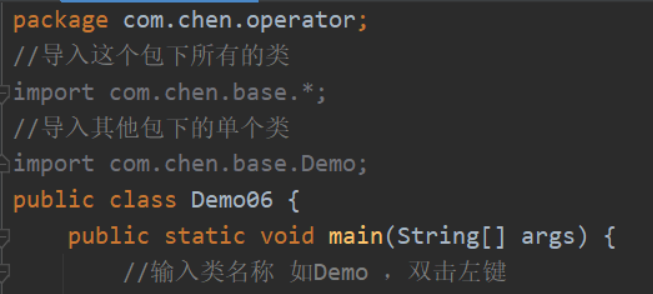
7.包机制
- 用于区别类名的命名空间,本质等同于文件夹
- 包语句的语法格式为:
package pkg1[. pkg2[. pkg3...]];

eg : com.chen.base com.yunyan.xxx
- 为了能够使用某一个包的成员,我们需要在java程序中明确导入该包,使用import完成此功能
import package1[.package2...].(classname|*);![]()
package com.chen.operator;
//导入这个包下所有的类
import com.chen.base.*;
//导入其他包下的单个类
import com.chen.base.Demo;
public class Demo06 {
    public static void main(String[] args) {
        Demo//输入类名称,双击左键
    }
}
8.
package com.chen.base;
//注释需加在想要显示的上面
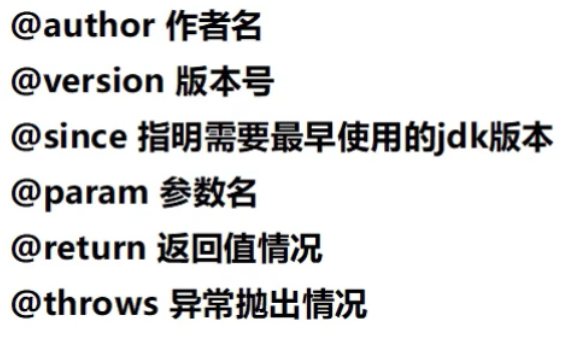
/**
 * @author yunyan
 * @version 1.0
 * @since 1.8
 */
public class Doc {
    //属性
    String name;
    //test 方法
    /**
     * @author yunyan
     * @param name
     * @return
     * @throws Exception
     */
    public String test(String name) throws Exception{
        return name;
    }
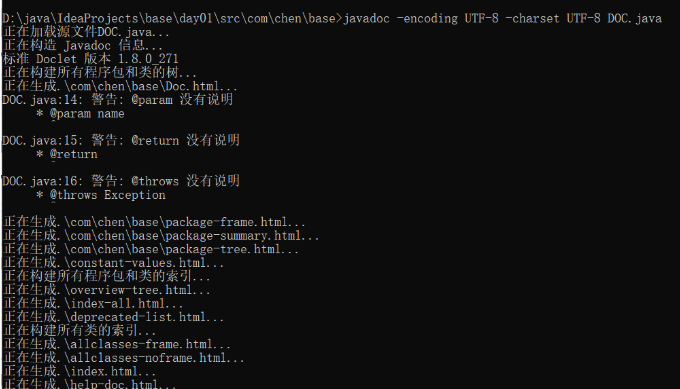
    //通过命令行  javadoc 参数 java文件
    //作业:学会查找使用IDEA生产javaDoc文档   呀 作业不会写。。。
}

 浙公网安备 33010602011771号