


Trie字典树
字典树介绍
字典树(Trie,前缀树或单词查找树)是一种多叉树形数据结构,专门用于高效存储和检索字符串(或有序序列) 的前缀、完整序列。其核心设计思想是利用数据的公共前缀共享存储路径,从而减少空间浪费,并将插入、查询的时间复杂度降低到与序列长度相关的水平(O(L),L为序列长度),在字符串处理场景中具有不可替代的优势。
核心思想
在处理大量字符串时,若直接存储每个字符串,会存在大量重复前缀的冗余(比如
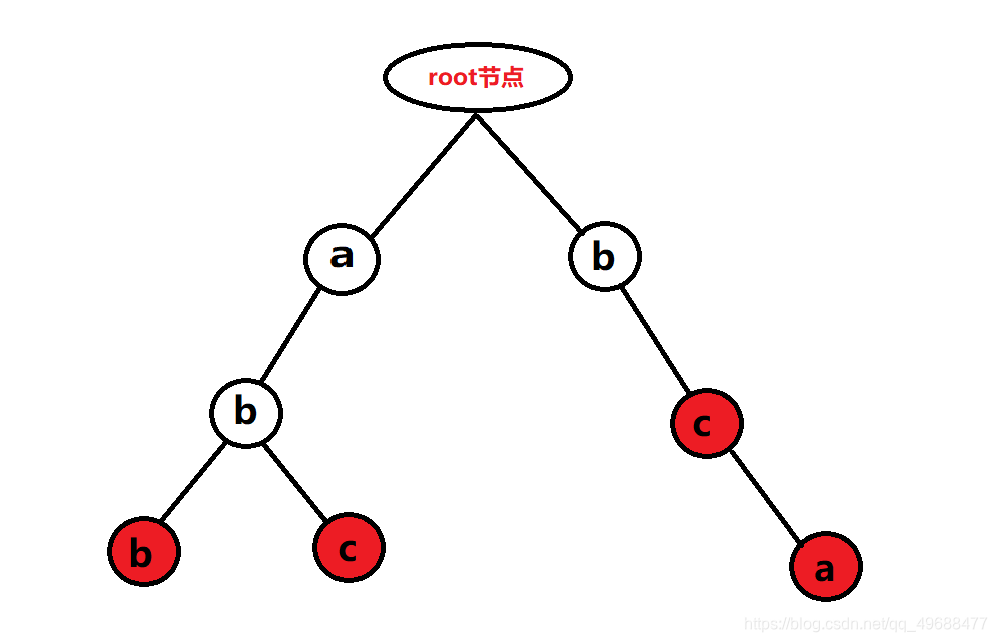
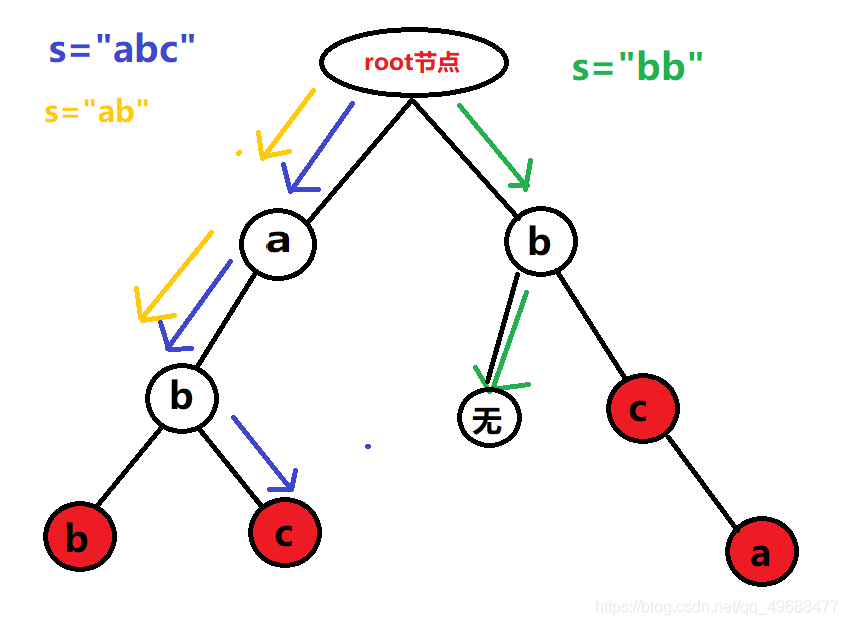
apple、app、apply都共享app前缀)。字典树通过让拥有相同前缀的字符串共享同一部分路径,将冗余的前缀合并,从而实现空间和时间的优化。比如插入字符串单"abc",“abb”,“bca”,"bc"。红点代表有一个以此节点为终点的单词。
然后,我们如果要查找某个单词如s=“abc”,就可以这样
构建字典树
int id = 0;             // 节点计数器:为新建节点分配唯一编号(根节点固定为0)
int cnt[N];             // cnt[p]:以节点p对应的前缀的模式串数量(核心统计值)
unordered_map<int, int> node[N];  // 每个节点的子节点映射:
                                 // node[p]是哈希表,键=字符转换后的索引,值=子节点编号
插入模式串以构建字典树
void insert(string s){
    int p = 0;  // 从根节点(编号0)开始遍历
    for(int i = 0; i < s.size(); ++i){  // 遍历字符串的每个字符
        int t = change(s[i]);  // 字符转索引
        if(node[p][t] == 0){  // 若当前节点p的t字符对应的子节点不存在
            id++;  // 新建节点,编号自增
            node[p][t] = id;  // 记录子节点编号
        }
        p = node[p][t];  // 移动到子节点
        cnt[p]++;  // 该前缀的模式串数量+1
    }
}
在字典树上查找文本串
int find(string s){
    int p = 0;  // 从根节点开始遍历
    for(int i = 0; i < s.size(); ++i){  // 遍历查询字符串的每个字符
        int t = change(s[i]);  // 字符转索引
        if(node[p].count(t) == 0) return 0;  // 子节点不存在,返回0
        p = node[p][t];  // 移动到子节点
    }
    return cnt[p];  // 返回该前缀的模式串数量
}
代码通过change函数实现了大小写字母均支持的字典树
const int N = 1e5 + 5;
int id = 0;
int cnt[N];
unordered_map<int, int> node[N];

int change(char c){
    if(c >= 'a' && c <= 'z') return c - 'a';
    if(c >= 'A' && c <= 'Z') return 26 + c - 'A';
    return -1;
}

void insert(string s){
    int p = 0;
    for(int i = 0; i < s.size(); ++i){
        int t = change(s[i]);
        if(node[p][t] == 0){
            id++;
            node[p][t] = id;
        }
        p = node[p][t];
        cnt[p]++;
    }
}

int find(string s){
    int p = 0;
    for(int i = 0; i < s.size(); ++i){
        int t = change(s[i]);
        if(node[p].count(t) == 0) return 0;
        p = node[p][t];
    }
    return cnt[p];
}

void solve(){
    int n, q;
    string s, t;
    cin >> n >> q;
    for(int i = 0; i < n; ++i){
        cin >> s;
        insert(s);
    }
    while(q--){
        cin >> t;
        cout << find(t) << endl;
    }
}

 浙公网安备 33010602011771号