
【java】javaSE知识梳理-反射机制
反射机制,即动态的处理类信息
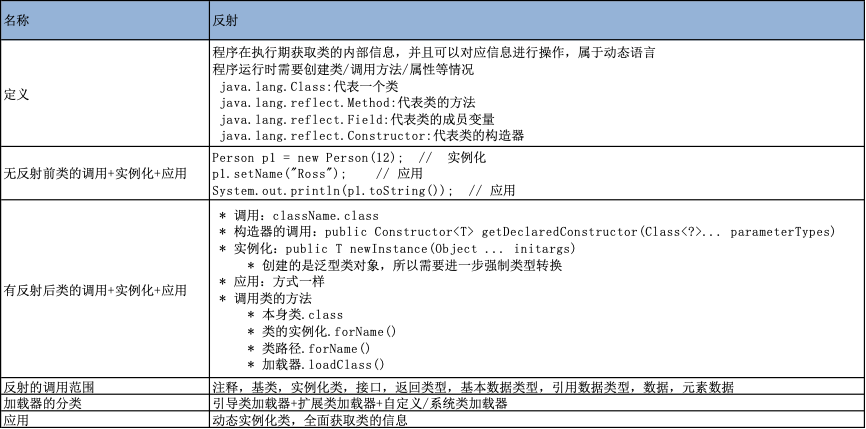
反射的应用


package javaLang.reflect.methods;

import org.junit.Test;

import java.lang.annotation.ElementType;
import java.lang.reflect.Constructor;
import java.lang.reflect.Field;
import java.lang.reflect.Method;

/**
 * @author ChenDan
 * @create 2021-06-03
 * @desc
 */
public class ReflectTest {

    /**
     * 对应Class实例可以是如下结构
     */
    @Test
    public void test4() {
        Class c1 = Object.class;  // 类
        Class c2 = Comparable.class; // 接口
        Class c3 = String[].class; // 饮用数据类
        Class c4 = ElementType.class; // 元素类型
        Class c5 = Override.class; // 注解
        Class c6 = int.class;  // 基本数据类型
        Class c7 = void.class; // 数据返回类型
        Class c8 = Class.class;  // 基类
        Class c9 = Object.class;
        int[] i = new int[12];
        Class c10 = i.getClass(); // 数组类
    }

    /**
     * 关于java.lang.Class类的理解
     * 1.类的加载过程:
     *     程序经过javac.exe命令以后,会生成一个或多个字节码文件(.class结尾)。
     *     接着我们使用java.exe命令对某个字节码文件进行解释运行。相当于将某个字节码文件
     *     加载到内存中。此过程就称为类的加载。加载到内存中的类,我们就称为运行时类,此
     *     运行时类,就作为Class的一个实例。
     * 2.换句话说,Class的实例就对应着一个运行时类。
     * 3.加载到内存中的运行时类,会缓存一定的时间。在此时间之内,我们可以通过不同的方式来获取此运行时类。
     * 类的属性:.class
     * 类对象的方法:public final native Class<?> getClass()
     * 类的目录:public static Class<?> forName(String className)
     * 加载器:ReflectTest.class.getClassLoader()
     */
    @Test
    public void test3() throws Exception{
        // 1,通过类的属性调用类.class
        Class clazz = Person.class;
        System.out.println(clazz);

        // 2,通过对象调用类.getClass()
        Person person = new Person();
        Class clazz1 = person.getClass();
        System.out.println(clazz1);

        // 通过Class的静态方法调用类
        Class clazz2 = Class.forName("javaLang.reflect.methods.Person");
        System.out.println(clazz2);

        // 通过加载器classLoader调用类
        ClassLoader classLoader = ReflectTest.class.getClassLoader();
        Class clazz3 = classLoader.loadClass("javaLang.reflect.methods.Person");
        System.out.println(clazz3);

    }

    /**
     * 有了反射之后的类的初始化+调用
     * Class clazz = Person.class;
     * 获取构造函数
         * public Constructor<T> getConstructor(Class<?>... parameterTypes)
         * 实例化:public T newInstance(Object ... initargs)
     * 获取属性
         * public Field getDeclaredField(String name)
         * 调用:public void set(Object obj, Object value)
     * 获取方法
         * public Method getDeclaredMethod(String name, Class<?>... parameterTypes)
         * 调用:public Object invoke(Object obj, Object... args),返回参数
     * 私有类型访问
         * public void setAccessible(boolean flag)-true
     */
    @Test
    public void test2() throws Exception{
        Class clazz = Person.class;

        // 通过反射创建Person对象:类+获取对应构造方法+实例化+强制类型转换
        Constructor cons = clazz.getConstructor(String.class,int.class);
        Object obj = cons.newInstance("Joey",43);
        Person p = (Person) obj;
        System.out.println(p.toString());

        // 通过反射调用对象指定的属性+方法
        Field age = clazz.getDeclaredField("age");
        age.set(p,54);
        System.out.println(p.toString());
//        Field name = clazz.getDeclaredField("name"); //IllegalAccessException
//        name.set(p,"Phoebe");

        Method show = clazz.getDeclaredMethod("show");
        show.invoke(p);

        // 通过反射,调用类中的私有结构-构造器+方法+属性
        Constructor cons1 = clazz.getDeclaredConstructor(String.class);
        cons1.setAccessible(true);
        Person p1 = (Person) cons1.newInstance("Rachel");
        System.out.println(p1);

        Field name = clazz.getDeclaredField("name");
        name.setAccessible(true);
        name.set(p1,"Monica");
        System.out.println(p1);

        Method showNation = clazz.getDeclaredMethod("showNation", String.class);
        showNation.setAccessible(true);
        String nation = (String)showNation.invoke(p1, "中国");
        System.out.println(nation);
    }

    // 反射之前,类的初始化+调用
    @Test
    public void test1() {
        Person p1 = new Person("Ross",32);
        p1.age = 67;
        System.out.println(p1.toString());

        p1.show();
    }
}
关联自定义类
package javaLang.reflect.methods;

/**
 * @author ChenDan
 * @create 2021-06-03
 * @desc
 */
public class Person {
    private String name;
    public int age;

    @Override
    public String toString() {
        return "Person{" +
                "name='" + name + '\'' +
                ", age=" + age +
                '}';
    }

    public String getName() {
        return name;
    }

    public void setName(String name) {
        this.name = name;
    }

    public int getAge() {
        return age;
    }

    public void setAge(int age) {
        this.age = age;
    }

    private Person(String name) {
        this.name = name;
    }

    public Person(String name, int age) {
        this.name = name;
        this.age = age;
    }

    public Person() {
        System.out.println("Person()");
    }

    public void show() {
        System.out.println("你好,我是一个人");
    }

    private String showNation(String nation) {
        System.out.println("我的国际是:" + nation);
        return nation;
    }
}
使用反射动态创建类
package javaLang.reflect.methods;

import org.junit.Test;

import java.util.Random;
/**
 * @author ChenDan
 * @create 2021-06-06
 * @desc 通过反射创建对应的运行时类的对象
 */
public class NewInstanceTest {

    //使用反射的动态性,实例化对象
    @Test
    public void test2() throws Exception {
        for (int i = 0; i < 100; i++) {
            int num = new Random().nextInt(3);//0,1,2
            String classPath = "";
            switch(num){
                case 0:
                    classPath = "java.util.Date";
                    break;
                case 1:
                    classPath = "java.lang.Object";
                    break;
                case 2:
                    classPath = "javaLang.reflect.methods.Person";
                    break;
            }
            Object obj = getInstance(classPath);
            System.out.println("i=" + i + ": " + obj);
        }
    }

    /*
    创建一个指定类的对象。
    classPath:指定类的全类名
     */
    public Object getInstance(String classPath) throws Exception {
        Class clazz =  Class.forName(classPath);
        return clazz.newInstance();
    }

    @Test
    public void test1() throws IllegalAccessException, InstantiationException {
        Class<Person> clazz = Person.class;
        Person person = clazz.newInstance();
        System.out.println(person);
    }

}
加载器的应用-只能用扩展类+自定义加载器
package javaLang.reflect.methods;

import org.junit.Test;

import java.io.FileInputStream;
import java.io.IOException;
import java.io.InputStream;
import java.util.Properties;

/**
 * @author ChenDan
 * @create 2021-06-06
 * @desc
 */
public class ClassLoaderTest {

    /**
     * Properties:用来读取配置文件。
     */
    @Test
    public void test2() throws IOException {
        Properties properties = new Properties();

        //方式一:FileInputStream流读取--默认地址在当前module下--不建议默认地址
//        FileInputStream fis = new FileInputStream("jdbc.properties");
        FileInputStream fis = new FileInputStream("src///jdbc1.properties");
        properties.load(fis);
        String user = properties.getProperty("user");
        String password = properties.getProperty("password");
        System.out.println("user = " + user + ",password = " + password);
        fis.close();

        // 方式二:ClassLoader读取--默认地址在当前的src下
        ClassLoader classLoader = ClassLoaderTest.class.getClassLoader();
        InputStream is = classLoader.getResourceAsStream("jdbc1.properties");
        properties.load(is);
        String user1 = properties.getProperty("user");
        String password1 = properties.getProperty("password");
        System.out.println("user = " + user1 + ",password = " + password1);
        is.close();
    }

    /**
     * 加载器分类
     * 引导类:系统自动,核心模块类
     * 扩展类:java.ext.jar下的jar库
     * 自定义类-系统类:自己定义的类
     */
    @Test
    public void test1(){
        // 自定义类-系统类
        ClassLoader classLoader = ClassLoaderTest.class.getClassLoader();  // 自定义类加载器
        System.out.println(classLoader);

        // 扩展类
        ClassLoader classLoader1 = classLoader.getParent();  // 扩展类加载器
        System.out.println(classLoader1);

        // 自定义类-系统类
        ClassLoader classLoader2 = classLoader1.getParent(); // 系统类加载器
        System.out.println(classLoader2);

        // 当前类使用的哪种加载器
        ClassLoader classLoader3 = ClassLoaderTest.class.getClassLoader();
        System.out.println(classLoader3);
    }
}
全面获取类的信息
package javaLang.reflect.other;

import org.junit.Test;

import java.lang.annotation.Annotation;
import java.lang.reflect.*;

/**
 * @author ChenDan
 * @create 2021-06-06
 * @desc
 */
public class ReflectionTest {
    Class clazz = Person.class;

    /**
     * 权限修饰符  返回值类型  方法名(参数类型1 形参名1,...) throws XxxException{}
     */
    @Test
    public void testOther() throws Exception {
        Method[] declaredMethods = clazz.getDeclaredMethods();
//        Field[] declaredFields = clazz.getDeclaredFields();
//        Annotation[] declaredAnnotations = clazz.getDeclaredAnnotations();
//        Constructor[] declaredConstructors = clazz.getDeclaredConstructors();

        Class[] interfaces = clazz.getInterfaces();// 接口
        Package aPackage = clazz.getPackage();// 包名
        Class superclass = clazz.getSuperclass();// 父类
        Type genericSuperclass = clazz.getGenericSuperclass();// 泛型

        System.out.println(aPackage);
        System.out.println(superclass);
        System.out.println(genericSuperclass);


        for (Method method:declaredMethods) {
            // 方法名
            System.out.print(method.getName() + "\t");
            // 注释
            Annotation[] annotations = method.getAnnotations();
            for (Annotation annotation:annotations) {
                System.out.print("annotations:" + annotation + "\t");
            }
            // 权限修饰符
            System.out.print("modifier:" + Modifier.toString(method.getModifiers()) + "\t");
            // 返回类型
            System.out.print("returnType:" + method.getReturnType() + "\t");
            // 参数变量
            System.out.print("parameterTypes:");
            Type[] parameterTypes = method.getGenericParameterTypes();
            for (Type para:parameterTypes) {
                System.out.print(para.getTypeName() + "\t");
            }
            // 抛出的异常
            System.out.print("exceptionTypes:");
            Type[] exceptionTypes = method.getExceptionTypes();
            for (Type exception:exceptionTypes) {
                System.out.print(exception.getTypeName() + "\t");
            }
            System.out.println();
        }
    }

    /**
     * 获取指定构造器
         * 获取构造器-public:public Constructor<T> getConstructor(Class<?>... parameterTypes)
         * 获取构造器-所有:public Constructor<T> getDeclaredConstructor(Class<?>... parameterTypes)
         * 实例化构造器:public T newInstance(Object ... initargs)
     */
    @Test
    public void testConstructor() throws Exception {
        // 获取构造器-public
        Constructor constructor1 = clazz.getConstructor();
        Person person1 = (Person) constructor1.newInstance();
        System.out.println(person1.toString());
        // 获取构造器-所有
        Constructor constructor2 = clazz.getDeclaredConstructor(String.class);
        constructor2.setAccessible(true);
        Person person2 = (Person) constructor2.newInstance("Ross");
        System.out.println(person2.toString());
        // 获取构造器-默认
        Constructor constructor3 = clazz.getDeclaredConstructor(String.class,int.class,int.class);
        Person person3 = (Person) constructor3.newInstance("Rachel",12,43);
        System.out.println(person3.toString());
    }

    /**
     * 获取方法
         * 获取方法-public:public Method getMethod(String name, Class<?>... parameterTypes)
         * 获取方法-所有:public Method getDeclaredMethod(String name, Class<?>... parameterTypes)
         * 方法调用:public Object invoke(Object obj, Object... args)
             * 返回类型Object是数据的变量
     */
    @Test
    public void testMethod() throws Exception {
        Person person = (Person)clazz.newInstance();
        // 获取方法-public
        Method info = clazz.getMethod("info");
        info.invoke(person);
        // 获取方法-所有
        Method show = clazz.getDeclaredMethod("show",String.class);
        show.setAccessible(true);
        System.out.println(show.invoke(person,"China"));
        // 获取方法-所有-静态-invoke中的参数可以是基类
        Method showDesc = clazz.getDeclaredMethod("showDesc");
        showDesc.setAccessible(true);
        System.out.println(showDesc.invoke(Person.class));
    }

    /**
     * 获取属性
         * 获取属性-public:public Field getField(String name)
         * 获取属性- 所有:public Field getDeclaredField(String name)
         * 赋值:public void set(Object obj, Object value)
         * 获取:public Object get(Object obj)
         * ** 私有化可访问:public void setAccessible(boolean flag)
     */
    @Test
    public void testField() throws Exception{
        Person person = (Person)clazz.newInstance();

        Field id = clazz.getField("id");  // 只能获取类的public字段
        id.set(person,123);
        System.out.println(person.id);
        System.out.println(id.get(person));

        Field name = clazz.getDeclaredField("name");  // 可以获取一个类的所有字段.
        name.setAccessible(true);
        name.set(person,"Ross");
        System.out.println(name.get(person));
    }
}
package javaLang.reflect.other;

/**
 * @author ChenDan
 * @create 2021-06-06
 * @desc
 */
public class Person extends Creature<String> implements Comparable<String>,MyInterface{
    private String name;
    int age;
    public int id;

    public Person() {
    }

    @MyAnnotation(value="abc")
    private Person(String name) {
        this.name = name;
    }

    Person(String name, int age, int id) {
        this.name = name;
        this.age = age;
        this.id = id;
    }

    @MyAnnotation
    private String show(String nation){
        System.out.println("我的国籍是:" + nation);
        return nation;
    }

    public String display(String interests,int age) throws NullPointerException,ClassCastException{
        return interests + age;
    }

    @Override
    public void info() {
        System.out.println("我是一个人");
    }

    @Override
    public int compareTo(String o) {
        return 0;
    }

    private static void showDesc(){
        System.out.println("我是一个可爱的人");
    }

    @Override
    public String toString() {
        return "Person{" +
                "name='" + name + '\'' +
                ", age=" + age +
                ", id=" + id +
                '}';
    }
}
package javaLang.reflect.other;

import java.io.Serializable;

/**
 * @author ChenDan
 * @create 2021-06-06
 * @desc
 */
public class Creature<T> implements Serializable {
    private char gender;
    public double weight;

    private void breath(){
        System.out.println("生物呼吸");
    }

    public void eat(){
        System.out.println("生物吃东西");
    }
}
package javaLang.reflect.other;

/**
 * @author ChenDan
 * @create 2021-06-06
 * @desc
 */
public interface MyInterface {
    void info();
}
package javaLang.reflect.other;

import java.lang.annotation.Retention;
import java.lang.annotation.RetentionPolicy;
import java.lang.annotation.Target;

import static java.lang.annotation.ElementType.*;
import static java.lang.annotation.ElementType.LOCAL_VARIABLE;

/**
 * @author ChenDan
 * @create 2021-06-06
 * @desc
 */
@Target({TYPE, FIELD, METHOD, PARAMETER, CONSTRUCTOR, LOCAL_VARIABLE})
@Retention(RetentionPolicy.RUNTIME)
public @interface MyAnnotation {
    String value() default "hello";
}

 浙公网安备 33010602011771号