
【java】javaSE知识梳理-静态数组+动态数组(集合)
数组:同数据类型,同名称,一定顺序排列,编号[0,^]
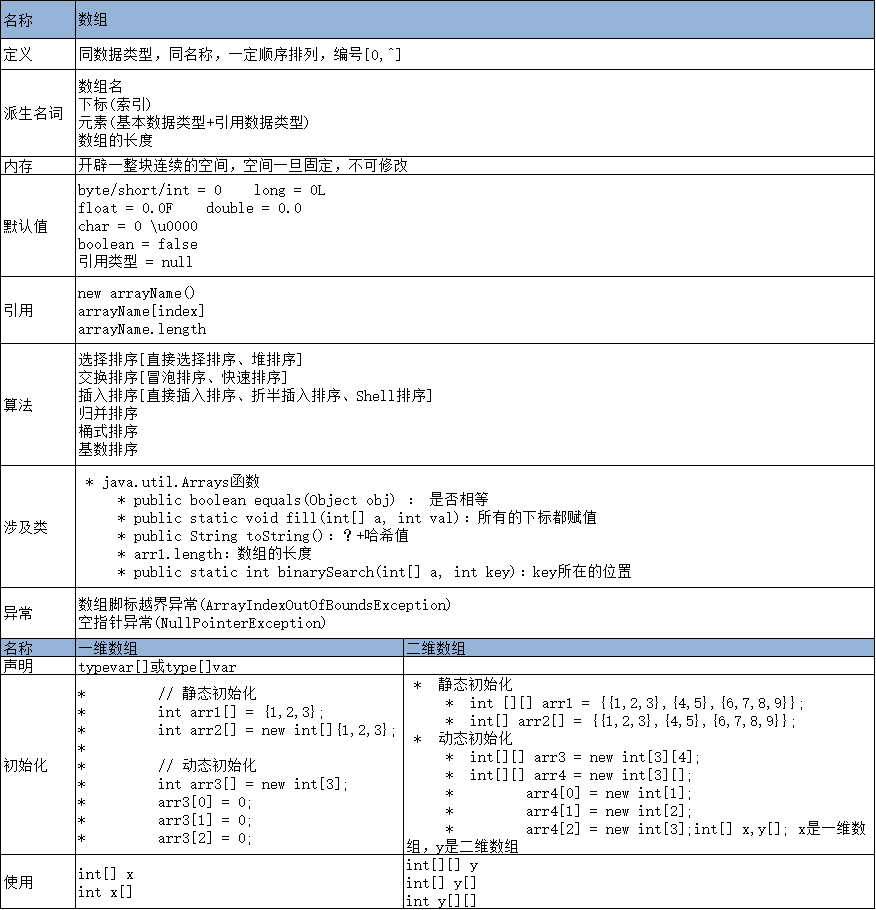
数组声明+初始化


package javaUtil.arrays.constructor;

import org.junit.Test;

/**
 * @desc
 * @author ChenDan
 * @create 2021-05-23
 */
public class ConstructorsTest {
    /**
     * 一维数
*         // 静态初始化
*         int arr1[] = {1,2,3};
*         int arr2[] = new int[]{1,2,3};
*
*         // 动态初始化
*         int arr3[] = new int[3];
*         arr3[0] = 0;
*         arr3[1] = 0;
*         arr3[2] = 0;
     */
    @Test
    public void test1() {
        // 静态初始化
        int arr1[] = {1,2,3};
        int arr2[] = new int[]{1,2,3};

        // 动态初始化
        int arr3[] = new int[3];
        arr3[0] = 0;
        arr3[1] = 0;
        arr3[2] = 0;
    }

    /**
     *  二维数组
 *  静态初始化
     *  int [][] arr1 = {{1,2,3},{4,5},{6,7,8,9}};
     *  int[] arr2[] = {{1,2,3},{4,5},{6,7,8,9}};
 *  动态初始化
     *  int[][] arr3 = new int[3][4];
     *  int[][] arr4 = new int[3][];
     *         arr4[0] = new int[1];
     *         arr4[1] = new int[2];
     *         arr4[2] = new int[3];
     */
    @Test
    public void test2() {

        // 静态初始化
        int [][] arr1 = {{1,2,3},{4,5},{6,7,8,9}};
        int[] arr2[] = {{1,2,3},{4,5},{6,7,8,9}};

        // 动态初始化1
        int[][] arr3 = new int[3][4];
        for (int i = 0; i < arr3.length; i++) {
            for (int j = 0; j < arr3[i].length ; j++) {
                arr3[i][j] = i*j;
            }
        }
        // 动态初始化2
        int[][] arr4 = new int[3][];
        arr4[0] = new int[1];
        arr4[1] = new int[2];
        arr4[2] = new int[3];

    }
}
java.util.Arrays类的使用
package javaUtil.arrays.methods;

import org.junit.Before;
import org.junit.Test;

import java.util.Arrays;

/**
 * @desc
 * @author ChenDan
 * @create 2021-05-23
 */
public class MethodsTest {
    int[] arr1 = new int[3];
    int[][] arr2 = new int[3][];

    /**
     * 数组遍历
     */
    @Test
    public void iterator() {
        for (int arr:arr1) {
            System.out.println(arr);
        }

        for (int i = 0; i < arr2.length; i++) {
            for (int arr:arr2[i]) {
                System.out.println(arr);
            }
        }
    }

    /**
 * java.util.Arrays函数
     * public boolean equals(Object obj) : 是否相等
     * public static void fill(int[] a, int val):所有的下标都赋值
     * public String toString():?+哈希值
     * arr1.length:数组的长度
     * public static int binarySearch(int[] a, int key):key所在的位置
     */
    @Test
    public void testMethods() {
        System.out.println(arr1.equals(arr2));
        Arrays.fill(arr1,43);
        System.out.println(arr1.toString());
        System.out.println(arr1.length);
        Arrays.sort(arr1);
        Arrays.binarySearch(arr1,12);
    }

    @Before
    public void before() {
        for (int i = 0; i < arr1.length; i++) {
            arr1[i] = i;
        }

        for (int i = 0; i < arr2.length; i++) {
            arr2[i] = new int[i];
            for (int j = 0; j < arr2[i].length; j++) {
                arr2[i][j] = i * j;
            }
        }
    }

}
集合是静态数组的延伸
列表和接口如下:
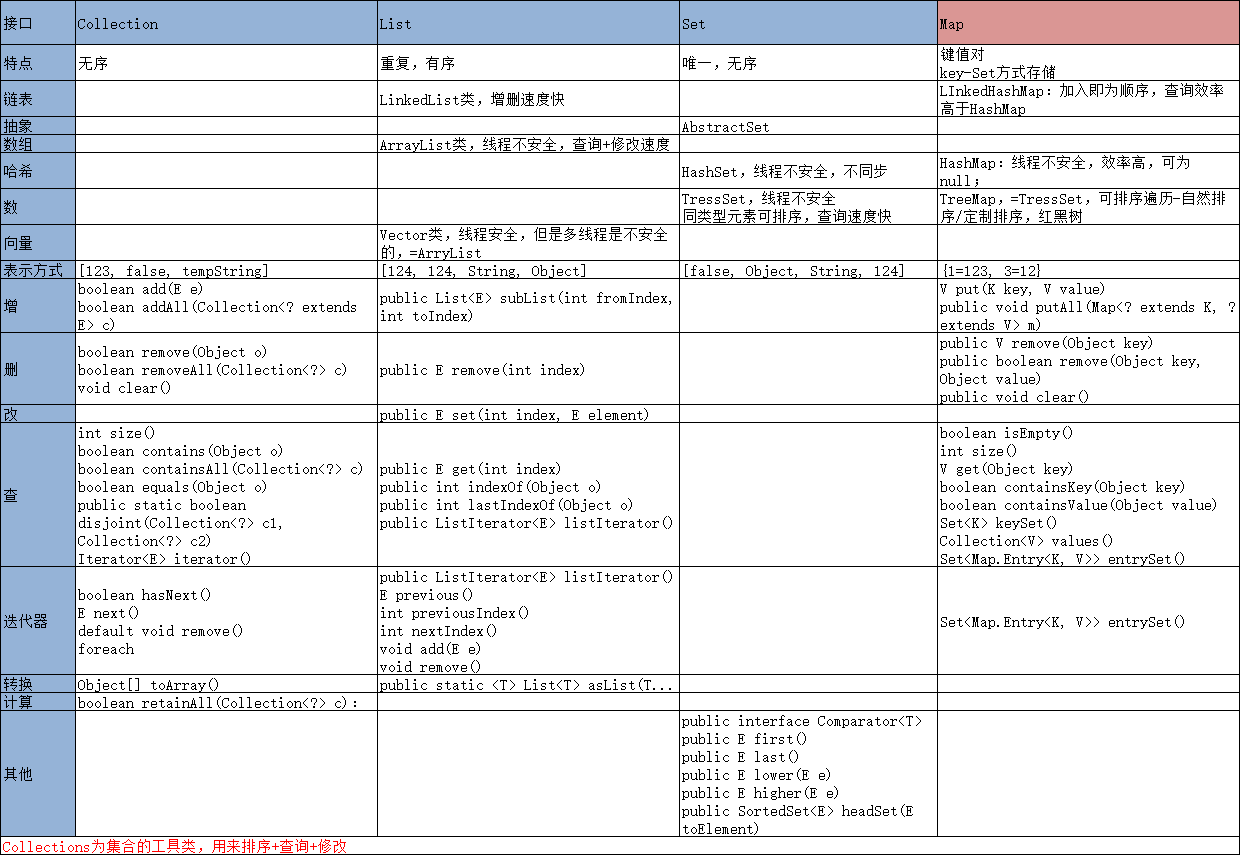
Interface Collection<E>接口
import org.junit.Test;

import java.util.*;

/**
 * Collection 方法
 * @author ChenDan
 * @create 2021-05-15
 */
public class Methods {
    Collection coll = new ArrayList();
    Collection coll1 = new ArrayList();

    /**
     * <p>addition:<pre>
     *     boolean add(E e)
     *     boolean addAll(Collection<? extends E> c)
     *     </pre>
     */
    @Test
    public void addTest() {
        coll.add("123Temp");

        coll1.addAll(coll);

        Iterator iterator = coll1.iterator();
        while(iterator.hasNext()) {
            System.out.println(iterator.next());
        }
    }

    /**
     * <p>deletion:<pre>
     *     boolean remove(Object o)
     *     boolean removeAll(Collection<?> c)
     *     void clear()</pre>
     */
    @Test
    public void deleTest() {
        coll.add(123);
        coll1.add(123);
        coll1.add(false);
        coll1.add(new String("tempString"));

        System.out.println(coll1);
        coll1.remove(new String("tempString"));
        coll1.remove(true);
        coll1.removeAll(coll);
        System.out.println(coll1);
        coll.clear();
        System.out.println(coll);
    }

    /**
     * <p>modify:<pre></pre>
     */
    @Test
    public void modifyTest() {
        coll1.add(123);
        coll1.add(false);
        coll1.add(new String("tempString"));
        coll1.addAll(coll);

        System.out.println(coll1);
    }

    /**
     * <p>check:<pre>
     *     boolean isEmpty()
     *     int size()
     *     boolean contains(Object o)
     *     Iterator<E> iterator()
     *     boolean containsAll(Collection<?> c)
     *     boolean equals(Object o)
     *     boolean retainAll(Collection<?> c)
     *     public static boolean disjoint(Collection<?> c1, Collection<?> c2)</pre>
     */
    @Test
    public void checkTest() {
        coll.add(123);
        coll1.add(123);
        coll1.add(false);
        coll1.add(new String("tempString"));

        System.out.println(coll1.isEmpty());  // 空?
        System.out.println(coll1.size());  // 长度
        System.out.println(coll1.contains(true));  // 是否包含Object对象?
        System.out.println(coll1.containsAll(coll));  // 是否包含Collection对象?
        System.out.println(coll1.retainAll(coll));  // 获取两个集合的交集
        System.out.println(coll1.equals(coll));  // 是否等于Object对象?
        System.out.println(Collections.disjoint(coll, coll1)); // 两个Collection对象有没有共同元素
    }

    /**
     * <p>conversion:<pre>
     *     Object[] toArray()
     *     public static <T> List<T> asList(T... a)</pre>
     */
    @Test
    public void converTest() {
        Collection coll1 = new ArrayList();

        coll1.add(123);
        coll1.add(false);
        coll1.add(new String("tempString"));
        System.out.println(coll1);

        Object[] objs = coll1.toArray();  // 集合->数组
        for (Object obj:objs) {
            System.out.println(obj);
        }

        List list = Arrays.asList(new String[]{"AA", "BB", "CC"}); // 数组 -> 集合
        System.out.println(list);
    }

}
Interface List<E>接口
package javaUtil.list.method;

import org.junit.Test;

import java.util.*;

/**
 * <p>List 有序可重复集合,序列
 * @author ChenDan
 */
public class Methods {
    ArrayList list = new ArrayList();
    Collection coll = new ArrayList();

    /**
     * <p>addition <pre>
     *     public List<E> subList(int fromIndex, int toIndex):获取集合中的子集合
     *     </pre>
     */
    @Test
    public void addTest() {

        list.add(0,124);
        list.add(false);
        list.add("String");
        list.add(3,124);
        list.add(new String("Object"));
        list.addAll(coll);

        System.out.println(list);

        List list1 = list.subList(1,4);  // 获取集合中的部分元素
        System.out.println(list1);
    }

    /**
     * <p>deletion <pre>
     *     public E remove(int index):指定index元素删除
     *     </pre>
     */
    @Test
    public void deleTest() {
        list.add(124);

        System.out.println(list);
        list.remove(0); // 指定index元素删除
    }

    /**
     * <p>modify <pre>
     *     public E set(int index, E element):指定index位置元素替换为element
     *     </pre>
     */
    @Test
    public void modifyTest() {
        list.add(124);
        list.add(1,124);
        list.add(false);
        list.add("String");
        list.add(new String("Object"));

        System.out.println(list);
        list.set(1,123);
        System.out.println(list);
    }

    /**
     * <p>check <pre>
     *     public E get(int index):获取指定index位置的元素
     *     public int indexOf(Object o):首次出现o对象的集合内的位置
     *     public int lastIndexOf(Object o):最后一次出现o对象的集合内的位置
     *     public ListIterator<E> listIterator():集合迭代器
     *     </pre>
     */
    @Test
    public void checkTest() {
        list.add(124);
        list.add(1,124);
        list.add(false);
        list.add("String");
        list.add(new String("Object"));

        for (int i = 0; i < list.size(); i++) { // 长度
            System.out.println(list.get(i));  // 获取1
        }
        System.out.println(list.indexOf(124)); // 首次出现的位置
        System.out.println(list.lastIndexOf(124)); // 最后一次出现的位置

        ListIterator listIterator = list.listIterator();  // 集合迭代器
        while(listIterator.hasNext()) {
            System.out.println(listIterator.next());
        }

    }

    /**
     * <p>check <pre>
     *     public ListIterator<E> listIterator():集合迭代器
     *     E previous():集合前一个元素
     *     int previousIndex():集合前一个元素的位置
     *     int nextIndex():集合下一个元素的位置
     *     void add(E e):下一个位置添加元素
     *     void remove():删除对应位置的元素
     *     </pre>
     */
    @Test
    public void interatorTest() {
        list.add(124);
        list.add(1,124);
        list.add(false);
        list.add("String");
        list.add(new String("Object"));

        ListIterator listIterator = list.listIterator();  // 集合迭代器

        System.out.println(listIterator.nextIndex()); // 集合下一个元素的位置
        listIterator.next();
        System.out.println(listIterator.previous()); // 集合前一个元素
        System.out.println(listIterator.previousIndex()); // 集合前一个元素的位置
        System.out.println(list);
        listIterator.add("iterator"); // 下一个位置添加元素
        System.out.println(list);
        listIterator.next();
        listIterator.remove(); // 删除对应位置的元素
        System.out.println(list);
    }

    /**
     * <p>ArrayList <pre>
     *     Constructors
     *          public ArrayList()
     *          public ArrayList(Collection<? extends E> c)
     *          public ArrayList(int initialCapacity)
     *     Methods--modify
     *          public E set(int index, E element)
     *     Methods--check
     *          public boolean contains(Object o)
     *          public boolean containsAll(Collection<?> c)
     *          public boolean isEmpty()
     *          public int size()
     *          public E get(int index)
     *          public int indexOf(Object o)
     *          public int lastIndexOf(Object o)
     *          public ListIterator<E> listIterator():集合迭代器
     *     </pre>
     */
    @Test
    public void arrayListTest() {
        ArrayList arraylist = new ArrayList();  // 构建容量为10的空列表
        ArrayList arraylist1 = new ArrayList(coll); // 构建以集合为基础的列表
        ArrayList arraylist2 = new ArrayList(1); // 构建容量为1的空列表

        arraylist.add(123);
        arraylist.add(true);
        arraylist.add(123);
        arraylist.add("123");

        arraylist.set(1,"tmrp"); // 指定index位置元素替换为element

        System.out.println(arraylist.contains("123"));
        System.out.println(arraylist.containsAll(coll));
        System.out.println(arraylist.isEmpty()); // 列表中是否为空
        System.out.println(arraylist.size()); // 列表长度
        System.out.println(arraylist);
        System.out.println(arraylist.get(0)); // 获取指定index位置的元素
        System.out.println(arraylist.indexOf(123)); // 首次出现o对象的集合内的位置
        System.out.println(arraylist.lastIndexOf(123)); // 最后一次出现o对象的集合内的位置
        System.out.println(arraylist.contains("123"));  // 列表中是否包含o对象
        System.out.println(arraylist.containsAll(coll));  // 列表中是否包含Collection对象

        ListIterator listIterator = arraylist.listIterator();
        while(listIterator.hasNext()) {
            System.out.println(listIterator.next());
        }

        System.out.println(arraylist);
    }

    /**
     * <p>linkedList <pre>
     *     Constructors
     *          public LinkedList()
     *          public LinkedList(Collection<? extends E> c)
     *     Methods--additon
     *          void add(int index, E element)
     *          boolean addAll(int index, Collection<? extends E> c)
     *          public void addFirst(E e)
     *          public void addLast(E e)
     *     Methods--deletion
     *          public E remove()
     *          public boolean remove(Object o)
     *          public boolean removeFirstOccurrence(Object o)
     *          public boolean removeLastOccurrence(Object o)
     *          public E remove(int index)
     *          public E removeFirst()
     *          public E removeLast()
     *     </pre>
     */
    @Test
    public void linkedListTest() {
        coll.add(true);
        coll.add('C');
        coll.add(456);
        coll.add(new String[]{"AA", "BB", "tempString"});

        LinkedList linkedList = new LinkedList(); // 创建空列表
        LinkedList linkedList1 = new LinkedList(coll); // 创建以集合为基础的列表

        linkedList.add(0,"AA");  // 列表index中加入element元素
        linkedList.addAll(1,coll); // 列表index中加入Collection对象
        linkedList.addFirst(true); // 列表首中加入e元素
        linkedList.addLast(new String("money")); // 列表尾中加入e元素

        System.out.println(linkedList);
        linkedList.remove();  // 删除列表首的元素
        linkedList.remove(true); // 删除列表第一个出现的元素
        linkedList.removeFirstOccurrence(true); // 删除列表第一个出现的元素
        linkedList.removeLastOccurrence(true); // 删除列表最后一个出现的元素
        linkedList.remove(1); // 删除index=1的元素
        linkedList.removeFirst(); // 删除列表首的元素
        linkedList.removeLast(); // 删除列表尾的元素
        System.out.println(linkedList);

//        ListIterator listIterator = list.listIterator();
//        while(listIterator.hasNext()){
//            System.out.println(listIterator.next());
//        }

    }

}
Interface Set<E>接口
package javaUtil.set.method;

import org.junit.Test;

import java.util.*;

/**
 * <p>Set接口<pre>
 *      继承了Collection集合接口,未扩展对应信息</pre>
 * <p>HashSet类<pre>
 *      具体化Set接口,未扩展对应信息</pre>
 * <p>TreeSet类<pre>
 *  *      具体化Set接口,扩展对应信息,使得集合可排序</pre>
 * @author ChenDan
 * @create 2021-05-15
 */
public class Methods {
    Collection coll = new ArrayList();
    Set set = new HashSet();
    HashSet hashSet = new HashSet();
    TreeSet treeSet = new TreeSet();
    TreeSet treeSet1 = new TreeSet();

    /**
     * <p>TreeSet <pre>
     *     同类型元素,  自然排序;如果想定制排序,就重写Comparator
     *     public interface Comparator<T>
     *     public E first()
     *     public E last()
     *     public E lower(E e)
     *     public E higher(E e)
     *     public SortedSet<E> headSet(E toElement)
     *     </pre>
     */
    @Test
    public void treeSetTest() {
        TreeSet<Integer> treeSet1 = new TreeSet<Integer>(new Comparator<Integer>() {
            @Override
            public int compare(Integer i1, Integer i2) {
                if(i1 instanceof Integer && i2 instanceof Integer) {
                    Integer str1 = (Integer) i1;
                    Integer str2 = (Integer) i2;
                    return -Integer.compare(i1,i2);
                }
                throw new RuntimeException("数据类型不一致!");
            }
        });

        treeSet1.add(1);
        treeSet1.add(3);
        treeSet1.add(6);
        treeSet1.add(4);

        System.out.println(treeSet1);
        System.out.println(treeSet1.first()); // 集合中最低元素
        System.out.println(treeSet1.last()); // 集合中最高元素
        System.out.println(treeSet1.lower(3)); // 小于给定元素的最大元素
        System.out.println(treeSet1.higher(3)); // 大于给定元素的最小元素
        System.out.println(treeSet1.headSet(4)); // 小于于给定元素的子集合
    }

    /**
     * <p>addition <pre>
     *     继承了Collection集合接口,未扩展对应信息
     *     哈希函数怎么理解??
     *     </pre>
     */
    @Test
    public void addTest() {

        set.add(124);
        set.add(124);
        set.add(false);
        set.add(new String("Object"));
        set.add(new User("Object",12));  // 自定义的类,需要重写hashCode+equal方法,、
        set.add(new User("Object",12));
        set.addAll(coll);
        System.out.println(set);

        Iterator iterator = set.iterator();
        while(iterator.hasNext()) {
            System.out.print(iterator.hashCode() + ": ");
            System.out.println(iterator.next());
        }

    }

}
相关类
package javaUtil.set.method;

import java.util.Objects;

/**
 * @author ChenDan
 * @create 2021-05-18
 * @desc
 */
public class User {
    private String name;
    private int age;

    public User() {
    }

    public User(String name, int age) {
        this.name = name;
        this.age = age;
    }

    public String getName() {
        return name;
    }

    public void setName(String name) {
        this.name = name;
    }

    public int getAge() {
        return age;
    }

    public void setAge(int age) {
        this.age = age;
    }

    @Override
    public String toString() {
        return "User{" +
                "name='" + name + '\'' +
                ", age=" + age +
                '}';
    }

    @Override
    public boolean equals(Object o) {
        if (this == o) return true;
        if (o == null || getClass() != o.getClass()) return false;
        User user = (User) o;
        return age == user.age && Objects.equals(name, user.name);
    }

    @Override
    public int hashCode() {
        return Objects.hash(name, age);
    }
}
Interface Map<K,V>接口
package javaUtil.map.method;

import org.junit.Test;

import java.util.*;

/**
 * <p>Map接口<pre>
 *     DEFAULT_INITIAL_CAPACITY 默认容量为16
 *      </pre>
 * @author ChenDan
 * @create 2021-05-15
 */
public class Methods {
    Map map = new HashMap();  // 默认容量为16,加载因子0.75,扩容的临界值16 * 0.75 >= 12
    HashMap hashMap = new HashMap();
    LinkedHashMap linkedHashMap = new LinkedHashMap();
    TreeMap treeMap = new TreeMap();

    /**
     * <p>addition <pre>
     *     V put(K key, V value)
     *     public void putAll(Map<? extends K, ? extends V> m)</pre>
     */
    @Test
    public void addTest() {
        map.put("1","123");

        hashMap.put("3","123");
        hashMap.put("3","12");
        hashMap.putAll(map);

        System.out.println(hashMap);
    }

    /**
     * <p>deletion <pre>
     *     public V remove(Object key)
     *     public boolean remove(Object key, Object value)
     *     public void clear()
     *     </pre>
     */
    @Test
    public void deleTest() {
        hashMap.put("1","123");
        hashMap.put("3","123");
        hashMap.put("2","12");

        System.out.println(hashMap);
        hashMap.remove("1");
        System.out.println(hashMap);
        hashMap.remove("2","12");
        hashMap.clear();
        System.out.println(hashMap);
        System.out.println(hashMap.size());
    }

    /**
     * <p>modify <pre>
     *     V put(K key, V value)
     *     </pre>
     */
    @Test
    public void modifyTest() {
        map.put("1","65");
        map.put("1","63");  // 修改

        System.out.println(map);
    }

    /**
     * <p>check <pre>
     *     boolean isEmpty()
     *     int size()
     *     V get(Object key)
     *     boolean containsKey(Object key)
     *     boolean containsValue(Object value)
     *     Set<K> keySet()
     *     Collection<V> values()
     *     Set<Map.Entry<K, V>> entrySet()  ??
     *     </pre>
     */
    @Test
    public void checkTest() {
        map.put("1","123");
        map.put("3",false);
        map.put(2,12);

//        System.out.println(map);
//        System.out.println(map.isEmpty());  // 为空?
//        System.out.println(map.size());  // 长度
//        System.out.println(map.get("2"));  // 获取value值
//        System.out.println(map.containsKey(2));  //  是否有key=2?
//        System.out.println(map.containsValue(2)); //是否有value=2?
//
//        Set keys = map.keySet(); // 获取所有的key
//        System.out.println(keys);
//        Collection values = map.values(); // 获取所有的value
//        System.out.println(values);

        Set mappings = map.entrySet(); // 方式一:获取所有的key-value集合
        System.out.println(mappings);
        for (Object mapping:mappings) {
            Map.Entry entry = (Map.Entry) mapping;
            System.out.println("Key是:" + entry.getKey() + ", Value是:" + entry.getValue());
        }

        Set keySet = map.keySet();  // 方式二:获得key,根据key去找value
        Iterator iterator = keySet.iterator();
        while(iterator.hasNext()) {
            Object key = iterator.next();
            Object value = map.get(key);
            System.out.println(key + ":" + value);
        }
    }

}
-
java.util.Properties 类
-
![]() View Code
View Codepackage javaUtil.properties.method; import org.junit.Test; import java.io.FileInputStream; import java.io.IOException; import java.util.Properties; /** * <p>Properties<pre> * 处理属性文件 * </pre> * @author ChenDan * @create 2021-05-15 */ public class Methods { /** * <p>handling <pre> * public String getProperty(String key) * </pre> */ @Test public void addTest() { FileInputStream fis = null; Properties pros = new Properties(); try { fis = new FileInputStream("jdbc.properties"); pros.load(fis); String name = pros.getProperty("name"); String password = pros.getProperty("password"); String stringName = pros.getProperty("StringName"); System.out.println("name= " + name + ", password= " + password); System.out.println("stringName= " + stringName); } catch (IOException e) { e.printStackTrace(); } } }
java.util.Collections 类
package javaUtil.collections.method;

import org.junit.Test;

import java.util.*;

/**
 * Collections类<pre>
 *     是Set,List,Map的工具类
 *     排序+查询+修改
 * </pre>
 * @author ChenDan
 * @create 2021-05-15
 */
public class Methods {
    List list = new ArrayList();
    /**
     * <p>check:<pre>
     *     </pre>
     */
    @Test
    public void checkTest() {
        list.add(12);
        list.add(23);
        list.add(3);
        list.add(389);

        System.out.println(list);
        System.out.println(Collections.max(list));  //  最大值
        System.out.println(Collections.min(list));  // 最小值
        System.out.println(Collections.frequency(list,3));  // 某元素出现的次数
        System.out.println(Collections.replaceAll(list,3,44));  // 替换
    }

    /**
     * <p>sort:<pre>
     *     public static <T> void sort(List<T> list, Comparator
     *     public static void reverse(List<?> list)
     *     public static void shuffle(List<?> list)
     *     public static <T> void sort(List<T> list, Comparator<? super T> c)
     *     public static void swap(List<?> list, int i, int j)
     *     </pre>
     */
    @Test
    public void sortTest() {
        list.add(12);
        list.add(23);
        list.add(3);
        list.add(389);

        System.out.println(list);
        Collections.sort(list);  //  同类型排序
        Collections.reverse(list);  //  反转
        Collections.shuffle(list);  //  随机排序
//        Collections.sort(list, new Comparator<Object>() {
//        });  //  自定义比较排序-省略
        Collections.swap(list,2,1);  //  交换元素
        System.out.println(list);
    }


}
迭代器,遍历集合:
Interface Iterator<E>接口
package javaUtil.interator;

import org.junit.Test;

import java.util.*;

/**
 * <p>Interator迭代器 <pre>
 *     boolean hasNext():是否可以迭代
 *     E next():下一个元素
 *     default void remove()
 *     foreach</pre>
 * @author ChenDan
 * @create 2021-05-15
 */
public class Methods {

    /**
     * <p>遍历 <pre>
     *     hasNext + next</pre>
     */
    @Test
    public void test1(){  // 迭代遍历输出
        Collection coll1 = new ArrayList();
        coll1.add(123);
        coll1.add(false);
        coll1.add(new String("tempString"));

        Iterator iterator = coll1.iterator();
        // 方法一:无法确定是否完成
//        System.out.println(iterator.next());
//        System.out.println(iterator.next());

        // 方法二:为什么不推荐?
//        for (int i = 0; i < coll1.size(); i++) {
//            System.out.println(iterator.next());
//        }

        // 方法三:推荐
        while(iterator.hasNext()) {
            System.out.println(iterator.next());
        }
    }

    /**
     * <p>错误表达
     */
    @Test
    public void test2() {  // 错误的迭代方式
        Collection coll1 = new ArrayList();
        coll1.add(123);
        coll1.add(false);
        coll1.add(new String("tempString"));

        Iterator iterator = coll1.iterator();
        // 错误方式一:迭代器调用了一次,每次的next也是一次访问
        while(iterator.next() != null) {
            System.out.println(iterator.next());
        }
//        // 错误方式二:每调用一次iterator方法都得到一个新的迭代器
//        while(coll1.iterator().hasNext()){
//            System.out.println(iterator.next());
//        }
    }

    /**
     * <p>deletion <pre>
     *     remove</pre>
     */
    @Test
    public void test3() {  // 删除集合元素
        Collection coll1 = new ArrayList();
        coll1.add(123);
        coll1.add(false);
        coll1.add(new String("tempString"));

        Iterator iterator = coll1.iterator();
        while(iterator.hasNext()) {
            Object obj = iterator.next();
            if("tempString".equals(obj)) {
                iterator.remove();
                System.out.println(obj);
            }
        }
        iterator = coll1.iterator();
        while(iterator.hasNext()) {
            System.out.println(iterator.next());
        }
    }

    /**
     * <p>foreach
     */
    @Test
    public void test4() {
        Collection coll1 = new ArrayList();
        coll1.add(123);
        coll1.add(false);
        coll1.add(new String("tempString"));

        for (Object coll:coll1) {
            System.out.println(coll);
        }

        String[] strs = new String[]{"AA", "BB", "CC"};
        for (String str:strs) {
            System.out.println(str);
        }
    }

}

 浙公网安备 33010602011771号