
【java】javaSE知识梳理-java常用类
比较器

自定义类比较,直接使用(跟常用类一样)


package javaUtil.comparable.method;

import javaLang.comparator.method.Goods;
import org.junit.Test;

import java.util.Arrays;

/**
 * 比较器<pre>
 *     Comparable接口
 *     常用类直接调用现成的compare即可实现
 *     如果不满意现有的比较器,可以自己调用对应接口,重写对应方法
 *     </pre>
 * @author ChenDan
 * @create 2021-05-15
 */
public class Methods {

    /**
     * <p>比较器(内比较器)<pre>
     *      自己定义类,将Comparable重写compare(obj)方法
     *          重写规则:[< == >] [<0 =0 >0]
     *          public static <T> void sort(T[] a, Comparator<? super T> c)</pre>
     */
    @Test
    public void test1() {
        Goods[] goods = new Goods[5];

        for (int i = goods.length - 1; i >= 0; i--) {
            goods[4 - i] = new Goods(Character.toString((char) ('A' + i)), i);
        }

        System.out.println(Arrays.toString(goods));
        Arrays.sort(goods);
        System.out.println(Arrays.toString(goods));

    }

}
自定义类,调用Comparable接口,重写compare方法
package javaLang.comparator.method;

/**
 * @author ChenDan
 * @create 2021-05-16
 * @desc
 */
public class Goods implements Comparable{
    private String name;
    private double price;

    public Goods(){}

    public Goods(String name, double price) {
        this.name = name;
        this.price = price;
    }

    public String getName() {
        return name;
    }

    public void setName(String name) {
        this.name = name;
    }

    public double getPrice() {
        return price;
    }

    public void setPrice(double price) {
        this.price = price;
    }

    @Override
    public String toString() {
        return "Goods{" +
                "name='" + name + '\'' +
                ", price=" + price +
                '}';
    }

    @Override
    public int compareTo(Object o) {
        if(o instanceof Goods) {
            Goods goods = (Goods) o;
            if(this.price > goods.price) {
                return 1;
            }else if(this.price < goods.price){
                return -1;
            }else{
                return 0;
            }
        }
        throw new RuntimeException("传入数据类型不一致!");
    }
}
调用类比较
package javaLang.comparator.method;

import org.junit.Test;

import java.util.Arrays;
import java.util.Comparator;
import java.util.TreeSet;

/**
 * 比较器<pre>
 *     Comparator接口
 *     该接口不能直接调用,而是创建Comparator对象,重写compare方法
 *     </pre>
 * @author ChenDan
 * @create 2021-05-15
 */
public class Methods {

    /**
     * <p>实例化1
     */
    @Test
    public void test1(){
        Comparator com = new Comparator() {
            @Override
            public int compare(Object o1, Object o2) {
                if(o1 instanceof Goods && o2 instanceof Goods) {
                    Goods goods1 = (Goods) o1;
                    Goods goods2 = (Goods) o2;
                    return Double.compare(goods1.getPrice(),goods2.getPrice());
                }
                throw new RuntimeException("数据类型不一致!");
            }
        };

        TreeSet set = new TreeSet(com);
        set.add(new Goods("apple",12.3));
        set.add(new Goods("pear",32.3));
        set.add(new Goods("peach",2.3));

        System.out.println(set);

    }

    /**
     * <p>实例化2
     */
    @Test
    public void test2(){
        Goods[] goods = new Goods[5];

        for (int i = goods.length - 1; i >= 0; i--) {
            goods[4 - i] = new Goods(Character.toString((char) ('A' + i)), i);
        }

        System.out.println(Arrays.toString(goods));

        Arrays.sort(goods, new Comparator<Goods>() {
            @Override
            public int compare(Goods o1, Goods o2) {
                if(o1 instanceof Goods && o2 instanceof Goods){
                    Goods goods1 = (Goods)o1;
                    Goods goods2 = (Goods)o2;
                    if(goods1.getName().equals(goods2.getName())) {
                        return -Double.compare(goods1.getPrice(),goods2.getPrice());
                    }else{
                        return -goods1.getName().compareTo(goods2.getName());
                    }
                }
                throw new RuntimeException("输入的数据类型不一致!");
            }
        });
        System.out.println(Arrays.toString(goods));
    }
}
基本数据类
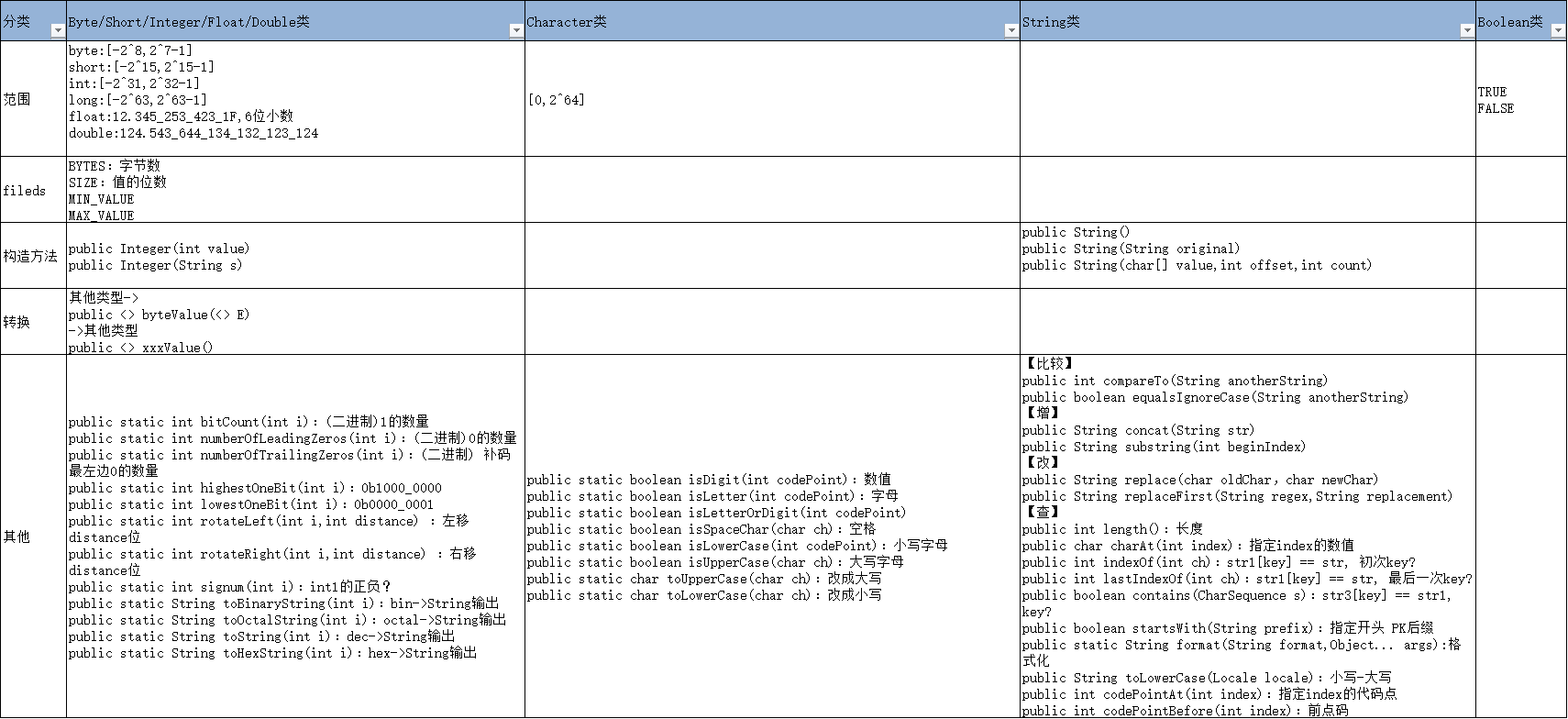
数据类型-基本数据类型
public class BaseDataType {
    /*
     * 数据类型-基本类型-整数型(byte-1/short-2/int-4/long-8)、浮点型(float-4/double-8)、布尔型(boolean)
     * 只声明不初始化不可使用(may not have been initialized)
     */
    public static void main(String[] args) {
        byte b1 = -0b1000_0000 + 0b0111_1111; // 取值范围[-2^8,2^7-1]
        short s1 = -32768 + 32767; // 取值范围[-2^15,2^15-1]
        int i1 = -2147483648 + 2147483647; // 取值范围[-2^31,2^32-1]
        long l1 = -1; // 取值范围[-2^63,2^63-1]
        float f1 = 12.345_253_423_1F; // 输出12.345325,6位小数
        double d1 = 124.543_644_134_132_123_124;// 输出124.543_644_134_132_12,14位小数
        boolean bo1 = true;
        char c1 = 'C'; // 取值范围[0,2^64]

        b1 = (byte) (b1 + s1); // 高->低,需要强制类型转换,不然会报:Type mismatch: cannot convert from int to byte
        i1 = b1 + b1; // short,byte,int的加减,系统都会将其结果转换为int
        f1 = (float) d1 + b1; // 不同数据类型运算结果的类型为字节最大的那个类型
    }
}
java.lang.Byte/Short/Float/Double类
public class ReferenceDataTypeByte {

    public static void main(String[] args) {
        String str = "127";

        /* java.lang.Byte(引用数据类型) 字段 */
        System.out.println(Byte.BYTES); // 1byte, 8bit,[-128,127]
        System.out.println(Byte.SIZE);
        System.out.println(Byte.MIN_VALUE);
        System.out.println(Byte.MAX_VALUE);

        /* java.lang.Byte 构造方法 */
        Byte b1 = new Byte((byte) 12);
        Byte b2 = new Byte("124");

        /* java.lang.Byte 方法-其他数据类型转换为Byte */
        System.out.println(Byte.valueOf(b1)); // Byte->Byte
        System.out.println(Byte.valueOf(str)); // String->Byte

        /* java.lang.Byte 方法-其他(计数,找位置,比较,哈希) */
        System.out.println(b1.compareTo(b2)); // b1>b2 ? [b1-b2]
        System.out.println(b1.equals(b2)); // b1==b2 ?
        System.out.println(b1.hashCode()); // hashCode值

        /* java.lang.Byte 方法-Byte以其他数据类型返回 */
        System.out.println(b1.byteValue()); // Byte->byte
        System.out.println(b1.shortValue()); // Byte->short
        System.out.println(b1.intValue()); // Byte->int
        System.out.println(b1.longValue()); // Byte->long
        System.out.println(b1.floatValue()); // Byte->float
        System.out.println(b1.doubleValue()); // Byte->double
        System.out.println(Byte.parseByte(str)); // String->byte

        /* java.lang.Byte 方法-int数据类型(进制)以String的类型输出 */
        System.out.println(Byte.toString(b1)); // bin->String输出

    }

}
java.lang.Integer类
public class ReferenceDataTypeInteger {
    public static void main(String[] args) {
        int bin = 0b0000_0001;
        int octal = 0110;
        int dec = 110;
        int hex = 0x10;
        String str = "999";

        /* java.lang.Integer(引用数据类型) 字段 */
        System.out.println(Integer.BYTES); // 4byte,32bit,取值范围[-2147483648, 2147483647]
        System.out.println(Integer.SIZE);
        System.out.println(Integer.MIN_VALUE);
        System.out.println(Integer.MAX_VALUE);

        /* java.lang.Integer 构造方法 */
        Integer int1 = new Integer(90); // int/String 作为形参
        Integer int2 = new Integer(str);

        /* java.lang.Integer 方法-其他(计数,找位置,比较,哈希) */
        System.out.println(int1.bitCount(bin)); // (二进制)1的数量
        System.out.println(int1.numberOfLeadingZeros(bin)); // (二进制)0的数量
        System.out.println(int1.numberOfTrailingZeros(bin)); // (二进制) 补码最左边0的数量
        System.out.println(int1.highestOneBit(bin)); // 0b1000_0000
        System.out.println(int1.lowestOneBit(bin)); // 0b0000_0001
        System.out.println(Integer.compare(int1, int2)); // int1>int2 ? [-1 0 1] [< = >]
        System.out.println(int1.equals(int2)); // int1 == int2 ?
        System.out.println(int1.hashCode()); // ihashCode值
        System.out.println(int1.rotateLeft(bin, 1)); // 左移1位
        System.out.println(int1.rotateRight(bin, 1)); // 右移1位
        System.out.println(Integer.signum(int1)); // int1的正负?

        /* java.lang.Integer 方法-其他数据类型转换为Integer */
        System.out.println(Integer.valueOf(bin)); // binary->Integer
        System.out.println(Integer.decode(str)); // String->Integer
        System.out.println(Integer.valueOf(str)); // Integer(String值)
        System.out.println(Integer.getInteger("sun.arch.data.model")); // 属性->Integer
        System.out.println(Integer.getInteger("90")); // String->Integer
        System.out.println(Integer.getInteger("sun.arch.data.modl", 5)); // 属性->Integer,属性无效->数值

        /* java.lang.Integer 方法-Integer以其他数据类型返回 */
        System.out.println(int1.byteValue()); // Integer->byte
        System.out.println(int1.shortValue()); // Integer->short
        System.out.println(int1.intValue()); // Integer->int
        System.out.println(int1.longValue()); // Integer->long
        System.out.println(int1.floatValue()); // Integer->float
        System.out.println(int1.doubleValue()); // Integer->double
        System.out.println(Integer.parseInt(str)); // Integer:String->int

        /* java.lang.Integer 方法-int数据类型(进制)以String的类型输出 */
        System.out.println(Integer.toBinaryString(bin)); // bin->String输出
        System.out.println(Integer.toOctalString(octal)); // octal->String输出
        System.out.println(Integer.toString(dec)); // dec->String输出
        System.out.println(Integer.toHexString(hex)); // hex->String输出

    }
}
java.lang.Character类
public class ReferenceDataTypeCharacter {
    public static void main(String[] args) {
        // java.lang.Character(引用数据类型) 字段
        System.out.println(Character.BYTES); // 2byte 16bit,[0,65535]
        System.out.println(Character.SIZE);
        System.out.println((int) Character.MIN_VALUE);
        System.out.println((int) Character.MAX_VALUE);
        System.out.println(Character.MIN_RADIX); // 基数:0-9,a-z=10+26,所以基数的范围在[2,36]
        System.out.println(Character.MAX_RADIX);
        // java.lang.Character(引用数据类型) 其他字段待理解

        // java.lang.Character 构造方法
        Character char1 = new Character('E');
        Character char2 = new Character('D');

        // java.lang.Character 方法
        System.out.println(char1.charValue()); // char值?
        System.out.println(char1.compareTo(char2)); // char1>char2?
        System.out.println(char1.equals(char2)); // char1==char2?
        System.out.println(Character.isDigit(char1)); // 数值?
        System.out.println(Character.isLetter(char1)); // 字母?
        System.out.println(Character.isLetterOrDigit(char1)); // 字母/数值?
        System.out.println(Character.isSpaceChar(char1)); // 空格?
        System.out.println(Character.isLowerCase(char1)); // 小写字母?
        System.out.println(Character.isUpperCase(char1)); // 大写字母?
        System.out.println(Character.toLowerCase(char1)); // 改成小写字母
        System.out.println(Character.toUpperCase(char1)); // 改成大写字母
        System.out.println(Character.toString(char1)); // 输出字符
        // java.lang.Character 继承的方法这个东西待理解
        // 基数,代码点,代码单元,unicode这个东西待理解

    }
}
java.lang.String类
import java.util.Arrays;

public class ReferenceDataTypeString {

    public static void main(String[] args) {
        String str = "9";
        char[] c1 = new char[] { '3', 'd', 'a' };
        char[] c2 = new char[6];

        /* java.lang.String 构造方法 */
        String str1 = new String(str);
        String str2 = new String("3"); // 默认为空值
        String str3 = new String("3ds4vf*dd32jjb*3ds4vf"); // 默认为空值

        System.out.println(str1);
        System.out.println(str2);

        /* java.lang.String 方法-str1,str2比较 */
        System.out.println(str1.compareTo(str2)); // str1<str2 ? [str2 str1 str1] [< = >]
        System.out.println(str1.compareToIgnoreCase(str2)); // str1<str2 && 忽略大小写 ? [str2 str1 str1] [< = >]
        System.out.println(str1.equals(str2)); // str1==str2 ?
        System.out.println(str1.concat(str2)); // str1+str2

        /* java.lang.String 方法-处理String信息 */
        System.out.println(str1.hashCode()); // hashCode值
        System.out.println(str1.charAt(0)); // str1[0]
        System.out.println(str3.indexOf(str, 0)); // str1[key] == str, 初次key?
        System.out.println(str3.lastIndexOf(str)); // str1[key] == str, 最后一次key?
        System.out.println(str3.contains(str1)); // str3[key] == str1, key?
        System.out.println(str3.startsWith(str1)); // str3[key] == str1, key==0?
        System.out.println(str3.endsWith(str1)); // str3[key] == str1, key==str3.length?
        System.out.println(str3.substring(0, 4)); // str3[0,4]
        System.out.println(str3.length()); // str3.length
        System.out.println(str3.isEmpty()); // str3 == null?
        System.out.println(String.format("str3的长度为:%d", str3.length())); // format(str3.length)
        System.out.println(str3.replace('d', 'D')); // str3(d->D)
        System.out.println(str3.replaceFirst("vf", "vF")); // str3(第一个:"vf"->"vF")
        System.out.println(str3.replace("vf", "vF")); // str3(所有:"vf"->"vF")
        System.out.println(Arrays.toString(str3.split("\\*"))); // str3用"*"拆开
        System.out.println(Arrays.toString(c1)); // format(str3.length)
        System.out.println(String.format("str3的长度为:%d", str3.length())); // format(str3.length)
        System.out.println(str3.toLowerCase()); // 小写
        System.out.println(str3.toUpperCase()); // 大写

        /* java.lang.String 方法-String以其他数据类型返回 */
        System.out.println(Arrays.toString(str3.toCharArray())); // String->char[]

        /* java.lang.String 方法-其他数据类型转换为String */
        System.out.println(String.valueOf((byte) 12)); // byte->String
        System.out.println(String.valueOf((byte) 123)); // short->String
        System.out.println(String.valueOf(123)); // int->String
        System.out.println(String.valueOf(123L)); // long->String
        System.out.println(String.valueOf(123.0432)); // float->String
        System.out.println(String.valueOf(123.123214798213928)); // double->String
        System.out.println(String.valueOf('A')); // char->String
        System.out.println(String.valueOf("hkjhdkwqd")); // String->String
        System.out.println(String.valueOf(str1)); // String->String

    }
}
java.lang.Boolean类
public class BooleanTest {

    public static void main(String[] args) {
        Boolean b = false;

        /* java.lang.Boolean(引用数据类型) 字段 */
        System.out.println(Boolean.TYPE); // 1Boolean true false
        System.out.println(Boolean.TRUE);
        System.out.println(Boolean.FALSE);

        /* java.lang.Boolean 构造方法 */
        Boolean b1 = new Boolean(true);
        Boolean b2 = new Boolean("false");

        /* java.lang.Boolean 方法-其他(计数,找位置,比较,哈希) */
        System.out.println(b1.compareTo(b2)); // b1>b2 ? [1 0 1] [> = <]
        System.out.println(b1.equals(b2)); // b1==b2 ?
        System.out.println(b1.hashCode()); // hashCode值

        /* java.lang.Boolean 方法-其他数据类型转换为Boolean */
        System.out.println(b.booleanValue()); // Boolean->Boolean
        System.out.println(Boolean.valueOf(true)); // Boolean->Boolean
        System.out.println(Boolean.getBoolean("false")); // String->Boolean
        System.out.println(Boolean.valueOf("false")); // String->Boolean

        /* java.lang.Boolean 方法-boolean数据类型(进制)以String的类型输出 */
        System.out.println(Boolean.toString(b1)); // bin->String输出
    }
}
基础类
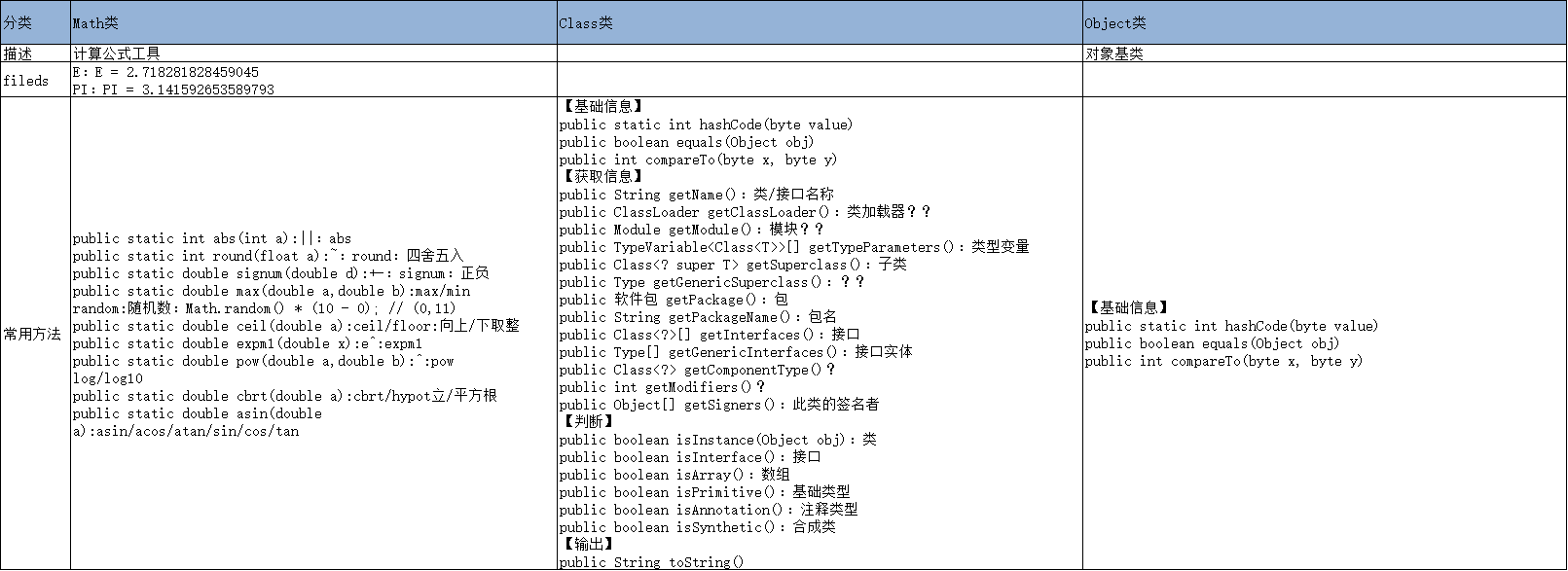
java.lang.Math类
public class MathTest {
    public static void main(String[] args) {
        int i1 = 2;
        float f1 = 0.5F;
        double d1 = 12.43;

        // java.lang.Math 字段
        System.out.println(Math.E); // E = 2.718281828459045
        System.out.println(Math.PI); // PI = 3.141592653589793

        // java.lang.Math 方法
        System.out.println(Math.abs(i1)); // ||
        System.out.println(Math.round(f1)); // 四舍五入
        System.out.println(Math.signum(f1)); // 正负?
        System.out.println(Math.max(i1, d1)); // max
        System.out.println(Math.min(i1, d1)); // min
        System.out.println(Math.random() * (10 - 0)); // (0,11)
        System.out.println(Math.ceil(f1)); // 向上取整
        System.out.println(Math.floor(d1)); // 向下取整
        System.out.println(Math.expm1(d1)); // e^x-1
        System.out.println(Math.pow(i1, d1)); // x^y
        System.out.println(Math.log(d1)); // loge(d1)
        System.out.println(Math.log10(d1)); // log10(d1)
        System.out.println(Math.cbrt(f1)); // f1立方根
        System.out.println(Math.hypot(f1, f1)); // 平方根
        System.out.println(Math.sqrt(f1)); // 平方根
        System.out.println(Math.ulp(f1)); // ??
        System.out.println(Math.asin(f1)); // asin
        System.out.println(Math.acos(f1)); // acos
        System.out.println(Math.atan(f1)); // atan
        System.out.println(Math.sin(f1)); // sin
        System.out.println(Math.cos(f1)); // cos
        System.out.println(Math.tan(f1)); // tan
    }
}
java.lang.Class类
import java.util.Arrays;

public class ClassTest {

    public static void main(String[] args) {
        ClassTest ct1 = new ClassTest();
        SubClass sct1 = new SubClass();

        /* 创建Class对象 */
        Class ct2 = ct1.getClass(); // getClass()
        Class sct2 = ct1.getClass();
        Class<?> _class;
        _class = ClassTest.class; // T.class
        try {
            _class = Class.forName("java.lang.String"); // forName()
        } catch (ClassNotFoundException e) {
            e.printStackTrace();
        }

        /* 常用方法 */
        System.out.println("******");
        System.out.println(ct2.getName()); // 类/接口名
        System.out.println(ct2.getPackage()); // 类名
        System.out.println(ct2.getTypeName()); // 类/接口名
        System.out.println(sct2.asSubclass(ct2)); // 子类名称
        System.out.println(ct2.getSimpleName()); // 类/接口简单名
//         类的修饰符 [1,2,4,8,16,32,64,128,256,512,1024,2048]
//         [public,private,protected,static,final,synchronized,volatile,transient,native,interface,abstract,strict]
        System.out.println(ct2.getModifiers());
        System.out.println(Arrays.toString(ct2.getAnnotations())); // 注释
        System.out.println(ct2.getProtectionDomain()); // ???

        /* 还有一些方法待理解 */
    }
}

class SubClass extends ClassTest {
    int field;

    public void method() {
    }
}
java.lang.Object类
public class ObjectTest {
    public static void main(String[] args) {
        /* java.lang.Object 构造方法 */
        Object obj = new Object();
        Object obj1 = new Object();

        /* java.lang.Object 方法-其他(计数,找位置,比较,哈希) */
        System.out.println(obj.hashCode()); // hashCode值

        /* java.lang.Object 方法-其他数据类型转换为Byte */
        System.out.println(obj1.equals(obj1)); // obj1 == obj ?
        System.out.println(obj.getClass()); // Object

        /* java.lang.Object 方法-obj数据类型(进制)以String的类型输出 */
        System.out.println(obj.toString()); // Object->String输出
    }
}

 浙公网安备 33010602011771号