实验1 现代C++编程初体验
任务1:
task1.cpp
  1 // 现代C++标准库、算法库体验
  2 // 本例用到以下内容:
  3 // 1. 字符串string, 动态数组容器类vector、迭代器
  4 // 2. 算法库:反转元素次序、旋转元素
  5 // 3. 函数模板、const引用作为形参
  6
  7 #include <iostream>
  8 #include <string>
  9 #include <vector>
 10 #include <algorithm>
 11
 12 using namespace std;
 13
 14 // 声明
 15 // 模板函数声明
 16 template<typename T>
 17 void output(const T &c);
 18
 19 // 普通函数声明
 20 void test1();
 21 void test2();
 22 void test3();
 23
 24 int main() {
 25     cout << "测试1: \n";
 26     test1();
 27
 28     cout << "\n测试2: \n";
 29     test2();
 30
 31     cout << "\n测试3: \n";
 32     test3();
 33 }
 34
 35 // 函数实现
 36 // 输出容器对象c中的元素
 37 template <typename T>
 38 void output(const T &c) {
 39     for(auto &i: c)
 40         cout << i << " ";
 41     cout << endl;
 42 }
 43
 44 // 测试1
 45 // 组合使用算法库、迭代器、string反转字符串
 46 void test1() {
 47     string s0{"0123456789"};
 48     cout << "s0 = " << s0 << endl;
 49
 50     string s1{s0};
 51     reverse(s1.begin(), s1.end());  // 反转指定迭代器区间的元素
 52     cout << "s1 = " << s1 << endl;
 53
 54     string s2{s0};
 55     reverse_copy(s0.begin(), s0.end(), s2.begin()); // 将指定迭代区间的元素拷贝到指定迭代器开始的目标区间,并且在复制过程中反转次序
 56     cout << "s2 = " << s2 << endl;
 57 }
 58
 59 // 测试2
 60 // 组合使用算法库、迭代器、vector反转动态数组对象vector内数据
 61 void test2() {
 62     vector<int> v0{2, 0, 4, 9};
 63     cout << "v0: ";
 64     output(v0);
 65
 66     vector<int> v1{v0};
 67     reverse(v1.begin(), v1.end());
 68     cout << "v1: ";
 69     output(v1);
 70
 71     vector<int> v2{v0};
 72     reverse_copy(v0.begin(), v0.end(), v2.begin());
 73     cout << "v2: ";
 74     output(v2);
 75 }
 76
 77 // 测试3
 78 // 组合使用算法库、迭代器、vector实现元素旋转移位
 79 void test3() {
 80     vector<int> v0{0, 1, 2, 3, 4, 5, 6, 7, 8, 9};
 81     cout << "v0: ";
 82     output(v0);
 83
 84     vector<int> v1{v0};
 85     rotate(v1.begin(), v1.begin()+1, v1.end());  // 旋转指定迭代器区间[v1.begin(), v1.end())之间的数据项,旋转后从迭代器v1.begin()+1位置的数据项开始
 86     cout << "v1: ";
 87     output(v1);
 88
 89     vector<int> v2{v0};
 90     rotate(v2.begin(), v2.begin()+2, v2.end());
 91     cout << "v2: ";
 92     output(v2);
 93
 94     vector<int> v3{v0};
 95     rotate(v3.begin(), v3.end()-1, v3.end());
 96     cout << "v3: ";
 97     output(v3);
 98
 99     vector<int> v4{v0};
100     rotate(v4.begin(), v4.end()-2, v4.end());
101     cout << "v4: ";
102     output(v4);
103 }
运行结果截图:
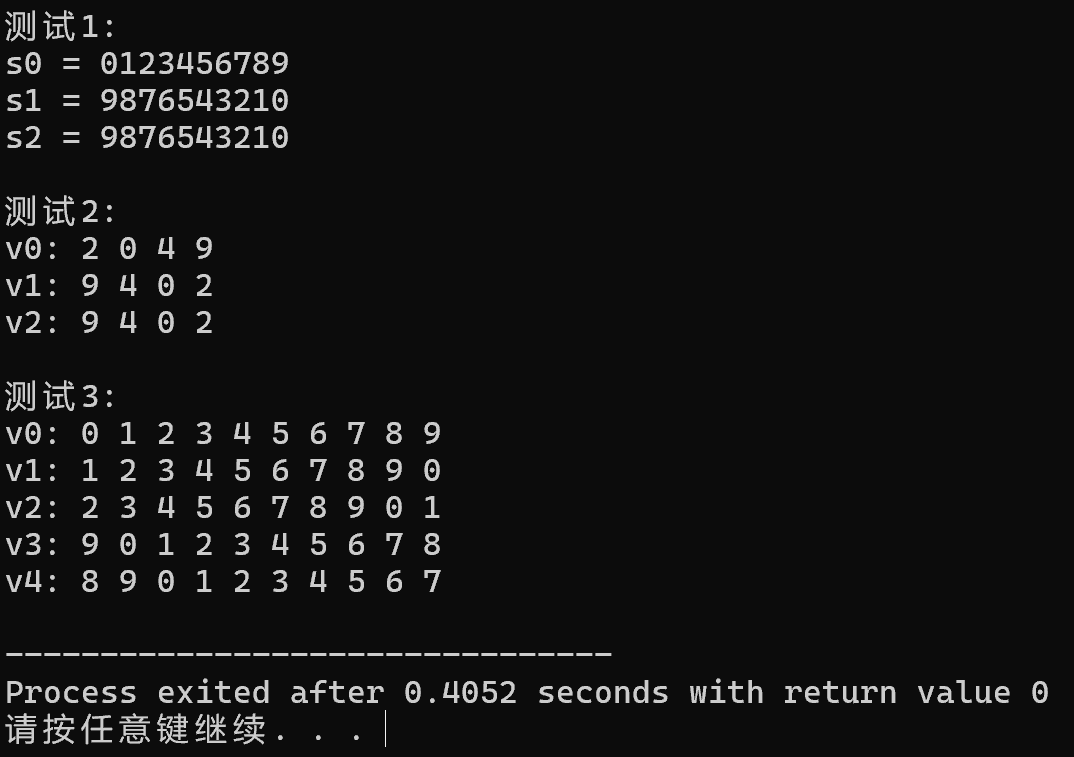
总结:
C++算法库灵活使用能大大简化代码,对于字符串、容器内数据操作来说反转元素次序(reverse)、旋转元素(rotate)使用频率高,可以高效解决回文串等数据具有对称性等一定规律的问题。
任务2:
task2.cpp
 1 #include <iostream>
 2 #include <vector>
 3 #include <string>
 4 #include <algorithm>
 5 #include <numeric>
 6 #include <iomanip>
 7
 8 using namespace std;
 9
10 // 函数声明
11 // 模板函数声明
12 template<typename T>
13 void output(const T &c);
14
15 // 普通函数声明
16 int rand_int_100();
17 void test1();
18 void test2();
19
20 int main() {
21     cout << "测试1: \n";
22     test1();
23
24     cout << "\n测试2: \n";
25     test2();
26 }
27
28 // 函数实现
29 // 输出容器对象c中的元素
30 template <typename T>
31 void output(const T &c) {
32     for(auto &i: c)
33         cout << i << " ";
34     cout << endl;
35 }
36
37 // 返回[0, 100]区间内的一个随机整数
38 int rand_int_100() {
39     return rand() % 101;
40 }
41
42 // 测试1
43 // 对容器类对象指定迭代器区间进行赋值、排序
44 void test1() {
45     vector<int> v0(10);  // 创建一个动态数组对象v0, 对象大小为10
46     generate(v0.begin(), v0.end(), rand_int_100); // 产生[0, 100]之间的随机整数赋值给指定迭代器区间[v0.begin(), v0.end())内的每个数据项
47     cout << "v0: ";
48     output(v0);
49
50     vector<int> v1{v0};
51     sort(v1.begin(), v1.end()); // 对指定迭代器区间[v1.begin(), v1.end())内数据项进行升序排序
52     cout << "v1: ";
53     output(v1);
54
55     vector<int> v2{v0};
56     sort(v2.begin()+1, v2.end()-1); // 对指定迭代器区间[v1.begin()+1, v1.end()-1)内数据项进行升序排序
57     cout << "v2: ";
58     output(v2);
59 }
60
61 // 测试2
62 // 对容器类对象指定迭代器区间进行赋值、计算最大值/最小值/均值
63 void test2() {
64     vector<int> v0(10);
65     generate(v0.begin(), v0.end(), rand_int_100);
66     cout << "v0: ";
67     output(v0);
68
69     auto iter1 = min_element(v0.begin(), v0.end());
70     cout << "最小值: " << *iter1 << endl;
71
72     auto iter2 = max_element(v0.begin(), v0.end());
73     cout << "最大值: " << *iter2 << endl;
74
75     auto ans = minmax_element(v0.begin(), v0.end());
76     cout << "最小值: " << *(ans.first) << endl;
77     cout << "最大值: " << *(ans.second) << endl;
78     double avg1 = accumulate(v0.begin(), v0.end(), 0)/v0.size();
79     cout << "均值: " << fixed << setprecision(2) << avg1 << endl;
80
81     cout << endl;
82
83     vector<int> v1{v0};
84     cout << "v0: ";
85     output(v0);
86     sort(v1.begin(), v1.end());
87     double avg2 = accumulate(v1.begin()+1, v1.end()-1, 0)/(v1.size()-2);
88     cout << "去掉最大值、最小值之后,均值: " << avg2 << endl;
89 }
运行结果截图: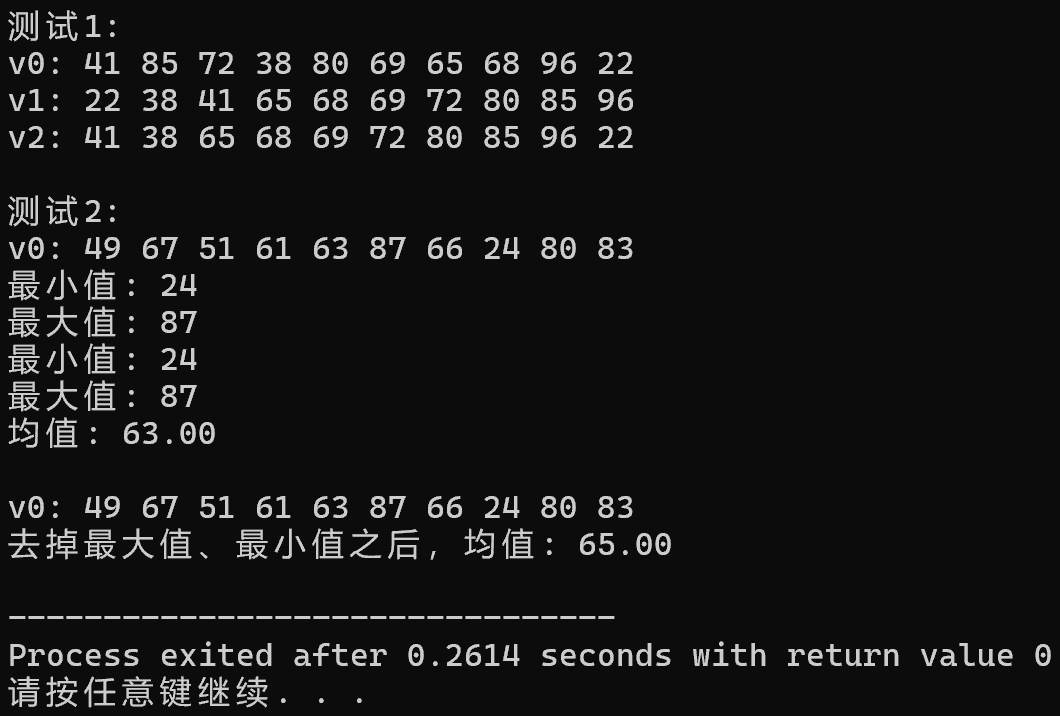
总结:
算法库中排序(sort)、赋值(generate);求最大值(max_element)、最小值(min_element)、均值(accumulate)等函数对数据运算(如处理成绩、打分等问题)作用较明显。
任务3:
task3.cpp
 1 #include <iostream>
 2 #include <string>
 3 #include <algorithm>
 4
 5 bool is_palindrome(std::string s);
 6
 7 int main() {
 8     using namespace std;
 9     string s;
10
11     while(cin >> s)  // 多组输入,直到按下Ctrl+Z后结束测试
12         cout << boolalpha << is_palindrome(s) << endl;
13 }
14
15 // 函数is_palindrom定义
16 // 待补足
17 // ×××
18 bool is_palindrome(std::string s) {
19     using namespace std;
20     string s1{s};
21     reverse (s1.begin(), s1.end());
22     if(s1 == s)
23         return true;
24     else
25         return false;
26 }
运行结果截图: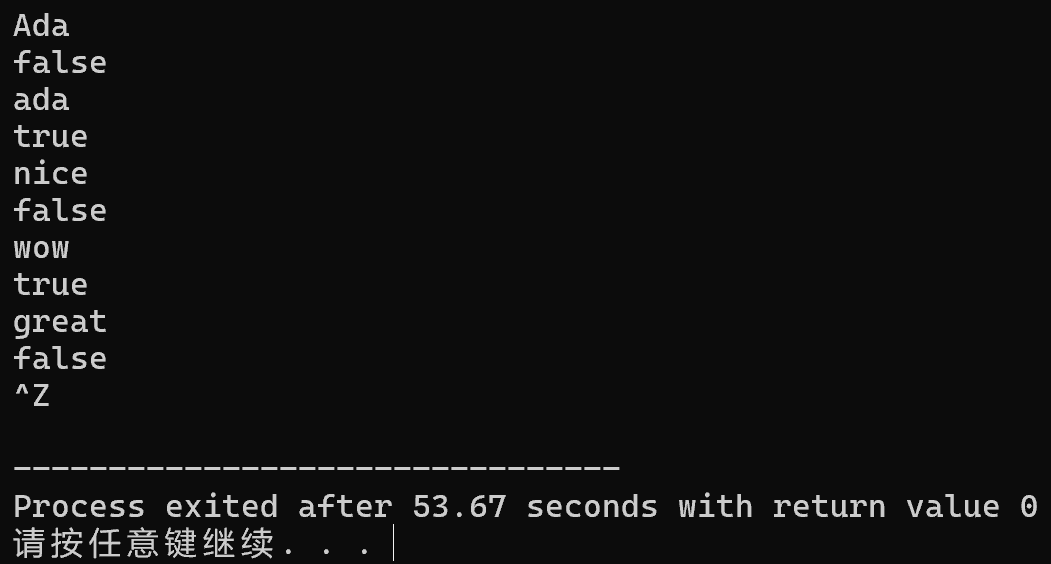
任务4:
task4.cpp
 1 #include <iostream>
 2 #include <string>
 3 #include <algorithm>
 4
 5 std::string dec2n(int x, int n = 2);
 6
 7 int main() {
 8     using namespace std;
 9
10     int x;
11     while(cin >> x) {
12         cout << "十进制: " << x << endl;
13         cout << "二进制: " << dec2n(x) << endl;
14         cout << "八进制: " << dec2n(x, 8) << endl;
15         cout << "十六进制: " << dec2n(x, 16) << endl << endl;
16     }
17 }
18
19 // 函数dec2n定义
20 // 待补足
21 // ×××
22
23 std::string dec2n(int x, int n) {
24     const std::string number = "0123456789ABCDE";
25     std::string result{};
26
27     do {
28         int remain = x % n;
29         result += number[remain];
30         x /= n;
31     } while (x > 0);
32
33     std::reverse(result.begin(), result.end());
34     return result;
35 }
运行结果截图: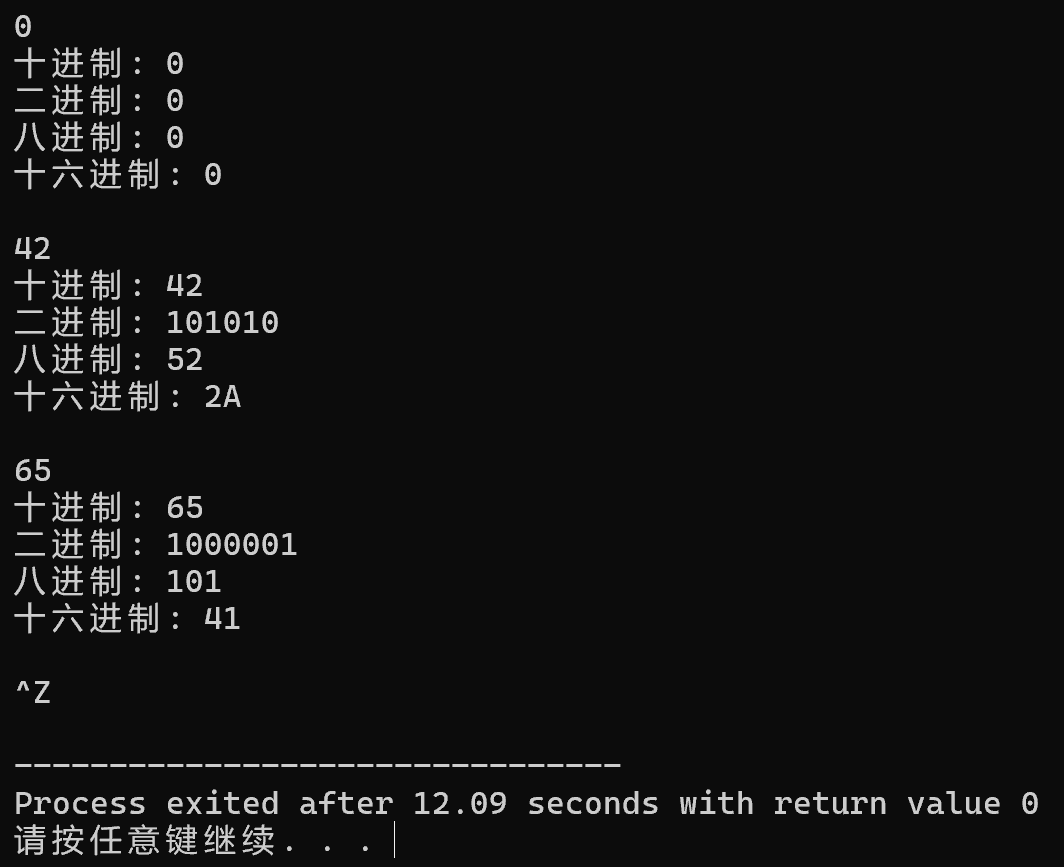
总结:
十进制转其余进制核心思想为除留取余倒排。
任务5:
task5.cpp
 1 #include <iostream>
 2 #include <string>
 3 #include <algorithm>
 4 #include <vector>
 5 #include <iomanip>
 6 using namespace std;
 7
 8 int main() {
 9     vector<char> str{'a','b','c','d','e','f','g','h','i','j','k','l','m','n','o','p','q','r','s','t','u','v','w','x','y','z'};
10     vector<char> Str{'A','B','C','D','E','F','G','H','I','J','K','L','M','N','O','P','Q','R','S','T','U','V','W','X','Y','Z'};
11
12     cout << "  ";
13     for(auto &c: str) {
14         cout << setw(2) << c;
15     }
16     cout << endl;
17
18     for(int i = 1; i <= 26; i++) {
19         cout << setw(2) << i;
20         rotate(Str.begin(),Str.begin()+1,Str.end());
21
22         for(auto &c: Str) {
23             cout << setw(2) << c;
24         }
25         cout << endl;
26    }
27 }
运行结果截图: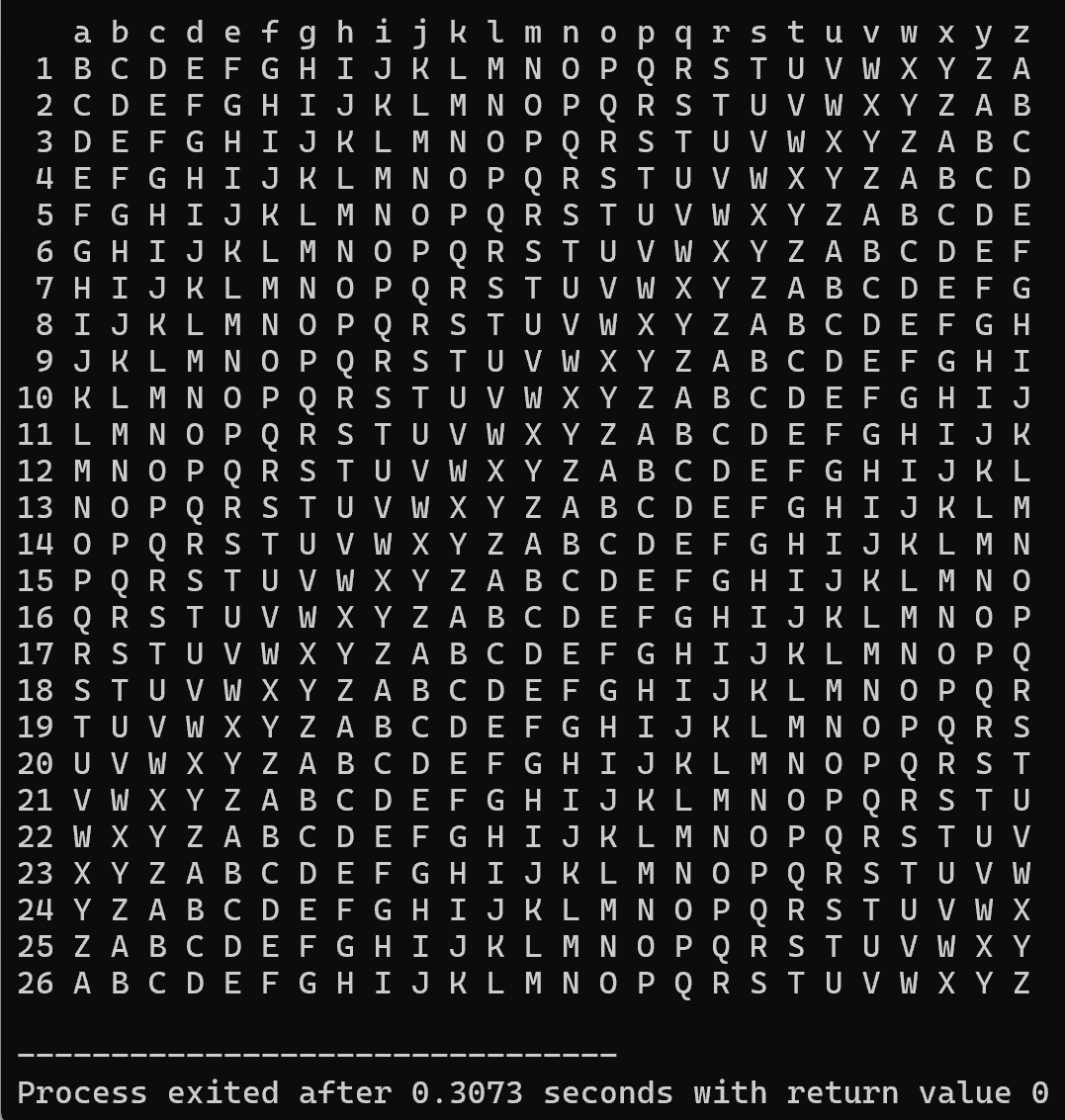
总结:
本题主要考察输入输出格式控制(setw) 以及旋转元素(rotate)函数的使用。
任务6:
task6.cpp
 1 #include <iostream>
 2 #include <string>
 3 #include <vector>
 4 #include <iomanip>
 5 #include <algorithm>
 6 using namespace std;
 7
 8 int rand_int_10();
 9 int rand_int_4();
10 void test();
11
12
13 int main() {
14     test();
15 }
16
17
18 int rand_int_10() {
19     return rand() % 11;
20 }
21
22 int rand_int_4() {
23     return rand() % 5;
24 }
25
26 void test() {
27     srand((unsigned)time(NULL));
28     vector<int> v(2) ;
29     int time = 10;
30     float count = 0;
31     int answer;
32     while(time--) {
33         int choice = rand_int_4();
34         generate(v.begin(), v.end(), rand_int_10);
35
36         if(choice == 0) {
37         int correct_answer = v[0] + v[1];
38         cout <<setw(2) << v[0] << " + " << v[1] << " = ";
39         cin >> answer;
40         if(answer == correct_answer)
41             count++;
42         }
43
44         else if(choice == 1) {
45         while(v[0] < v[1])
46             generate(v.begin(), v.end(), rand_int_10);
47         int correct_answer = v[0] - v[1];
48         cout << setw(2) << v[0] << " - " << v[1] << " = ";
49         cin >> answer;
50         if(answer == correct_answer)
51             count++;
52         }
53
54         else if(choice == 2) {
55             generate(v.begin(), v.end(), rand_int_10);
56             int correct_answer = v[0] * v[1];
57               cout << setw(2) << v[0] << " * " << v[1] << " = ";
58             cin >> answer;
59             if(answer == correct_answer)
60                 count++;
61         }
62
63         else{
64             while(v[0] % v[1] != 0)
65                 generate(v.begin(), v.end(), rand_int_10);
66             int correct_answer = v[0] / v[1];
67             cout << setw(2) << v[0] << " / " << v[1] << " = ";
68             cin >> answer;
69             if(answer == correct_answer)
70                 count++;
71         }
72     }
73             cout << "正确率:" << fixed << setprecision(2) << count * 10 << "%";
74 }
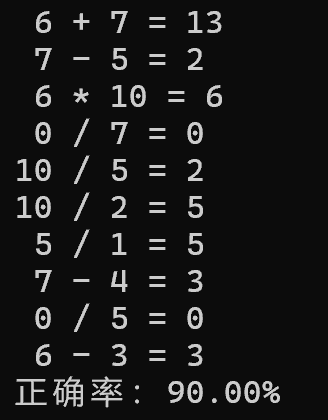
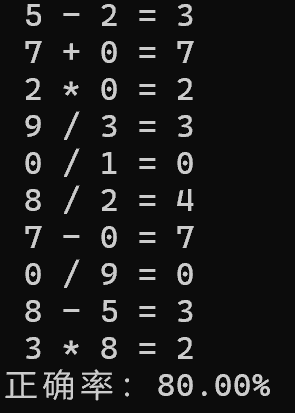
运行结果截图:
总结:
多次运行程序产生的随机数不一致需要用到srand函数。

 浙公网安备 33010602011771号