
理解Java中的抽象队列同步器(AQS)
最近项目里用到了些Lock,爬了些文了解到它们是基于AbstractQueuedSynchronizer(即AQS)实现的。那么,不如趁热打铁,看看里面是怎么工作的。
什么是AQS
AbstractQueuedSynchronizer,抽象队列同步器,是很多同步器(如ReentrantLock、CountDownLatch、Semaphore)等都是基于它实现的。
在AQS内部,它维护了一个FIFO队列,和一个volatile类型的变量state。FIFO队列用来实现多线程的排队工作,线程加锁失败时,这个线程就会被封装成一个Node节点放到队尾,然后当锁被释放后,队列头部的线程就会被唤醒并让它重新尝试获取锁;state变量用来记录锁的状态,如Semaphore的permit就是存在state里面的。
状态管理
上面说到,AQS使用一个volatile的int变量state来管理锁的状态,state为0时说明锁被释放,反之锁被持有。
AQS提供了三个方法来同步锁的状态:getState(),setState(int newState)和compareAndSetState(int expect, int update)。
/**
 * The synchronization state.
 */
private volatile int state;

/**
 * Returns the current value of synchronization state.
 * This operation has memory semantics of a {@code volatile} read.
 * @return current state value
 */
protected final int getState() {
    return state;
}

/**
 * Sets the value of synchronization state.
 * This operation has memory semantics of a {@code volatile} write.
 * @param newState the new state value
 */
protected final void setState(int newState) {
    state = newState;
}

/**
 * Atomically sets synchronization state to the given updated
 * value if the current state value equals the expected value.
 * This operation has memory semantics of a {@code volatile} read
 * and write.
 *
 * @param expect the expected value
 * @param update the new value
 * @return {@code true} if successful. False return indicates that the actual
 *         value was not equal to the expected value.
 */
protected final boolean compareAndSetState(int expect, int update) {
    return U.compareAndSetInt(this, STATE, expect, update);
}
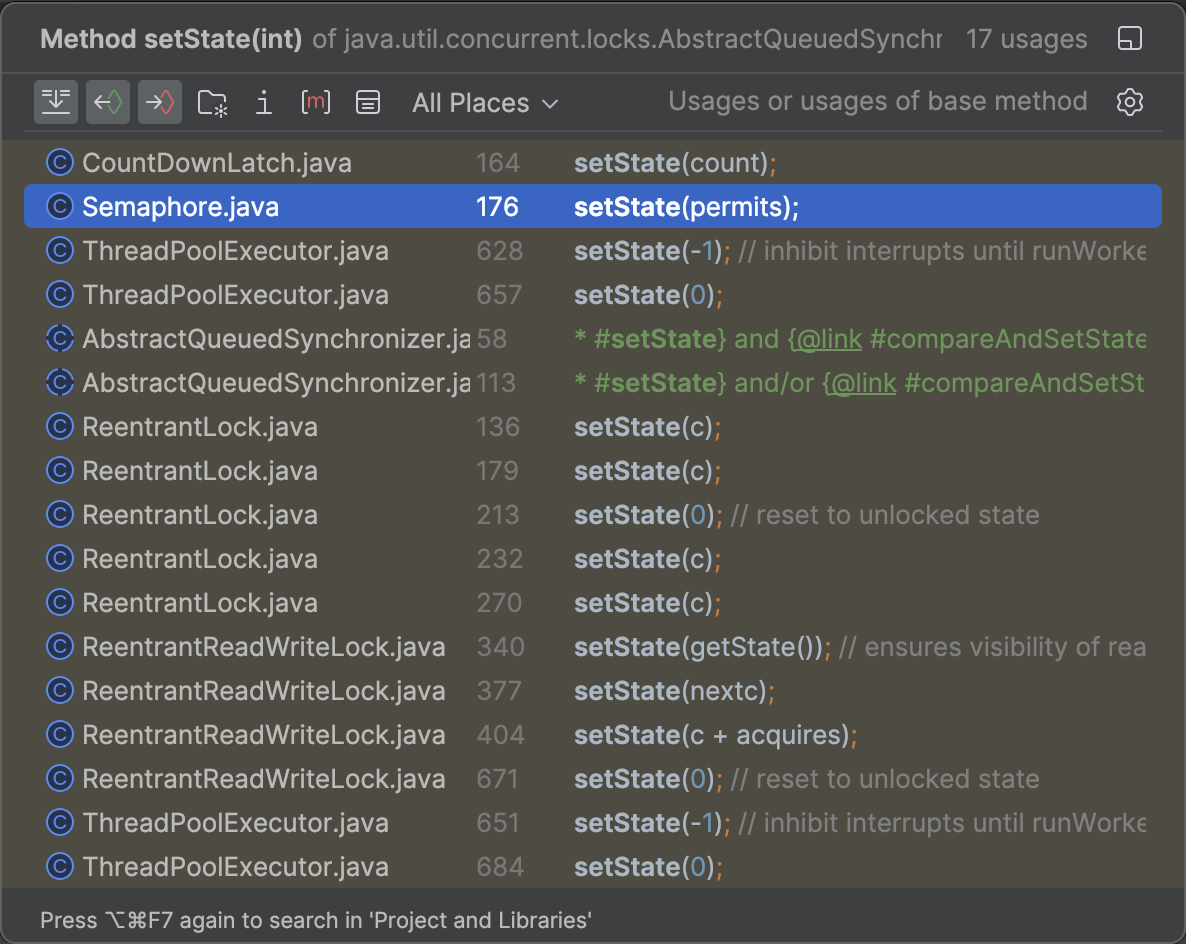
查看setState方法的引用,不难发现像CountDownLatch和Semaphore这些熟悉的身影。
FIFO队列 - 线程排队等待锁的地方
在AQS内部,未能成功获取锁的线程都会被包装成一个Node节点,然后放到FIFO队列尾部让它等待。
// Node status bits, also used as argument and return values
static final int WAITING   = 1;          // must be 1
static final int CANCELLED = 0x80000000; // must be negative
static final int COND      = 2;          // in a condition wait

abstract static class Node {
    volatile Node prev;       // initially attached via casTail
    volatile Node next;       // visibly nonnull when signallable
    Thread waiter;            // visibly nonnull when enqueued
    volatile int status;      // written by owner, atomic bit ops by others
    // 略
}

/**
 * Head of the wait queue, lazily initialized.
 */
private transient volatile Node head;

/**
 * Tail of the wait queue. After initialization, modified only via casTail.
 */
private transient volatile Node tail;

/**
 * Enqueues the node unless null. (Currently used only for
 * ConditionNodes; other cases are interleaved with acquires.)
 */
final void enqueue(Node node) {
    if (node != null) {
        for (;;) {
            Node t = tail;
            node.setPrevRelaxed(t);        // avoid unnecessary fence
            if (t == null)                 // initialize
                tryInitializeHead();
            else if (casTail(t, node)) {
                t.next = node;
                if (t.status < 0)          // wake up to clean link
                    LockSupport.unpark(node.waiter);
                break;
            }
        }
    }
}
Semaphore
Semaphore就是AQS的一个实现,从它的源码就能很容易看出来,它内部就是通过AQS的state来管理permits。
public class Semaphore implements java.io.Serializable {
    /** All mechanics via AbstractQueuedSynchronizer subclass */
    private final Sync sync;

    /**
     * Synchronization implementation for semaphore.  Uses AQS state
     * to represent permits. Subclassed into fair and nonfair
     * versions.
     */
    abstract static class Sync extends AbstractQueuedSynchronizer {
        Sync(int permits) {
            setState(permits);
        }

        final int getPermits() {
            return getState();
        }

        final int nonfairTryAcquireShared(int acquires) {
            for (;;) {
                int available = getState();
                int remaining = available - acquires;
                if (remaining < 0 ||
                    compareAndSetState(available, remaining))
                    return remaining;
            }
        }

        protected final boolean tryReleaseShared(int releases) {
            for (;;) {
                int current = getState();
                int next = current + releases;
                if (next < current) // overflow
                    throw new Error("Maximum permit count exceeded");
                if (compareAndSetState(current, next))
                    return true;
            }
        }

        final void reducePermits(int reductions) {
            for (;;) {
                int current = getState();
                int next = current - reductions;
                if (next > current) // underflow
                    throw new Error("Permit count underflow");
                if (compareAndSetState(current, next))
                    return;
            }
        }

        final int drainPermits() {
            for (;;) {
                int current = getState();
                if (current == 0 || compareAndSetState(current, 0))
                    return current;
            }
        }
    }

    /**
     * NonFair version
     */
    static final class NonfairSync extends Sync {
        private static final long serialVersionUID = -2694183684443567898L;

        NonfairSync(int permits) {
            super(permits);
        }

        protected int tryAcquireShared(int acquires) {
            return nonfairTryAcquireShared(acquires);
        }
    }

    /**
     * Fair version
     */
    static final class FairSync extends Sync {
        private static final long serialVersionUID = 2014338818796000944L;

        FairSync(int permits) {
            super(permits);
        }

        protected int tryAcquireShared(int acquires) {
            for (;;) {
                if (hasQueuedPredecessors())
                    return -1;
                int available = getState();
                int remaining = available - acquires;
                if (remaining < 0 ||
                    compareAndSetState(available, remaining))
                    return remaining;
            }
        }
    }

    /**
     * Creates a {@code Semaphore} with the given number of
     * permits and nonfair fairness setting.
     *
     * @param permits the initial number of permits available.
     *        This value may be negative, in which case releases
     *        must occur before any acquires will be granted.
     */
    public Semaphore(int permits) {
        sync = new NonfairSync(permits);
    }

    /**
     * Creates a {@code Semaphore} with the given number of
     * permits and the given fairness setting.
     *
     * @param permits the initial number of permits available.
     *        This value may be negative, in which case releases
     *        must occur before any acquires will be granted.
     * @param fair {@code true} if this semaphore will guarantee
     *        first-in first-out granting of permits under contention,
     *        else {@code false}
     */
    public Semaphore(int permits, boolean fair) {
        sync = fair ? new FairSync(permits) : new NonfairSync(permits);
    }
}
与synchronized的区别
synchronized是一个Java内置的关键字,AQS扩展的各种锁则是通过Java代码实现的synchronzed锁是自动获取和释放的,而AQS的锁需要手动获取和释放- 像
ReentrantLock还可以设置超时等特性,但synchronized不行

 浙公网安备 33010602011771号