
numpy中array 和mat 以及 list的使用
 1 import matplotlib
 2 import matplotlib.pyplot as plt
 3 import numpy as np
 4 from numpy import *;#导入numpy的库函数
 5 import sys
 6 # Numpy matrices必须是2维的,但是 numpy arrays (ndarrays) 可以是多维的(1D,2D,3D····ND).
 7 # Matrix是Array的一个小的分支,包含于Array。所以matrix 拥有array的所有特性。
 8
 9 # 一维 array
10 tem1 = [1, 2, 3]
11 atem1 = np.array(tem1)
12
13 # 添加元素
14 tem1.insert(0, 4)
15 atem1_i = np.insert(atem1, 0, values=4,  axis=0)
16 #atem1_i = np.insert(atem1, 0, values=4)    # 省略最后一个 参数也可以,是默认的
17
18 #删除元素
19 tem1.pop(0)
20
21 #切片提取
22 atem1_i = atem1[1:]
23 atem1_i = atem1[0: atem1.size - 1]
24
25 # list 对应 也是一维 的
26 tolist1 = atem1_i.tolist()
27
28 # 二维 array
29 a = np.array([[1,2,3],[4,5,6],[7,8,9]])
30 b = np.array([[0,0,0]])
31 c = np.insert(a, 0, values=b, axis=0)
32 d = np.insert(a, 0, values=b, axis=1)
33
34 # 切片提取
35 tem = d[0][1:]
36
37 # list 对应 也是二维 的
38 tolist1 = d.tolist()
39
40 # 三维
41 a = np.array([[[1,2,3],[4,5,6],[7,8,9]], [[1,2,3],[4,5,6],[7,8,9]]])
42
43 # list 对应 也是二维 的
44 tolist1 = a.tolist()
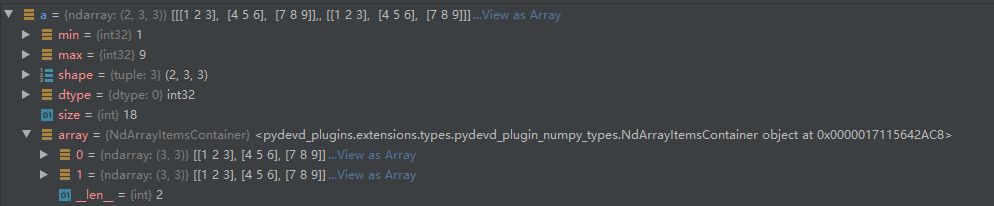
array 的结构,每个子模块都是一个array
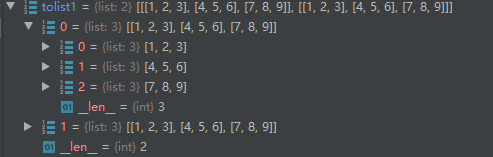
转化成对应维数的list:
 1 # 固定维数数据生成
 2 def ones(shape, dtype=None, order='C'):
 3     """
 4     Return a new array of given shape and type, filled with ones.
 5
 6     Parameters
 7     ----------
 8     shape : int or sequence of ints
 9         Shape of the new array, e.g., ``(2, 3)`` or ``2``.
10     dtype : data-type, optional
11         The desired data-type for the array, e.g., `numpy.int8`.  Default is
12         `numpy.float64`.
13     order : {'C', 'F'}, optional, default: C
14         Whether to store multi-dimensional data in row-major
15         (C-style) or column-major (Fortran-style) order in
16         memory.
17
18     Returns
19     -------
20     out : ndarray
21         Array of ones with the given shape, dtype, and order.
22
23     See Also
24     --------
25     ones_like : Return an array of ones with shape and type of input.
26     empty : Return a new uninitialized array.
27     zeros : Return a new array setting values to zero.
28     full : Return a new array of given shape filled with value.
29
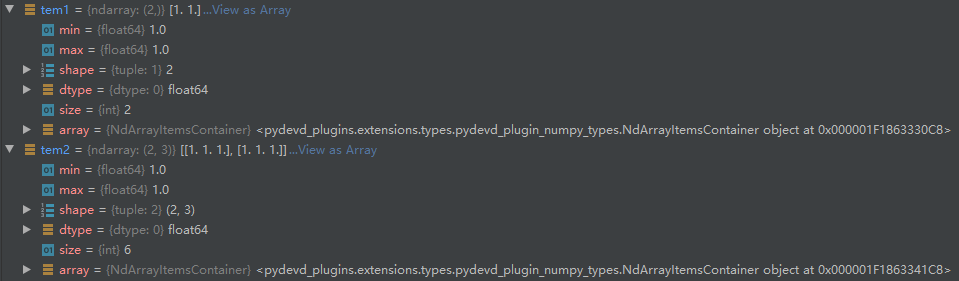
30 # 对应的得到的就是array 类型
31 # 通过参数shape(tuple类型) 设置得到的维数,一维设置需要特别注意
32 tem1 = np.ones((2,))
33 tem2 = np.ones((2, 3))
34 #tem2 = np.array(np.ones((2,))) 本身就是array ,所以这个转化是多余的
1 # Numpy matrices必须是2维的,但是 numpy arrays (ndarrays) 可以是多维的(1D,2D,3D····ND).
2 # Matrix是Array的一个小的分支,包含于Array。所以matrix 拥有array的所有特性。
3
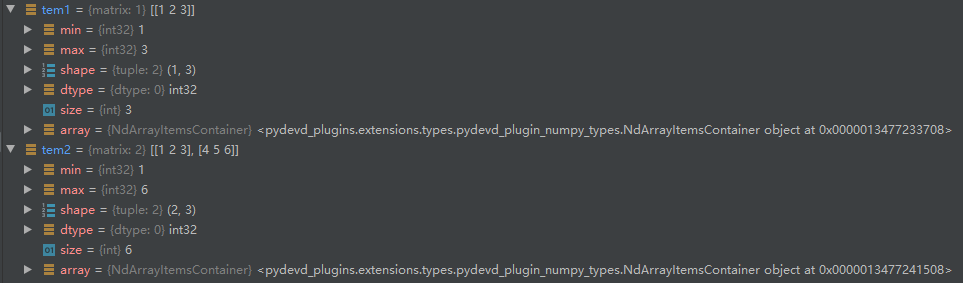
4 # 一维的list会默认转成 1*n
5 tem1 = np.mat([1, 2, 3])
6 # 二维的list 对应 m*n
7 tem2 = np.mat([[1, 2, 3], [4, 5, 6]])
8 # 三维的list ,此时执行会报错,不允许
9 #tem2 = np.mat([[[1, 2, 3], [4, 5, 6]], [[1, 2, 3], [4, 5, 6]]])
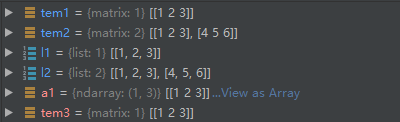
互相转化:
l1 = tem1.tolist()
l2 = tem2.tolist()

a1 = np.asarray(tem1)
tem3 = np.asmatrix(a1)
array 可迭代特性检查及使用:
 1 from collections.abc import Iterable
 2
 3 # 一维 array
 4 tem1 = [1, 2, 3]
 5 atem1 = np.array(tem1)
 6 print(isinstance(atem1, Iterable))      # true
 7 for x in atem1:
 8     print(x)
 9 #1
10 #2
11 #3
12
13  # 二维 array
14 a = np.array([[1,2,3],[4,5,6],[7,8,9]])
15 print(isinstance(a, Iterable))      # true
16
17 for x in a:
18     print(x)
19 #[1 2 3]
20 #[4 5 6]
21 #[7 8 9]
22 for x, y, z in a[0], a[1], a[2]:
23     print(x, y, z)
24 #1 2 3
25 #4 5 6
26 #7 8 9
记录每天生活的点点滴滴,呵呵呵呵呵呵

 浙公网安备 33010602011771号