
PaddlePaddle 飞桨实现GAN生成对抗网络生成MINIST手写数字图像
import paddle
from paddle.nn import Conv2D, MaxPool2D, Linear, BatchNorm,Upsample
import numpy as np
import matplotlib.pyplot as plt
/opt/conda/envs/python35-paddle120-env/lib/python3.7/site-packages/paddle/fluid/layers/utils.py:26: DeprecationWarning: np.int is a deprecated alias for the builtin int. To silence this warning, use int by itself. Doing this will not modify any behavior and is safe. When replacing np.int, you may wish to use e.g. np.int64 or np.int32 to specify the precision. If you wish to review your current use, check the release note link for additional information.
Deprecated in NumPy 1.20; for more details and guidance: https://numpy.org/devdocs/release/1.20.0-notes.html#deprecations
def convert_to_list(value, n, name, dtype=np.int):
/opt/conda/envs/python35-paddle120-env/lib/python3.7/site-packages/matplotlib/init.py:107: DeprecationWarning: Using or importing the ABCs from 'collections' instead of from 'collections.abc' is deprecated, and in 3.8 it will stop working
from collections import MutableMapping
/opt/conda/envs/python35-paddle120-env/lib/python3.7/site-packages/matplotlib/rcsetup.py:20: DeprecationWarning: Using or importing the ABCs from 'collections' instead of from 'collections.abc' is deprecated, and in 3.8 it will stop working
from collections import Iterable, Mapping
/opt/conda/envs/python35-paddle120-env/lib/python3.7/site-packages/matplotlib/colors.py:53: DeprecationWarning: Using or importing the ABCs from 'collections' instead of from 'collections.abc' is deprecated, and in 3.8 it will stop working
from collections import Sized
train_reader = paddle.vision.datasets.MNIST(mode='train')
print("训练集样本数:", len(train_reader))
print("样本形状:", np.array(train_reader[0][0]).shape)
print("标签形状:", np.array(train_reader[0][1]).shape)
训练集样本数: 60000
样本形状: (28, 28)
标签形状: (1,)
# 噪声维度
Z_DIM = 100
BATCH_SIZE = 128

paddle.vision.set_image_backend('cv2')
mnist_generator = paddle.io.DataLoader(paddle.vision.datasets.MNIST(mode='train'),
                                       batch_size=BATCH_SIZE, shuffle=True)

# 生成假图片的reader, 噪声生成,通过由噪声来生成假的图片数据输入
class ZReader(paddle.io.Dataset):
    def __init__(self, z_dim):
        super(ZReader, self).__init__()
        self.z_dim = z_dim
    def __getitem__(self, index):
        return np.random.normal(0.0, 1.0, (self.z_dim,1,1)).astype('float32')#正态分布,正态分布的均值、标准差、参数
    def __len__(self):
        return int(1e8)  # a large number

z_dataset = ZReader(Z_DIM)
z_generator = paddle.io.DataLoader(z_dataset, batch_size=BATCH_SIZE)
image,label =next(mnist_generator())
print("图像数据形状和对应数据为:", image.shape)
print("图像标签形状和对应数据为:", label.shape)

plt.imshow(image[0].numpy().astype(np.uint8)) # (28,28)
plt.show
/opt/conda/envs/python35-paddle120-env/lib/python3.7/site-packages/paddle/fluid/dataloader/dataloader_iter.py:89: DeprecationWarning: np.bool is a deprecated alias for the builtin bool. To silence this warning, use bool by itself. Doing this will not modify any behavior and is safe. If you specifically wanted the numpy scalar type, use np.bool_ here.
Deprecated in NumPy 1.20; for more details and guidance: https://numpy.org/devdocs/release/1.20.0-notes.html#deprecations
if isinstance(slot[0], (np.ndarray, np.bool, numbers.Number)):
图像数据形状和对应数据为: [128, 28, 28]
图像标签形状和对应数据为: [128, 1]
W0511 14:09:22.929143 892 device_context.cc:362] Please NOTE: device: 0, GPU Compute Capability: 7.0, Driver API Version: 11.2, Runtime API Version: 10.1
W0511 14:09:22.933797 892 device_context.cc:372] device: 0, cuDNN Version: 7.6.
/opt/conda/envs/python35-paddle120-env/lib/python3.7/site-packages/matplotlib/cbook/init.py:2349: DeprecationWarning: Using or importing the ABCs from 'collections' instead of from 'collections.abc' is deprecated, and in 3.8 it will stop working
if isinstance(obj, collections.Iterator):
/opt/conda/envs/python35-paddle120-env/lib/python3.7/site-packages/matplotlib/cbook/init.py:2366: DeprecationWarning: Using or importing the ABCs from 'collections' instead of from 'collections.abc' is deprecated, and in 3.8 it will stop working
return list(data) if isinstance(data, collections.MappingView) else data
<function matplotlib.pyplot.show(*args, **kw)>
/opt/conda/envs/python35-paddle120-env/lib/python3.7/site-packages/matplotlib/image.py:425: DeprecationWarning: np.asscalar(a) is deprecated since NumPy v1.16, use a.item() instead
a_min = np.asscalar(a_min.astype(scaled_dtype))
/opt/conda/envs/python35-paddle120-env/lib/python3.7/site-packages/matplotlib/image.py:426: DeprecationWarning: np.asscalar(a) is deprecated since NumPy v1.16, use a.item() instead
a_max = np.asscalar(a_max.astype(scaled_dtype))

##测试一下噪声
z_tmp = next(z_generator())
print('一个batch噪声z的形状:', z_tmp[0].shape)
一个batch噪声z的形状: [128, 100, 1, 1]
GAN 网络
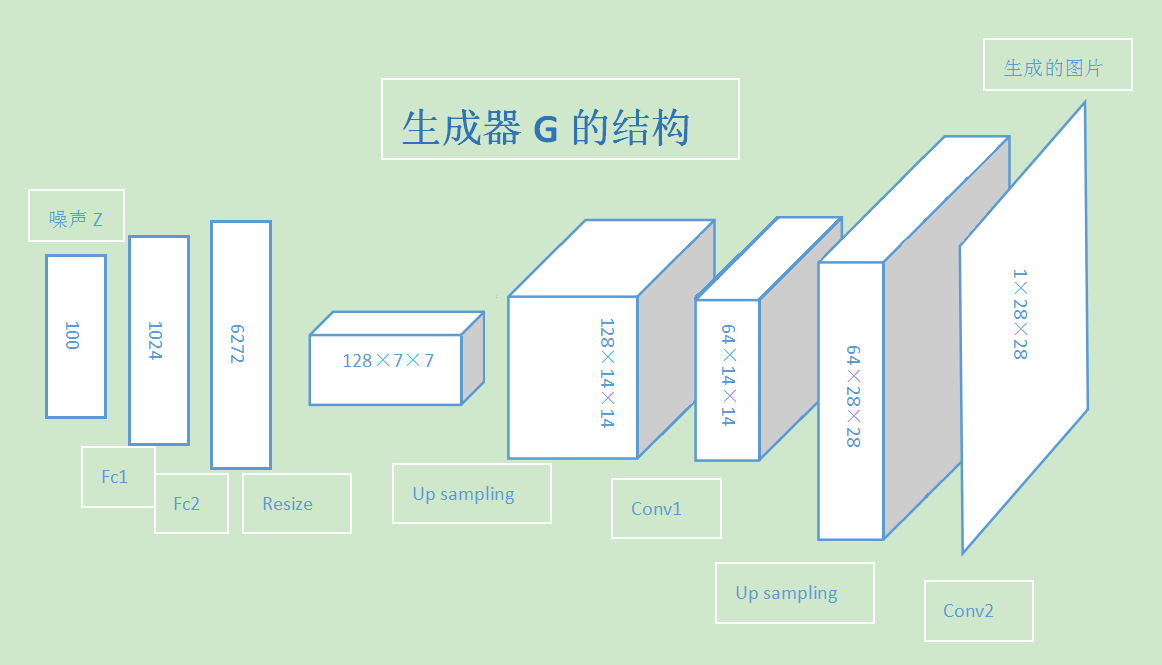
GAN 性能的提升从生成器 G 和判别器 D 进行左右互搏、交替完善的过程得到的。所以其 G 网络和 D 网络的能力应该设计得相近,复杂度也差不多。这个项目中的生成器,采用了两个全链接层接两组上采样和转置卷积层,将输入的噪声 Z 逐渐转化为 1×28×28 的单通道图片输出。
生成器结构:
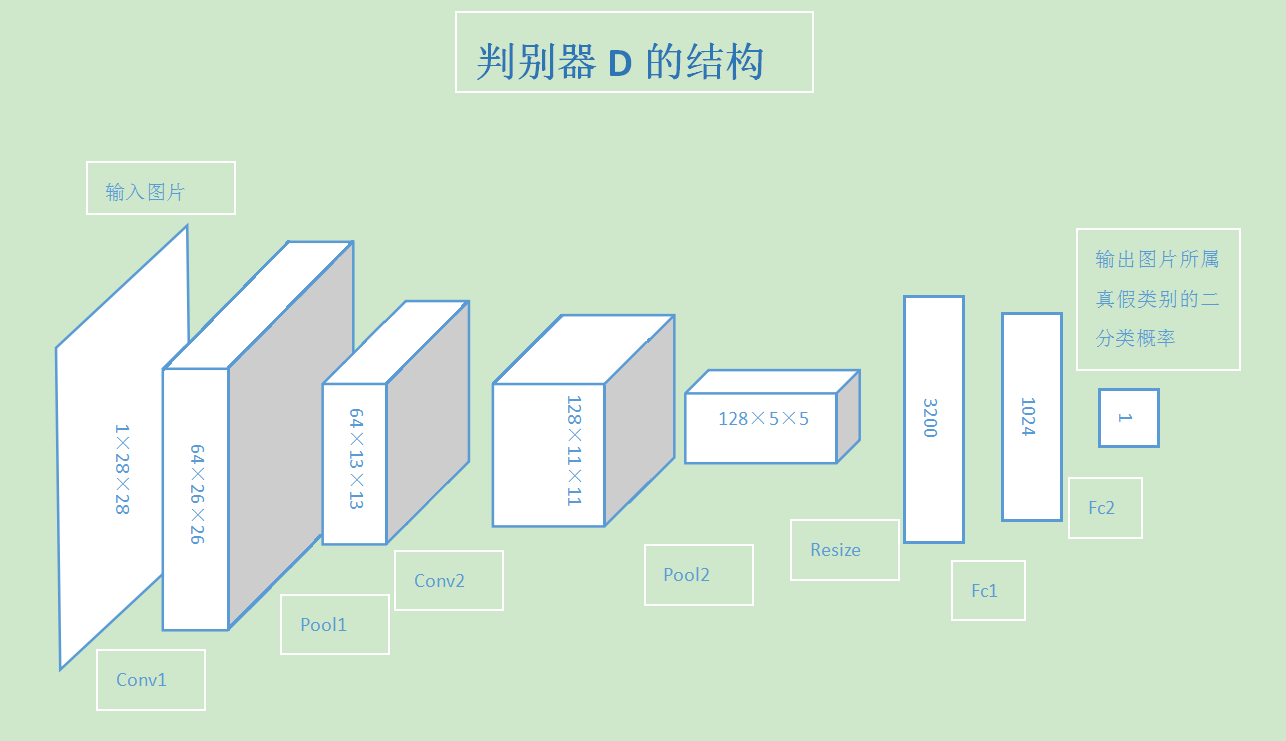
判别器的结构正好相反,先通过两组卷积和池化层将输入的图片转化为越来越小的特征图,再经过两层全链接层,输出图片是真是假的二分类结果。
判别器结构:
import paddle


# 判别器 D
class D(paddle.nn.Layer):
    def __init__(self, name_scope):
        super(D, self).__init__(name_scope)
        name_scope = self.full_name()
        #
        # My_D的代码
        self.conv1 = paddle.fluid.Conv2D(num_channels=1, num_filters=64, filter_size=3)
        self.bn1 = paddle.nn.BatchNorm(num_channels=64, act='leaky_relu')
        self.pool1 = paddle.fluid.Pool2D(pool_size=2, pool_stride=2)
        self.conv2 = paddle.fluid.Conv2D(num_channels=64, num_filters=128, filter_size=3)
        self.bn2 = paddle.nn.BatchNorm(num_channels=128, act='leaky_relu')
        self.pool2 = paddle.fluid.Pool2D(pool_size=2, pool_stride=2)
        self.fc1 = paddle.fluid.Linear(input_dim=128 * 5 * 5, output_dim=1024)
        self.bnfc1 = paddle.nn.BatchNorm(num_channels=1024, act='leaky_relu')
        self.fc2 = paddle.fluid.Linear(input_dim=1024, output_dim=1)

    def forward(self, img):
        #
        # My_G forward的代码
        y = self.conv1(img)
        y = self.bn1(y)
        y = self.pool1(y)
        y = self.conv2(y)
        y = self.bn2(y)
        y = self.pool2(y)
        y = paddle.reshape(x=y, shape=[-1, 128 * 5 * 5])
        y = self.fc1(y)
        y = self.bnfc1(y)
        y = self.fc2(y)
        return y


# 生成网络G
class G(paddle.nn.Layer):
    def __init__(self, name_scope):
        super(G, self).__init__(name_scope)
        name_scope = self.full_name()
        # 第一组全连接和BN层
        self.fc1 = paddle.fluid.Linear(input_dim=100, output_dim=1024)
        self.bn1 = paddle.nn.BatchNorm(num_channels=1024, act='tanh')
        # 第二组全连接和BN层
        self.fc2 = paddle.fluid.Linear(input_dim=1024, output_dim=128 * 7 * 7)
        self.bn2 = paddle.nn.BatchNorm(num_channels=128 * 7 * 7, act='tanh')
        # 第一组卷积运算(卷积前进行上采样,以扩大特征图)
        # 注:此处使用转置卷积的效果似乎不如上采样后直接用卷积,转置卷积生成的图片噪点较多
        self.conv1 = paddle.fluid.Conv2D(num_channels=128, num_filters=64, filter_size=5, padding=2)
        self.bn3 = paddle.nn.BatchNorm(num_channels=64, act='tanh')
        # 第二组卷积运算(卷积前进行上采样,以扩大特征图)
        self.conv2 = paddle.fluid.Conv2D(num_channels=64, num_filters=1, filter_size=5, padding=2, act='tanh')

    def forward(self, z):
        z = paddle.reshape(x=z, shape=[-1, 100])
        y = self.fc1(z)
        y = self.bn1(y)
        y = self.fc2(y)
        y = self.bn2(y)
        y = paddle.reshape(x=y, shape=[-1, 128, 7, 7])
        # 第一组卷积前进行上采样以扩大特征图
        y = paddle.fluid.layers.image_resize(y, scale=2)
        y = self.conv1(y)
        y = self.bn3(y)
        # 第二组卷积前进行上采样以扩大特征图
        y = paddle.fluid.layers.image_resize(y, scale=2)
        y = self.conv2(y)
        return y
paddle.Model(G('G')).summary((-1,100))
---------------------------------------------------------------------------
Layer (type) Input Shape Output Shape Param #
===========================================================================
Linear-1 [[1, 100]] [1, 1024] 103,424
BatchNorm-1 [[1, 1024]] [1, 1024] 4,096
Linear-2 [[1, 1024]] [1, 6272] 6,428,800
BatchNorm-2 [[1, 6272]] [1, 6272] 25,088
Conv2D-1 [[1, 128, 14, 14]] [1, 64, 14, 14] 204,864
BatchNorm-3 [[1, 64, 14, 14]] [1, 64, 14, 14] 256
Conv2D-2 [[1, 64, 28, 28]] [1, 1, 28, 28] 1,601
===========================================================================
Total params: 6,768,129
Trainable params: 6,738,689
Non-trainable params: 29,440
---------------------------------------------------------------------------
Input size (MB): 0.00
Forward/backward pass size (MB): 0.31
Params size (MB): 25.82
Estimated Total Size (MB): 26.13
---------------------------------------------------------------------------
{'total_params': 6768129, 'trainable_params': 6738689}
paddle.Model(D('D')).summary((-1,1,28,28))
---------------------------------------------------------------------------
Layer (type) Input Shape Output Shape Param #
===========================================================================
Conv2D-3 [[1, 1, 28, 28]] [1, 64, 26, 26] 640
BatchNorm-4 [[1, 64, 26, 26]] [1, 64, 26, 26] 256
Pool2D-1 [[1, 64, 26, 26]] [1, 64, 13, 13] 0
Conv2D-4 [[1, 64, 13, 13]] [1, 128, 11, 11] 73,856
BatchNorm-5 [[1, 128, 11, 11]] [1, 128, 11, 11] 512
Pool2D-2 [[1, 128, 11, 11]] [1, 128, 5, 5] 0
Linear-3 [[1, 3200]] [1, 1024] 3,277,824
BatchNorm-6 [[1, 1024]] [1, 1024] 4,096
Linear-4 [[1, 1024]] [1, 1] 1,025
===========================================================================
Total params: 3,358,209
Trainable params: 3,353,345
Non-trainable params: 4,864
---------------------------------------------------------------------------
Input size (MB): 0.00
Forward/backward pass size (MB): 1.02
Params size (MB): 12.81
Estimated Total Size (MB): 13.83
---------------------------------------------------------------------------
{'total_params': 3358209, 'trainable_params': 3353345}
z_tmp = next(z_generator())
g_tmp = G('G')
tmp_g = g_tmp(z_tmp[0]).numpy()
print('生成器G生成图片数据的形状:', tmp_g.shape)
plt.imshow(tmp_g[0][0])
plt.show()

d_tmp = D('D')
tmp_d = d_tmp(paddle.to_tensor(tmp_g)).numpy()
print('判别器D判别生成的图片的概率数据形状:', tmp_d.shape)
print(max(tmp_d))
生成器G生成图片数据的形状: (128, 1, 28, 28)
判别器D判别生成的图片的概率数据形状: (128, 1)
[3.0552034]

import matplotlib.pyplot as plt
%matplotlib inline

def show_image_grid(images, batch_size=128, pass_id=None):
    fig = plt.figure(figsize=(8, batch_size/32))
    gs = plt.GridSpec(int(batch_size/16), 16)
    gs.update(wspace=0.05, hspace=0.05)

    for i, image in enumerate(images):
        ax = plt.subplot(gs[i])
        plt.axis('off')
        ax.set_xticklabels([])
        ax.set_yticklabels([])
        ax.set_aspect('equal')
        plt.imshow(image[0], cmap='Greys_r')
    plt.show()

show_image_grid(tmp_g, BATCH_SIZE)

网络训练
网络的训练优化目标就是如下公式:
公式出自 Goodfellow 在 2014 年发表的论文Generative Adversarial Nets。
这里简单介绍下公式的含义和如何应用到代码中。上式中等号左边的部分:
\(V(D, G)\)表示的是生成样本和真实样本的差异度,可以使用二分类(真、假两个类别)的交叉商损失。
\(\max _{D} V(D,G)\)表示在生成器固定的情况下,通过最大化交叉商损失\(V(D, G)\)来更新判别器 D 的参数。
\(\min _{G} \max _{D} V(D, G)\)表示生成器要在判别器最大化真、假图片交叉商损失\(\max _{D} V(D,G)\)的情况下,最小化这个交叉商损失。
等式的右边其实就是将等式左边的交叉商损失公式展开,并写成概率分布的期望形式。详细的推导请参见原论文《Generative Adversarial Nets》。
下面是训练模型的代码,有详细的注释。大致过程是:先用真图片训练一次判别器 d 的参数,再用生成器 g 生成的假图片训练一次判别器 d 的参数,最后用判别器 d 判断生成器 g 生成的假图片的概率值更新一次生成器 g 的参数,即每轮训练先训练两次判别器 d,再训练一次生成器 g,使得判别器 d 的能力始终稍稍高于生成器 g 一些。
for i, real_image in enumerate(mnist_generator()):
    print(real_image[0].shape, len(real_image[0]))
    break
[128, 28, 28] 128
训练代码
import paddle.nn.functional as F
d = D('D')
d.train()
g = G('G')
g.train()
# 创建优化方法
real_d_optimizer = paddle.optimizer.Adam(learning_rate=1e-4, parameters=d.parameters())
fake_d_optimizer = paddle.optimizer.Adam(learning_rate=1e-4, parameters=d.parameters())
g_optimizer = paddle.optimizer.Adam(learning_rate=5e-4, parameters=g.parameters())

iteration_num = 0
epoch_num = 5
for epoch in range(epoch_num):
    for i, (real_image, label) in enumerate(mnist_generator()):
        # 丢弃不满整个batch_size的数据
        if(len(real_image) != BATCH_SIZE):
            continue
        iteration_num += 1
        '''
        判别器d通过最小化输入真实图片时判别器d的输出与真值标签ones的交叉熵损失,来优化判别器的参数,
        以增加判别器d识别真实图片real_image为真值标签ones的概率。
        '''
        # 将MNIST数据集里的图片读入real_image,将真值标签ones用数字1初始化
        real_image = real_image.unsqueeze(1)
        real_image = paddle.to_tensor(real_image)
        ones = paddle.to_tensor(np.ones([len(real_image), 1]).astype('float32'))
        # 计算判别器d判断真实图片的概率
        p_real = d(real_image)
        # 计算判别真图片为真的损失
        real_cost = F.binary_cross_entropy_with_logits(p_real, ones)
        real_avg_cost = paddle.mean(real_cost)
        # 反向传播更新判别器d的参数
        real_avg_cost.backward()
        real_d_optimizer.minimize(real_avg_cost)
        d.clear_gradients()

        '''
        判别器d通过最小化输入生成器g生成的假图片g(z)时判别器的输出与假值标签zeros的交叉熵损失,
        来优化判别器d的参数,以增加判别器d识别生成器g生成的假图片g(z)为假值标签zeros的概率。
        '''
        # 创建高斯分布的噪声z,将假值标签zeros初始化为0
        z = next(z_generator())
        zeros = paddle.to_tensor(np.zeros([len(real_image), 1]).astype('float32'))
        # 判别器d判断生成器g生成的假图片的概率
        p_fake = d(g(z[0]))
        # 计算判别生成器g生成的假图片为假的损失
        fake_cost = F.binary_cross_entropy_with_logits(p_fake, zeros)
        fake_avg_cost = paddle.mean(fake_cost)
        # 反向传播更新判别器d的参数
        fake_avg_cost.backward()
        fake_d_optimizer.minimize(fake_avg_cost)
        d.clear_gradients()
        '''
        生成器g通过最小化判别器d判别生成器生成的假图片g(z)为真的概率d(fake)与真值标签ones的交叉熵损失,
        来优化生成器g的参数,以增加生成器g使判别器d判别其生成的假图片g(z)为真值标签ones的概率。
        '''
        # 生成器用输入的高斯噪声z生成假图片
        fake = g(z[0])
        # 计算判别器d判断生成器g生成的假图片的概率
        p_confused = d(fake)
        # 使用判别器d判断生成器g生成的假图片的概率与真值ones的交叉熵计算损失
        g_cost = paddle.fluid.layers.sigmoid_cross_entropy_with_logits(p_confused, ones)
        g_avg_cost = paddle.mean(x=g_cost)
        # 反向传播更新生成器g的参数
        g_avg_cost.backward()
        g_optimizer.minimize(g_avg_cost)
        g.clear_gradients()

        # 打印输出
        if(iteration_num % 100 == 0):
            print('epoch =', epoch, ', batch =', i, ', real_d_loss =', real_avg_cost.numpy(),
                ', fake_d_loss =', fake_avg_cost.numpy(), 'g_loss =', g_avg_cost.numpy())
            show_image_grid(fake.numpy(), BATCH_SIZE, epoch)
            # 存储模型
paddle.save(g.state_dict(), './output/'+'g')
paddle.save(d.state_dict(), './output/'+'d_o_r')
paddle.save(d.state_dict(), './output/'+'d_o_f')
epoch = 0 , batch = 99 , real_d_loss = [0.63881606] , fake_d_loss = [0.43077955] g_loss = [1.1314435]
/opt/conda/envs/python35-paddle120-env/lib/python3.7/site-packages/matplotlib/image.py:425: DeprecationWarning: np.asscalar(a) is deprecated since NumPy v1.16, use a.item() instead
a_min = np.asscalar(a_min.astype(scaled_dtype))
/opt/conda/envs/python35-paddle120-env/lib/python3.7/site-packages/matplotlib/image.py:426: DeprecationWarning: np.asscalar(a) is deprecated since NumPy v1.16, use a.item() instead
a_max = np.asscalar(a_max.astype(scaled_dtype))

epoch = 0 , batch = 199 , real_d_loss = [0.4727745] , fake_d_loss = [0.40940467] g_loss = [1.1723493]

epoch = 0 , batch = 299 , real_d_loss = [0.3923043] , fake_d_loss = [0.38755333] g_loss = [1.2083172]

epoch = 0 , batch = 399 , real_d_loss = [0.3553782] , fake_d_loss = [0.3865837] g_loss = [1.2023909]

epoch = 1 , batch = 31 , real_d_loss = [0.30362654] , fake_d_loss = [0.3808377] g_loss = [1.22538]

epoch = 1 , batch = 131 , real_d_loss = [0.3126711] , fake_d_loss = [0.38687515] g_loss = [1.2130171]

epoch = 1 , batch = 231 , real_d_loss = [0.273176] , fake_d_loss = [0.37318167] g_loss = [1.2494049]

epoch = 1 , batch = 331 , real_d_loss = [0.40979803] , fake_d_loss = [0.4624972] g_loss = [1.1285127]

epoch = 1 , batch = 431 , real_d_loss = [0.5482184] , fake_d_loss = [0.4858724] g_loss = [1.1077986]

epoch = 2 , batch = 63 , real_d_loss = [0.5916477] , fake_d_loss = [0.5695666] g_loss = [0.9861771]

epoch = 2 , batch = 163 , real_d_loss = [0.6595901] , fake_d_loss = [0.54358363] g_loss = [1.0098863]

epoch = 2 , batch = 263 , real_d_loss = [0.7349342] , fake_d_loss = [0.5123524] g_loss = [1.0610704]

epoch = 2 , batch = 363 , real_d_loss = [0.88330436] , fake_d_loss = [0.51227736] g_loss = [1.0595765]

epoch = 2 , batch = 463 , real_d_loss = [0.83836365] , fake_d_loss = [0.53332305] g_loss = [0.99540174]

epoch = 3 , batch = 95 , real_d_loss = [0.86019707] , fake_d_loss = [0.53724575] g_loss = [0.9913846]

epoch = 3 , batch = 195 , real_d_loss = [0.8524647] , fake_d_loss = [0.5335064] g_loss = [1.0278957]

epoch = 3 , batch = 295 , real_d_loss = [0.90599334] , fake_d_loss = [0.5457525] g_loss = [0.9990233]

epoch = 3 , batch = 395 , real_d_loss = [0.7981782] , fake_d_loss = [0.539215] g_loss = [0.98800594]

epoch = 4 , batch = 27 , real_d_loss = [0.8963315] , fake_d_loss = [0.5651827] g_loss = [0.94507515]

epoch = 4 , batch = 127 , real_d_loss = [0.8121051] , fake_d_loss = [0.61096513] g_loss = [0.8886054]

epoch = 4 , batch = 227 , real_d_loss = [0.7931969] , fake_d_loss = [0.5683154] g_loss = [0.9184775]

epoch = 4 , batch = 327 , real_d_loss = [0.8052078] , fake_d_loss = [0.55665344] g_loss = [0.947585]

epoch = 4 , batch = 427 , real_d_loss = [0.9077438] , fake_d_loss = [0.52213967] g_loss = [0.9807905]

生成测试
z = next(z_generator())
fake = g(z[0])
show_image_grid(fake.numpy(), 128, 0)


 浙公网安备 33010602011771号