
类与对象_运算符重载
运算符重载概念:对已有的运算符重新进行定义,赋予另一种功能,以适应不同的数据类型
加号运算符重载
作用:实现两个自定义数据类型相加的运算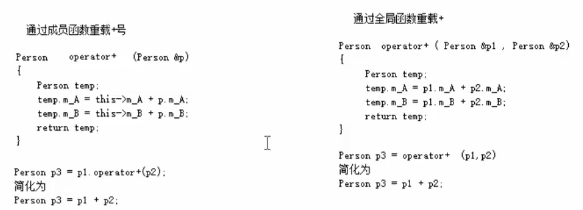
#include <iostream>
using namespace std;

//成员函数重载
class Person {
    public:
        Person operator+(Person &p) {
            Person temp;
            temp.m_A = this->m_A + p.m_A;
            temp.m_B = this->m_B + p.m_B;
            return temp;
        }

        int m_A;
        int m_B;
};


//全局函数重载
Person operator-(Person &p1, Person &p2) {
    Person temp;
    temp.m_A = p1.m_A - p2.m_A;
    temp.m_B = p1.m_B - p2.m_B;
    return temp;
}

int main() {
    Person p1;
    p1.m_A = 10;
    p1.m_B = 10;
    Person p2;
    p2.m_A = 10;
    p2.m_B = 10;

    Person p3 = p1 + p2;
    cout << p3.m_A << " " << p3.m_B << endl; // 20 20

    Person p4 = p1 - p2;
    cout << p4.m_A << " " << p4.m_B << endl; // 0 0
}
运算符重载也可以发生函数重载
总结1:对于内置的数据类型的表达式的运算符是不可能改变的
总结2:不要滥用运算符重载
左移运算符重载
作用:可以输出自定义数据类型
#include <iostream>
using namespace std;

class Person {
    friend ostream & operator<<(ostream &cout, Person &p);

    public:
        Person(int a, int b) {
            m_A = a;
            m_B = b;
        }

    private:
        //operator<<(cout)  相当于 p.operator<<(cout) 简化为 p << cout;
        // 顺序不是 cout << p;这样的预期效果,所以一般不用成员函数重载

        int m_A;
        int m_B;
};

//流对象不能复制,只能引用&cout
ostream & operator<<(ostream &cout, Person &p) { //本质 operator(cout, p) 简化 cout << p;
    cout << "m_A = " << p.m_A << " " << "m_B = " << p.m_B;
    return cout; //链式编程思想 可以在后面接endl了
}


int main() {
    Person p(10, 10);

//以前的<<功能不变,追加了输出Person对象的功能
    cout << p << endl;
}
总结:重载做运算符配合友元可以实现输出自定义数据类型
递增运算符重载
作用:通过重载递增运算符,实现自己的整型数据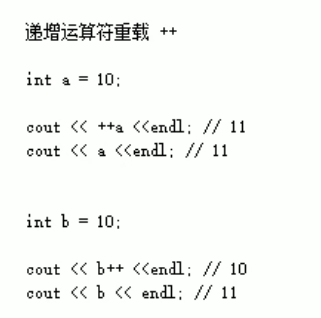
#include <iostream>
using namespace std;

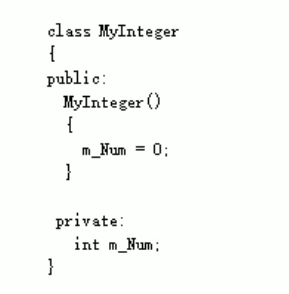
class MyInteger {
    friend ostream & operator<<(ostream &cout, MyInteger myint);
    public:
        MyInteger() {
            m_Num = 0;
        }

        //重载前置++运算符
        MyInteger& operator++() { //返回引用 是为了一直对一个数据进行递增操作
            //先自增
            m_Num++;
            //后返回
            return *this;
        }

        //重载后置++运算符
        MyInteger operator++(int) { //int代表占位参数,可以用于区分前置递增和后置递增
            //先记录当时结果
            MyInteger temp = *this;
            //后 递增
            m_Num++;
            //最后将记录结果返回
            return temp;      //temp是局部对象,不要返回引用
        }
    private:
        int m_Num;
};

//重载左移运算符
ostream & operator<<(ostream &cout, MyInteger myint) {
    cout << myint.m_Num;
    return cout;
}


int main() {
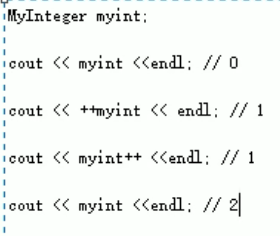
    MyInteger myint;
    cout << myint << endl; //0

    cout << ++myint << endl;//1
    cout << myint++ << endl;//1
    cout << myint << endl;//2
}
总结:前置递增返回引用,后置递增返回值
赋值运算符重载
C++编译器至少给一个类添加4个函数
- 默认构造函数(无参,函数体为空)
- 默认析构函数(无参,函数体为空)
- 默认拷贝构造函数,对属性进行值拷贝
- 赋值运算符operator= 对属性进行值拷贝
如果类中有属性指向堆区,做赋值操作时也会出现深浅拷贝问题
#include <iostream>
using namespace std;

class Person {
    public:
        Person(int age) {
            m_Age = new int(age);
        }

        ~Person() {
            if (m_Age != NULL) {
                delete m_Age;
                m_Age = NULL;
            }
        }

        //重载 赋值运算
        Person& operator=(Person &p) {
            //编译器提供的 是浅拷贝
            //m_Age = p.m_Age;

            //应该先判断是否有属性在堆区,如果有先释放干净,然后再深拷贝
            if (m_Age != NULL) {
                delete m_Age;
                m_Age = NULL;
            }
            //深拷贝
            m_Age = new int(*p.m_Age);
            //返回对象本身 链式
            return  *this;
        }

        int *m_Age;

};
int main() {
    Person p1(18);
    Person p2(20);
    Person p3(30);

    p3 = p2 = p1;

    cout << *p1.m_Age << endl; //18
    cout << *p2.m_Age << endl; //18
    cout << *p3.m_Age << endl; //18
}
关系运算符重载
作用:重载关系运算符,可以让两个自定义类型对象进行操作对比
#include <iostream>
#include <string>
using namespace std;

class Person {
    public:
        Person(string name, int age) {
            m_Name = name;
            m_Age = age;
        }

        //重载==
        bool operator==(Person &p) {
            if (this->m_Name == p.m_Name && this->m_Age == p.m_Age) {
                return true;
            }
            return false;
        }
        //重载!=
        bool operator!=(Person &p) {
            if (this->m_Name == p.m_Name && this->m_Age == p.m_Age) {
                return false;
            }
            return true;
        }

        string m_Name;
        int m_Age;

};


int main() {
    Person p1("Tom", 18);
    Person p2("Tom", 18);

    if (p1 == p2) {
        cout << "p1和P2相等" << endl;
    }
    else
        cout << "p1和P2不相等" << endl;
}
函数调用运算符重载
- 函数调用运算符()也可以重载
- 由于重载后使用的方式非常像函数的调用,因此称为仿函数
- 仿函数没有固定写法,非常灵活#include <iostream>
#include <string>
using namespace std;

class MyPrint {
    public:
        void operator()(string test) {
            cout << test << endl;
        }

};


class MyAdd {
    public:
        int operator()(int num1, int num2) {
            return num1 + num2;
        }
};

int main() {
    MyPrint myPrint;
    myPrint("hello world");

    MyAdd myAdd;
    cout << myAdd(1, 1) << endl;
   cout << MyAdd()(100, 100) << endl;  //匿名函数对象
}

 浙公网安备 33010602011771号