实验7:基于REST API的SDN北向应用实践
一、基础要求
编写Python程序,调用OpenDaylight的北向接口实现以下功能
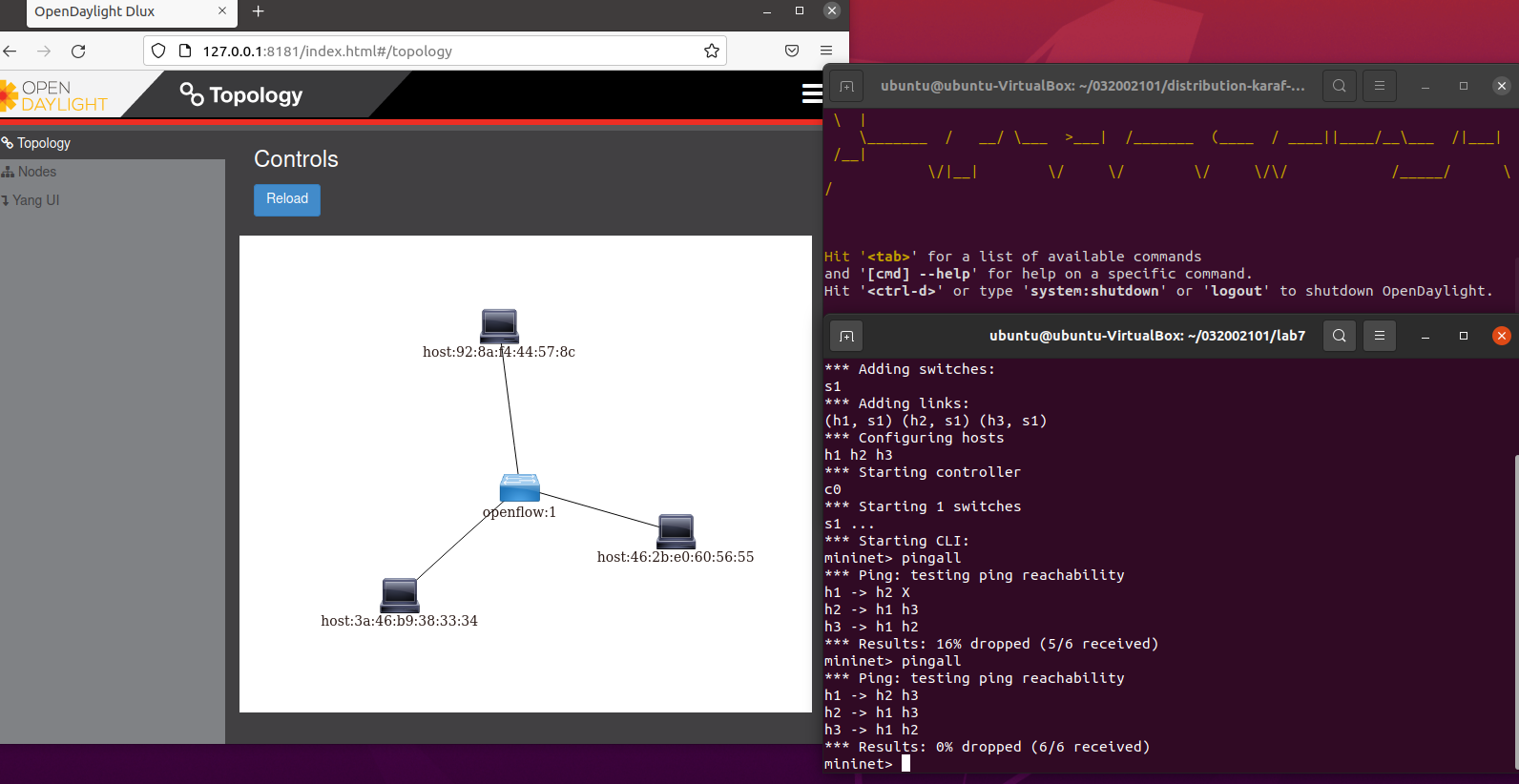
(1) 利用Mininet平台搭建下图所示网络拓扑,并连接OpenDaylight
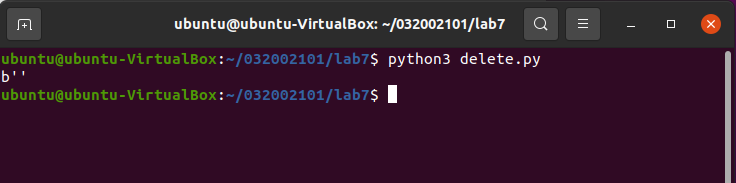
(2) 下发指令删除s1上的流表数据。
from requests.auth import HTTPBasicAuth

if __name__ == "__main__":
    url = 'http://127.0.0.1:8181/restconf/config/opendaylight-inventory:nodes/node/openflow:1/'
    headers = {'Content-Type': 'application/json'}
    res = requests.delete(url, headers=headers, auth=HTTPBasicAuth('admin', 'admin'))
    print (res.content)
先任意下发一个流表,例如(3)中的硬超时20秒,再执行delete.py,可以看到硬超时提前结束,即流表数据被删除
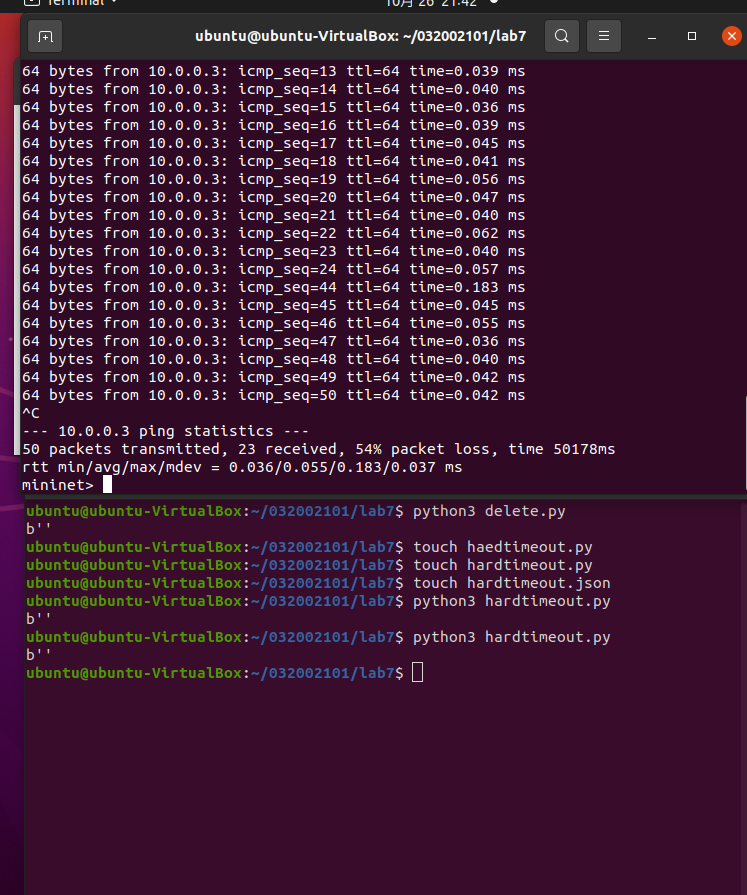
(3) 下发硬超时流表,实现拓扑内主机h1和h3网络中断20s。
创建并编写 hardtimeout.py 文件
import requests
from requests.auth import HTTPBasicAuth
if __name__ == "__main__":
    url = 'http://127.0.0.1:8181/restconf/config/opendaylight-inventory:nodes/node/openflow:1/flow-node-inventory:table/0/flow/1'
    with open("./hardtimeout.json") as file:
        str = file.read()
    headers = {'Content-Type': 'application/json'}
    res = requests.put(url, str, headers=headers, auth=HTTPBasicAuth('admin', 'admin'))
    print (res.content)
创建并编写 hardtimeout.json 文件
# hardtimeout.json
{
    "flow": [
      {
        "id": "1",
        "match": {
          "in-port": "1",
          "ethernet-match": {
            "ethernet-type": {
              "type": "0x0800"
            }
          },
          "ipv4-destination": "10.0.0.3/32"
        },
        "instructions": {
          "instruction": [
            {
              "order": "0",
              "apply-actions": {
                "action": [
                  {
                    "order": "0",
                    "drop-action": {}
                  }
                ]
              }
            }
          ]
        },
        "flow-name": "flow",
        "priority": "65535",
        "hard-timeout": "20",
        "cookie": "2",
        "table_id": "0"
      }
    ]
  }
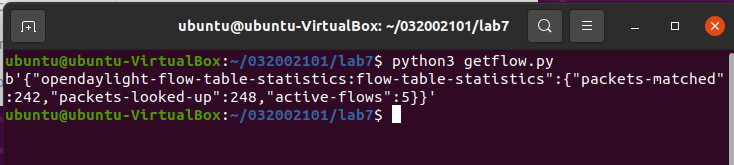
(4) 获取s1上活动的流表数
创建并编写 getflow.py 文件
# getflow.py
import requests
from requests.auth import HTTPBasicAuth
if __name__ == "__main__":
    url = 'http://127.0.0.1:8181/restconf/operational/opendaylight-inventory:nodes/node/openflow:1/flow-node-inventory:table/0/opendaylight-flow-table-statistics:flow-table-statistics'
    headers = {'Content-Type': 'application/json'}
    res = requests.get(url,headers=headers, auth=HTTPBasicAuth('admin', 'admin'))
    print (res.content)
2.编写Python程序,调用Ryu的北向接口实现以下功能
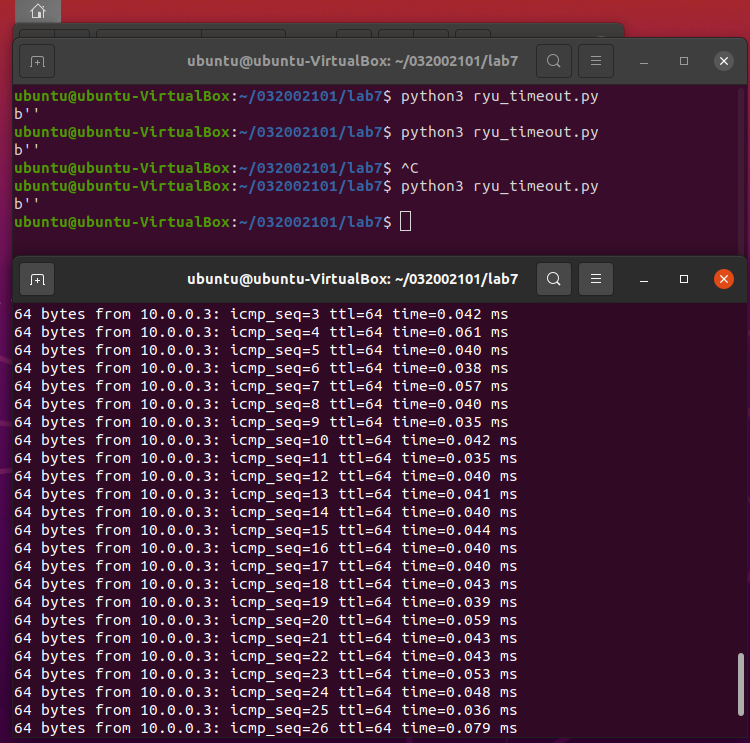
(1) 实现上述OpenDaylight实验拓扑上相同的硬超时流表下发。
创建并编写 ryu_timeout.py 文件
# ryu_timeout.py
import requests
if __name__ == "__main__":
    url = 'http://127.0.0.1:8080/stats/flowentry/add'
    with open("./ryu_timeout.json") as file:
        str = file.read()
    headers = {'Content-Type': 'application/json'}
    res = requests.post(url, str, headers=headers)
    print (res.content)
创建并编写 ryu_timeout.json 文件
# ryu_timeout.json
{
    "dpid": 1,
    "cookie": 1,
    "cookie_mask": 1,
    "table_id": 0,
    "hard_timeout": 20,
    "priority": 65535,
    "flags": 1,
    "match":{
        "in_port":1
    },
    "actions":[

    ]
 }
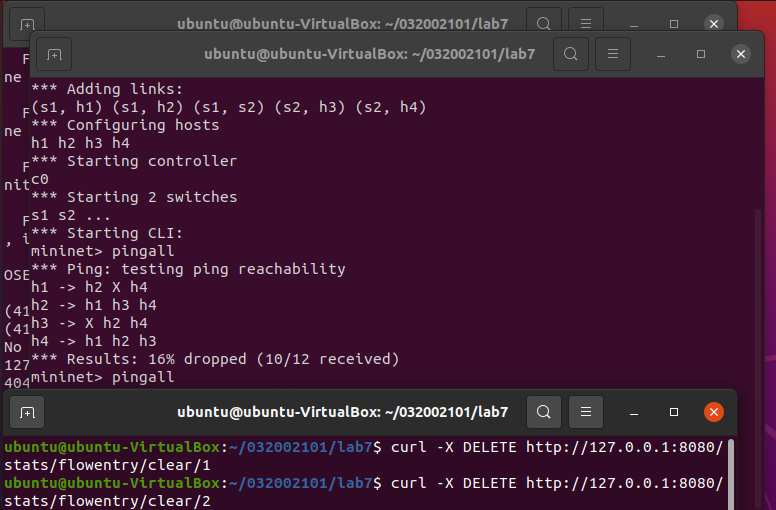
(2) 参考Ryu REST API的文档,基于VLAN实验的网络拓扑,编程实现相同的VLAN配置。
创建并编写 ryu_topo.py 文件
# ryu_topo.py
from mininet.topo import Topo

class MyTopo(Topo):
    def __init__(self):
        # initilaize topology
        Topo.__init__(self)

        self.addSwitch("s1")
        self.addSwitch("s2")

        self.addHost("h1")
        self.addHost("h2")
        self.addHost("h3")
        self.addHost("h4")

        self.addLink("s1", "h1")
        self.addLink("s1", "h2")
        self.addLink("s2", "h3")
        self.addLink("s2", "h4")
        self.addLink("s1", "s2")

topos = {'mytopo': (lambda: MyTopo())}
创建并编写 ryu_vlan.py 文件
# ryu_vlan.py
import json

import requests

if __name__ == "__main__":
    url = 'http://127.0.0.1:8080/stats/flowentry/add'
    headers = {'Content-Type': 'application/json'}
    flow1 = {
        "dpid": 1,
        "priority": 1,
        "match":{
            "in_port": 1
        },
        "actions":[
            {
                "type": "PUSH_VLAN",
                "ethertype": 33024
            },
            {
                "type": "SET_FIELD",
                "field": "vlan_vid",
                "value": 4096
            },
            {
                "type": "OUTPUT",
                "port": 3
            }
        ]
    }
    flow2 = {
        "dpid": 1,
        "priority": 1,
        "match":{
            "in_port": 2
        },
        "actions":[
            {
                "type": "PUSH_VLAN",
                "ethertype": 33024
            },
            {
                "type": "SET_FIELD",
                "field": "vlan_vid",
                "value": 4097
            },
            {
                "type": "OUTPUT",
                "port": 3
            }
        ]
    }
    flow3 = {
        "dpid": 1,
        "priority": 1,
        "match":{
            "vlan_vid": 0
        },
        "actions":[
            {
                "type": "POP_VLAN",
                "ethertype": 33024
            },
            {
                "type": "OUTPUT",
                "port": 1
            }
        ]
    }
    flow4 = {
        "dpid": 1,
        "priority": 1,
        "match": {
            "vlan_vid": 1
        },
        "actions": [
            {
                "type": "POP_VLAN",
                "ethertype": 33024
            },
            {
                "type": "OUTPUT",
                "port": 2
            }
        ]
    }
    flow5 = {
        "dpid": 2,
        "priority": 1,
        "match": {
            "in_port": 1
        },
        "actions": [
            {
                "type": "PUSH_VLAN",
                "ethertype": 33024
            },
            {
                "type": "SET_FIELD",
                "field": "vlan_vid",
                "value": 4096
            },
            {
                "type": "OUTPUT",
                "port": 3
            }
        ]
    }
    flow6 = {
        "dpid": 2,
        "priority": 1,
        "match": {
            "in_port": 2
        },
        "actions": [
            {
                "type": "PUSH_VLAN",
                "ethertype": 33024
            },
            {
                "type": "SET_FIELD",
                "field": "vlan_vid",
                "value": 4097
            },
            {
                "type": "OUTPUT",
                "port": 3
            }
        ]
    }
    flow7 = {
        "dpid": 2,
        "priority": 1,
        "match": {
            "vlan_vid": 0
        },
        "actions": [
            {
                "type": "POP_VLAN",
                "ethertype": 33024
            },
            {
                "type": "OUTPUT",
                "port": 1
            }
        ]
    }
    flow8 = {
        "dpid": 2,
        "priority": 1,
        "match": {
            "vlan_vid": 1
        },
        "actions": [
            {
                "type": "POP_VLAN",
                "ethertype": 33024
            },
            {
                "type": "OUTPUT",
                "port": 2
            }
        ]
    }
    res1 = requests.post(url, json.dumps(flow1), headers=headers)
    res2 = requests.post(url, json.dumps(flow2), headers=headers)
    res3 = requests.post(url, json.dumps(flow3), headers=headers)
    res4 = requests.post(url, json.dumps(flow4), headers=headers)
    res5 = requests.post(url, json.dumps(flow5), headers=headers)
    res6 = requests.post(url, json.dumps(flow6), headers=headers)
    res7 = requests.post(url, json.dumps(flow7), headers=headers)
    res8 = requests.post(url, json.dumps(flow8), headers=headers)
个人总结
1.我认为这次的实验难度较大,因为这次实验把之前的OpenDaylight和Ryu等综合起来,另外代码量也比较大
2.在基于VLAN实验的网络拓扑,编程实现相同的VLAN配置时,首先要先运行Ryuryu-manager ryu.app.simple_switch_13 ryu.app.ofctl_rest再构建自己用代码建立的拓扑,这样pingall才能成功
3.查看不了交换机上的流表,把指令更改为opctl dump-flows --protocols=Openflow13即可查看流表

 浙公网安备 33010602011771号