
环境信息:
系统:ubuntu 22.04 K8S版本: 1.25.9
1.确认节点信息
# 检查节点是否有 GPU
lspci | grep -i nvidia

# 确认 GPU 卡型号
nvidia-smi  #
2.安装NVIDIA驱动
# 添加 NVIDIA 驱动仓库
sudo apt update
sudo apt install -y ubuntu-drivers-common

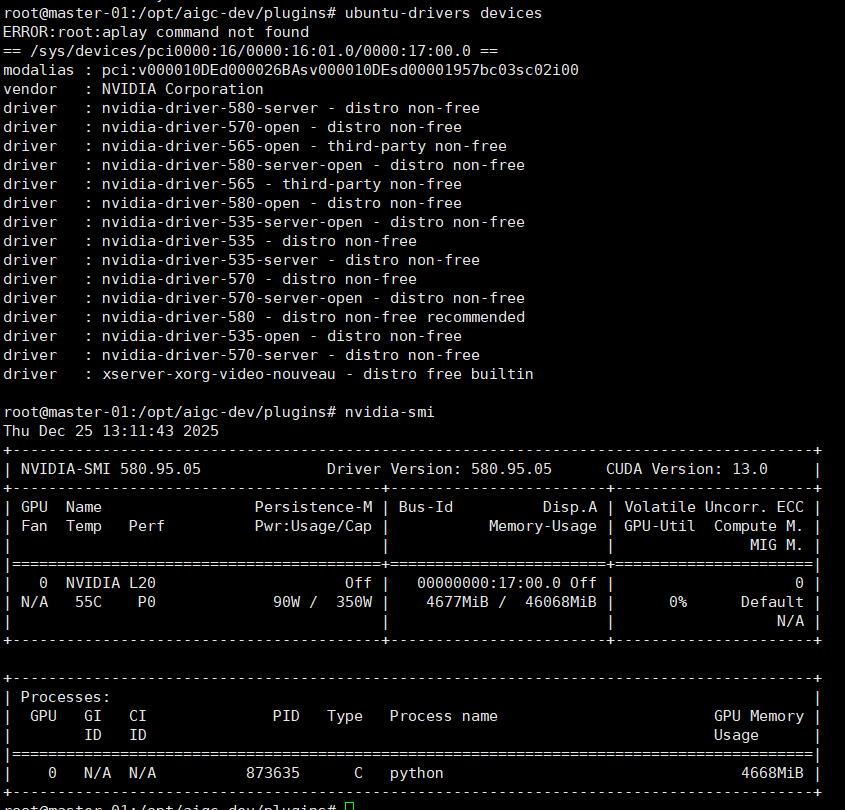
# 查看推荐驱动版本
ubuntu-drivers devices

# 安装推荐驱动
sudo ubuntu-drivers autoinstall

# 或安装特定版本
sudo apt install -y nvidia-driver-535  # 根据实际情况选择版本

# 重启系统
sudo reboot

# 验证驱动安装
nvidia-smi
3.安装NVIDIA Container Toolkit
官网:https://docs.nvidia.com/datacenter/cloud-native/container-toolkit/1.18.1/install-guide.html
# 配置 NVIDIA 容器仓库
distribution=$(. /etc/os-release;echo $ID$VERSION_ID)
curl -fsSL https://nvidia.github.io/libnvidia-container/gpgkey | sudo gpg --dearmor -o /usr/share/keyrings/nvidia-container-toolkit-keyring.gpg
curl -s -L https://nvidia.github.io/libnvidia-container/$distribution/libnvidia-container.list | \
  sed 's#deb https://#deb [signed-by=/usr/share/keyrings/nvidia-container-toolkit-keyring.gpg] https://#g' | \
  sudo tee /etc/apt/sources.list.d/nvidia-container-toolkit.list
如果网络不通, 用国内源:
curl -fsSL https://mirrors.ustc.edu.cn/libnvidia-container/gpgkey | sudo gpg --dearmor -o /usr/share/keyrings/nvidia-container-toolkit.gpg
echo "deb [signed-by=/usr/share/keyrings/nvidia-container-toolkit.gpg] https://mirrors.ustc.edu.cn/libnvidia-container/stable/deb/\$(ARCH) /" | sudo tee /etc/apt/sources.list.d/nvidia-container-toolkit.list

# 安装 nvidia-container-toolkit
sudo apt update
sudo apt install -y nvidia-container-toolkit

# 配置容器运行时
# 如果是 containerd
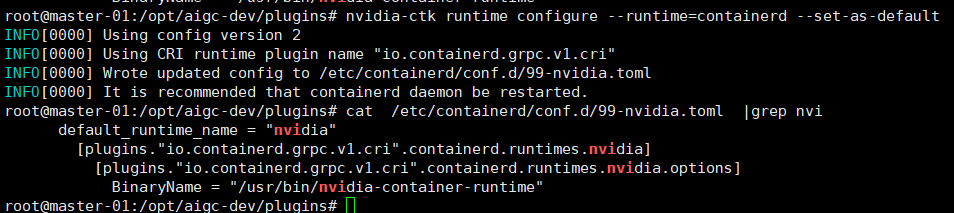
sudo nvidia-ctk runtime configure --runtime=containerd --set-as-default

# 重启 containerd
sudo systemctl restart containerd

# 验证配置
sudo nvidia-ctk config --in-place --set nvidia-container-runtime.debug=/var/log/nvidia-container-runtime.log
测试容器GPU访问
ctr run --rm \
    --gpus 0 \
    --runc-binary /usr/bin/nvidia-container-runtime \
    docker.io/nvidia/cuda:12.1.0-base-ubuntu22.04 \
    cuda-test \
    nvidia-smi
国内镜像: registry.cn-hangzhou.aliyuncs.com/mytest_docker123/nvidia-cuda:12.1.0-runtime-ubuntu22.04
4.安装NVIDIA Device Plugin For K8S
参考:https://github.com/NVIDIA/k8s-device-plugin
# 下载 device plugin yaml
wget https://raw.githubusercontent.com/NVIDIA/k8s-device-plugin/v0.14.1/nvidia-device-plugin.yml

# 修改配置(可选)
# 编辑 nvidia-device-plugin.yml,根据需求调整

# 部署 device plugin
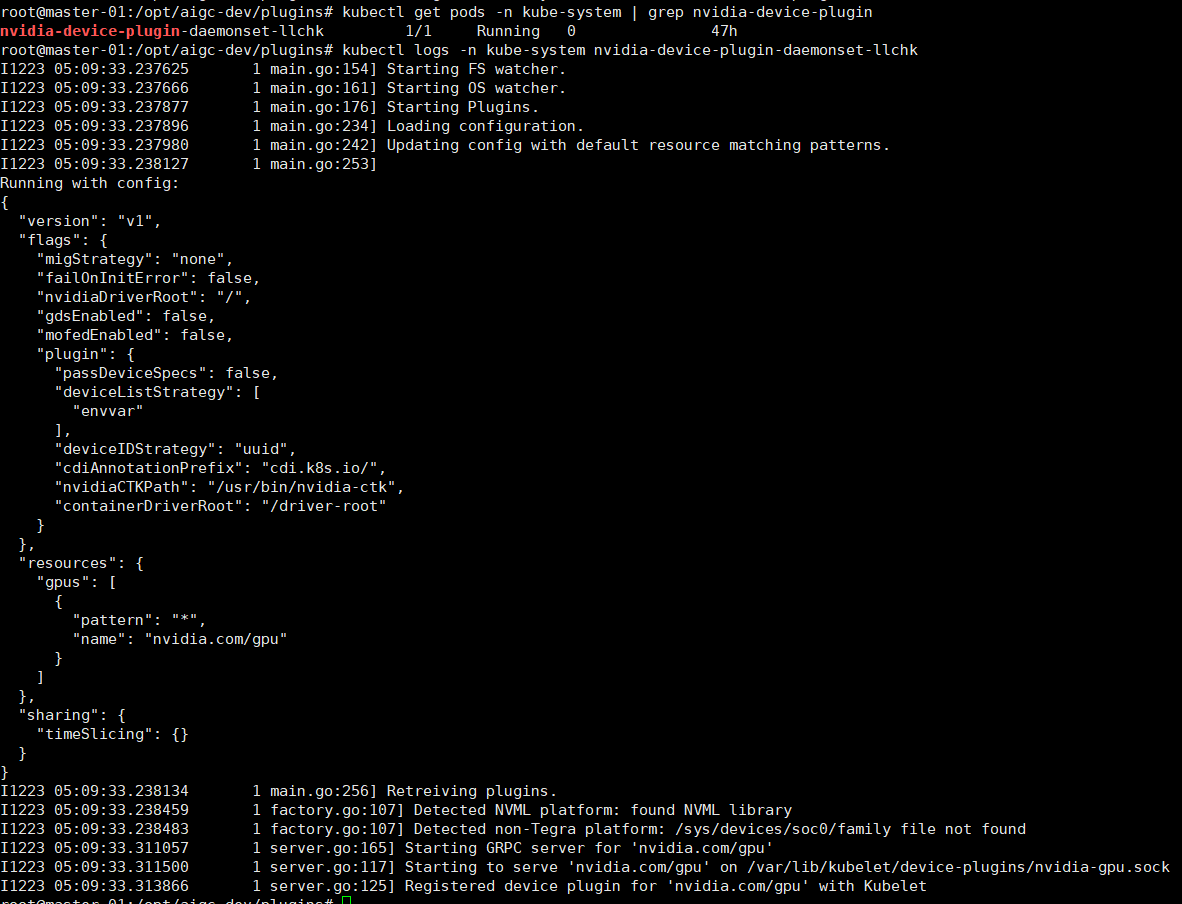
kubectl create -f nvidia-device-plugin.yml

# 检查部署状态
kubectl get pods -n kube-system | grep nvidia-device-plugin


cat nvidia-device-plugins.yaml
# Copyright (c) 2019, NVIDIA CORPORATION.  All rights reserved.
#
# Licensed under the Apache License, Version 2.0 (the "License");
# you may not use this file except in compliance with the License.
# You may obtain a copy of the License at
#
#     http://www.apache.org/licenses/LICENSE-2.0
#
# Unless required by applicable law or agreed to in writing, software
# distributed under the License is distributed on an "AS IS" BASIS,
# WITHOUT WARRANTIES OR CONDITIONS OF ANY KIND, either express or implied.
# See the License for the specific language governing permissions and
# limitations under the License.

apiVersion: apps/v1
kind: DaemonSet
metadata:
  name: nvidia-device-plugin-daemonset
  namespace: kube-system
spec:
  selector:
    matchLabels:
      name: nvidia-device-plugin-ds
  updateStrategy:
    type: RollingUpdate
  template:
    metadata:
      labels:
        name: nvidia-device-plugin-ds
    spec:
      tolerations:
      - key: nvidia.com/gpu
        operator: Exists
        effect: NoSchedule
      # Mark this pod as a critical add-on; when enabled, the critical add-on
      # scheduler reserves resources for critical add-on pods so that they can
      # be rescheduled after a failure.
      # See https://kubernetes.io/docs/tasks/administer-cluster/guaranteed-scheduling-critical-addon-pods/
      priorityClassName: "system-node-critical"
      containers:
      - image: registry.cn-hangzhou.aliyuncs.com/mytest_docker123/nvidia-k8s-device-plugin:v0.14.1
        name: nvidia-device-plugin-ctr
        env:
          - name: FAIL_ON_INIT_ERROR
            value: "false"
        securityContext:
          allowPrivilegeEscalation: false
          capabilities:
            drop: ["ALL"]
        volumeMounts:
        - name: device-plugin
          mountPath: /var/lib/kubelet/device-plugins
      volumes:
      - name: device-plugin
        hostPath:
          path: /var/lib/kubelet/device-plugins
5.验证GPU可用性
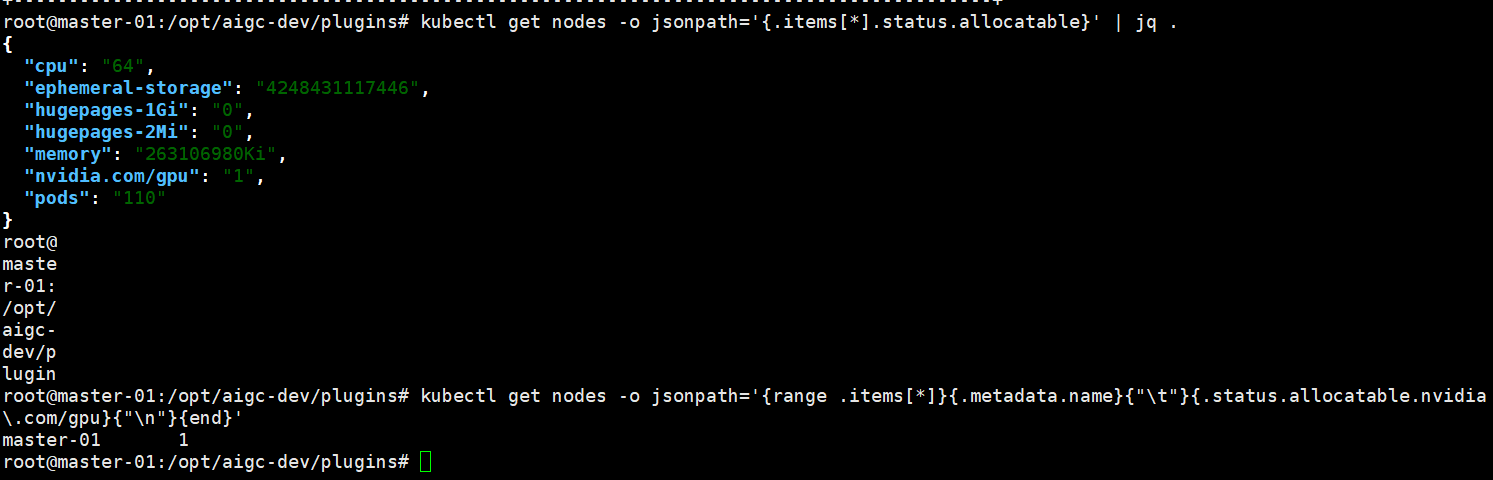
kubectl get nodes -o jsonpath='{.items[*].status.allocatable}' | jq .

# 查看 GPU 资源
kubectl get nodes -o jsonpath='{range .items[*]}{.metadata.name}{"\t"}{.status.allocatable.nvidia\.com/gpu}{"\n"}{end}'
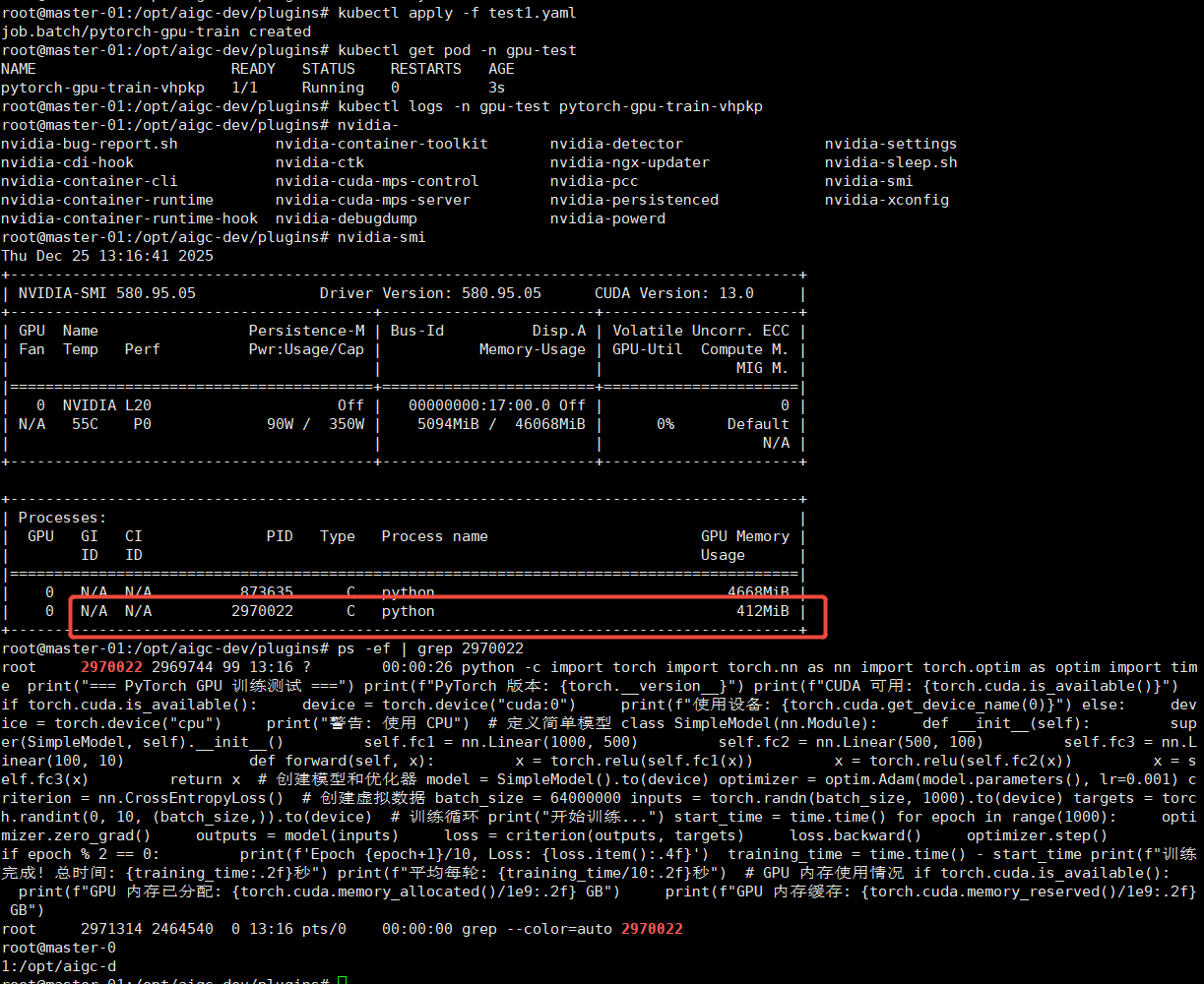
6.部署测试pod
cat test1.yaml
# pytorch-gpu-job.yaml
apiVersion: batch/v1
kind: Job
metadata:
  name: pytorch-gpu-train
  namespace: gpu-test
spec:
  backoffLimit: 1
  template:
    spec:
      containers:
      - name: pytorch-trainer
        image: registry.cn-hangzhou.aliyuncs.com/mytest_docker123/pytorch:2.0.1-cuda11.7-cudnn8-runtime
        command: ["python"]
        args:
        - -c
        - |
          import torch
          import torch.nn as nn
          import torch.optim as optim
          import time

          print("=== PyTorch GPU 训练测试 ===")
          print(f"PyTorch 版本: {torch.__version__}")
          print(f"CUDA 可用: {torch.cuda.is_available()}")

          if torch.cuda.is_available():
              device = torch.device("cuda:0")
              print(f"使用设备: {torch.cuda.get_device_name(0)}")
          else:
              device = torch.device("cpu")
              print("警告: 使用 CPU")

          # 定义简单模型
          class SimpleModel(nn.Module):
              def __init__(self):
                  super(SimpleModel, self).__init__()
                  self.fc1 = nn.Linear(1000, 500)
                  self.fc2 = nn.Linear(500, 100)
                  self.fc3 = nn.Linear(100, 10)

              def forward(self, x):
                  x = torch.relu(self.fc1(x))
                  x = torch.relu(self.fc2(x))
                  x = self.fc3(x)
                  return x

          # 创建模型和优化器
          model = SimpleModel().to(device)
          optimizer = optim.Adam(model.parameters(), lr=0.001)
          criterion = nn.CrossEntropyLoss()

          # 创建虚拟数据
          batch_size = 64000000
          inputs = torch.randn(batch_size, 1000).to(device)
          targets = torch.randint(0, 10, (batch_size,)).to(device)

          # 训练循环
          print("开始训练...")
          start_time = time.time()
          for epoch in range(1000):
              optimizer.zero_grad()
              outputs = model(inputs)
              loss = criterion(outputs, targets)
              loss.backward()
              optimizer.step()

              if epoch % 2 == 0:
                  print(f'Epoch {epoch+1}/10, Loss: {loss.item():.4f}')

          training_time = time.time() - start_time
          print(f"训练完成! 总时间: {training_time:.2f}秒")
          print(f"平均每轮: {training_time/10:.2f}秒")

          # GPU 内存使用情况
          if torch.cuda.is_available():
              print(f"GPU 内存已分配: {torch.cuda.memory_allocated()/1e9:.2f} GB")
              print(f"GPU 内存缓存: {torch.cuda.memory_reserved()/1e9:.2f} GB")
        resources:
          limits:
            cpu: "4"
            memory: "30Gi"
          requests:
            cpu: "2"
            memory: "4Gi"
      restartPolicy: Never
问题:
1.驱动报错:could not load NVML library: libnvidia-ml.so.1
参考:https://github.com/NVIDIA/k8s-device-plugin/issues/604
kubectl apply -f - <<EOF
apiVersion: node.k8s.io/v1
handler: nvidia
kind: RuntimeClass
metadata:
  name: nvidia
EOF
