


最短路径问题 Dijkstra ——Python实现
# 最短路径算法 Dijkstra
# 输入:含权有向图 G=(V,E),V={1,2,3...n}
# 输出:G中顶点 1 到各个顶点地最短距离
Dijkstra算法各点权值变化情况:
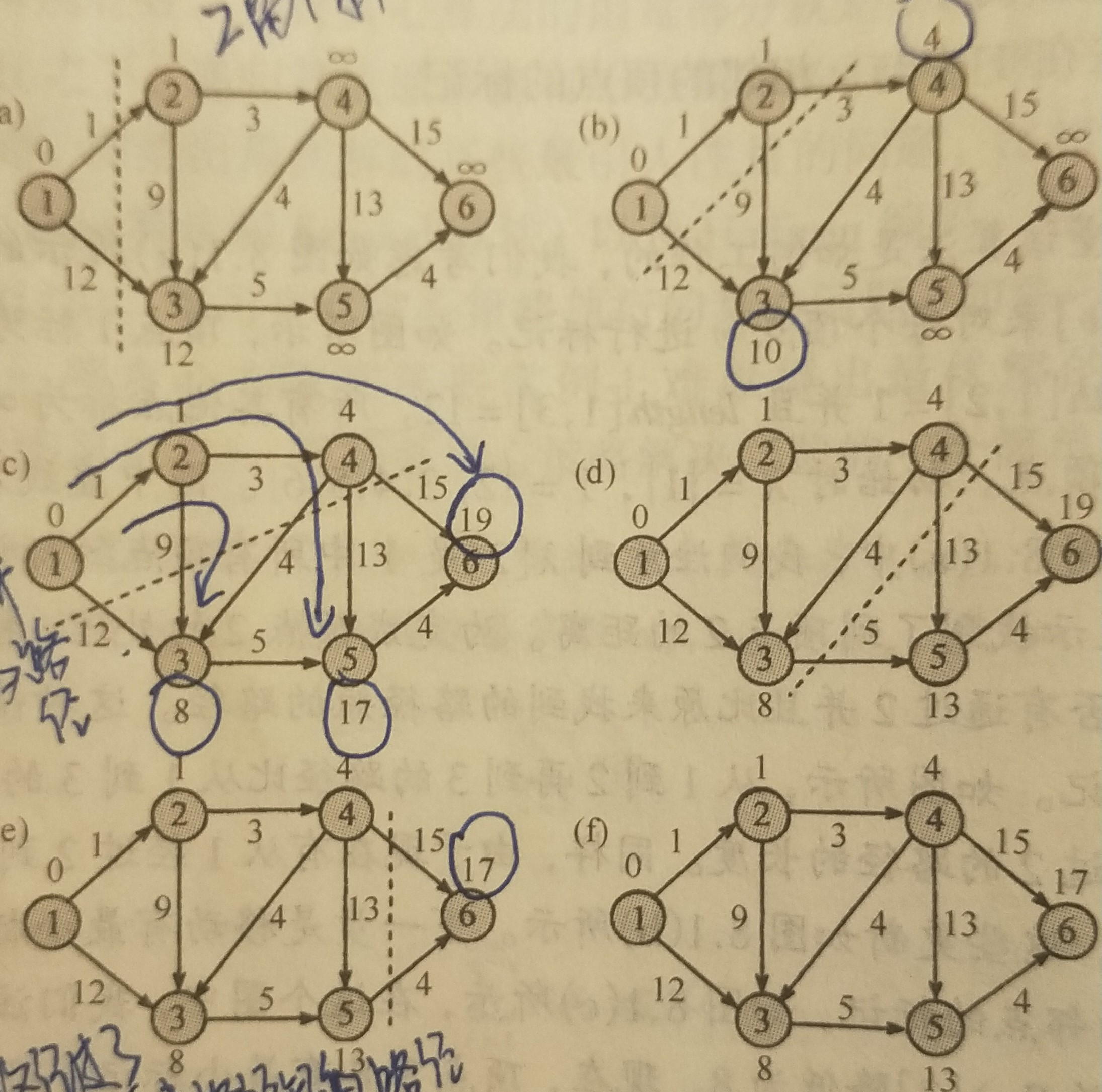
 1 class Vertex:
 2     #顶点类
 3     def __init__(self,vid,outList):
 4         self.vid = vid  #出边
 5         self.outList = outList  #出边指向的顶点id的列表,也可以理解为邻接表
 6         self.know = False   #默认为假
 7         self.dist = float('inf')    #s到该点的距离,默认为无穷大
 8         self.prev = 0   #上一个顶点的id,默认为0
 9     def __eq__(self, other):
10         if isinstance(other, self.__class__):
11             return self.vid == other.vid
12         else:
13             return False
14     def __hash__(self):
15         return hash(self.vid)
 1 #创建顶点对象
 2 v1=Vertex(1,[2,3])
 3 v2=Vertex(2,[3,4])
 4 v3=Vertex(3,[5])
 5 v4=Vertex(4,[3,5,6])
 6 v5=Vertex(5,[6])
 7 v6=Vertex(6,[])
 8
 9 #存储边的权值
10 edges = dict()
11 def add_edge(front,back,value):
12     edges[(front,back)]=value
13 add_edge(1,2,1)
14 add_edge(1,3,12)
15 add_edge(2,3,9)
16 add_edge(2,4,3)
17 add_edge(3,5,5)
18 add_edge(4,3,4)
19 add_edge(4,5,13)
20 add_edge(4,6,15)
21 add_edge(5,6,4)
1 #创建一个长度为7的数组,来存储顶点,0索引元素不存
2 vlist = [False,v1,v2,v3,v4,v5,v6]
3 #使用set代替优先队列,选择set主要是因为set有方便的remove方法
4 vset = set([v1,v2,v3,v4,v5,v6])
 1 def get_unknown_min():#此函数则代替优先队列的出队操作
 2     the_min = 0
 3     the_index = 0
 4     j = 0
 5     for i in range(1,len(vlist)):
 6         if(vlist[i].know is True):
 7             continue
 8         else:
 9             if(j==0):
10                 the_min = vlist[i].dist
11                 the_index = i
12             else:
13                 if(vlist[i].dist < the_min):
14                     the_min = vlist[i].dist
15                     the_index = i
16             j += 1
17     #此时已经找到了未知的最小的元素是谁
18     vset.remove(vlist[the_index])#相当于执行出队操作
19     return vlist[the_index]
 1 def main():
 2     #将v1设为顶点
 3     v1.dist = 0
 4
 5     while(len(vset)!=0):
 6         v = get_unknown_min()
 7         print(v.vid,v.dist,v.outList)
 8         v.know = True
 9         for w in v.outList:#w为索引
10             if(vlist[w].know is True):
11                 continue
12             if(vlist[w].dist == float('inf')):
13                 vlist[w].dist = v.dist + edges[(v.vid,w)]
14                 vlist[w].prev = v.vid
15             else:
16                 if((v.dist + edges[(v.vid,w)])<vlist[w].dist):
17                     vlist[w].dist = v.dist + edges[(v.vid,w)]
18                     vlist[w].prev = v.vid
19                 else:#原路径长更小,没有必要更新
20                     pass
函数调用:
1 main()
2 print('v.dist 即为从起始点到该点的最短路径长度:')
3 print('v1.prev:',v1.prev,'v1.dist',v1.dist)
4 print('v2.prev:',v2.prev,'v2.dist',v2.dist)
5 print('v3.prev:',v3.prev,'v3.dist',v3.dist)
6 print('v4.prev:',v4.prev,'v4.dist',v4.dist)
7 print('v5.prev:',v5.prev,'v5.dist',v5.dist)
8 print('v6.prev:',v6.prev,'v6.dist',v6.dist)
运行结果:
1 0 [2, 3]
2 1 [3, 4]
4 4 [3, 5, 6]
3 8 [5]
5 13 [6]
6 17 []
v.dist 即为从起始点到该点的最短路径长度:
v1.prev: 0 v1.dist 0
v2.prev: 1 v2.dist 1
v3.prev: 4 v3.dist 8
v4.prev: 2 v4.dist 4
v5.prev: 3 v5.dist 13
v6.prev: 5 v6.dist 17

 浙公网安备 33010602011771号