
基于Chains构造大模型流程
目录
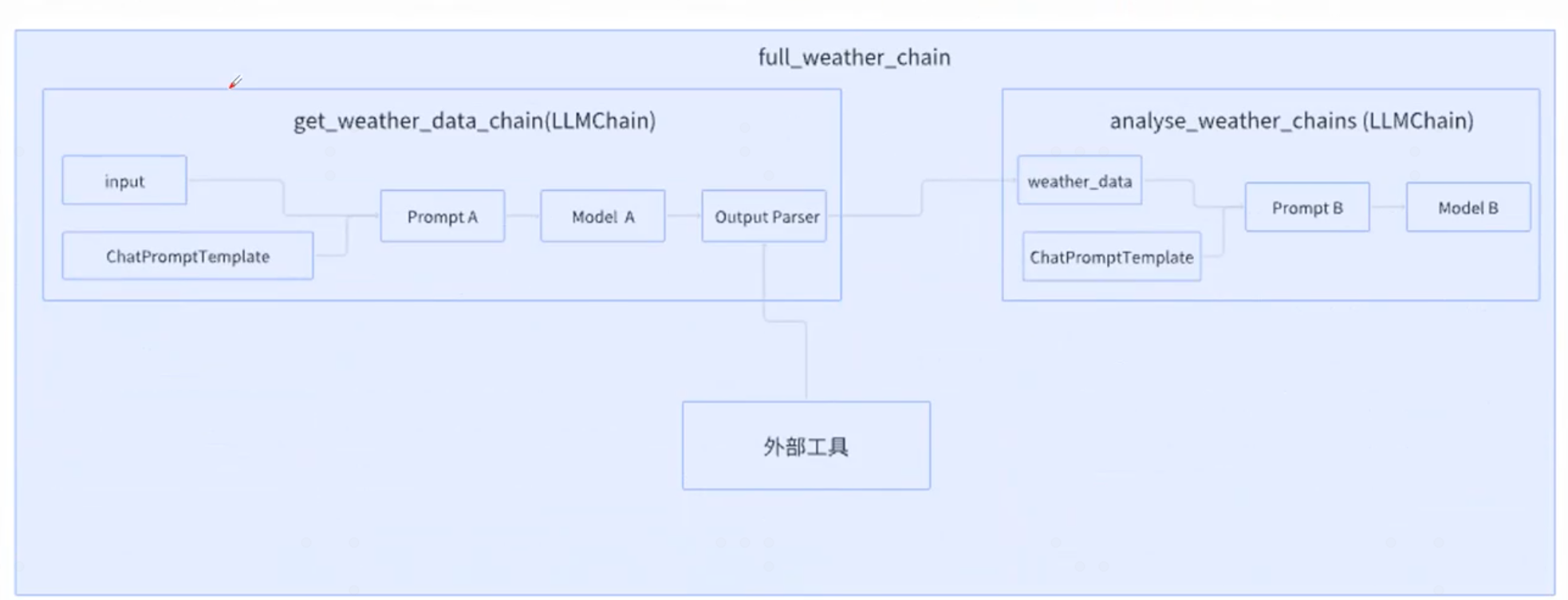
阶段1:实现第一个chain。 获取天气数据
1. 构造提示词模板
1.1 规划
如果模型推理能力弱的大模型,你给他一个复杂的问题,他回答不好,我们需要根据场景准备好一系列回答好的问题(示例)投喂给大模型,让大模型学习。
。所以我们需要通过few show拆解步骤。
大概步骤
1 准备好问题
2 组装成提示词模板+用户的提的问题给到大模型
使用fewshot可以简化问题的拼接。
设计原则:1 静态的提示词示例和动态的用户输入问题分离。2 历史聊天记录和用户输入的消息分类
建议
1. 使用Few-shot示例提示:将固定示例作为Few-shot示例,与动态输入分开,这样模型既能参考示例,又能处理实际用户输入。
2. 消息角色分离:将系统消息、示例对话和实际用户输入明确区分,避免混淆。
3. 维护对话历史:正确处理多轮对话中的消息历史,确保工具调用的结果能够被正确记录和响应。
反模式
chat_template = ChatPromptTemplate.from_messages([
    ("system", "..."),
    ("human", "{user_input}"),
    ("human", "我要退货,订单号是: "),  # 硬编码用户输入
    ("ai", "按流程处理退货...")        # 硬编码AI回复
])
推荐写法
class ExamplePrompts:
    examples = [
        {"input": "我要退货,订单号是: ",
         "output": "按严格流程处理退货请求 "
                   "1. 获取订单号并验证有效性,调用函数validate_order ,如果返回结果为 无效订单,告诉用户订单号无效流程结束 。如果订单号有效继续走后续流程 "
                   "2. 检查订单时间是否符合退货政策,调用函数 get_order_date  "
                   "3. 若超期,拒绝退货但提供替代方案(维修服务),提供维护服务地址  taobao.com/mend/xxx  "
                   "4. 若未超期,引导客户填写退货表单,表单地址 taobao.com/refund/xxx"},

        {"input": "食堂总共有23个苹果,如果他们用掉20个苹果,然后又买了6个苹果,请问现在食堂总共有多少个苹果?",
         "output": "食堂最初有23个苹果,用掉20个,然后又买了6个,总共有23-20+6=9个苹果,答案是9。"},
    ]

    def get_prompts(self) -> ChatPromptTemplate:
        example_prompt = ChatPromptTemplate.from_messages([
            ("human", "{input}"),
            ("ai", "{output}")
        ])

        few_shot_prompt = FewShotChatMessagePromptTemplate(
            example_prompt=example_prompt,
            examples=self.examples
        )

        # 添加历史占位符
        prompt = ChatPromptTemplate.from_messages([
            few_shot_prompt,
            MessagesPlaceholder(variable_name="history"),  # 动态历史支持
            ("human", "{input}")
        ])

        return prompt
使用
    def invoke_without_tools(self, prompt: ChatPromptTemplate, user_input: str, history: list):
        llm = self.create_llm()
        chain = prompt | llm

        return chain.invoke({
            "input": user_input,
            "history": history  # 传递历史状态
        })
1.2 根据用户提的问题精准找到高质量的示例,投喂给大模型,以节约token,降低成本,提升效率
基于向量数据库
langchain 提供 selector的工具支持示例过滤。支持向量化,问题长度等方式。
2 定义外部函数
2.1 定义外部函数
2.2 编写函数工具说明 (可通过@tools注解可以不用编写工具说明)
2.3 构建函数列表
构造chains链 提示词模板 | llm.bind_tools | 输出格式化 | 调用外部函数
 def invoke_with_tools(self,prompt:ChatPromptTemplate, user_input:str, history:list):
        llm = self.create_llm()
        chain = prompt | llm.bind_tools([
            self.validate_order,
            self.check_order_time_complies_policy
        ])

        return chain.invoke({
            "input": user_input,
            "history": history  # 传递历史状态
        })
阶段2:基于外部函数的结果交给大模型组织输出
通过一个simple chain 串联阶段1,2完成调用。
底层 memory 贯穿
性能优化点
1 使用摘要功能简化存储,2
简单memory ConversationBufferMemory
简化多轮对话历史消息传递。
用法 https://www.cnblogs.com/aibi1/p/18804608
【注意】
- 使用ConversationChain 或带记忆的链时 框架会自动记录历史消息,如果直接调用LLM.invoke不会自动记录历史消息】
- 即使使用ConversationBufferMemory, 当前命中的工具信息还是要手动传递到历史消息记录。
memory.chat_memory.add_message(
                    ToolMessage(
                        content=result,
                        name=tool_call['name'],
                        tool_call_id=tool_call['id']
                    )
                )
entity memory
具备摘要功能的memory (减少token占用)
示例
示例1,使用原生的写法,自己构造历史消息,工具调用,工具链传递
from langchain_openai import ChatOpenAI
from langchain_core.messages import SystemMessage, HumanMessage
import os
import json
import os
from langchain_core.messages import AIMessage
import json
from langchain.tools import BaseTool, StructuredTool, tool
from langchain_openai import ChatOpenAI
from langchain.output_parsers import JsonOutputKeyToolsParser
from langchain_core.prompts import ChatPromptTemplate
from langchain_openai import ChatOpenAI
from langchain_core.messages import SystemMessage, HumanMessage, ToolMessage
from langchain_core.prompts import (
    ChatPromptTemplate,
    FewShotChatMessagePromptTemplate,
    MessagesPlaceholder
)

class ExamplePrompts:
    examples = [
        {"input": "我要退货,订单号是: ",
         "output": "按严格流程处理退货请求 "
                   "1. 获取订单号并验证有效性,调用函数validate_order ,如果返回结果为 无效订单,告诉用户订单号无效流程结束 。如果订单号有效继续走后续流程 "
                   "2. 检查订单时间是否符合退货政策,调用函数 get_order_date  "
                   "3. 若超期,拒绝退货但提供替代方案(维修服务),提供维护服务地址  taobao.com/mend/xxx  "
                   "4. 若未超期,引导客户填写退货表单,表单地址 taobao.com/refund/xxx"},

        {"input": "食堂总共有23个苹果,如果他们用掉20个苹果,然后又买了6个苹果,请问现在食堂总共有多少个苹果?",
         "output": "食堂最初有23个苹果,用掉20个,然后又买了6个,总共有23-20+6=9个苹果,答案是9。"},
    ]

    def get_prompts(self) -> ChatPromptTemplate:
        example_prompt = ChatPromptTemplate.from_messages([
            ("human", "{input}"),
            ("ai", "{output}")
        ])

        few_shot_prompt = FewShotChatMessagePromptTemplate(
            example_prompt=example_prompt,
            examples=self.examples
        )

        # 添加历史占位符
        prompt = ChatPromptTemplate.from_messages([
            few_shot_prompt,
            MessagesPlaceholder(variable_name="history"),  # 动态历史支持
            ("human", "{input}")
        ])

        return prompt

class IntelligentCustomerService:


    @tool
    def validate_order(orderNumber: str) -> str:
        """
          订单号是否有效校验函数,该函数定义了订单号是否有效的校验
          :param orderNumber: 必要参数,表示订单号,用字符串进行表示
          :return:"无效订单" 表示无效订单,"有效订单" 表示有效订单
          """
        if orderNumber == "123":
            return "无效订单"
        else:
            return "有效订单"

    @tool
    def check_order_time_complies_policy(orderNumber: str) -> str:
        """
        检查订单时间是否符合退货政策
        :param orderNumber: 必要参数,表示订单号,用字符串进行表示
        :return:"无效订单" 表示无效订单,"有效订单" 表示有效订单
        """
        if orderNumber == "125":
            return "符合退货政策"
        else:
            return "不符合退货政策"

    def create_llm(self) -> ChatOpenAI:
        """创建并返回配置好的大模型实例"""
        return ChatOpenAI(
            api_key=os.getenv("DASHSCOPE_API_KEY") or "your_api_key_here",
            base_url="https://dashscope.aliyuncs.com/compatible-mode/v1",
            model="qwen2.5-72b-instruct"
        )

    def invoke_with_tools(self,prompt:ChatPromptTemplate, user_input:str, history:list):
        llm = self.create_llm()
        chain = prompt | llm.bind_tools([
            self.validate_order,
            self.check_order_time_complies_policy
        ])

        return chain.invoke({
            "input": user_input,
            "history": history  # 传递历史状态
        })

    def invoke_without_tools(self, prompt: ChatPromptTemplate, user_input: str, history: list):
        llm = self.create_llm()
        chain = prompt | llm

        return chain.invoke({
            "input": user_input,
            "history": history  # 传递历史状态
        })

    def process_without_tool_calls(self, prompt_template: ChatPromptTemplate, question: str, history: list) :
        response = self.invoke_without_tools(prompt_template, question, history)
        history.extend([
            response
        ])

        return response

    def process_tool_calls(self, prompt_template: ChatPromptTemplate, question: str, history: list) -> bool:

            response = self.invoke_with_tools(prompt_template, question, history)
            print(response)
            if isinstance(response, AIMessage) and hasattr(response, 'tool_calls'):
                for tool_call in response.tool_calls:
                    try:

                        func_name = tool_call["name"]
                        args = json.loads(tool_call["args"]["orderNumber"])

                        # 通过实例调用工具方法
                        tool_func = getattr(self, func_name)
                        result = tool_func(str(args))
                        print(result)
                        # 更新历史记录
                        history.extend([
                            response,
                            ToolMessage(
                                content=result,
                                name=func_name,
                                tool_call_id=tool_call["id"]
                            )
                        ])


                        return True

                    except json.JSONDecodeError:
                        print("❌ 工具参数解析失败")
                    except (AttributeError, ValueError) as e:
                        print(f"❌ 工具调用错误: {str(e)}")
                    except Exception as e:
                        print(f"❌ 未知工具错误: {str(e)}")
                return False
            else:
                return False

    def answer(self, prompt_template: ChatPromptTemplate, question: str, history: list):
        i = 4
        while (i := i - 1) > 0:
            try:
                result = self.process_tool_calls(prompt_template, question, history)
                if not result:  # 如果处理失败,回退到无工具调用
                    return self.process_without_tool_calls(prompt_template, question, history)
            except json.JSONDecodeError:
                print("❌ 工具参数解析失败")
            except (AttributeError, ValueError) as e:
                print(f"❌ 工具调用错误: {str(e)}")
            except Exception as e:
                print(f"❌ 未知工具错误: {str(e)}")  # 英文引号
        # 所有尝试失败后的默认返回(可选)
        return self.invoke_without_tools(prompt_template, question, history)


def main():
    # 1. 获取用户输入
    user_input = ""
    aiChat = IntelligentCustomerService()
    exampleService = ExamplePrompts()
    history = []
    while (True):
        user_input = input("请输入文本:")
        if(user_input == "exit"):
            print("程序结束")
            break
    # 2. 处理数据
        print(user_input)
        aiChat.answer(exampleService.get_prompts(),user_input,history)
        ## TODO history 要追加到下次的聊天里面


if __name__ == "__main__":
    main()  # 启动主程序

 浙公网安备 33010602011771号