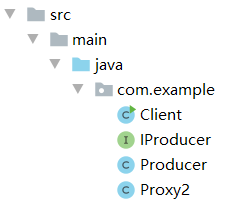
![]()
package com.example;

/**
 * 消费者
 */
public class Client {
    public static void main(String[] args) {
        IProducer producer = Proxy2.getProducer(Producer.class);

        producer.saleProduct(10000f);

    }
}
package com.example;

/**
 * 生产厂家标准
 */
public interface IProducer {
    /**
     * 销售
     * @param money
     */
    public void saleProduct(float money);

    /**
     * 销后
     * @param money
     */
    public void afterService(float money);
}
package com.example;

/**
 * 生产者
 */
public class Producer implements IProducer {
    /**
     * 销售
     * @param money
     */
    public void saleProduct(float money){
        System.out.println("销售产品,并拿到钱:"+money);
    }

    /**
     * 销后
     * @param money
     */
    public void afterService(float money){
        System.out.println("销后服务,并拿到钱:"+money);
    }
}
package com.example;

import java.lang.reflect.InvocationHandler;
import java.lang.reflect.Method;
import java.lang.reflect.Proxy;


public class Proxy2 {

    public static <T> T getProducer(Class<T> tClass){


        //ClassLoader:被代理对象的类加载器
        //Class[]:被代理对象的接口
        //InvocationHandler:增强代码

        T proxy = null;
        try {
            proxy = (T) Proxy.newProxyInstance(tClass.getClassLoader(), tClass.getInterfaces(), new InvocationHandler() {

                T t=(T)Class.forName(tClass.getName()).newInstance();
                /**
                 *
                 * @param proxy
                 * @param method
                 * @param args
                 * @return
                 * @throws Throwable
                 */
                @Override
                public Object invoke(Object proxy, Method method, Object[] args) throws Throwable {

                    if("saleProduct".equals(method.getName())){
                        args[0]=0.8f*(float)args[0];
                    }
                    return method.invoke(t,args);
                }

            });
        } catch (Exception e) {
            e.printStackTrace();
        }
        return proxy;
    }


}


 浙公网安备 33010602011771号