
我的单子(Monad)教程(JS版)
草稿:代码未经测试,欢迎大家多提意见
不得不说,LISP 和 Haskell 这样的语言正在极大的影响着各种编程语言。今天我们主要 来看一下 Haskell 中的单子是个什么东西。Haskell 基于范畴论,范畴论属于抽象数学。 而抽象的魅力在于可以把很多看似不相关的东西解释成同一个东西,既然是同一个东西, 我们就可以使用同样的的代码来完成看似不同的任务。这样同样一段代码出现的机会就更 大,就可以通过规定语法的方式来减小代码量。比如在Javascript 中常用的一个形式是 (function (x){return x;}).bind(this),所以ES2015定义了新的语法,上述代码可以写 为x => x。短的代码书写迅速,不宜出错,调试方便。
网上单子的教程都是转来转去——单子类似于一个盒子。不得不说这种比喻真的很对,可是 似乎对学习单子帮助不大。如果只是想了解一下这些东西还是很值得推荐 的。Haskell 中的单子等价于数学上定义的单子,可是数学总是过于抽象的,现在我们来 看一下具体到编程里该如何去理解单子。来看一看 Haskell 对 Javascript 的影 响是什么(或许着不是Haskell影响,而是广大的Javascript程序员们自己总结出来的设计 模式,但是不能不说这种处理思想越来越趋于 Haskell)。
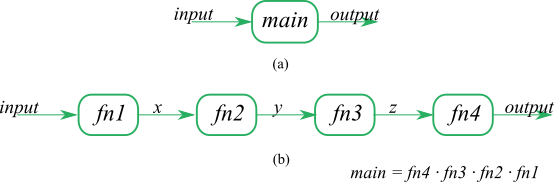
编程就是编写代码处理”我们关心的数据”以产生”我们想要的数据”。通常这是一个比较复 杂的函数,需要把这个大函数拆分成更小的函数,然后把这些函数复合到一起组合成最终 的这个大函数。编程语言提供了基本的函数,比如加法,减法等。因此 编程就是把一个个 的函数复合到一起组成一个更大的函数去处理”我们关心的数据” 。程序员的精力应该更多 的放在 fn1~fn4 的实现上,而不是如何去复合这些函数。一个好的“模式”,就应该能够让 程序员方便的复合这些函数。因此,作为程序的一小部分,fn2 只关心 x 是什么,它要完 成的任务是什么,而不用关心程序的其他部分。对 fn2 来说,x 就是”我们关心的数据”。
函数的复合方式有很多中,单子就是着其中的一种。单子成功的分离了”我们关心的数据” 以及”我们不关心的实现”——那些书上一直教育我们的。而且”我们不关心的实现”是一个更 加的通用的代码,”我们关心的数据”获取更加方便。”我们不关心的实现” 这种复合方式的 内部实现,,我们真的不用关心(可是设计者为了给我们留特别简单的接口就需要非太多的 心思)。与其说这是单子不如说是设计模式,一种特别通用的设计模式,一种 Java 中暂时 还不存在的设计模式。
1. 基本函数复合
最简单的函数复合类似于数学上的函数复合,比如:
1 2 3 4 5 6 7 8 9 10 11 12 13 14 15 16 17 18 19 |
function compose(f,g) {
    // 注意参数顺序,先调用 g ;为了和 f(g(x)) 顺序一样所以这样规定
    return function(x){ return f(g(x)); };
}
//===================================================
function father(name) {
    // 获取一个人的父亲...代码略
    return name + "'s father";
}
function mother(name){
    // 获取一个人的母亲...代码略
    return name + "'s mother";
}
// 获取一个人祖母
var fn = compose(mother,father);
var grandma = fn("Peter");
// 或更常见的写法
var dad = father("Peter");
var grandma = mother(dad);
|
这是最简单的最基本的函数复合方式,只是写起来也不是很方便,但是到处都可以见到这 样的代码。如果再涉及到错误处理还需要判断 father和 mother 是否能够正确的执行 ,这样实际写的代码会更加的复杂。写这样的代码仅仅体力劳动,枯燥而且特别容易出错, 尤其是代码更长的时候:
1 2 3 4 5 6 7 8 |
function grandgrandma(name)
{
    var dad = father(name);
    if(!dad) { return ""; } // 假设返回空表示错误
    var grandpa = father(dad);
    if(!grandpa) { return ""; }
    return mother(grandpa);
}
|
这段代码中有好多讨厌的if,所以如果把错误处理的代码放到 compose 中,这样就不 需要再在 compose 外面写错误处理了(为了更通用写的复杂了一点儿):
1 2 3 4 5 6 7 8 9 10 11 12 13 14 |
const ERROR="";
function compose(f,g){
    var args = [].slice.call(arguments);
    return function(x) {
        var t=x,i;
        for(i=args.length-1;i>=0;i--)
        {
            t = args[i].call(null,t);
            if(t===ERROR) { return ERROR; }
        }
        return t;
    }
}
var grandgrandma = compose(mother,father,father);
|
虽然这样 compose 复杂了一点儿,但毕竟是”我们不关心的实现”。 只要“库”给我们提供了一个这样的 compose 函数,我们就可以写出简洁的代码了。
可是,很多时候代码要处理的不仅仅是”错误”,所以一个”库”提供的不能仅仅只是这种函数 复合的方式。另外,这样获得一些函数的复合函数很容易,要获得“我们想要的数据”还是 需要对这个函数进行调用。当仅仅需要对这个函数进行调用一次,这样写就可能显得有点 儿不太方便了:
1 |
var grandgrandma = compose(mother,father,father)("Peter");
|
另外,这样的代码不太方便阅读,毕竟人还是习惯从左到右读文字,即使把 compose 参数 的顺序改变一下也不方便阅读。如果把函数复合的方式”挂在”数据上, 作为对象的方法是不是更好的呢? 当想使用某种方式复合的时候选取合适的数据类型就好了。
2. 错误处理
这种”模式”主要用于错误处理以及顺序执行。或者说后面一步能否执行取决于前一步执行 是否能正确执行。就是上面compose类似的函数复合方式.比如,链接数据库成功才能查 询数据,查询成功才能发送数据给用户,如果其中任意一步出错则整个操作就失败了。
2.1. Maybe
简单一段”我们不关心的实现”:
1 2 3 4 5 6 7 8 9 10 11 12 13 14 |
function Maybe(value) { this._value = value;}
Maybe.prototype = {
    constructor:Maybe,
    getMaybe: function() { return this._value;},
    // 注意这个函数
    bindM: function(fn) {
        if(this !== Nothing ) { return fn(this.getMaybe()); }
        return Nothing;
    },
    isJust: function() { return this !== Nothing;},
    isNothing: function() { return this === Nothing;}
}
var Nothing = new Maybe();  // 约定此变量表示错误
function Just(x) { return new Maybe(x);}
|
其中Nothing表示处理出错,既然选择这个“库”提供的错误处理方式,就必须遵循这个规 定,Just中保存了处理正确情况下的结果。这样做相当于在原始的字符串所有可能取值 上额外添加了一个取值Nothing,这样就不需要用特殊值来表示错误。原本代码使用空字 符串来表示处理出错,但是谁能保证将来空字符串不可以表示一个合法的名字呢。改写一 下father mother函数:
1 2 3 4 5 6 7 8 9 10 11 12 13 14 |
function father(name)
{
    if(Math.random() > 0.8) {
        return Nothing; // 处理出错
    }
    return Just(name + "'s father");
}
function mother(name)
{
    if(Math.random() > 0.8) {
        return Nothing; // 处理出错
    }
    return Just(name + "'s mother");
}
|
于是要获得一个人的曾祖母就可以写为:
1 2 3 4 5 6 7 8 |
var grandgrandma = father("Peter")
    .bindM(father)
    .bindM(mother);
    // 或者
var grandgrandma = Just("Peter") // 不严谨的说,这句表明我们使用Maybe提供的错误处理方式
    .bindM(father)
    .bindM(father)
    .bindM(mother);
|
于是整个程序可以读为”Peter的 father 的 father 的 mother”,显然就是”Peter”的曾祖母。
从另一个角度看,mother 函数仅仅是整个获取曾祖母函数中的一小部分, 当编写 mother函数的时候”我们关心的数据”就是上一步执行正确时候的执行结果。可以使用这样的方式获得:
1 2 3 4 5 |
Just("Peter").bindM(father).bindM(father)
    .bindM( function(x) {
        // 理解为 var x = Just("Peter").bindM(father).bindM(father)
        // x 就是这一小步中要处理的数据
    });
|
通过上面”我们不关心的实现”中的 bindM 函数,可以知道匿名函数就是 bindM 的形 参fn,而 bindM 给函数提供的参数就是 Just 中的值(上一步处理正确情况下的返 回值为”Peter”的祖父),即 x 就是 “Peter”的祖父,是在这一小步中”我们关心的数据”, 是前面所有步骤都执行正确情况下,这一步需要处理的数据。不过在此函数中只需要知 道x是某个人,此函数是要完成查询一个人母亲的任务就好了,而不需要关心其他部分是 如何实现的,它只需要做好查询一个人母亲的任务就好了。再写个例子,比如我们要过滤 和处理用户的输入:
1 2 3 4 5 |
var str = "user input";
var Output = Just(str)
    .bindM(x=> x.length > 0 ? Just(x):Nothing) // 长度大于 0
    .bindM(y=>/\n/.exec(y) ? Nothing:Just(y)) // 不能有换行
    .bindM(z=>Just(z.replace(/\t/g,"  "))) // Tab替换为空格
|
通过 bindM 的实现可以知道,如果上述步骤任意一步返回Nothing,则最终结果为 Nothing。只有每一步成功整个操作才会成功,这正是”我们不关心的实现”,上述的”x” “y” “z” 就是每一小步要处理的数据,他们都可以认为是用户的输入,每一小步做好自己的过滤工作就好了。 上述代码也可以写为:
1 2 3 4 5 6 7 8 9 |
var isNotEmpty = x => x.length > 0 ? Just(x):Nothing);
var isOneLine  = y=>/\n/.exec(y) ? Nothing:Just(y));
var replaceTab = z=>Just(z.replace(/\t/g,"  ")));
var str = "user input";
var Output = isNotEmpty(str)
    .bindM(isOneLine)
    .bindM(replacetab);
if(Output.isNothing()) { console.log("输入不符合要求"); }
// 又出现了讨厌的 if,其实可以消除
|
这样减小了函数粒度,提高了函数的复用性和可读性,而且多个函数的复合也是很简单的。
2.2. Either
当使用 Maybe的时候最终我们只知道出错了,但并不知道错误的原因。 或许”我们不关心的实现”可以更复杂一点儿,用来处理错误信息。
1 2 3 4 5 6 7 8 9 10 11 12 13 |
function Either(value) { this._value = value;}
Either.prototype = {
    constructor:Either,
    getEither: function() { return this._value;},
    bindM: function(fn) {
        if(this.isRight()) { return fn(this.getEither()); }
        return this;
    },
    isLeft: function() { return this._lr_ === "left";},
    isRight: function() { return this._lr_ === "right";}
}
function Left(value) { var e = new Either(value);e._lr_="left"; return e;}
function Right(value) { var e = new Either(value);e._lr_="right";  return e;}
|
其中Left中保存错误信息,Right中保存了处理正确情况下的结果。改写一下father mother函数为
1 2 3 4 5 6 7 8 9 10 11 12 13 14 15 16 17 18 19 |
function father(name)
{
    if(Math.random() > 0.8) {
        return Left("Can not find " + name + "'s father");
    }
    return Right(name + "'s father");
}
function mother(name)
{
    if(Math.random() > 0.8) {
        return Left("Can not find " + name + "'s mother");
    }
    return Right(name + "'s mother");
}
// 注意,下面的代码是不变的
var grandgrandmaName = Just("Peter")
    .bindM(father)
    .bindM(father)
    .bindM(mother);
|
上述代码和Maybe相似:Left相当于Nothing,只是其中可以保存错误信息,Right 相当于Just。在此就不做过多的阐述了。既然有了错误信息,给”我们不关心的实现”加 个catch方便我们错误处理,当然Maybe也可以加。
1 2 3 4 5 6 7 8 9 |
Either.prototype.catch = function(fn){
    if(this.isLeft()) { return fn(this.getEither()); }
    return this.getEither();
}
var grandgradma = father("Peter")
    .bindM(father)
    .bindM(mother)
    .catch(err=> {console.log(err);return "";});
    // 这里的错误处理仅仅是回归到以前假设空表示出错。
|
上述代码还是存在问题,就是不支持异步操作,可是做为 Javascript 不支持异步怎么行呢?
2.3. Promise
在上述 Either 的实现中会有三个全局变量Either,Left,Right,这点我们不太喜欢 。可是我们可以通过再复杂一点儿的实现只留下一个全局变量,如:
1 2 3 4 5 6 7 8 9 10 11 12 13 14 15 16 17 18 19 20 21 22 23 24 25 26 27 28 29 30 31 32 33 34 35 36 37 38 |
var Promise = (function(){
    // 原始 Either 实现
    function Either(value) { this._value = value;}
    Either.prototype = {
        constructor:Either,
        getEither: function() { return this._value;},
        bindM: function(fn) {
            if(this.isRight()) { return fn(this.getEither()); }
            return this;
        },
        isLeft: function() { return this._lr_ === "left";},
        isRight: function() { return this._lr_ === "right";}
    }
    function Left(value) { var e = new Either(value);e._lr_="left"; return e;}
    function Right(value) { var e = new Either(value);e._lr_="right";  return e;}

    function Promise(fn){
        // 这样,在使用的时候可以不写 return
        var ret;
        resolve = value => { ret = Right(value); };
        reject = value =>  { ret = Left(value); };
        fn(resolve,reject);
        return ret;
    }
    return Promise;
})();
 // 于是`father`函数就可以写为:
function father(name)
{
    // to do 链接数据库等
    return Promise( function(resolve,reject){
        if(Math.random() > 0.8) {
            // 通过上面对 Promise 的定义,这里可以不用写 return
            reject("Can not find " + name + "'s father"); // 不需要再写 return;
        }
        resolve(name + "'s father"); // 不需要再写 return;
    });
}
|
这样我们的代码就不受制于Right和Left 这两个变量名字。ES2015 就提供了一个这样 的 Promise 对象,只是它的实现比上述代码更复杂,而且支持异步操作(准确来说是异步操作)。不过既然是”我们不关 心的实现” 就不写实现了。不过呢,在 ES2015 中,方法bindM叫做then,也支持 catch。写个 AJAX 的例子:
1 2 3 4 5 6 7 8 9 10 11 12 13 14 |
var $ = jQuery;
function getJSON(url){
    return Promise(resolve,reject){
        $.ajax({ url:url,
            success:function(result){
                resolve(result);
            },
            error:function() { reject("Error!"); }
        });
    }
}
getJSON("http://example.com/path/to/JSON")
    .then(info=>console.log(info))
    .catch(err => console.error(err));
|
使用方法和 Either 区别不大,只不过Either不支持异步操作。另外,Promise 中的 then 是 支持两个参数的,至于什么意义,自行搜索。
像这样,定义了类似 bindM 函数的数据类型(其实还有一个叫return的函数),叫做单子Monad。 不过这些函数是要满足某些性质,至于是什么样的性质,后面再做介绍。而要求的这些性质比较少,于是一大批数据类型都可以定义出 符合要求的bindM,所以很多东西都是单子,只是这些 bindM 就看上去毫不相干。不过,他们都有一个通用的 目的,方便函数复合和调用,不同的 bindM 的实现和定义了不同的复合方式。比如如果我们要进行有错误处理的复合 我们可以选择Maybe或是Either。
3. 数组遍历
数组也可以定义一个符合要求的 bindM 函数,而这个函数的作用是完成类似数组遍历的作用[注]。
1 2 3 4 5 6 7 8 9 |
Array.prototype.bindM = function (fn){
    var len = this.length, result = [], i,ret;
    for(i = 0; i < len; i++){
        ret = fn(this[i]);
        // ASSERT(ret instanceof Array);
        result = result.concat(ret);
    }
    return result;
}
|
于是遍历数组就可以:
1 2 3 4 5 6 7 8 9 10 11 12 13 14 15 |
[1,2,3].bindM( x=> console.log(x));

[1,2,3].bindM(x => {
    return [x+10,x+100]; // 此处 x 取值分别为 1,2,3
}).bindM(y =>{
    return [y*10]; // 为了保持类型的统一,此处最好是返回一个数组
});
// [110,1010,120,1020,130,1030]

[1,2,3].bindM(x => {
    return [100,200,300].bindM( y => {
        // 这样写在这个函数里面就可以访问上一层的变量 x
       return [x+y];
}}));
//[101,201,301,102,202,203,301,302,303]
|
在第二段代码中 x 遍历 [1,2,3] 中的值, y遍历 [100,200,300] 中的值,返回值是着两个值的和 [x+y],因此最终会返回含有九个值的数组。从bindM 的实现来看,一个bindM 是一个for循环, 两层 bindM 就是两层 for 循环,所以计算结果含有九个值。
do语法糖
第二段代码似乎写起来有点儿复杂,但是结构性很强。于是在 Haskell 中发明了一个 do 语法糖(可以理解为一种简写的方式或是宏)。上述代码可以简写为:
1 2 3 4 |
do
    x <- [1,2,3]
    y <- [100,200,300]
    [x+y]
|
是不是看起来更清晰,把<- 看作赋值,是不是更清晰一点儿,其意义就是 x 赋值为后面数组的每一个元素。
由于是仅仅类似于字符串替换的东西(隐藏bindM函数的调用嗯和匿名函数的创建),Maybe 和 Either 也可以用 do 语法糖。do 语法糖可以极大的简化代码,由于许多东西都可以归结 为单子,定义bindM 函数,所以这样的代码出现率也特别高,写出来的程序可以很短。 下面完成一个查询一个人的祖父母,外祖父母的函数(假设用Maybe),有点儿复杂,但是仔细看看还是可以看出来的:
1 2 3 4 5 6 7 8 9 |
var grandprants = Just("Peter").bindM( p =>{ // var p = "Peter"
    father(p).bindM(dad =>   //  var dad = father(p);
        mother(p).bindM( mon =>  // var mon = mother(p);
            father(dad).bindM(g1 => // var g1 = father(dad);
                 mother(dad).bindM(g2 =>
                     father(mon).bindM(g3 =>
                         mother(mon).bindM(g4 =>
                             Just([g1,g2,g2,g4]);
); ); ); ); ); ); );
|
用 do 就方便阅读多了,大家肯都见过类似的代码:
1 2 3 4 5 6 7 8 9 |
grandprants = do
    p <- Just("Peter");
    dad <- father(p);
    mon <- mother(p);
    g1 <- father(dad);
    g2 <- mother(dad);
    g3 <- father(mon);
    g4 <- mother(mon);
    Just([g1,g2,g2,g4]);
|
这里面<- 的意义就是”赋值”呗,只是它可以自动进行错误处理。
数组函数的复合方式
上面说过,单子其实定义了一种函数复合的方式,当我们想使用不同的复合方式选择合适的数据类型就可以了。 那么在数组里的这个bindM 定义了怎样的复合方式呢?下面以一个例子来说明,一个简单的问题: 在一个 8x8 的棋盘上,象棋中的马经过三步从一个点到达哪些点。
1 2 3 4 5 6 7 8 9 10 11 12 13 14 15 16 17 18 19 20 21 22 23 24 25 26 27 28 29 30 31 32 33 34 35 36 37 38 |
// 定义一个坐标
function Point(x,y) { this.x = x; this.y = y; }
Point.prototype = {
    constructor:Point,
    equal: function(p) { return this.x===p.x && this.y===p.y; },
    toString: function(p){ return "(" + this.x + "," + this.y + ")"; }
}
// 判断是否合法
function isValidPos(pos) {
    return pos.x >= 1 && pos.x <= 8 && pos.y >= 1 && pos.y <= 8;
}
var Unit = {};
function guard(b) { return b?[Unit]:[]; }
// 移动一步
function moveKnight(pos)
{
    var x = pos.x,y = pos.y;
    // 使用 doM 和 eval 模拟 do 糖
    // doM 的具体代码参见 https://github.com/zonxin/jHaskell/blob/master/src/doM.js
    var code = doM(function(){
            next <- [new Point(x+2,y-1),new Point(x+2,y+1),new Point(x-2,y-1),new Point(x-2,y+1),
new Point(x+1,y-2),new Point(x+1,y+2),new Point(x-1,y-2),new Point( |