
数据结构之图(2-1)【十字链表】适用于有向图
邻接表固然优秀,但也有不足,例如对有向图的处理上,有时候需要再建立一个逆邻接表~
那我们思考了:有没有可能把邻接表和逆邻接表结合起来呢?
答案是肯定的,这就是我们现在要谈的十字链表(Orthogonal List)
为此我们重新定义顶点表结点结构:

接着重新定义边表结点结构

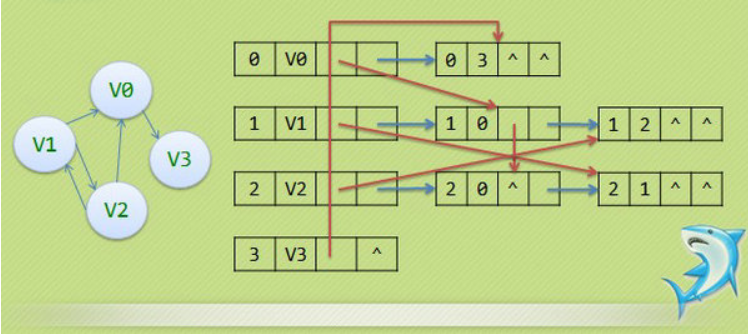
十字链表的好处就是因为把邻接表和逆邻接表整合在了一起,这样既容易找到以Vi为尾的弧,也容易找到以Vi为头的弧,因
而容易求得顶点的出度和入度。十字链表除了结构复杂一点外,其实创建图算法的时间复杂度是和邻接表相同的,因此,在
有向图的应用中,十字链表也是非常好的数据结构模型。
代码如下:

 1 #include "stdafx.h"
 2 #include<iostream>
 3 using namespace std;
 4 #define MAX_VERTEX_NUM 20
 5 typedef char InfoType;
 6
 7 typedef struct ArcBox
 8 {
 9     int tailvex, headvex;              //该弧的尾和头顶点的位置
10     struct ArcBox *hlink, *tlink;      //分别为弧头相同和弧尾相同的弧的链域
11     InfoType *info;                    //改弧相关信息的指针
12 }ArcBox;
13 typedef struct
14 {
15     char data;
16     ArcBox *firstin, *firstout;        //分别指向该顶点第一条入弧和出弧
17 }VexNode;
18 typedef struct
19 {
20     VexNode xlist[MAX_VERTEX_NUM];     //表头向量
21     int vexnum, arcnum;                //有向图的当前顶点数和弧数
22 }OLGraph;
23
24 int LocateVex(OLGraph G, char v)       //// 返回顶点v在有向图G中的位置(序号),如不存在则返回-1
25 {
26     for (int u = 0; u<G.vexnum; u++)
27         if(G.xlist[u].data == v)
28             return u;
29     return -1;
30 }
31
32 void CreateDG(OLGraph &G)              // 采用十字链表存储表示,构造有向图G
33 {
34     int i, j, k;
35     int IncInfo;
36     ArcBox *p;
37     char v1, v2;
38     cout << "请输入有向图的顶点数,弧数:";
39     cin >> G.vexnum >> G.arcnum ;
40     cout << "输入顶点:";
41     for (i = 0; i<G.vexnum; ++i)
42     {
43         cin >> G.xlist[i].data;
44         G.xlist[i].firstin = NULL;
45         G.xlist[i].firstout = NULL;
46     }
47     cout << "请输入" << G.arcnum << "条弧的弧尾和弧头(空格为间隔): " << endl;
48     for (k = 0; k<G.arcnum; ++k)
49     {
50         cin >> v1 >> v2;
51         i = LocateVex(G, v1);
52         j = LocateVex(G, v2);
53         p = new ArcBox;
54         p->tailvex = i;
55         p->headvex = j;
56         p->hlink = G.xlist[j].firstin;
57         p->tlink = G.xlist[i].firstout;
58         G.xlist[j].firstin = G.xlist[i].firstout = p;
59     }
60 }
61
62 void Display(OLGraph G)                // 输出有向图G
63 {
64     int i;
65     ArcBox *p;
66     cout << "共" << G.vexnum << "个顶点," << G.arcnum << "条弧:" << endl;
67     for (i = 0; i<G.vexnum; i++)
68     {
69         cout << "顶点" << G.xlist[i].data << ": 入度: ";
70         p = G.xlist[i].firstin;
71         while (p)
72         {
73             cout << G.xlist[p->tailvex].data<<" ";
74             p = p->hlink;
75         }
76         cout << "出度: ";
77         p = G.xlist[i].firstout;
78         while (p)
79         {
80             cout << G.xlist[p->headvex].data<<" ";
81             p = p->tlink;
82         }
83         cout << endl;
84     }
85 }
86