
作业6
# 代码12-1 评论去重的代码

import pandas as pd
import re
import jieba.posseg as psg
import numpy as np


# 去重,去除完全重复的数据
reviews = pd.read_csv(r"C:\Users\86184\Desktop\data\reviews.csv")
reviews = reviews[['content', 'content_type']].drop_duplicates()
content = reviews['content']


# 代码12-2 数据清洗

# 去除去除英文、数字等
# 由于评论主要为京东美的电热水器的评论,因此去除这些词语
strinfo = re.compile('[0-9a-zA-Z]|京东|美的|电热水器|热水器|')
content = content.apply(lambda x: strinfo.sub('', x))

# 代码12-3 分词、词性标注、去除停用词代码

# 分词
worker = lambda s: [(x.word, x.flag) for x in psg.cut(s)] # 自定义简单分词函数
seg_word = content.apply(worker)

# 将词语转为数据框形式,一列是词,一列是词语所在的句子ID,最后一列是词语在该句子的位置
n_word = seg_word.apply(lambda x: len(x))  # 每一评论中词的个数

n_content = [[x+1]*y for x,y in zip(list(seg_word.index), list(n_word))]
index_content = sum(n_content, [])  # 将嵌套的列表展开,作为词所在评论的id

seg_word = sum(seg_word, [])
word = [x[0] for x in seg_word]  # 词

nature = [x[1] for x in seg_word]  # 词性

content_type = [[x]*y for x,y in zip(list(reviews['content_type']), list(n_word))]
content_type = sum(content_type, [])  # 评论类型

result = pd.DataFrame({"index_content":index_content,
                       "word":word,
                       "nature":nature,
                       "content_type":content_type})

# 删除标点符号
result = result[result['nature'] != 'x']  # x表示标点符号


# 删除停用词
stop_path = open(r"C:\Users\86184\Desktop\data\stoplist.txt", 'r',encoding='UTF-8')
stop = stop_path.readlines()
stop = [x.replace('\n', '') for x in stop]
word = list(set(word) - set(stop))
result = result[result['word'].isin(word)]

# 构造各词在对应评论的位置列
n_word = list(result.groupby(by = ['index_content'])['index_content'].count())
index_word = [list(np.arange(0, y)) for y in n_word]
index_word = sum(index_word, [])  # 表示词语在改评论的位置

# 合并评论id,评论中词的id,词,词性,评论类型
result['index_word'] = index_word


# 代码12-4 提取含有名词的评论

# 提取含有名词类的评论
ind = result[['n' in x for x in result['nature']]]['index_content'].unique()
result = result[[x in ind for x in result['index_content']]]

# -*- coding: utf-8 -*-

# 代码12-6 匹配情感词

import pandas as pd
import numpy as np
word = pd.read_csv(r"C:\Users\86184\Desktop\data\word.csv")

# 读入正面、负面情感评价词
pos_comment = pd.read_csv(r"C:\Users\86184\Desktop\data\正面评价词语(中文).txt", header=None,sep="\n",
                          encoding = 'utf-8', engine='python')
neg_comment = pd.read_csv(r"C:\Users\86184\Desktop\data\负面评价词语(中文).txt", header=None,sep="\n",
                          encoding = 'utf-8', engine='python')
pos_emotion = pd.read_csv(r"C:\Users\86184\Desktop\data\正面情感词语(中文).txt", header=None,sep="\n",
                          encoding = 'utf-8', engine='python')
neg_emotion = pd.read_csv(r"C:\Users\86184\Desktop\data\负面情感词语(中文).txt", header=None,sep="\n",
                          encoding = 'utf-8', engine='python')

# 合并情感词与评价词
positive = set(pos_comment.iloc[:,0])|set(pos_emotion.iloc[:,0])
negative = set(neg_comment.iloc[:,0])|set(neg_emotion.iloc[:,0])
intersection = positive&negative  # 正负面情感词表中相同的词语
positive = list(positive - intersection)
negative = list(negative - intersection)

positive = pd.DataFrame({"word":positive,
                         "weight":[1]*len(positive)})
negative = pd.DataFrame({"word":negative,
                         "weight":[-1]*len(negative)})

posneg = positive.append(negative)

#  将分词结果与正负面情感词表合并,定位情感词
data_posneg = posneg.merge(word, left_on = 'word', right_on = 'word',
                           how = 'right')
data_posneg = data_posneg.sort_values(by = ['index_content','index_word'])


# 代码12-7 修正情感倾向

# 根据情感词前时候有否定词或双层否定词对情感值进行修正
# 载入否定词表
notdict = pd.read_csv(r"C:\Users\86184\Desktop\data\not.csv")

# 处理否定修饰词
data_posneg['amend_weight'] = data_posneg['weight']  # 构造新列,作为经过否定词修正后的情感值
data_posneg['id'] = np.arange(0, len(data_posneg))
only_inclination = data_posneg.dropna()  # 只保留有情感值的词语
only_inclination.index = np.arange(0, len(only_inclination))
index = only_inclination['id']

for i in np.arange(0, len(only_inclination)):
    review = data_posneg[data_po
# -*- coding: utf-8 -*-

# 代码12-9 建立词典及语料库

import pandas as pd
import numpy as np
import re
import itertools
import matplotlib.pyplot as plt

# 载入情感分析后的数据

posdata = pd.read_csv(r"C:\Users\86184\Desktop\data\posdata.csv", encoding = 'utf-8')
negdata = pd.read_csv(r"C:\Users\86184\Desktop\data\negdata.csv", encoding = 'utf-8')

from gensim import corpora, models
# 建立词典
pos_dict = corpora.Dictionary([[i] for i in posdata['word']])  # 正面
neg_dict = corpora.Dictionary([[i] for i in negdata['word']])  # 负面

# 建立语料库
pos_corpus = [pos_dict.doc2bow(j) for j in [[i] for i in posdata['word']]]  # 正面
neg_corpus = [neg_dict.doc2bow(j) for j in [[i] for i in negdata['word']]]   # 负面

# 代码12-10 主题数寻优

# 构造主题数寻优函数
def cos(vector1, vector2):  # 余弦相似度函数
    dot_product = 0.0;
    normA = 0.0;
    normB = 0.0;
    for a,b in zip(vector1, vector2):
        dot_product += a*b
        normA += a**2
        normB += b**2
    if normA == 0.0 or normB==0.0:
        return(None)
    else:
        return(dot_product / ((normA*normB)**0.5))

# 主题数寻优
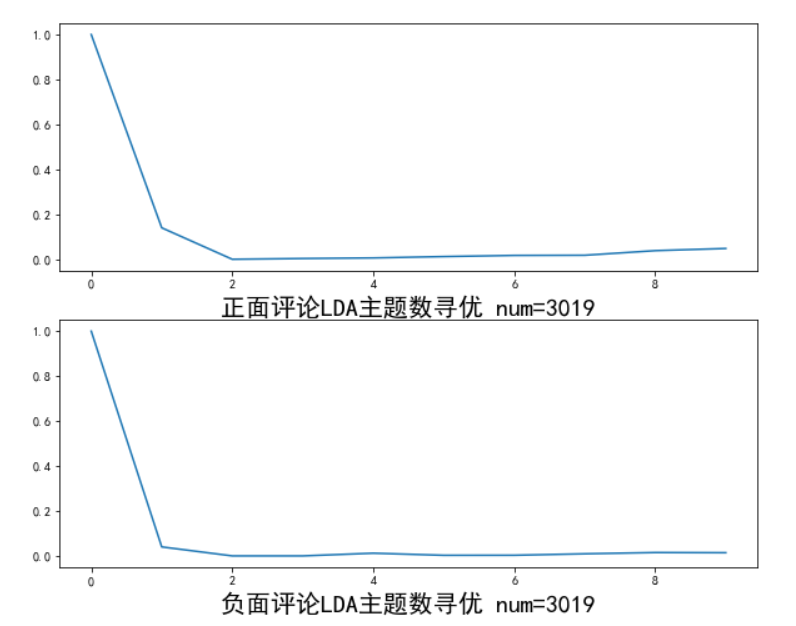
def lda_k(x_corpus, x_dict):

    # 初始化平均余弦相似度
    mean_similarity = []
    mean_similarity.append(1)

    # 循环生成主题并计算主题间相似度
    for i in np.arange(2,11):
        lda = models.LdaModel(x_corpus, num_topics = i, id2word = x_dict)  # LDA模型训练
        for j in np.arange(i):
            term = lda.show_topics(num_words = 50)

        # 提取各主题词
        top_word = []
        for k in np.arange(i):
            top_word.append([''.join(re.findall('"(.*)"',i)) \
                             for i in term[k][1].split('+')])  # 列出所有词

# 构造词频向量
        word = sum(top_word,[])  # 列出所有的词
        unique_word = set(word)  # 去除重复的词

        # 构造主题词列表,行表示主题号,列表示各主题词
        mat = []
        for j in np.arange(i):
            top_w = top_word[j]
            mat.append(tuple([top_w.count(k) for k in unique_word]))

        p = list(itertools.permutations(


 浙公网安备 33010602011771号