

实验6 文件I/O与异常处理
实验任务一:
源码:


#pragma once
#include <iomanip>
#include <iostream>
#include <string>

struct Contestant {
    long   id;              // 学号
    std::string name;       // 姓名
    std::string major;      // 专业
    int    solved;          // 解题数
    int    penalty;         // 总罚时
};

// 重载<<
// 要求:姓名/专业里不含空白符
inline std::ostream& operator<<(std::ostream& out, const Contestant& c) {
    out << std::left;
    out << std::setw(15) << c.id
        << std::setw(15) << c.name
        << std::setw(15) << c.major
        << std::setw(10) << c.solved
        << std::setw(10) << c.penalty;

    return out;
}

// 重载>>
inline std::istream& operator>>(std::istream& in, Contestant& c) {
    in >> c.id >> c.name >> c.major >> c.solved >> c.penalty;

    return in;
}
#pragma once
#include <fstream>
#include <iostream>
#include <stdexcept>
#include <string>
#include <vector>
#include "contestant.hpp"

// ACM 排序规则:先按解题数降序,再按罚时升序
inline bool cmp_by_solve(const Contestant& a, const Contestant& b) {
    if(a.solved != b.solved)
        return a.solved > b.solved;

    return a.penalty < b.penalty;
}

// 将结果写至任意输出流
inline void write(std::ostream& os, const std::vector<Contestant>& v) {
    for (const auto& x : v)
        os << x << '\n';
}

// 将结果打印到屏幕
inline void print(const std::vector<Contestant>& v) {
    write(std::cout, v);
}

// 将结果保存到文件
inline void save(const std::string& filename, const std::vector<Contestant>& v) {
    std::ofstream os(filename);
    if (!os)
        throw std::runtime_error("fail to open " + filename);

    write(os, v);
}

// 从文件读取信息(跳过标题行)
inline std::vector<Contestant> load(const std::string& filename) {
    std::ifstream is(filename);
    if (!is)
        throw std::runtime_error("fail to open " + filename);

    std::string line;
    std::getline(is, line);          // 跳过标题

    std::vector<Contestant> v;
    Contestant t;
    int seq;
    while (is >> seq >> t)
        v.push_back(t);

    return v;
}
task1.cpp运行结果测试截图:
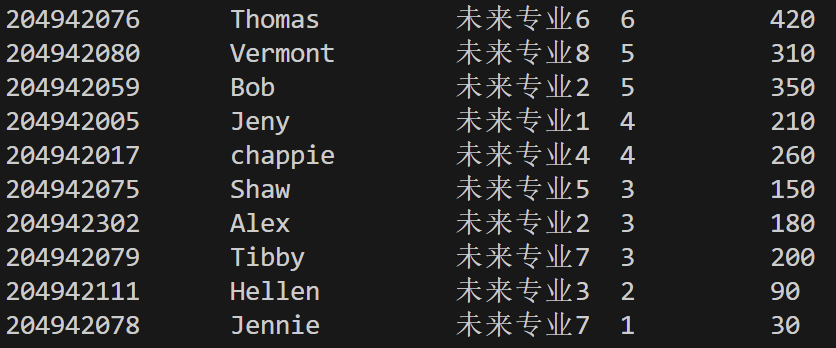
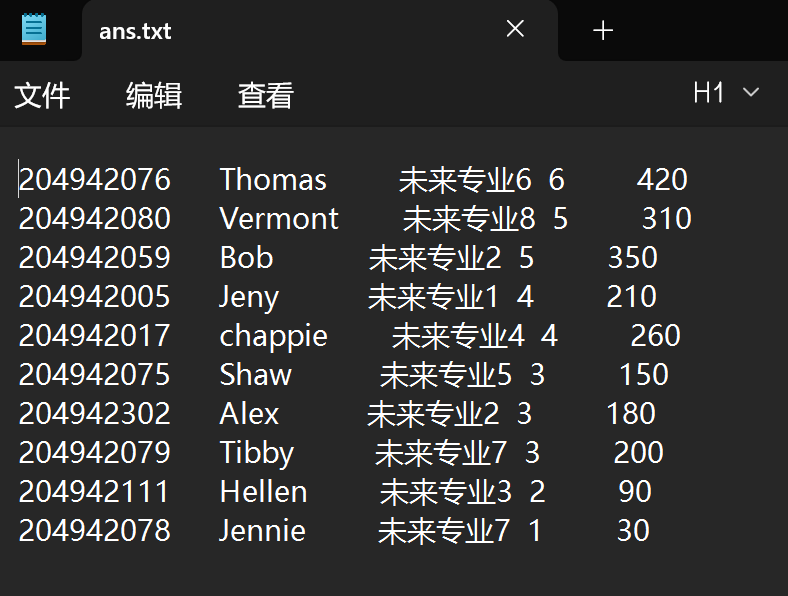
回答问题:
问题1:流操作与代码复用
观察 print() 与 save() 的实现,均在内部调用 write() :
(1) write() 的参数类型是 std::ostream& ,它为什么能同时接受 std::cout 和 std::ofstream 对象作为实参?
答:因为cout是ostream类的对象;ofsream是ostream的派生类,基类引用可以绑定到派生类对象。
(2)如果要把结果写到其他设备,只要该设备也提供std::ostream 接口,还需改动 write() 吗?
答:不需要改动write()。write()只依赖于ostream接口,新设备需要提供输出能力,即能实现ostream接口即可。
问题2:异常处理与捕获
在代码中找到两处 throw 语句,说明:
(1)什么情况下会抛出异常;
答:①打开os文件失败。
1 if (!os)
2         throw std::runtime_error("fail to open " + filename);
②读取is文件失败。
1 if (!is)
2         throw std::runtime_error("fail to open " + filename);
(2)异常被谁捕获、做了哪些处理。
答:异常被app()函数中catch块捕获,并存入exception类型引用e,用cerr无缓冲立刻显示e.what()的错误提示,并立即return防止程序继续执行错误代码。
1 try {
2         contestants = load(in_file);
3         std::sort(contestants.begin(), contestants.end(), cmp_by_solve);
4         print(contestants);
5         save(out_file, contestants);
6     } catch (const std::exception& e) {
7         std::cerr << e.what() << '\n';
8         return;
9     }
问题3:替代写法
函数app中 std::sort(contestants.begin(), contestants.end(), cmp_by_solve);参数 cmp_by_solve 换成下面的lambda表达式是否可以?功能、性能、结果是否一致?
1 [](const Contestant& a, const Contestant& b) {
2 return a.solved != b.solved ? a.solved > b.solved
3 : a.penalty < b.penalty;}
答:可以,两者功能、性能、结果基本一致。用lambda表达式使代码更易理解、简洁,但是可读性、复用性较差。
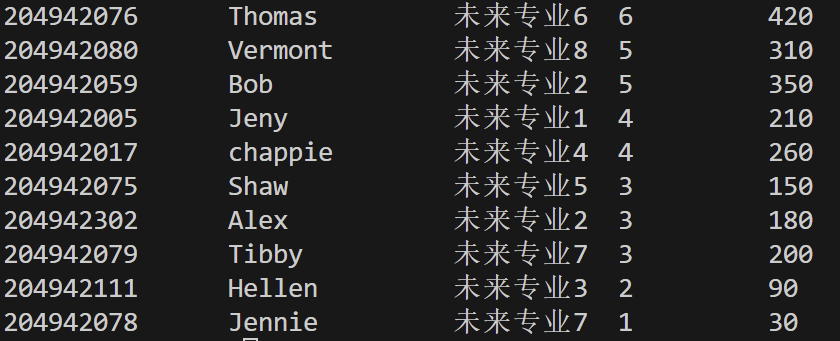
问题4:数据完整性与代码健壮性
把 in_file 改成 "./data_bad.txt" (内含空白行或字段缺失),重新编译运行:
(1)观察运行结果有什么问题?给出测试截图并分析原因。
答:问题是Thomas的解题数和总罚时数据错误、缺失了Vermont的全部信息。原因是txt中没有提供Thomas的解题数和总罚时数据,导致错位读取到了下一组的"8"、"204942078"。而空白行被读入并存储,使最后一行Vermont无法被读入。
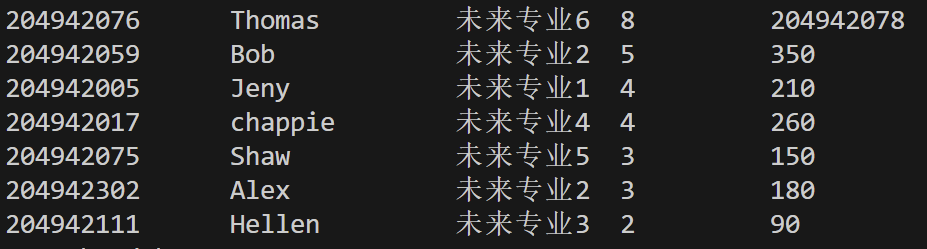
(2)思考:如何修改函数 std::vector load(const std::string& filename) ,使其提示出错行号并跳过有问题的数据行,同时让程序继续执行?(选答*)
答:因为while中使用getline逐行获得了行信息,所以下面要使用istringstream类型的对象iss,从line创建字符串流,而非文件流is。初始化line_num来追踪行号以提示出错行号。使用if(line.empty())检测有问题的数据行,使用continue跳过。解析失败时用cerr输出错误信息,但不抛出异常以便程序继续执行。
inline std::vector<Contestant> load(const std::string& filename) {
    std::ifstream is(filename);
    if (!is)
        throw std::runtime_error("fail to open " + filename);

    std::string line;
    std::getline(is, line);          // 跳过标题

    int line_num = 1;
    std::vector<Contestant> v;

    while (std::getline(is, line)) {
        line_num++;

        // 跳过空行
        if (line.empty()) {
            std::cerr << "警告:第" << line_num << "行为空行,跳过" << std::endl;
            continue;
        }

    Contestant t;
    int seq;
    std::istringstream iss(line);

    if (iss >> seq >> t.id >> t.name >> t.major >> t.solved >> t.penalty) {
            v.push_back(t);
        } else {
            // 读取失败,报告错误但继续
            std::cerr << "错误:第" << line_num << "行格式错误: " << line << std::endl;
        }
    }

    return v;
}
实验任务二:
源码:
#pragma once

#include <iostream>
#include <string>

class Student {
public:
    Student() = default;
    ~Student() = default;

    const std::string get_major() const;
    int get_grade() const;

    friend std::ostream& operator<<(std::ostream& os, const Student& s);
    friend std::istream& operator>>(std::istream& is, Student& s);

private:
    int id;
    std::string  name;
    std::string  major;
    int          grade;  // 0-100
};
#include "student.hpp"
#include <iomanip>

const std::string Student::get_major() const {
    return major;
}

int Student::get_grade() const {
    return grade;
}

// 格式化输出,列宽与 stumgr.cpp 保持一致
std::ostream& operator<<(std::ostream& os, const Student& s) {
    const int w_id = 6;
    const int w_name = 12;
    const int w_major = 12;
    const int w_grade = 6;

    auto flags = os.flags();
    std::streamsize prec = os.precision();

    os << std::left
       << std::setw(w_id)   << s.id
       << std::setw(w_name) << s.name
       << std::setw(w_major)<< '\t' << s.major
       << std::right << std::setw(w_grade) << s.grade;

    os.flags(flags);
    os.precision(prec);
    return os;
}

std::istream& operator>>(std::istream& is, Student& s) {
    is >> s.id >> s.name >> s.major >> s.grade;
    return is;
}
#pragma once
#include <string>
#include <vector>
#include "student.hpp"

class StuMgr {
public:
    void load(const std::string& file);  // 加载数据文件(空格分隔)
    void sort();                         // 排序: 按专业字典序升序、同专业分数降序
    void print() const;                  // 打印到屏幕
    void save(const std::string& file) const; // 保存到文件

private:
    void write(std::ostream &os) const;  // 把数据写到任意输出流

private:
    std::vector<Student> students;
};
#include "stumgr.hpp"
#include "student.hpp"

#include <fstream>
#include <sstream>
#include <algorithm>
#include <iostream>
#include <iomanip>
#include <stdexcept>

void StuMgr::load(const std::string& file) {
    students.clear();
    std::ifstream ifs(file);
    if (!ifs) {
        throw std::runtime_error("无法打开文件: " + file);
    }

    // 跳过第一行表头
    std::string header;
    std::getline(ifs, header);

    Student s;
    while (ifs >> s) {
        students.push_back(s);
    }
}

void StuMgr::sort() {
    if (students.empty()) {
        std::cout << "(empty)\n";
        std::cout << "排序已完成\n";
        return;
    }
    std::sort(students.begin(), students.end(), [](const Student& a, const Student& b) {
        if (a.get_major() != b.get_major()) return a.get_major() < b.get_major();
        return a.get_grade() > b.get_grade();
    });
    std::cout << "排序已完成\n";
}

void StuMgr::write(std::ostream &os) const {
    const int w_id = 6;
    const int w_name = 12;
    const int w_major = 12;
    const int w_grade = 6;

    for (const auto& s : students) {
        os << s << '\n';
    }
}

void StuMgr::print() const {
    write(std::cout);
}

void StuMgr::save(const std::string& file) const {
    std::ofstream ofs(file);
    if (!ofs) {
        throw std::runtime_error("无法创建/打开文件: " + file);
    }
    write(ofs);
}
#include <iostream>
#include <limits>
#include <string>
#include "stumgr.hpp"

const std::string in_file = "./data.txt";
const std::string out_file = "./ans.txt";

void menu() {
    std::cout << "\n**********简易应用**********\n"
                 "1. 加载文件\n"
                 "2. 排序\n"
                 "3. 打印到屏幕\n"
                 "4. 保存到文件\n"
                 "5. 退出\n"
                 "请选择:";
}

void app() {
    StuMgr mgr;

    while(true) {
        menu();
        int choice;
        std::cin >> choice;

        try {
            switch (choice) {
            case 1: mgr.load(in_file);
                    std::cout << "加载成功\n"; break;
            case 2: mgr.sort();
                    break;
            case 3: mgr.print();
                    std::cout << "打印已完成\n"; break;
            case 4: mgr.save(out_file);
                    std::cout << "导出成功\n"; break;
            case 5: return;
            default: std::cout << "不合法输入\n";
            }
        }
        catch (const std::exception& e) {
            std::cout << "Error: " << e.what() << '\n';
        }
    }
}

int main() {
    app();
}
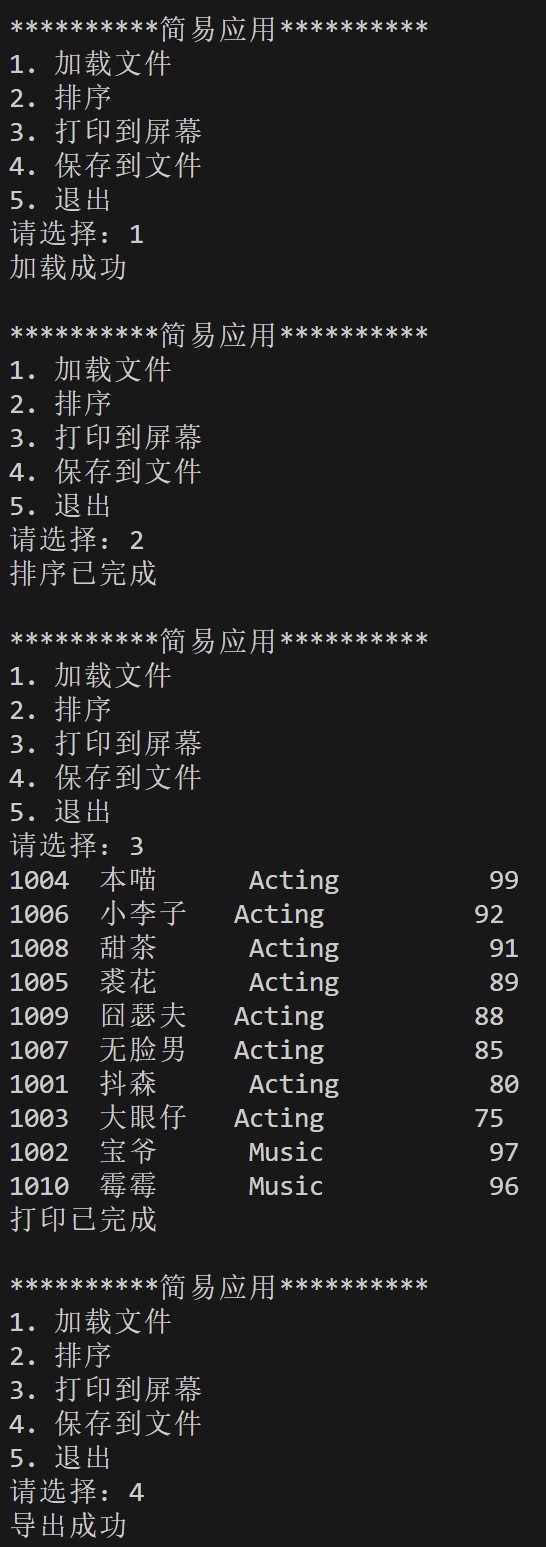
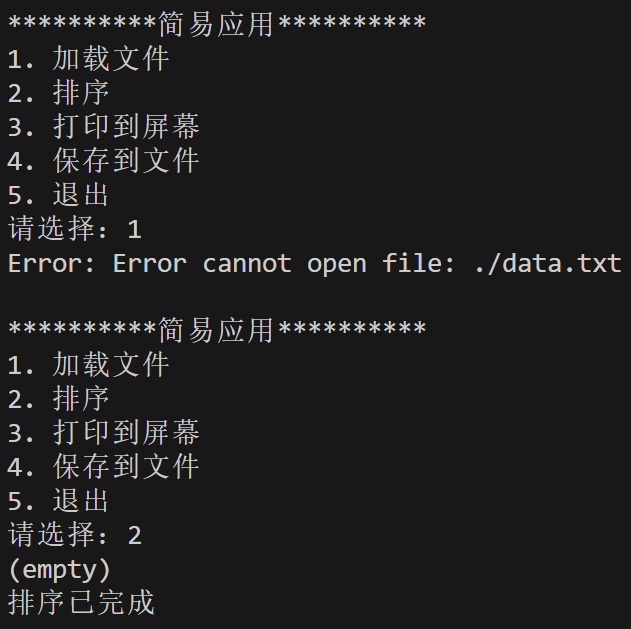
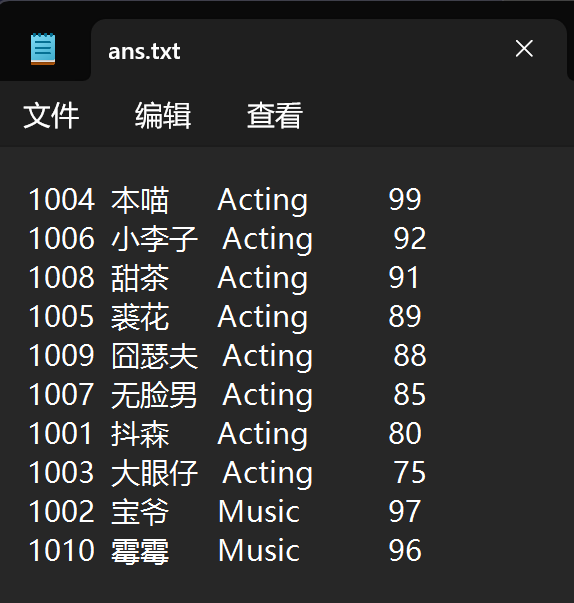
运行结果测试截图:

 浙公网安备 33010602011771号