
[题解]GYM 101196H Vin Diagrams
题意
给定一个 \(n \times m\) 的字符矩阵 \(a\)。
在矩阵中有两个集合,每个集合的边界是 X(特别的,每个集合有一个点是 A 或 B)。
这两个集合组成了一个维恩图,现在求两个集合的补集,以及并集。(也就是 . 的数量)
注意:
- 保证了两个集合的两个交点一定是形如下图的:
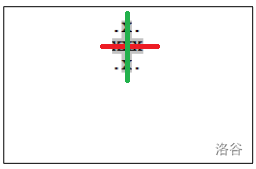
-
保证了任意两个 `X` 不可能出现形如下图的情况:
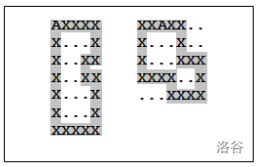
思路
首先先 DFS 出两个集合的边界。
其中遇到交点时,继续按照原方向走,一定能保证最后的图形是当前集合。并将标记出的两个集合的边界分别记录在 \(vis_1\) 与 \(vis_2\) 中。
然后,不难发现,对于两个集合中靠左的集合边界的左上角的点 \((ax,ay)\),向右下角走一步一定能走到集合内部(即 \((ax + 1,ay + 1)\))。
同理,对于靠右集合右上角的点 \((bx,by)\),向左下角一定能走到集合内部(即 \((bx + 1,by - 1)\))。
随后,分别以这两个点为起点 DFS,并分别以 \(vis_1,vis_2\) 中记录的边界为边界。然后将经过的点分别用 \(st_1,st_2\) 标记。
不难发现,对于 \(a_{i,j}\) 是 . 时,可以分为 \(3\) 中情况:
- \(st_{1,i,j} \wedge st_{2,i,j}\) 时,一定是两集合的并集,所以 \(ansc\) 加 \(1\)。
- \(st_{1,i,j} \wedge \neg st_{2,i,j}\) 时,一定是
A集合的补集,所以 \(ansa\) 加 \(1\)。 - \(\neg st_{1,i,j} \wedge st_{2,i,j}\) 时,一定是
B集合的补集,所以 \(ansb\) 加 \(1\)。
Code
#include <bits/stdc++.h>
#define re register

using namespace std;

const int N = 110,inf = 1e9 + 10;
int n,m,sax,say,sbx,sby;
int ax = inf,ay = inf,bx = inf,by = -inf;
int ansa,ansb,ansc;
int dx[] = {0,1,-1,0,0};
int dy[] = {0,0,0,1,-1};
char arr[N][N];
bool vis[5][N][N],st[5][N][N];

inline int read(){
    int r = 0,w = 1;
    char c = getchar();
    while (c < '0' || c > '9'){
        if (c == '-') w = -1;
        c = getchar();
    }
    while (c >= '0' && c <= '9'){
        r = (r << 3) + (r << 1) + (c ^ 48);
        c = getchar();
    }
    return r * w;
}

inline void dfs(int x,int y,int l,bool vis[][N]){
    bool falg = false;
    vis[x][y] = true;
    for (re int i = 1;i <= 4;i++){
        int tx = x + dx[i];
        int ty = y + dy[i];
        if (arr[tx][ty] != 'X' && arr[tx][ty] != 'A' && arr[tx][ty] != 'B'){
            falg = true;
            break;
        }
    }
    if (falg){
        for (re int i = 1;i <= 4;i++){
            int tx = x + dx[i];
            int ty = y + dy[i];
            if (tx >= 1 && tx <= n && ty >= 1 && ty <= m && arr[tx][ty] != '.' && !vis[tx][ty]) dfs(tx,ty,i,vis);
        }
    }
    else{
        int tx = x + dx[l];
        int ty = y + dy[l];
        if (tx >= 1 && tx <= n && ty >= 1 && ty <= m && arr[tx][ty] != '.' && !vis[tx][ty]) dfs(tx,ty,l,vis);
    }
}

inline void dfs1(int x,int y){
    st[1][x][y] = true;
    for (re int i = 1;i <= 4;i++){
        int tx = x + dx[i];
        int ty = y + dy[i];
        if (tx >= 1 && tx <= n && ty >= 1 && ty <= m && !vis[1][tx][ty] && !st[1][tx][ty]) dfs1(tx,ty);
    }
}

inline void dfs2(int x,int y){
    st[2][x][y] = true;
    for (re int i = 1;i <= 4;i++){
        int tx = x + dx[i];
        int ty = y + dy[i];
        if (tx >= 1 && tx <= n && ty >= 1 && ty <= m && !vis[2][tx][ty] && !st[2][tx][ty]) dfs2(tx,ty);
    }
}

int main(){
    n = read();
    m = read();
    for (re int i = 1;i <= n;i++){
        scanf("%s",arr[i] + 1);
        for (re int j = 1;j <= m;j++){
            if (arr[i][j] == 'A'){
                sax = i;
                say = j;
            }
            else if (arr[i][j] == 'B'){
                sbx = i;
                sby = j;
            }
        }
    }
    dfs(sax,say,1,vis[1]);//标记边界
    dfs(sbx,sby,1,vis[2]);
    for (re int i = 1;i <= n;i++){
        for (re int j = 1;j <= m;j++){
            if (vis[1][i][j]){//找 (ax,ay) 与 (bx,by)
                if (ax > i){
                    ax = i;
                    ay = j;
                }
                else if (ax == i && ay > j) ay = j;
            }
            if (vis[2][i][j]){
                if (bx > i){
                    bx = i;
                    by = j;
                }
                else if (bx == i && by < j) by = j;
            }
        }
    }
    dfs1(ax + 1,ay + 1);
    dfs2(bx + 1,by - 1);
    for (re int i = 1;i <= n;i++){//更新答案
        for (re int j = 1;j <= m;j++){
            if (st[1][i][j] && st[2][i][j] && arr[i][j] == '.') ansc++;
            else if (st[1][i][j] && arr[i][j] == '.') ansa++;
            else if (st[2][i][j] && arr[i][j] == '.') ansb++;
        }
    }
    printf("%d %d %d",ansa,ansb,ansc);
    return 0;
}

 浙公网安备 33010602011771号