
委托详解
委托
delagate是函数指针(c和c++中)的升级版
函数指针的实例如下:
# include <stdio.h>
int Max(int, int);  //函数声明
int main(void)
{
    int(*p)(int, int);  //定义一个函数指针
    int a, b, c;
    p = Max;  //把函数Max赋给指针变量p, 使p指向Max函数
    printf("please enter a and b:");
    scanf("%d%d", &a, &b);
    c = (*p)(a, b);  //通过函数指针调用Max函数
    printf("a = %d\nb = %d\nmax = %d\n", a, b, c);
    return 0;
}
int Max(int x, int y)  //定义Max函数
{
    int z;
    if (x > y)
    {
        z = x;
    }
    else
    {
        z = y;
    }
    return z;
}
//输出结果是:
//please enter a and b:3 4
//a = 3
//b = 4
//max = 4
一切皆地址
变量(数据)是以某个地址为起点的一段内存中所存储的值
函数(算法)是以某个地址为起点的一段内存中所存储的一组机器语言指令
所以,变量是寻找数据的地址,函数是寻找算法的地址
直接调用与间接调用
直接调用:通过函数名来调用函数, CPU通过函数名直接获得函数所在地址并开始执行>返回
间接调用:通过函数指针来调用函数, CPU通过读取函数指针存储的值获得函数所在地址并开始执行→返回
JAVA舍弃了函数指针的功能,而C#通过委托保留了这种功能。
C#中有许多现成的委托,比如Action,Function
见下面实例:
class program
{
static void Main[string[] args]
 {
    Calculator calculator = new Calculator();
    //Action其实就是无返回值的delegate罢了,Action委托至少0个参数,至多16个参数,无返回值。
    Action action = new Action(calculator. Report);
    calculator.Report();//直接调用
    action.Invoke();//通过委托间接调用
    action();

    //Function就是有返回值的delegate,也是至多输入16个参数。
    Func<int,int,int> func1 = new Func<int,int,int>(calculator.Add);
    Func<int,int,int> func2 = new Func<int,int,int>(calculator.Sub);

    int x = 100;
    int y = 200;
    int z = 0;

    z = func1.Invoke(x, y);//通过委托间接调用
	Console.WriteLine(z);
	Z = func2.Invoke(x, y);//通过委托间接调用
	Console.Writeline(z);|

    //所有的调用都可以省略Invoke
 }
}

class Calculator
{
	public void Report()
    {
        Console.Writeline("I have 3 methods.")
    }

    public int Add(int a,int b)
    {
        int result = a + b;
        return result
    }
    public int sub(int a,int b)
    {
        int result = a - b;
        return result
    }
}
自定义委托
自定义委托重点:委托与所封装的方法必须“类型兼容”
返回值的数据类型一致
参数列表在个数和数据类型上一致(参数名不需要一样)
using System;

delegate int NumberChanger(int n);//声明委托
namespace DelegateAppl
{
   class TestDelegate
   {
      static int num = 10;
      public static int AddNum(int p)
      {
         num += p;
         return num;
      }

      public static int MultNum(int q)
      {
         num *= q;
         return num;
      }
      public static int getNum()
      {
         return num;
      }

      static void Main(string[] args)
      {
         // 创建委托实例
         NumberChanger nc1 = new NumberChanger(AddNum);//封装AddNum,MultNum方法
         NumberChanger nc2 = new NumberChanger(MultNum);
         // 使用委托对象调用方法
         nc1(25);
         Console.WriteLine("Value of Num: {0}", getNum());
         nc2(5);
         Console.WriteLine("Value of Num: {0}", getNum());
         Console.ReadKey();
      }
   }
}
声明委托的位置:委托尽量声明在命名空间里,不要放在别的类里。
委托的一般使用
实例:把方法当作参数传给另一个方法
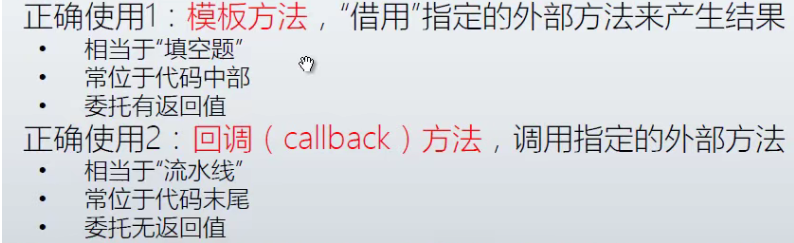
注意:

模板方法实例:
using System;
using System.Collections.Generic;

namespace DelegateExample
{
    class Program
    {
        static void Main(string[] args)
        {
            ProductFactory productFactory = new ProductFactory();
            WrapFactory wrapFactory = new WrapFactory();

            Func<Product> func1 = new Func<Product>(productFactory.MakePizza);
            Func<Product> func2 = new Func<Product>(productFactory.MakeToyCar);

            Box box1 = wrapFactory.WrapProduct(func1);
            Box box2 = wrapFactory.WrapProduct(func2);

            Console.WriteLine(box1.Product.Name);
            Console.WriteLine(box2.Product.Name);
        }
    }
    /// <summary>
    /// 产品
    /// </summary>
    class Product
    {
        public string Name { get; set; }
    }
    /// <summary>
    /// 包装
    /// </summary>
    class Box
    {
        public Product Product { get; set; }
    }
    /// <summary>
    /// 包装工厂
    /// </summary>
    class WrapFactory
    {
        /// <summary>
        /// 模板方法
        /// </summary>
        /// <param name="getProduct">委托变量</param>
        /// <returns></returns>
        public Box WrapProduct(Func<Product> getProduct)
        {
            Box box = new Box();
            Product product = getProduct.Invoke();
            box.Product = product;
            return box;
        }
    }
    /// <summary>
    /// 生产工厂
    /// </summary>
    class ProductFactory
    {
        public Product MakePizza()
        {
            Product product = new Product();
            product.Name = "Pizza";
            return product;
        }
        public Product MakeToyCar()
        {
            Product product = new Product();
            product.Name = "Toy Car";
            return product;
        }
    }


}
//输出:Pizza,Toy Car
委托的多播
委托对象可使用 "+" 运算符进行合并。一个合并委托调用它所合并的两个委托。只有相同类型的委托可被合并。"-" 运算符可用于从合并的委托中移除组件委托。
using System;

delegate int NumberChanger(int n);
namespace DelegateAppl
{
   class TestDelegate
   {
      static int num = 10;
      public static int AddNum(int p)
      {
         num += p;
         return num;
      }

      public static int MultNum(int q)
      {
         num *= q;
         return num;
      }
      public static int getNum()
      {
         return num;
      }

      static void Main(string[] args)
      {
         // 创建委托实例
         NumberChanger nc;
         NumberChanger nc1 = new NumberChanger(AddNum);
         NumberChanger nc2 = new NumberChanger(MultNum);
         nc = nc1;
         nc += nc2;
         // 调用多播
         nc(5);
         Console.WriteLine("Value of Num: {0}", getNum());
         Console.ReadKey();
      }
   }
}
//输出:Value of Num: 75
隐式异步调用委托
同步与异步的简介
同步:你做完了我(在你的基础上)接着做
异步:咱们两个同时做(相当于汉语中的“同步进行”)
同步:红色代表主线程

异步:

同步调用与异步调用的对比
每一个运行的程序是一个进程 ( process )
每个进程可以有一个或者多个线程( thread )
同步调用是在同一线程内
异步调用的底层机理是多线程
串行同步单线程,并行异步多线程
invoke是同步调用,BeginInvoke是隐式异步调用
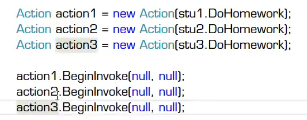
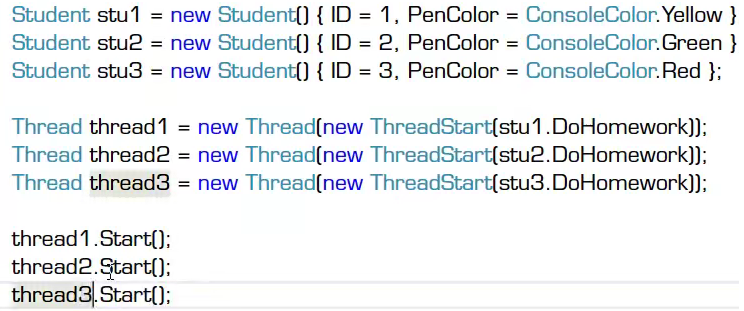
显示异步调用:使用Thread
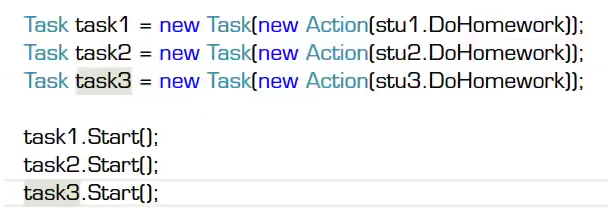
也可以使用Task:
程序中尽量使用接口去替代委托。
如以下代码代替上面工厂实例:
using System;
using System.Collections.Generic;

namespace DelegateExample
{
    class Program
    {
        static void Main(string[] args)
        {
            IProductFactory pizzaFactory = new PizzaFactory();
            IProductFactory toycarFactory = new ToyCarFactory();

            WrapFactory wrapFactory = new WrapFactory();


            Box box1 = wrapFactory.WrapProduct(pizzaFactory);
            Box box2 = wrapFactory.WrapProduct(toycarFactory);

            Console.WriteLine(box1.Product.Name);
            Console.WriteLine(box2.Product.Name);
        }
    }

    interface IProductFactory
    {
        Product Make();
    }

    class PizzaFactory : IProductFactory
    {
        Product IProductFactory.Make()
        {
            Product product = new Product();
            product.Name = "Pizza";
            return product;
        }
    }
    class ToyCarFactory : IProductFactory
    {
        Product IProductFactory.Make()
        {
            Product product = new Product();
            product.Name = "Toy Car";
            return product;
        }
    }
    /// <summary>
    /// 产品
    /// </summary>
    class Product
    {
        public string Name { get; set; }
    }
    /// <summary>
    /// 包装
    /// </summary>
    class Box
    {
        public Product Product { get; set; }
    }
    /// <summary>
    /// 包装工厂
    /// </summary>
    class WrapFactory
    {
        /// <summary>
        /// 模板方法
        /// </summary>
        /// <param name="getProduct">委托变量</param>
        /// <returns></returns>
        public Box WrapProduct(IProductFactory productFactory)
        {
            Box box = new Box();
            Product product = productFactory.Make();
            box.Product = product;
            return box;
        }
    }
}
委托的优点
转载自委托的好处

 浙公网安备 33010602011771号