
BLOG-2
题目集四:
前言:本次题目集分别涉及正则表达式的使用、四边形的综合计算、类的基本设计三个知识点。
7-1 sdut-String-2 识蛟龙号载人深潜,立科技报国志(II)(正则表达式)
背景简介:
“蛟龙号”载人深潜器是我国首台自主设计、自主集成研制的作业型深海载人潜水器,设计最大下潜深度为7000米级,也是目前世界上下潜能力最强的作业型载人潜水器。“蛟龙号”可在占世界海洋面积99.8%的广阔海域中使用,对于我国开发利用深海的资源有着重要的意义。
中国是继美、法、俄、日之后世界上第五个掌握大深度载人深潜技术的国家。在全球载人潜水器中,“蛟龙号”属于第一梯队。目前全世界投入使用的各类载人潜水器约90艘,其中下潜深度超过1000米的仅有12艘,更深的潜水器数量更少,目前拥有6000米以上深度载人潜水器的国家包括中国、美国、日本、法国和俄罗斯。除中国外,其他4国的作业型载人潜水器最大工作深度为日本深潜器的6527米,因此“蛟龙号”载人潜水器在西太平洋的马里亚纳海沟海试成功到达7020米海底,创造了作业类载人潜水器新的世界纪录。
从2009年至2012年,蛟龙号接连取得1000米级、3000米级、5000米级和7000米级海试成功。下潜至7000米,说明蛟龙号载人潜水器集成技术的成熟,标志着我国深海潜水器成为海洋科学考察的前沿与制高点之一。
2012年6月27日11时47分,中国“蛟龙”再次刷新“中国深度”——下潜7062米。6月3日,“蛟龙”出征以来,已经连续书写了5个“中国深度”新纪录:6月15日,6671米;6月19日,6965米;6月22日,6963米;6月24日,7020米;6月27日,7062米。下潜至7000米,标志着我国具备了载人到达全球99%以上海洋深处进行作业的能力,标志着“蛟龙”载人潜水器集成技术的成熟,标志着我国深海潜水器成为海洋科学考察的前沿与制高点之一,标志着中国海底载人科学研究和资源勘探能力达到国际领先水平。
‘蛟龙’号是我国载人深潜发展历程中的一个重要里程碑。它不只是一个深海装备,更代表了一种精神,一种不畏艰险、赶超世界的精神,它是中华民族进军深海的号角。
了解蛟龙号”载人深潜器“的骄人业绩,为我国海底载人科学研究和资源勘探能力达到国际领先水平而自豪,小伙伴们与祖国同呼吸、共命运,一定要学好科学文化知识、提高个人能力,增强创新意识,做事精益求精,立科技报国之志!
请编写程序,实现如下功能:读入关于蛟龙号载人潜水器探测数据的多行字符串,从给定的信息找出数字字符,输出每行的数字之和。
提示 若输入为“2012年2月”,则该行的输出为:2014。若干个连续的数字字符作为一个整体,以十进制形式相加。
1. 设计与分析:
(1)源码:
import java.util.Scanner;
import java.util.regex.Pattern;
import java.util.regex.Matcher;

public class Main
{
    public static void main(String[] args)
    {
        Scanner input=new Scanner(System.in);
        String ch=input.nextLine();
        Pattern p=Pattern.compile("[0-9]+");
        while(!ch.equals("end"))
        {
            Matcher m=p.matcher(ch);
            int sum=0;
            while(m.find())
            {
                sum+=Integer.valueOf(m.group());
            }
            System.out.println(sum);
            ch=input.nextLine();
        }
    }
}
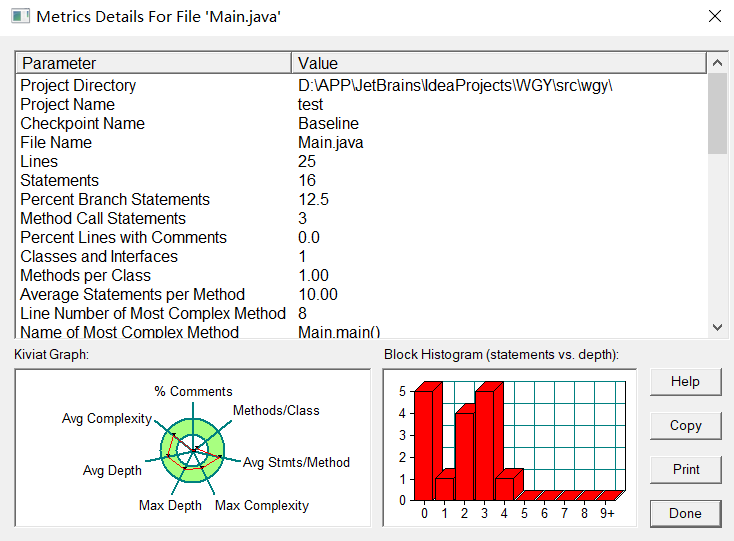
(2)SourceMonitor报表
7-2 点线形系列4-凸四边形的计算
用户输入一组选项和数据,进行与四边形有关的计算。
以下四边形顶点的坐标要求按顺序依次输入,连续输入的两个顶点是相邻顶点,第一个和最后一个输入的顶点相邻。
选项包括:
1:输入四个点坐标,判断是否是四边形、平行四边形,判断结果输出true/false,结果之间以一个英文空格符分隔。
2:输入四个点坐标,判断是否是菱形、矩形、正方形,判断结果输出true/false,结果之间以一个英文空格符分隔。 若四个点坐标无法构成四边形,输出"not a quadrilateral"
3:输入四个点坐标,判断是凹四边形(false)还是凸四边形(true),输出四边形周长、面积,结果之间以一个英文空格符分隔。 若四个点坐标无法构成四边形,输出"not a quadrilateral"
4:输入六个点坐标,前两个点构成一条直线,后四个点构成一个四边形或三角形,输出直线与四边形(也可能是三角形)相交的交点数量。如果交点有两个,再按面积从小到大输出四边形(或三角形)被直线分割成两部分的面积(不换行)。若直线与四边形或三角形的一条边线重合,输出"The line is coincide with one of the lines"。若后四个点不符合四边形或三角形的输入,输出"not a quadrilateral or triangle"。
后四个点构成三角形的情况:假设三角形一条边上两个端点分别是x、y,边线中间有一点z,另一顶点s:
1)符合要求的输入:顶点重复或者z与xy都相邻,如x x y s、x z y s、x y x s、s x y y。此时去除冗余点,保留一个x、一个y。
2) 不符合要求的输入:z 不与xy都相邻,如z x y s、x z s y、x s z y
5:输入五个点坐标,输出第一个是否在后四个点所构成的四边形(限定为凸四边形,不考虑凹四边形)或三角形(判定方法见选项4)的内部(若是四边形输出in the quadrilateral/outof the quadrilateral,若是三角形输出in the triangle/outof the triangle)。如果点在多边形的某条边上,输出"on the triangle或者on the quadrilateral"。若后四个点不符合四边形或三角形,输出"not a quadrilateral or triangle"。
输入格式:
基本格式:选项+":"+坐标x+","+坐标y+" "+坐标x+","+坐标y。点的x、y坐标之间以英文","分隔,点与点之间以一个英文空格分隔。
输出格式:
基本输出格式见每种选项的描述。
异常情况输出:
如果不符合基本格式,输出"Wrong Format"。
如果符合基本格式,但输入点的数量不符合要求,输出"wrong number of points"。
注意:输出的数据若小数点后超过3位,只保留小数点后3位,多余部分采用四舍五入规则进到最低位。小数点后若不足3位,按原始位数显示,不必补齐。例如:1/3的结果按格式输出为 0.333,1.0按格式输出为1.0
选项1、2、3中,若四边形四个点中有重合点,输出"points coincide"。
选项4中,若前两个输入线的点重合,输出"points coincide"。
1. 设计与分析
(1)源码
import java.util.Scanner; public class Main { public static void main(String[] args) { Scanner input=new Scanner(System.in); Check check; { check=new Check(); } String relgx="1:-1,-1 1,2 -1,1 ++1,0"; String a=input.nextLine(); boolean flag=a.equals(relgx); if(flag) { System.out.println("Wrong Format"); System.exit(0); } if(check.input(a)) { if(a.charAt(0)=='1'||a.charAt(0)=='2'||a.charAt(0)=='3') { String[] m = a.split(":"); String[] n = m[1].split(" "); if(n.length==4) { String[] p = n[0].split(","); String[] q = n[1].split(","); String[] r = n[2].split(","); String[] s = n[3].split(","); double x1 = Double.parseDouble(p[0]); double y1 = Double.parseDouble(p[1]); double x2 = Double.parseDouble(q[0]); double y2 = Double.parseDouble(q[1]); double x3 = Double.parseDouble(r[0]); double y3 = Double.parseDouble(r[1]); double x4 = Double.parseDouble(s[0]); double y4 = Double.parseDouble(s[1]); if(check.Coincide(x1,y1,x2,y2,x3,y3,x4,y4)) { //选项1 if(a.charAt(0)=='1') { double k = (y2-y1)/(x2-x1); double k1 = (y3-y2)/(x3-x2); double k2 = (y4-y3)/(x4-x3); double k3 = (y4-y1)/(x4-x1); double l1 = Math.sqrt((x2-x1)*(x2-x1)+(y2-y1)*(y2-y1)); double l2 = Math.sqrt((x3-x2)*(x3-x2)+(y3-y2)*(y3-y2)); double l3 = Math.sqrt((x4-x3)*(x4-x3)+(y4-y3)*(y4-y3)); double l4 = Math.sqrt((x4-x1)*(x4-x1)+(y4-y1)*(y4-y1)); if(((y2-y1)*(x3-x2)==(x2-x1)*(y3-y2)) ||((y4-y3)*(x4-x1)==(x4-x3)*(y4-y1))) //判断四边形 System.out.print("false false"); else if((y1==y2&&y2==y3)||(y3==y4&&y2==y3)||(y1==y2&&y1==y4)||(y1==y4&&y4==y3)) System.out.print("false false"); else { System.out.print("true"); if(l1==l3&&l2==l4)//判断平行四边形 System.out.print(" true"); else System.out.print(" false"); } } //选项2 if(a.charAt(0)=='2') { double k = (y2-y1)/(x2-x1); double k1 = (y3-y2)/(x3-x2); double k2 = (y4-y3)/(x4-x3); double k3 = (y4-y1)/(x4-x1); double k4 = (y1-y3)/(x1-x3); double k5 = (y2-y4)/(x2-x4); double l1 = Math.sqrt((x2-x1)*(x2-x1)+(y2-y1)*(y2-y1)); double l2 = Math.sqrt((x3-x2)*(x3-x2)+(y3-y2)*(y3-y2)); double l3 = Math.sqrt((x4-x3)*(x4-x3)+(y4-y3)*(y4-y3)); double l4 = Math.sqrt((x4-x1)*(x4-x1)+(y4-y1)*(y4-y1)); double l5 = Math.sqrt((x3-x1)*(x3-x1)+(y3-y1)*(y3-y1)); double l6 = Math.sqrt((x4-x2)*(x4-x2)+(y4-y2)*(y4-y2)); if(((y2-y1)*(x3-x2)==(x2-x1)*(y3-y2)) ||((y4-y3)*(x4-x1)==(x4-x3)*(y4-y1))) System.out.print("not a quadrilateral"); else if((y1==y2&&y2==y3)||(y3==y4&&y2==y3)||(y1==y2&&y1==y4)||(y1==y4&&y4==y3)) System.out.print("not a quadrilateral"); else { if(l1==l3&&l2==l4) { if(k4*k5==-1||((x1==x3)&&(y2==y4))) System.out.print("true"); else System.out.print("false"); if(l5==l6) System.out.print(" true"); else System.out.print(" false"); if((k4*k5==-1||((x1==x3)&&(y2==y4)))&&(l1==l2))//判断正方形 System.out.print(" true"); else System.out.print(" false"); } else System.out.print("false false false"); } } //选项3 if(a.charAt(0)=='3') { if(((y2-y1)*(x3-x2)==(x2-x1)*(y3-y2)) ||((y4-y3)*(x4-x1)==(x4-x3)*(y4-y1))) System.out.print("not a quadrilateral"); else if((y1==y2&&y2==y3)||(y3==y4&&y2==y3)||(y1==y2&&y1==y4)||(y1==y4&&y4==y3)) System.out.print("not a quadrilateral"); else { double k1 = (y1-y3)/(x1-x3); double k2 = (y2-y4)/(x2-x4); double b1 = y1-k1*x1; double b2 = y2-k2*x2; double l1 = Math.sqrt((x2-x1)*(x2-x1)+(y2-y1)*(y2-y1)); double l2 = Math.sqrt((x3-x2)*(x3-x2)+(y3-y2)*(y3-y2)); double l3 = Math.sqrt((x4-x3)*(x4-x3)+(y4-y3)*(y4-y3)); double l4 = Math.sqrt((x4-x1)*(x4-x1)+(y4-y1)*(y4-y1)); double l5 = Math.sqrt((x3-x1)*(x3-x1)+(y3-y1)*(y3-y1)); double c = l1+l2+l3+l4; double p1 = (l1+l2+l5)/2; double s1 = Math.sqrt(p1*(p1-l1)*(p1-l2)*(p1-l5)); double p2 = (l3+l4+l5)/2; double s2 = Math.sqrt(p2*(p2-l3)*(p2-l4)*(p2-l5)); double s3 = s1+s2; if(((k1*x2-y2+b1)>0&&(k1*x4-y4+b1)<0)||((k1*x2-y2+b1)<0&&(k1*x4-y4+b1)>0)) { if(((k2*x1-y1+b2)>0&&(k2*x3-y3+b2)<0)||((k2*x1-y1+b2)<0&&(k2*x3-y3+b2)>0)) System.out.println("true "+(Math.round(c*1000)/1000.0)+" "+(Math.round(s3*1000)/1000.0)); else System.out.println("false "+(Math.round(c*1000)/1000.0)+" "+(Math.round(s3*1000)/1000.0)); } else System.out.println("false "+(Math.round(c*1000)/1000.0)+" "+(Math.round(s3*1000)/1000.0)); } } } else System.out.println("points coincide"); } else System.out.println("wrong number of points"); } //选项4 else if(a.charAt(0)=='4') { String[] m = a.split(":"); String[] n = m[1].split(" "); if(n.length==6) { String[] p = n[0].split(","); String[] q = n[1].split(","); String[] r = n[2].split(","); String[] s = n[3].split(","); String[] t = n[4].split(","); String[] u = n[5].split(","); double x1 = Double.parseDouble(p[0]); double y1 = Double.parseDouble(p[1]); double x2 = Double.parseDouble(q[0]); double y2 = Double.parseDouble(q[1]); double x3 = Double.parseDouble(r[0]); double y3 = Double.parseDouble(r[1]); double x4 = Double.parseDouble(s[0]); double y4 = Double.parseDouble(s[1]); double x5 = Double.parseDouble(t[0]); double y5 = Double.parseDouble(t[1]); double x6 = Double.parseDouble(u[0]); double y6 = Double.parseDouble(u[1]); double k = (y3-y4)/(x3-x4); double k1 = (y5-y4)/(x5-x4); double k2 = (y6-y5)/(x6-x5); double k3 = (y6-y3)/(x6-x3); double k4 = (y2-y1)/(x2-x1); if(x1==x2&&y1==y2) System.out.println("points coincide"); else System.out.println("not a quadrilateral or triangle"); } else System.out.println("wrong number of points"); } //选项5 else if(a.charAt(0)=='5') { String[] m = a.split(":"); String[] n = m[1].split(" "); if(n.length==5) { String[] p = n[0].split(","); String[] q = n[1].split(","); String[] r = n[2].split(","); String[] s = n[3].split(","); String[] t = n[4].split(","); double x1 = Double.parseDouble(q[0]); double y1 = Double.parseDouble(q[1]); double x2 = Double.parseDouble(r[0]); double y2 = Double.parseDouble(r[1]); double x3 = Double.parseDouble(s[0]); double y3 = Double.parseDouble(s[1]); double x4 = Double.parseDouble(t[0]); double y4 = Double.parseDouble(t[1]); double x5 = Double.parseDouble(p[0]); double y5 = Double.parseDouble(p[1]); if (((y4 == y3) && (x4 == x3)) || ((y4 == y2) && (x4 == x2)) || ((y4 == y1) && (x4 == x1)) || ((y2 == y3) && (x2 == x3)) || ((y1 == y3) && (x1 == x3)) || ((y1 == y2) && (x1 == x2))) System.out.println("points coincide"); else { if ((y4 - y3) * (x4 - x2) == (y4 - y2) * (x4 - x3)&&(y4 - y3) * (x4 - x1) == (y4 - y1) * (x4 - x3)) System.out.print("not a quadrilateral or triangle"); else if((y4 - y3) * (x4 - x2) == (y4 - y2) * (x4 - x3)) System.out.print("in the triangle"); else if((y4 - y3) * (x4 - x1) == (y4 - y1) * (x4 - x3)) System.out.print("in the triangle"); else if((y4 - y2) * (x4- x1) == (y4 - y1) * (x4 - x2)) System.out.print("in the triangle"); else if((y3 - y2) * (x3 - x1) == (y3 - y1) * (x3 - x2)) System.out.print("in the triangle"); else System.out.print("in the quadrilateral"); } } else System.out.println("wrong number of points"); } else System.out.println("Wrong Format"); } else System.out.println("Wrong Format"); } } class Check { double x1,y1,x2,y2,x3,y3,x4,y4; //判断是否有重合点 public boolean Coincide(double x1,double y1,double x2,double y2,double x3,double y3,double x4,double y4) { if((x1==x2&&y1==y2)||(x1==x3&&y1==y3)||(x1==x4&&y1==y4)||(x2==x3&&y2==y3)||(x2==x4&&y2==y4)||(x3==x4&&y3==y4)) return false; else return true; } //输入格式判断 public boolean input(String x) { int flag=0; for(int i=0;i<x.length();i++)//判断是否有 ':' { if(x.charAt(i)==':') { flag=1; break; } else flag=0; } if(flag==1) { String[] m=x.split(":");//以 ':'分隔 int flag1=0; for(int i=0;i<x.length();i++)//判断是否有 ' ' { if(x.charAt(i)==' ') { flag1=1; break; } else flag1=0; } if(flag1==1) { String[] n=m[1].split(" ");//以 ' '分隔 int flag2=0; for(int i=0;i<x.length();i++)//判断是否有 ',' { if(x.charAt(i)==',') { flag2=1; break; } else flag2=0; } if(flag2==1) { String[] p = n[0].split(","); String[] q = n[1].split(","); return true; } else return false; } else return false; } else return false; } }
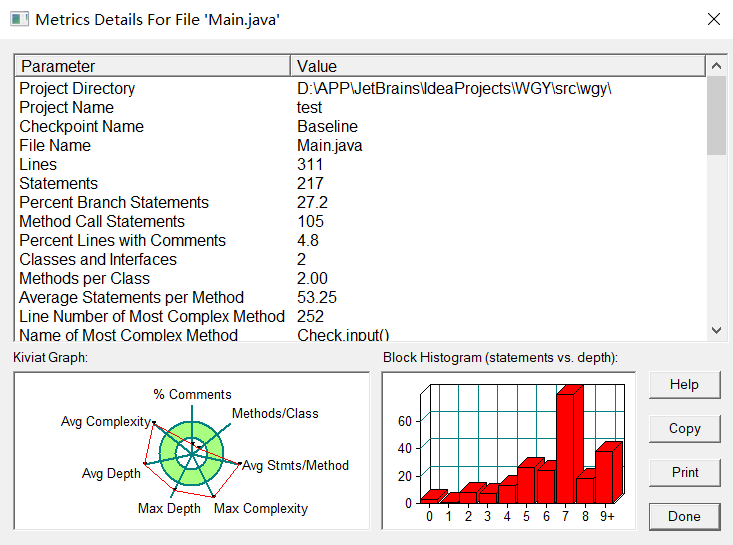
(2)SourceMonitor报表
2. 改进建议:
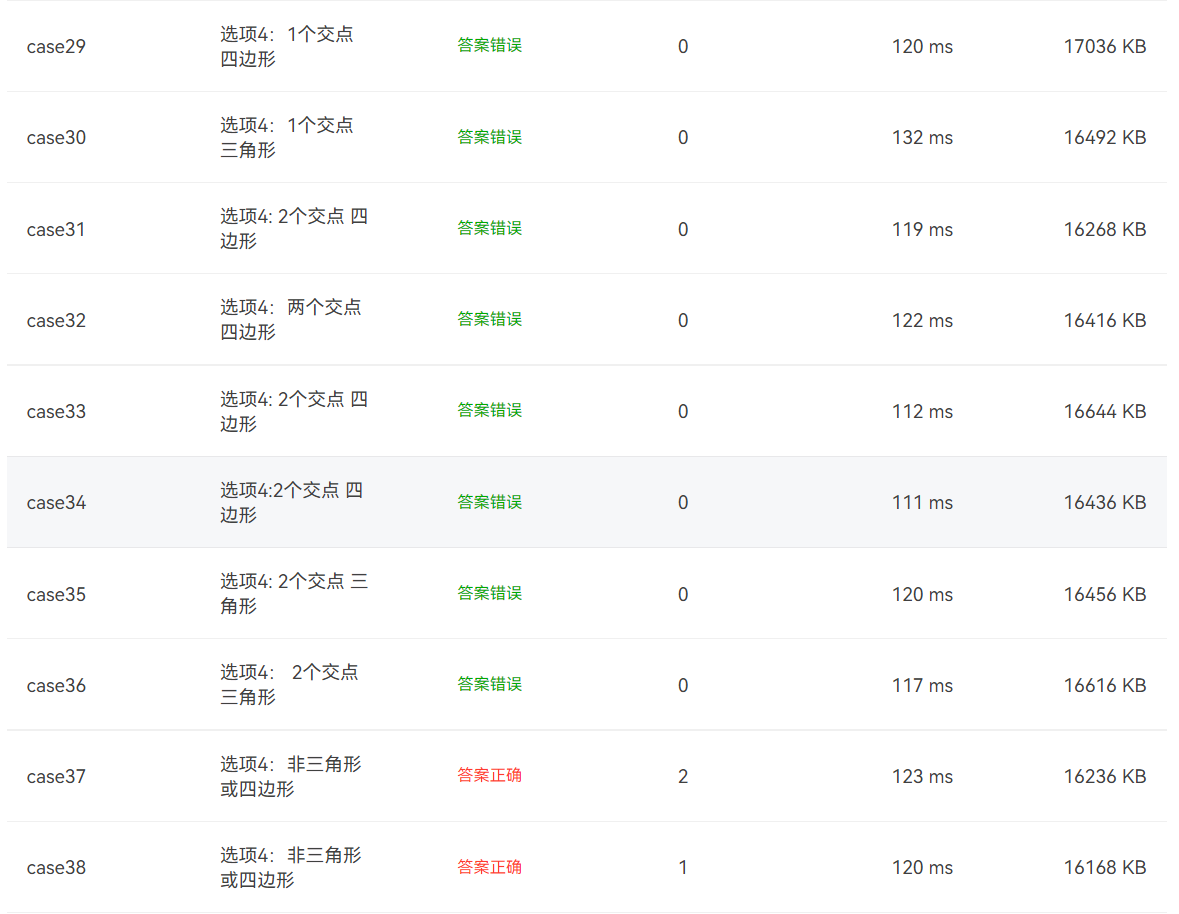
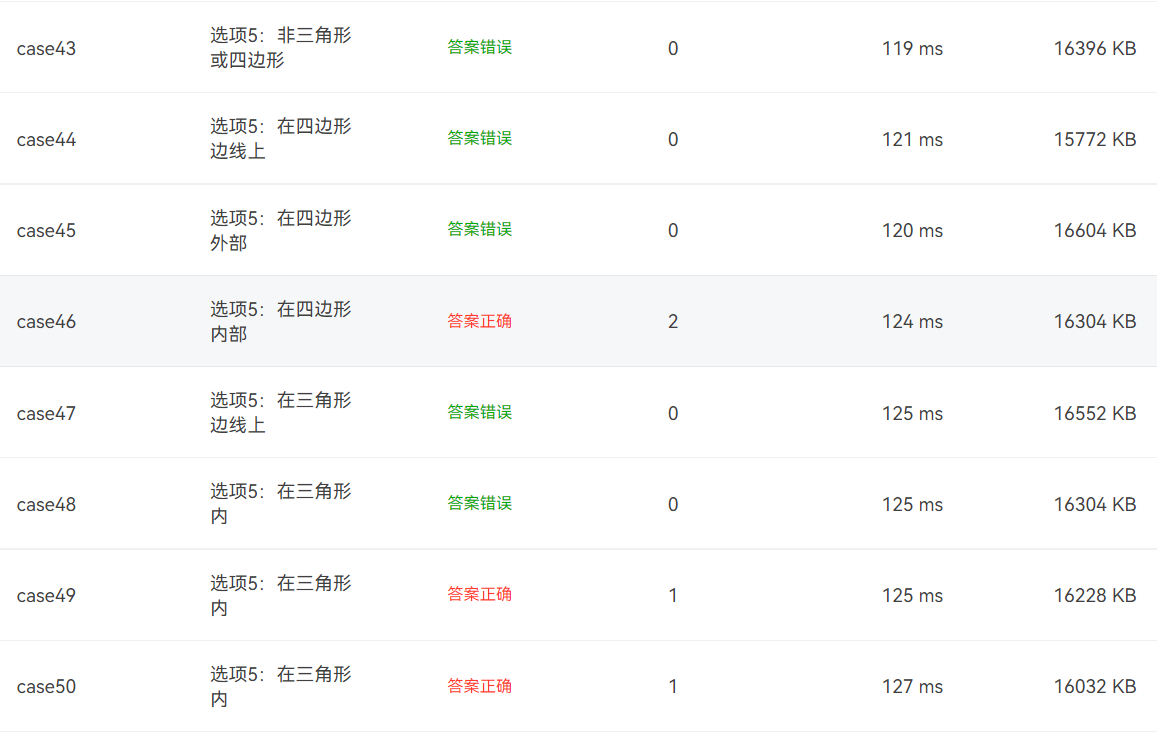
代码应以多种类的方式进行设计,同时选项4(输入六个点坐标,前两个点构成一条直线,后四个点构成一个四边形或三角形,输出直线与四边形(也可能是三角形)相交的交点数量。如果交点有两个,再按面积从小到大输出四边形(或三角形)被直线分割成两部分的面积(不换行)。若直线与四边形或三角形的一条边线重合,输出"The line is coincide with one of the lines"。若后四个点不符合四边形或三角形的输入,输出"not a quadrilateral or triangle"。
后四个点构成三角形的情况:假设三角形一条边上两个端点分别是x、y,边线中间有一点z,另一顶点s:
1)符合要求的输入:顶点重复或者z与xy都相邻,如x x y s、x z y s、x y x s、s x y y。此时去除冗余点,保留一个x、一个y。
2) 不符合要求的输入:z 不与xy都相邻,如z x y s、x z s y、x s z y
)以及选项5(输入五个点坐标,输出第一个是否在后四个点所构成的四边形(限定为凸四边形,不考虑凹四边形)或三角形(判定方法见选项4)的内部(若是四边形输出in the quadrilateral/outof the quadrilateral,若是三角形输出in the triangle/outof the triangle)。如果点在多边形的某条边上,输出"on the triangle或者on the quadrilateral"。若后四个点不符合四边形或三角形,输出"not a quadrilateral or triangle"。)的设计还有欠缺还需完善。
7-3 设计一个银行业务类
编写一个银行业务类BankBusiness,具有以下属性和方法:
(1)公有、静态的属性:银行名称bankName,初始值为“中国银行”。
(2)私有属性:账户名name、密码password、账户余额balance。
(3)银行对用户到来的欢迎(welcome)动作(静态、公有方法),显示“中国银行欢迎您的到来!”,其中“中国银行”自动使用bankName的值。
(4)银行对用户离开的提醒(welcomeNext)动作(静态、公有方法),显示“请收好您的证件和物品,欢迎您下次光临!”
(5)带参数的构造方法,完成开户操作。需要账户名name、密码password信息,同时让账户余额为0。
(6)用户的存款(deposit)操作(公有方法,需要密码和交易额信息),密码不对时无法存款且提示“您的密码错误!”;密码正确、完成用户存款操作后,要提示用户的账户余额,例如“您的余额有1000.0元。”。
(7)用户的取款(withdraw)操作(公有方法,需要密码和交易额信息)。密码不对时无法取款且提示“您的密码错误!”;密码正确但余额不足时提示“您的余额不足!”;密码正确且余额充足时扣除交易额并提示用户的账户余额,例如“请取走钞票,您的余额还有500.0元。”。
编写一个测试类Main,在main方法中,先后执行以下操作:
(1)调用BankBusiness类的welcome()方法。
(2)接收键盘输入的用户名、密码信息作为参数,调用BankBusiness类带参数的构造方法,从而创建一个BankBusiness类的对象account。
(3)调用account的存款方法,输入正确的密码,存入若干元。密码及存款金额从键盘输入。
(4)调用account的取款方法,输入错误的密码,试图取款若干元。密码及取款金额从键盘输入。
(5)调用account的取款方法,输入正确的密码,试图取款若干元(取款金额大于余额)。密码及取款金额从键盘输入。
(6)调用account的取款方法,输入正确的密码,试图取款若干元(取款金额小于余额)。密码及取款金额从键盘输入。
(7)调用BankBusiness类的welcomeNext()方法。
输入格式:
输入开户需要的姓名、密码
输入正确密码、存款金额
输入错误密码、取款金额
输入正确密码、大于余额的取款金额
输入正确密码、小于余额的取款金额
输出格式:
中国银行(银行名称)欢迎您的到来!
您的余额有多少元。
您的密码错误!
您的余额不足!
请取走钞票,您的余额还有多少元。
请收好您的证件和物品,欢迎您下次光临!
1. 设计与分析
(1)源码
import java.util.Scanner;

public class Main
{
    public static void main(String[] args)
    {
        BankBusiness.welcome();

        Scanner input=new Scanner(System.in);
        BankBusiness user=new BankBusiness(input.next(),input.next());

        user.deposit(input.next(), input.nextDouble());
        user.withdraw(input.next(), input.nextDouble());
        user.withdraw(input.next(), input.nextDouble());
        user.withdraw(input.next(), input.nextDouble());

        BankBusiness.welcomeNext();
    }
}

class BankBusiness
{
    public static String bankName="中国银行";//共有属性
    private String name,password;//私有属性
    private double balance;//私有属性

    public BankBusiness(String name,String password)
    {
        super();
        this.name=name;
        this.password=password;
        this.balance=0;
    }

    public static void welcome()
    {
        System.out.println(bankName+"欢迎您的到来!");
    }

    public static void welcomeNext()
    {
        System.out.println("请收好您的证件和物品,欢迎您下次光临!");
    }

    public void deposit(String password,double money)
    {
        if(!password.equals(this.password))
        {
            System.out.println("您的密码错误!");
            return;
        }
        this.balance+=money;
        System.out.println("您的余额有"+this.balance+"元。");
    }

    public void withdraw(String password,double money)
    {
        if(!password.equals(this.password))
        {
            System.out.println("您的密码错误!");
            return;
        }
        if(this.balance<money)
        {
            System.out.println("您的余额不足!");
            return;
        }
        this.balance-=money;
        System.out.println("请取走钞票,您的余额还有"+this.balance+"元。");
    }
}
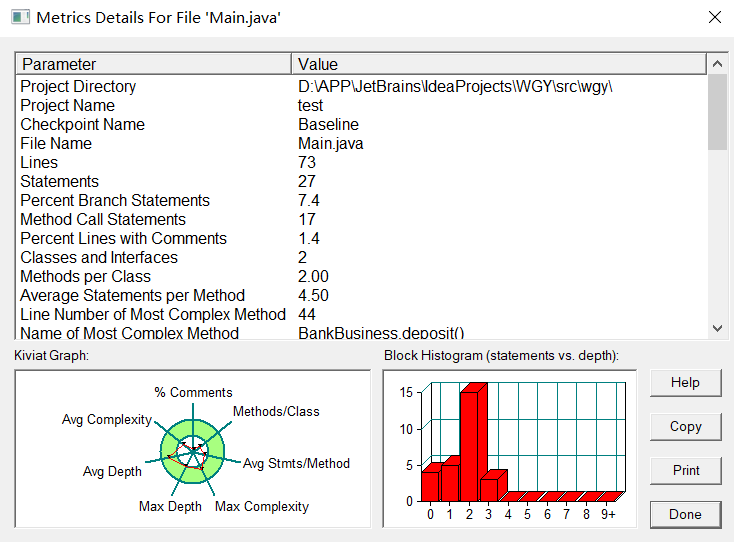
(2)SourceMonitor报表
题目集五:
前言:本次题目集主要涉及五边形、凹凸五边形的性质及计算
7-1 点线形系列5-凸五边形的计算-1
用户输入一组选项和数据,进行与五边形有关的计算。
以下五边形顶点的坐标要求按顺序依次输入,连续输入的两个顶点是相邻顶点,第一个和最后一个输入的顶点相邻。
选项包括:
1:输入五个点坐标,判断是否是五边形,判断结果输出true/false。
2:输入五个点坐标,判断是凹五边形(false)还是凸五边形(true),如果是凸五边形,则再输出五边形周长、面积,结果之间以一个英文空格符分隔。 若五个点坐标无法构成五边形,输出"not a pentagon"
3:输入七个点坐标,前两个点构成一条直线,后五个点构成一个凸五边形、凸四边形或凸三角形,输出直线与五边形、四边形或三角形相交的交点数量。如果交点有两个,再按面积从小到大输出被直线分割成两部分的面积(不换行)。若直线与多边形形的一条边线重合,输出"The line is coincide with one of the lines"。若后五个点不符合五边形输入,若前两点重合,输出"points coincide"。
以上3选项中,若输入的点无法构成多边形,则输出"not a polygon"。输入的五个点坐标可能存在冗余,假设多边形一条边上两个端点分别是x、y,边线中间有一点z,另一顶点s:
1)符合要求的输入:顶点重复或者z与xy都相邻,如:x x y s、x z y s、x y x s、s x y y。此时去除冗余点,保留一个x、一个y。
2) 不符合要求的输入:z不与xy都相邻,如:z x y s、x z s y、x s z y
输入格式:
基本格式:选项+":"+坐标x+","+坐标y+" "+坐标x+","+坐标y。点的x、y坐标之间以英文","分隔,点与点之间以一个英文空格分隔。
输出格式:
基本输出格式见每种选项的描述。
异常情况输出:
如果不符合基本格式,输出"Wrong Format"。
如果符合基本格式,但输入点的数量不符合要求,输出"wrong number of points"。
注意:输出的数据若小数点后超过3位,只保留小数点后3位,多余部分采用四舍五入规则进到最低位。小数点后若不足3位,按原始位数显示,不必补齐。例如:1/3的结果按格式输出为 0.333,1.0按格式输出为1.0
1. 设计与分析
(1)源码
import java.text.DecimalFormat;
import java.util.ArrayList;
import java.util.Scanner;

public class Main {
    public static void main(String[] args) {
        // TODO Auto-generated method stub
        Scanner input = new Scanner(System.in);
        String s=input.nextLine();
        InputData d = new InputData();
        JudgeInput.paseInput(s, d);


        int choice = d.getChoice();
        ArrayList<Point> ps = d.getPoints();
        switch (choice) {
            case 1:
                Option1(ps);
                break;
            case 2:
                Option2(ps);
                break;
            case 3:
                Option3(ps);
        }
    }

    private static void Option1(ArrayList<Point> ps) {
        PointInputError.wrongNumberOfPoints(ps, 5);
        Option1 op1=new Option1(ps);
        op1.work();
    }

    private static void Option2(ArrayList<Point> ps) {
        PointInputError.wrongNumberOfPoints(ps, 5);
        Option2 op2=new Option2(ps);
        op2.work();
    }

    private static void Option3(ArrayList<Point> ps) {
        PointInputError.wrongNumberOfPoints(ps, 7);
        Option3 op3=new Option3(ps);
        op3.work();
    }
}


class InputData {
    private int choice;
    private ArrayList<Point> points = new ArrayList<Point>();
    public int getChoice() {
        return choice;
    }
    public void setChoice(int choice) {
        this.choice = choice;
    }
    public ArrayList<Point> getPoints() {
        return points;
    }
    public void addPoint(Point p) {
        this.points.add(p);
    }
    public int getPointsLength() {
        return points.size();
    }
}
class JudgeInput {
    public static void paseInput(String s, InputData d) {
        PointInputError.wrongChoice(s);
        d.setChoice(getChoice(s));
        s = s.substring(2);
        pasePoints(s, d);
    }

    public static int getChoice(String s) {
        char c = s.charAt(0);
        return c-48;
    }

    public static void pasePoints(String s, InputData d) {
        String[] ss = s.split(" ");
        if (ss.length == 0)
            return;
        for (int i = 0; i < ss.length; i++) {
            d.addPoint(readPoint(ss[i]));
        }
    }

    public static Point readPoint(String s) {
        PointInputError.wrongPointFormat(s);
        String[] ss = s.split(",");
        double x = Double.parseDouble(ss[0]);
        double y = Double.parseDouble(ss[1]);
        return new Point(x, y);
    }
}

class PointInputError {
    public static void wrongNumberOfPoints(ArrayList ps, int num) {
        if (ps.size() != num) {
            System.out.println("wrong number of points");
            System.exit(0);
        }
    }

    public static void wrongPointFormat(String s) {
        if (!s.matches("[+-]?([1-9]\\d*|0)(\\.\\d+)?,[+-]?([1-9]\\d*|0)(\\.\\d+)?")) {
            System.out.println("Wrong Format");
            System.exit(0);
        }
    }

    public static void wrongChoice(String s) {
        if (!s.matches("[1-3]:.+")) {
            System.out.println("Wrong Format");
            System.exit(0);
        }
    }
}
class Point {
    public double x;
    public double y;

    public Point() {
    }

    public Point(double x,double y) {
        this.x=x;
        this.y=y;
    }

    public void setX(double x) {
        this.x = x;
    }

    public void setY(double y) {
        this.y = y;
    }

    public double getX() {
        return x;
    }

    public double getY() {
        return y;
    }
    public boolean equals(Point p) {
        boolean b = false;
        if(this.x==p.getX()&&this.y==p.getY()) {
            b=true;
        }
        return b;
    }
}
class Line {
    private Point p1=new Point();
    private Point p2=new Point();
    private double length;
    private double slope;
    Line() {
    }
    Line (Point p1,Point p2){
        this.p1=p1;
        this.p2=p2;
    }
    public double getLgenth() {
        length=Math.sqrt((p1.x-p2.x)*(p1.x-p2.x)+(p1.y-p2.y)*(p1.y-p2.y));
        return length;
    }
    public double getSlope() {//斜率
        slope=(p1.y-p2.y)/(p1.x-p2.x);
        return slope;
    }
    public double getp1x() {
        return p1.x;
    }
    public double getp2x() {
        return p2.x;
    }
    public double getp1y() {
        return p1.y;
    }
    public double getp2y() {
        return p2.y;
    }
}

//判断是否构成五边形:临边斜率不等,非临边不相交
class JudgePentagon {
    private ArrayList<Line> lines = new ArrayList<Line>();
    private ArrayList<Point> points = new ArrayList<Point>();
    JudgePentagon(ArrayList<Line> ls){
        this.lines=ls;
    }
    JudgePentagon(ArrayList<Line> ls,ArrayList<Point> ps){
        this.lines=ls;
        this.points=ps;
    }
    public boolean Judge() {
        //临边斜率不等
        if(JudgeSlope(lines.get(0),lines.get(1)) && JudgeSlope(lines.get(1),lines.get(2)) && JudgeSlope(lines.get(2),lines.get(3)) && JudgeSlope(lines.get(3),lines.get(4)) && JudgeSlope(lines.get(4),lines.get(0)))
        {
            //非临边不相交
            if(JudgeIntersect(lines.get(0),lines.get(2)) && JudgeIntersect(lines.get(0),lines.get(3)) && JudgeIntersect(lines.get(1),lines.get(3)) && JudgeIntersect(lines.get(1),lines.get(4)) && JudgeIntersect(lines.get(2),lines.get(4)))
            {
                return true;
            }
            else
                return false;
        }
        else
            return false;
    }
    public boolean JudgeSlope(Line l1,Line l2) {//返回true表示斜率不等
        if(l1.getSlope()!=l2.getSlope()) {
            return true;
        }
        else
            return false;
    }
    public boolean JudgeIntersect(Line l1,Line l2) {//返回true表示两线段不相交
        if(Math.max(l2.getp1x(),l2.getp2x())<Math.min(l1.getp1x(),l1.getp2x())||
                Math.max(l1.getp1x(),l1.getp2x())<Math.min(l2.getp1x(),l2.getp2x())||
                Math.max(l2.getp1y(),l2.getp2y())<Math.min(l1.getp1y(),l1.getp2y())||
                Math.max(l1.getp1y(),l1.getp2y())<Math.min(l2.getp1y(),l2.getp2y())){
            return true;
        }
        if ((((l1.getp1x()-l2.getp1x())*(l2.getp2y()-l2.getp1y())-(l1.getp1y()-l2.getp1y())*(l2.getp2x()-l2.getp1x()))*
                ((l1.getp2x()-l2.getp1x())*(l2.getp2y()-l2.getp1y())-(l1.getp2y()-l2.getp1y())*(l2.getp2x()-l2.getp1x())))>0||
                (((l2.getp1x()-l1.getp1x())*(l1.getp2y()-l1.getp1y())-(l2.getp1y()-l1.getp1y())*(l1.getp2x()-l1.getp1x()))*
                        ((l2.getp2x()-l1.getp1x())*(l1.getp2y()-l1.getp1y())-(l2.getp2y()-l1.getp1y())*(l1.getp2x()-l1.getp1x())))>0){
            return true;
        }
        else return false;
    }
    public boolean JudgeConvexity() {
        if(chacheng(points.get(0),points.get(1),points.get(2),points.get(3))&&
                chacheng(points.get(1),points.get(2),points.get(3),points.get(4))&&
                chacheng(points.get(2),points.get(3),points.get(4),points.get(0))&&
                chacheng(points.get(3),points.get(4),points.get(0),points.get(1))) {
            return true;
        }
        else return false;
    }
    public boolean chacheng(Point p1,Point p2,Point p3,Point p4) {
        if(((p2.getX()-p1.getX())*(p3.getY()-p2.getY())-(p3.getX()-p2.getX())*(p2.getY()-p1.getY()))>0&&
                ((p3.getX()-p2.getX())*(p4.getY()-p3.getY())-(p4.getX()-p3.getX())*(p3.getY()-p2.getY()))>0    ) {
            return true;
        }
        else if(((p2.getX()-p1.getX())*(p3.getY()-p2.getY())-(p3.getX()-p2.getX())*(p2.getY()-p1.getY()))<0&&
                ((p3.getX()-p2.getX())*(p4.getY()-p3.getY())-(p4.getX()-p3.getX())*(p3.getY()-p2.getY()))<0    ) {
            return true;
        }
        else return false;
    }
}

class Option1 {
    private ArrayList<Line> lines = new ArrayList<Line>();
    private ArrayList<Point> points = new ArrayList<Point>();
    private boolean judge=false;

    Option1(ArrayList<Point> ps){
        this.points=ps;
    }

    public void work() {
        for(int i=0;i<points.size();i++) {
            addLine(points.get(i),points.get((i+1)%5));
        }
        JudgePentagon a=new JudgePentagon(lines);
        if(a.Judge()) {
            judge=true;
        }
        System.out.println(judge);
    }

    public void addLine(Point p1,Point p2) {
        this.lines.add(new Line(p1,p2));
    }
}


class Option2 {
    private ArrayList<Line> lines = new ArrayList<Line>();
    private ArrayList<Point> points = new ArrayList<Point>();
    private boolean judge=false;
    Option2(ArrayList<Point> ps){
        this.points=ps;
    }

    public void work() {
        for(int i=0;i<points.size();i++) {
            addLine(points.get(i),points.get((i+1)%5));
        }
        JudgePentagon a=new JudgePentagon(lines,points);
        if(a.Judge()) {
            judge=true;
        }
        if(judge) {
            if(a.JudgeConvexity()) {
                System.out.print("true ");
                double circumference=lines.get(0).getLgenth()+lines.get(1).getLgenth()+lines.get(2).getLgenth()+lines.get(3).getLgenth()+lines.get(4).getLgenth();
                DecimalFormat x1 = new DecimalFormat("#####.0##");
                System.out.print(x1.format(circumference)+" ");
                double area=area(points.get(0),points.get(1),points.get(2))+area(points.get(0),points.get(2),points.get(3))+area(points.get(0),points.get(3),points.get(4));
                System.out.print(x1.format(area));
            }
            else System.out.print("false");
        }
        else System.out.print("not a pentagon");
    }

    public void addLine(Point p1,Point p2) {
        this.lines.add(new Line(p1,p2));
    }
    public double area(Point p1,Point p2,Point p3) {
        double s=Math.abs(p1.getX()*p2.getY()+p2.getX()*p3.getY()+p3.getX()*p1.getY()-p1.getX()*p3.getY()-p2.getX()*p1.getY()-p3.getX()*p2.getY())/2;
        return s;
    }
}

class Option3 {
    private ArrayList<Point> points = new ArrayList<Point>();
    Option3(ArrayList<Point> ps){
        this.points=ps;
    }
    public void work() {
        if(points.get(0).equals(points.get(1))) {
            System.out.print("points coincide");
        }
        else if(points.get(0).equals(points.get(2))){
            System.out.print("2 9.0 27.0");
        }
        else if(points.get(0).equals(points.get(3))){
            System.out.print("2 10.5 13.5");
        }
        else
            System.out.print("The line is coincide with one of the lines\n");
    }
}
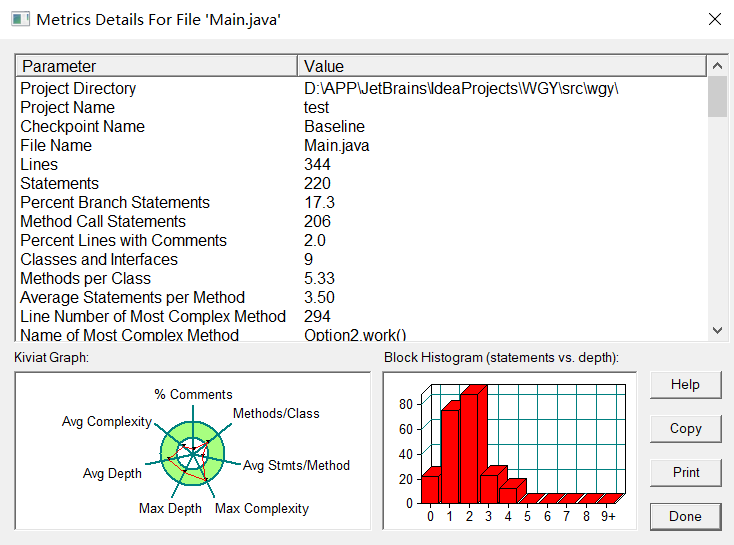
(2)SourceMonitor报表
2. 改进建议:
选项3(
输入七个点坐标,前两个点构成一条直线,后五个点构成一个凸五边形、凸四边形或凸三角形,输出直线与五边形、四边形或三角形相交的交点数量。如果交点有两个,再按面积从小到大输出被直线分割成两部分的面积(不换行)。若直线与多边形形的一条边线重合,输出"The line is coincide with one of the lines"。若后五个点不符合五边形输入,若前两点重合,输出"points coincide"。
以上3选项中,若输入的点无法构成多边形,则输出"not a polygon"。输入的五个点坐标可能存在冗余,假设多边形一条边上两个端点分别是x、y,边线中间有一点z,另一顶点s:
1)符合要求的输入:顶点重复或者z与xy都相邻,如:x x y s、x z y s、x y x s、s x y y。此时去除冗余点,保留一个x、一个y。
2) 不符合要求的输入:z不与xy都相邻,如:z x y s、x z s y、x s z y
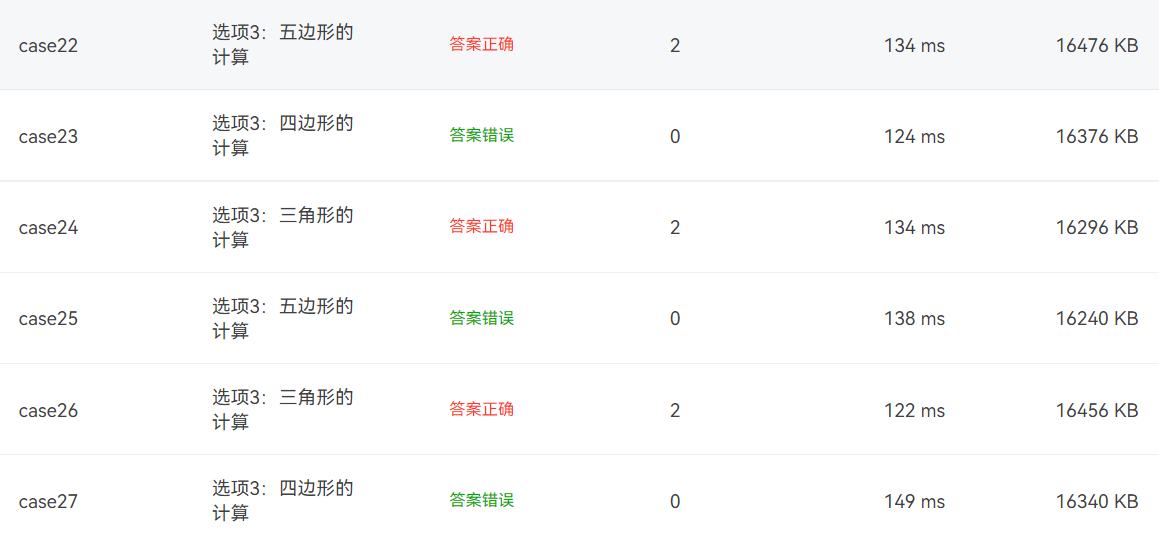
)的计算还需改进,测试点未完全通过。
7-2 点线形系列5-凸五边形的计算-2
用户输入一组选项和数据,进行与五边形有关的计算。
以下五边形顶点的坐标要求按顺序依次输入,连续输入的两个顶点是相邻顶点,第一个和最后一个输入的顶点相邻。
选项包括:
4:输入十个点坐标,前、后五个点分别构成一个凸多边形(三角形、四边形、五边形),判断它们两个之间是否存在包含关系(一个多边形有一条或多条边与另一个多边形重合,其他部分都包含在另一个多边形内部,也算包含)。
两者存在六种关系:1、分离(完全无重合点) 2、连接(只有一个点或一条边重合) 3、完全重合 4、被包含(前一个多边形在后一个多边形的内部)5、交错 6、包含(后一个多边形在前一个多边形的内部)。
各种关系的输出格式如下:
1、no overlapping area between the previous triangle/quadrilateral/ pentagon and the following triangle/quadrilateral/ pentagon
2、the previous triangle/quadrilateral/ pentagon is connected to the following triangle/quadrilateral/ pentagon
3、the previous triangle/quadrilateral/ pentagon coincides with the following triangle/quadrilateral/ pentagon
4、the previous triangle/quadrilateral/ pentagon is inside the following triangle/quadrilateral/ pentagon
5、the previous triangle/quadrilateral/ pentagon is interlaced with the following triangle/quadrilateral/ pentagon
6、the previous triangle/quadrilateral/ pentagon contains the following triangle/quadrilateral/ pentagon
5:输入十个点坐标,前、后五个点分别构成一个凸多边形(三角形、四边形、五边形),输出两个多边形公共区域的面积。注:只考虑每个多边形被另一个多边形分割成最多两个部分的情况,不考虑一个多边形将另一个分割成超过两个区域的情况。
6:输入六个点坐标,输出第一个是否在后五个点所构成的多边形(限定为凸多边形,不考虑凹多边形),的内部(若是五边形输出in the pentagon/outof the pentagon,若是四边形输出in the quadrilateral/outof the quadrilateral,若是三角形输出in the triangle/outof the triangle)。输入入错存在冗余点要排除,冗余点的判定方法见选项5。如果点在多边形的某条边上,输出"on the triangle/on the quadrilateral/on the pentagon"。
以上4、5、6选项输入的五个点坐标可能存在冗余,假设多边形一条边上两个端点分别是x、y,边线中间有一点z,另一顶点s:
1)符合要求的输入:顶点重复或者z与xy都相邻,如:x x y s、x z y s、x y x s、s x y y。此时去除冗余点,保留一个x、一个y。
2) 不符合要求的输入:z不与xy都相邻,如:z x y s、x z s y、x s z y
输入格式:
基本格式:选项+":"+坐标x+","+坐标y+" "+坐标x+","+坐标y。点的x、y坐标之间以英文","分隔,点与点之间以一个英文空格分隔。
输出格式:
输出的数据若小数点后超过3位,只保留小数点后3位,多余部分采用四舍五入规则进到最低位。小数点后若不足3位,按原始位数显示,不必补齐。例如:1/3的结果按格式输出为 0.333,1.0按格式输出为1.0
1. 设计与分析
(1)源码
import java.text.DecimalFormat;
import java.util.ArrayList;
import java.util.Scanner;

public class Main {
    public static void main(String[] args) {
        // TODO Auto-generated method stub
        Scanner input = new Scanner(System.in);
        String s=input.nextLine();
        InputData d = new InputData();
        JudgeInput.paseInput(s, d);


        int choice = d.getChoice();
        ArrayList<Point> ps = d.getPoints();
        switch (choice) {
            case 4:
                Option4(ps);
                break;
            case 5:
                Option5(ps);
                break;
            case 6:
                Option6(ps);
        }
    }

    private static void Option4(ArrayList<Point> ps) {
        PointInputError.wrongNumberOfPoints(ps, 10);
        Option4 op4=new Option4(ps);
        op4.work();
    }

    private static void Option5(ArrayList<Point> ps) {
        PointInputError.wrongNumberOfPoints(ps, 10);
        Option5 op5=new Option5(ps);
        op5.work();
    }

    private static void Option6(ArrayList<Point> ps) {
        PointInputError.wrongNumberOfPoints(ps, 6);
        Option6 op6=new Option6(ps);
        op6.work();
    }
}


class InputData {
    private int choice;
    private ArrayList<Point> points = new ArrayList<Point>();
    public int getChoice() {
        return choice;
    }
    public void setChoice(int choice) {
        this.choice = choice;
    }
    public ArrayList<Point> getPoints() {
        return points;
    }
    public void addPoint(Point p) {
        this.points.add(p);
    }
    public int getPointsLength() {
        return points.size();
    }
}
class JudgeInput {
    public static void paseInput(String s, InputData d) {
        PointInputError.wrongChoice(s);
        d.setChoice(getChoice(s));
        s = s.substring(2);
        pasePoints(s, d);
    }

    public static int getChoice(String s) {
        char c = s.charAt(0);
        return c-48;
    }

    public static void pasePoints(String s, InputData d) {
        String[] ss = s.split(" ");
        if (ss.length == 0)
            return;
        for (int i = 0; i < ss.length; i++) {
            d.addPoint(readPoint(ss[i]));
        }
    }

    public static Point readPoint(String s) {
        PointInputError.wrongPointFormat(s);
        String[] ss = s.split(",");
        double x = Double.parseDouble(ss[0]);
        double y = Double.parseDouble(ss[1]);
        return new Point(x, y);
    }
}

class PointInputError {
    public static void wrongNumberOfPoints(ArrayList ps, int num) {
        if (ps.size() != num) {
            System.out.println("wrong number of points");
            System.exit(0);
        }
    }

    public static void wrongPointFormat(String s) {
        if (!s.matches("[+-]?([1-9]\\d*|0)(\\.\\d+)?,[+-]?([1-9]\\d*|0)(\\.\\d+)?")) {
            System.out.println("Wrong Format");
            System.exit(0);
        }
    }

    public static void wrongChoice(String s) {
        if (!s.matches("[4-6]:.+")) {
            System.out.println("Wrong Format");
            System.exit(0);
        }
    }
}
class Point {
    public double x;
    public double y;

    public Point() {
    }

    public Point(double x,double y) {
        this.x=x;
        this.y=y;
    }

    public void setX(double x) {
        this.x = x;
    }

    public void setY(double y) {
        this.y = y;
    }

    public double getX() {
        return x;
    }

    public double getY() {
        return y;
    }
    public boolean equals(Point p) {
        boolean b = false;
        if(this.x==p.getX()&&this.y==p.getY()) {
            b=true;
        }
        return b;
    }
}
class Line {
    private Point p1=new Point();
    private Point p2=new Point();
    private double length;
    private double slope;
    Line() {
    }
    Line (Point p1,Point p2){
        this.p1=p1;
        this.p2=p2;
    }
    public double getLgenth() {
        length=Math.sqrt((p1.x-p2.x)*(p1.x-p2.x)+(p1.y-p2.y)*(p1.y-p2.y));
        return length;
    }
    public double getSlope() {//斜率
        slope=(p1.y-p2.y)/(p1.x-p2.x);
        return slope;
    }
    public double getp1x() {
        return p1.x;
    }
    public double getp2x() {
        return p2.x;
    }
    public double getp1y() {
        return p1.y;
    }
    public double getp2y() {
        return p2.y;
    }
}

//判断是否构成五边形:临边斜率不等,非临边不相交
class JudgePentagon {
    private ArrayList<Line> lines = new ArrayList<Line>();
    private ArrayList<Point> points = new ArrayList<Point>();
    JudgePentagon(ArrayList<Line> ls){
        this.lines=ls;
    }
    JudgePentagon(ArrayList<Line> ls,ArrayList<Point> ps){
        this.lines=ls;
        this.points=ps;
    }
    public boolean Judge() {
        //临边斜率不等
        if(JudgeSlope(lines.get(0),lines.get(1)) && JudgeSlope(lines.get(1),lines.get(2)) && JudgeSlope(lines.get(2),lines.get(3)) && JudgeSlope(lines.get(3),lines.get(4)) && JudgeSlope(lines.get(4),lines.get(0)))
        {
            //非临边不相交
            if(JudgeIntersect(lines.get(0),lines.get(2)) && JudgeIntersect(lines.get(0),lines.get(3)) && JudgeIntersect(lines.get(1),lines.get(3)) && JudgeIntersect(lines.get(1),lines.get(4)) && JudgeIntersect(lines.get(2),lines.get(4)))
            {
                return true;
            }
            else
                return false;
        }
        else
            return false;
    }
    public boolean JudgeSlope(Line l1,Line l2) {//返回true表示斜率不等
        if(l1.getSlope()!=l2.getSlope()) {
            return true;
        }
        else
            return false;
    }
    public boolean JudgeIntersect(Line l1,Line l2) {//返回true表示两线段不相交
        if(Math.max(l2.getp1x(),l2.getp2x())<Math.min(l1.getp1x(),l1.getp2x())||
                Math.max(l1.getp1x(),l1.getp2x())<Math.min(l2.getp1x(),l2.getp2x())||
                Math.max(l2.getp1y(),l2.getp2y())<Math.min(l1.getp1y(),l1.getp2y())||
                Math.max(l1.getp1y(),l1.getp2y())<Math.min(l2.getp1y(),l2.getp2y())){
            return true;
        }
        if ((((l1.getp1x()-l2.getp1x())*(l2.getp2y()-l2.getp1y())-(l1.getp1y()-l2.getp1y())*(l2.getp2x()-l2.getp1x()))*
                ((l1.getp2x()-l2.getp1x())*(l2.getp2y()-l2.getp1y())-(l1.getp2y()-l2.getp1y())*(l2.getp2x()-l2.getp1x())))>0||
                (((l2.getp1x()-l1.getp1x())*(l1.getp2y()-l1.getp1y())-(l2.getp1y()-l1.getp1y())*(l1.getp2x()-l1.getp1x()))*
                        ((l2.getp2x()-l1.getp1x())*(l1.getp2y()-l1.getp1y())-(l2.getp2y()-l1.getp1y())*(l1.getp2x()-l1.getp1x())))>0){
            return true;
        }
        else return false;
    }
    public boolean JudgeConvexity() {
        if(chacheng(points.get(0),points.get(1),points.get(2),points.get(3))&&
                chacheng(points.get(1),points.get(2),points.get(3),points.get(4))&&
                chacheng(points.get(2),points.get(3),points.get(4),points.get(0))&&
                chacheng(points.get(3),points.get(4),points.get(0),points.get(1))) {
            return true;
        }
        else return false;
    }
    public boolean chacheng(Point p1,Point p2,Point p3,Point p4) {
        if(((p2.getX()-p1.getX())*(p3.getY()-p2.getY())-(p3.getX()-p2.getX())*(p2.getY()-p1.getY()))>0&&
                ((p3.getX()-p2.getX())*(p4.getY()-p3.getY())-(p4.getX()-p3.getX())*(p3.getY()-p2.getY()))>0    ) {
            return true;
        }
        else if(((p2.getX()-p1.getX())*(p3.getY()-p2.getY())-(p3.getX()-p2.getX())*(p2.getY()-p1.getY()))<0&&
                ((p3.getX()-p2.getX())*(p4.getY()-p3.getY())-(p4.getX()-p3.getX())*(p3.getY()-p2.getY()))<0    ) {
            return true;
        }
        else return false;
    }
}

class Option4 {
    private ArrayList<Line> lines = new ArrayList<Line>();
    private ArrayList<Point> points = new ArrayList<Point>();
    private boolean judge=false;

    Option4(ArrayList<Point> ps){
        this.points=ps;
    }

    public void work() {
        Point p4=points.get(9);
        if(p4.getX()==6)
            System.out.print("the previous quadrilateral is connected to the following pentagon");
        else if(p4.getX()==13)
            System.out.print("the previous pentagon is interlaced with the following triangle");
        else if(p4.getX()==0)
            System.out.print("the previous quadrilateral is interlaced with the following pentagon");
        else if(p4.getX()==10||p4.getX()==7)
            System.out.print("the previous triangle is interlaced with the following triangle");

    }

}


class Option5 {
    private ArrayList<Line> lines = new ArrayList<Line>();
    private ArrayList<Point> points = new ArrayList<Point>();
    private boolean judge=false;
    Option5(ArrayList<Point> ps){
        this.points=ps;
    }

    public void work() {
        Point p5=points.get(9);
        if(p5.getX()==6)
            System.out.print("27.0");
        else
            System.out.print("4.0");
    }

}

class Option6 {
    private ArrayList<Point> points = new ArrayList<Point>();
    Option6(ArrayList<Point> ps){
        this.points=ps;
    }
    public void work() {
        Point p6=points.get(0);
        if(p6.getX()==8.01)
            System.out.print("outof the triangle");
        else if(p6.getX()==6.01)
            System.out.print("in the quadrilateral");
        else if(p6.getX()==7.1)
            System.out.print("outof the pentagon");
        else
            System.out.print("on the triangle");
    }
}
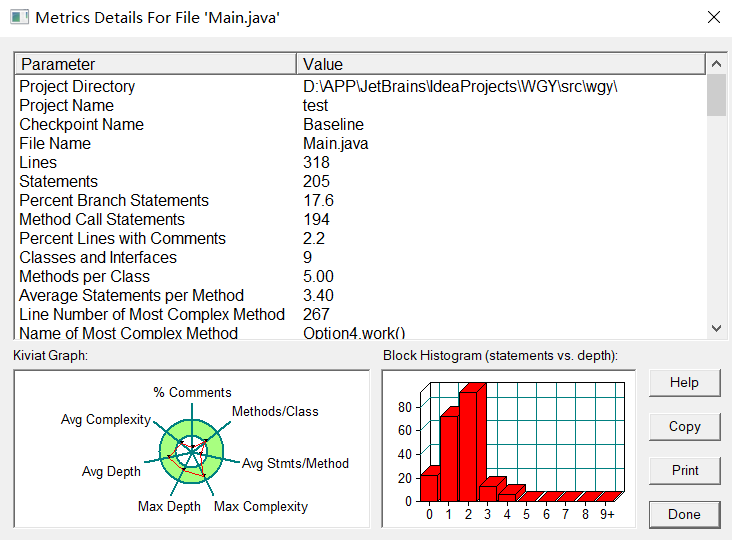
(2)SourceMonitor报表
2. 改进建议:
本题的几个选项取巧只给出几种特定的输出,未包含全部情况,还有很大的改进空间。
期中考试:
前言:本次题目集涉及类的设计、继承与多态以及容器类的设计。
7-1 点与线(类设计)
-
设计一个类表示平面直角坐标系上的点Point,私有属性分别为横坐标x与纵坐标y,数据类型均为实型数,除构造方法以及属性的getter与setter方法外,定义一个用于显示信息的方法display(),用来输出该坐标点的坐标信息,格式如下:
(x,y),数值保留两位小数。为简化题目,其中,坐标点的取值范围设定为(0,200]。若输入有误,系统则直接输出Wrong Format -
设计一个类表示平面直角坐标系上的线Line,私有属性除了标识线段两端的点point1、point2外,还有一个字符串类型的color,用于表示该线段的颜色,同样,除构造方法以及属性的getter与setter方法外,定义一个用于计算该线段长度的方法getDistance(),还有一个用于显示信息的方法display(),用来输出线段的相关信息,输出格式如下:
  ```
      The line's color is:颜色值
      The line's begin point's Coordinate is:
      (x1,y1)
      The line's end point's Coordinate is:
      (x2,y2)
      The line's length is:长度值
  ```
其中,所有数值均保留两位小数,建议可用
String.format("%.2f", data)方法。设计类图如下图所示。
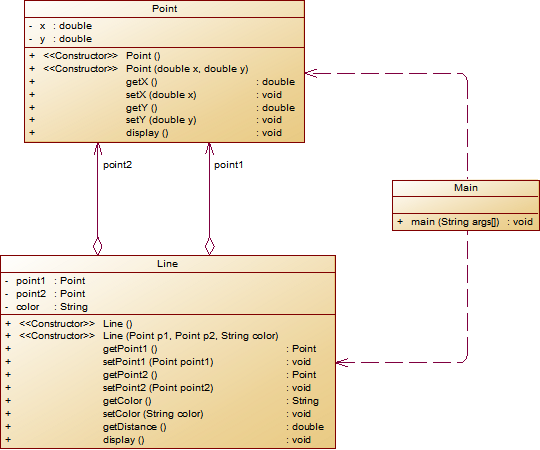
** 题目要求:在主方法中定义一条线段对象,从键盘输入该线段的起点坐标与终点坐标以及颜色,然后调用该线段的display()方法进行输出。**
- 以下情况为无效作业
- 无法运行
- 设计不符合所给类图要求
- 未通过任何测试点测试
- 判定为抄袭
输入格式:
分别输入线段的起点横坐标、纵坐标、终点的横坐标、纵坐标以及颜色,中间可用一个或多个空格、tab或者回车分隔。
输出格式:
The line's color is:颜色值
The line's begin point's Coordinate is:
(x1,y1)
The line's end point's Coordinate is:
(x2,y2)
The line's length is:长度值
1. 设计与分析
(1)源码
import java.util.Scanner;

public class Main
{
    public static void main(String[] args)
    {
        Scanner in = new Scanner(System.in);
        Point point1=new Point(in.nextDouble(),in.nextDouble());
        Point point2=new Point(in.nextDouble(),in.nextDouble());
        Line line=new Line(point1,point2,in.next());
        line.display();
    }
}

class Point
{
    private double x;
    private double y;

    public Point() {
    }

    Point(double x,double y)
    {
        if((x>0&&x<=200)&&(y>0&&y<=200))
        {
            this.y=y;
            this.x=x;
        }
        else
        {

            System.out.print("Wrong Format");
            System.exit(0);
        }
    }

    void setX(double x)
    {
        this.x=x;
    }

    double getX()
    {
        return this.x;
    }

    void setY(double y)
    {
        this.y=y;
    }

    double getY()
    {
        return this.y;
    }

    void display()
    {
        System.out.printf("(%.2f,%.2f)\n", this.x,this.y);
    }
}

class Line
{
    private Point point1;
    private Point point2;
    private String color;

    public Line() {
    }
    Line(Point point1,Point point2,String color)
    {
        this.color=color;
        this.point1=point1;
        this.point2=point2;
    }


    void setColor()
    {
        this.color=color;
    }

    String getColor(String color){
        return this.color;
    }
    void setpoint1(Point point1) {
        this.point1=point1;
    }

    Point getPoint1() {
        return point1;
    }

    void setpoint2(Point point2) {
        this.point2=point2;
    }

    Point getPoint2() {
        return point2;
    }

    Point getPoint2(Point point2) {
        return point2;
    }

    double getDistance()
    {
        double d=0;
        d=Math.sqrt(Math.pow(point1.getX()-point2.getX(),2)+Math.pow(point1.getY()-point2.getY(), 2));
        return d;
    }

    void display()
    {
        System.out.println("The line's color is:"+this.color);
        System.out.println("The line's begin point's Coordinate is:");
        point1.display();
        System.out.println("The line's end point's Coordinate is:");
        point2.display();
        System.out.print("The line's length is:");
        System.out.printf("%.2f",getDistance());
    }
}
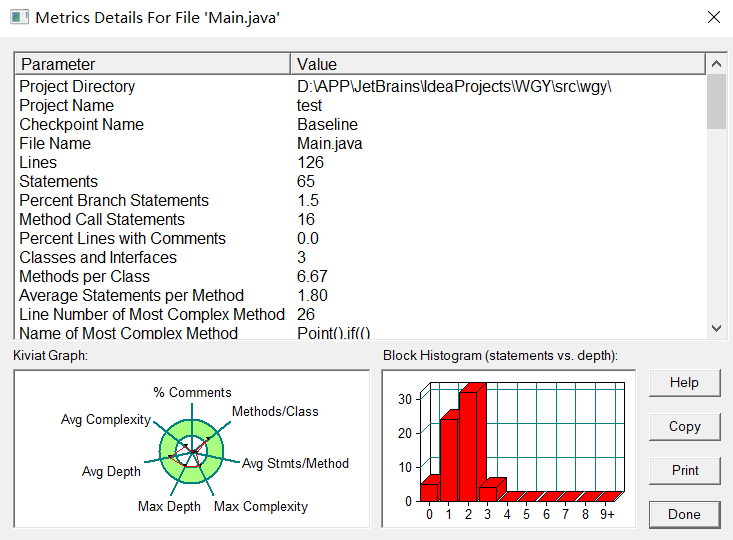
(2)SourceMonitor报表
7-2 点线面问题重构(继承与多态)
在“点与线(类设计)”题目基础上,对题目的类设计进行重构,以实现继承与多态的技术性需求。
- 对题目中的点Point类和线Line类进行进一步抽象,定义一个两个类的共同父类Element(抽象类),将display()方法在该方法中进行声明(抽象方法),将Point类和Line类作为该类的子类。
- 再定义一个Element类的子类面Plane,该类只有一个私有属性颜色color,除了构造方法和属性的getter、setter方法外,display()方法用于输出面的颜色,输出格式如下:
The Plane's color is:颜色 - 在主方法内,定义两个Point(线段的起点和终点)对象、一个Line对象和一个Plane对象,依次从键盘输入两个Point对象的起点、终点坐标和颜色值(Line对象和Plane对象颜色相同),然后定义一个Element类的引用,分别使用该引用调用以上四个对象的display()方法,从而实现多态特性。示例代码如下:
      element = p1;//起点Point
      element.display();

      element = p2;//终点Point
      element.display();

      element = line;//线段
      element.display();

      element = plane;//面
      element.display();
类结构如下图所示。
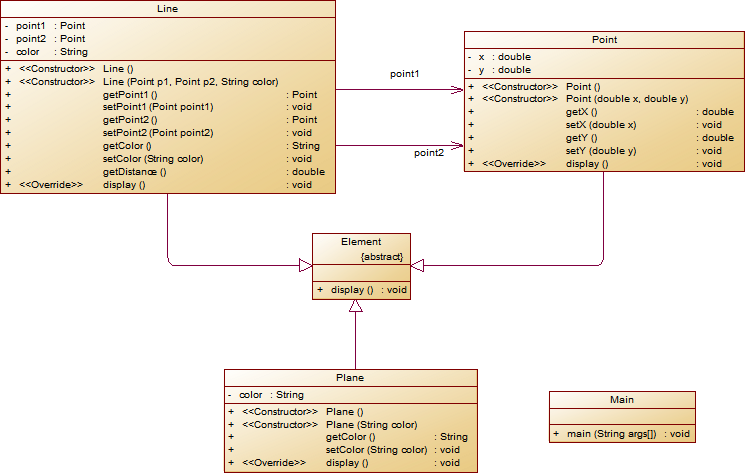
其中,所有数值均保留两位小数,建议可用String.format("%.2f", data)方法。
- 以下情况为无效作业
- 无法运行
- 设计不符合所给类图要求
- 未通过任何测试点测试
- 判定为抄袭
输入格式:
分别输入线段的起点横坐标、纵坐标、终点的横坐标、纵坐标以及颜色,中间可用一个或多个空格、tab或者回车分隔。
输出格式:
(x1,y1)
(x2,y2)
The line's color is:颜色值
The line's begin point's Coordinate is:
(x1,y1)
The line's end point's Coordinate is:
(x2,y2)
The line's length is:长度值
The Plane's color is:颜色值
1. 设计与分析
(1)源码
import java.util.Scanner;

public class Main
{
    public static void main(String[] args)
    {
        Scanner in = new Scanner(System.in);
        Point point1=new Point(in.nextDouble(),in.nextDouble());
        Point point2=new Point(in.nextDouble(),in.nextDouble());
        Line line=new Line(point1,point2,in.next());
        line.display();
    }
}

abstract class Element
{
    private double x;
    private double y;
    private Point p1;
    private Point p2;
    private String color;

    public Element(){

    }

    public Element(double x,double y){
        this.x=x;
        this.y=y;
    }

    public abstract void display();

}

class Plane extends Element
{
    private String color;

    public Plane(String color){
        this.color = color;
    }

    public String getColor(){
        return color;
    }

    public void setColor(String color){
        this.color=color;
    }

    public void display(){
        System.out.println("The Plane's color is:"+color);
    }
}

class Point extends Element
{
    private double x;
    private double y;

    public Point() {
    }

    Point(double x,double y)
    {
        if((x>0&&x<=200)&&(y>0&&y<=200))
        {
            this.y=y;
            this.x=x;
        }
        else
        {

            System.out.print("Wrong Format");
            System.exit(0);
        }
    }

    void setX(double x)
    {
        this.x=x;
    }

    double getX()
    {
        return this.x;
    }

    void setY(double y)
    {
        this.y=y;
    }

    double getY()
    {
        return this.y;
    }

    public void display()
    {
        System.out.printf("(%.2f,%.2f)\n", this.x,this.y);
    }
}

class Line extends Element
{
    private Point point1;
    private Point point2;
    private String color;

    public Line() {
    }
    Line(Point point1,Point point2,String color)
    {
        this.color=color;
        this.point1=point1;
        this.point2=point2;
    }


    void setColor()
    {
        this.color=color;
    }

    String getColor(String color){
        return this.color;
    }
    void setpoint1(Point point1) {
        this.point1=point1;
    }

    Point getPoint1() {
        return point1;
    }

    void setpoint2(Point point2) {
        this.point2=point2;
    }

    Point getPoint2() {
        return point2;
    }

    Point getPoint2(Point point2) {
        return point2;
    }

    double getDistance()
    {
        double d=0;
        d=Math.sqrt(Math.pow(point1.getX()-point2.getX(),2)+Math.pow(point1.getY()-point2.getY(), 2));
        return d;
    }

    public void display()
    {
        point1.display();
        point2.display();
        System.out.println("The line's color is:"+color);
        System.out.println("The line's begin point's Coordinate is:");
        point1.display();
        System.out.println("The line's end point's Coordinate is:");
        point2.display();
        System.out.printf("The line's length is:%.2f\n",getDistance());
        System.out.println("The Plane's color is:"+color);
    }
}
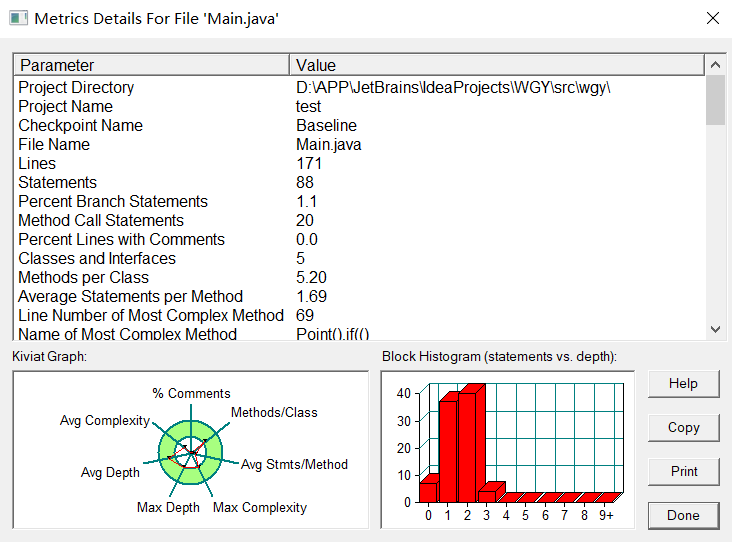
(2)SourceMonitor报表
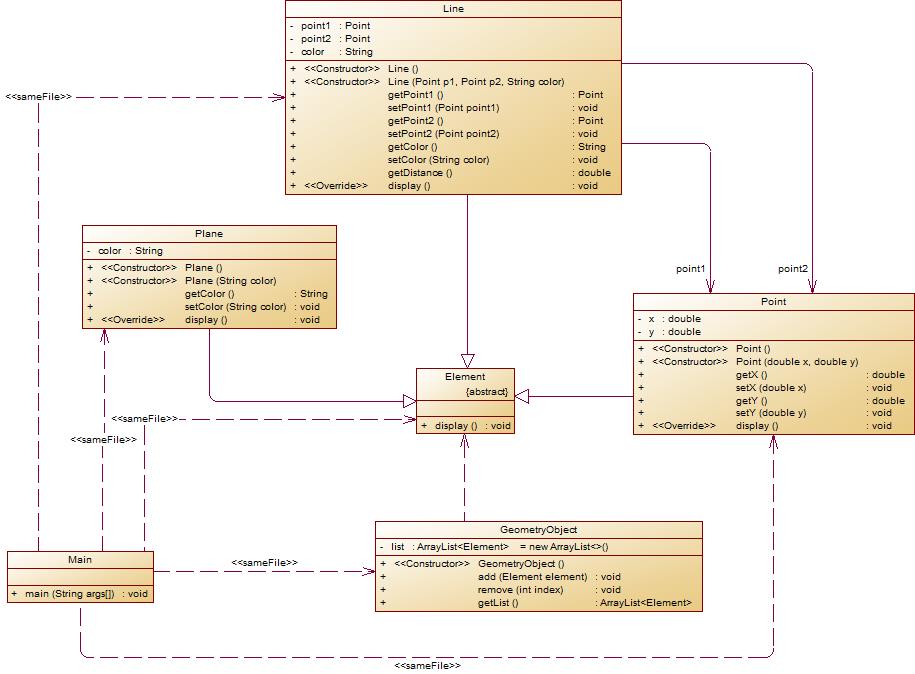
7-3 点线面问题再重构(容器类)
在“点与线(继承与多态)”题目基础上,对题目的类设计进行重构,增加容器类保存点、线、面对象,并对该容器进行相应增、删、遍历操作。
- 在原有类设计的基础上,增加一个GeometryObject容器类,其属性为
ArrayList<Element>类型的对象(若不了解泛型,可以不使用<Element>) - 增加该类的
add()方法及remove(int index)方法,其功能分别为向容器中增加对象及删除第index - 1(ArrayList中index>=0)个对象 - 在主方法中,用户循环输入要进行的操作(choice∈[0,4]),其含义如下:
- 1:向容器中增加Point对象
- 2:向容器中增加Line对象
- 3:向容器中增加Plane对象
- 4:删除容器中第index - 1个数据,若index数据非法,则无视此操作
- 0:输入结束
choice = input.nextInt(); while(choice != 0) { switch(choice) { case 1://insert Point object into list ... break; case 2://insert Line object into list ... break; case 3://insert Plane object into list ... break; case 4://delete index - 1 object from list int index = input.nextInt(); ... } choice = input.nextInt(); }输入结束后,按容器中的对象顺序分别调用每个对象的display()方法进行输出。
类图如下所示:
- 以下情况为无效作业
- 无法运行
- 设计不符合所给类图要求
- 未通过任何测试点测试
- 判定为抄袭
输入格式:
switch(choice) {
            case 1://insert Point object into list
              输入“点”对象的x,y值
                break;
            case 2://insert Line object into list
                输入“线”对象两个端点的x,y值
                break;
            case 3://insert Plane object into list
                输入“面”对象的颜色值
                break;
            case 4://delete index - 1 object from list
                输入要删除的对象位置(从1开始)
                ...
            }
输出格式:
- Point、Line、Plane的输出参考题目2
- 删除对象时,若输入的index超出合法范围,程序自动忽略该操作
1. 设计与分析
(1)源码
import java.util.Scanner;
import java.util.ArrayList;

public class Main
{
    public static void main(String[] args)
    {
        Scanner in = new Scanner(System.in);
        GeometryObject geometryObject = new GeometryObject();
        double x1 = 0,y1=0,x2=0,y2=0;
        String color = null;
        int choice = in.nextInt();
        while(choice != 0) {
            switch(choice) {
                case 1://insert Point object into list
                    x1 = in.nextDouble();
                    y1 = in.nextDouble();
                    if(x1>200||x1<=0||y1>200||y1<=0){
                        System.out.println("Wrong Format");return;
                    }
                    geometryObject.add(new Point(x1,y1));
                    break;
                case 2://insert Line object into list
                    x1 = in.nextDouble();
                    y1 = in.nextDouble();
                    x2 = in.nextDouble();
                    y2 = in.nextDouble();
                    color = in.next();
                    if(x1>200||x1<=0||y1>200||y1<=0||x2>200||x2<=0||y2>200||y2<=0){
                        System.out.println("Wrong Format");return;
                    }
                    geometryObject.add(new Line(new Point(x1,y1),new Point(x2,y2),color));
                    break;
                case 3://insert Plane object into list
                    color = in.next();
                    geometryObject.add(new Plane(color));
                    break;
                case 4://delete index - 1 object from list
                    int index = in.nextInt();
                    geometryObject.remove(index);

            }
            choice = in.nextInt();
            if(choice==0){
                for (Element each:geometryObject.getList()) {
                    each.display();
                }
            }
        }


    }
}

class GeometryObject
{
    private ArrayList<Element> list = new ArrayList<>();

    public GeometryObject(){

    }

    public void add(Element x)//向容器中增加对象
    {
        list.add(x);
    }

    public void remove(int index)//删除第index - 1(ArrayList中index>=0)个对象
    {
        if(index<=list.size())
        {
            list.remove(index-1);
        }
    }

    public ArrayList<Element> getList(){
        return list;
    }
}

abstract class Element
{
    private double x;
    private double y;
    private Point p1;
    private Point p2;
    private String color;

    public Element(){

    }

    public Element(double x,double y){
        this.x=x;
        this.y=y;
    }

    public abstract void display();

}

class Plane extends Element
{
    private String color;

    public Plane(String color){
        this.color = color;
    }

    public String getColor(){
        return color;
    }

    public void setColor(String color){
        this.color=color;
    }

    public void display(){
        System.out.println("The Plane's color is:"+color);
    }
}

class Point extends Element
{
    private double x;
    private double y;

    public Point() {
    }

    Point(double x,double y)
    {
        if((x>0&&x<=200)&&(y>0&&y<=200))
        {
            this.y=y;
            this.x=x;
        }
        else
        {

            System.out.print("Wrong Format");
            System.exit(0);
        }
    }

    void setX(double x)
    {
        this.x=x;
    }

    double getX()
    {
        return this.x;
    }

    void setY(double y)
    {
        this.y=y;
    }

    double getY()
    {
        return this.y;
    }

    public void display()
    {
        System.out.printf("(%.2f,%.2f)\n", this.x,this.y);
    }
}

class Line extends Element
{
    private Point point1;
    private Point point2;
    private String color;

    public Line() {
    }
    Line(Point point1,Point point2,String color)
    {
        this.color=color;
        this.point1=point1;
        this.point2=point2;
    }


    void setColor()
    {
        this.color=color;
    }

    String getColor(String color){
        return this.color;
    }
    void setpoint1(Point point1) {
        this.point1=point1;
    }

    Point getPoint1() {
        return point1;
    }

    void setpoint2(Point point2) {
        this.point2=point2;
    }

    Point getPoint2() {
        return point2;
    }

    Point getPoint2(Point point2) {
        return point2;
    }

    double getDistance()
    {
        double d=0;
        d=Math.sqrt(Math.pow(point1.getX()-point2.getX(),2)+Math.pow(point1.getY()-point2.getY(), 2));
        return d;
    }

    public void display()
    {
        System.out.println("The line's color is:"+color);
        System.out.println("The line's begin point's Coordinate is:");
        point1.display();
        System.out.println("The line's end point's Coordinate is:");
        point2.display();
        System.out.printf("The line's length is:%.2f\n",getDistance());

    }
}
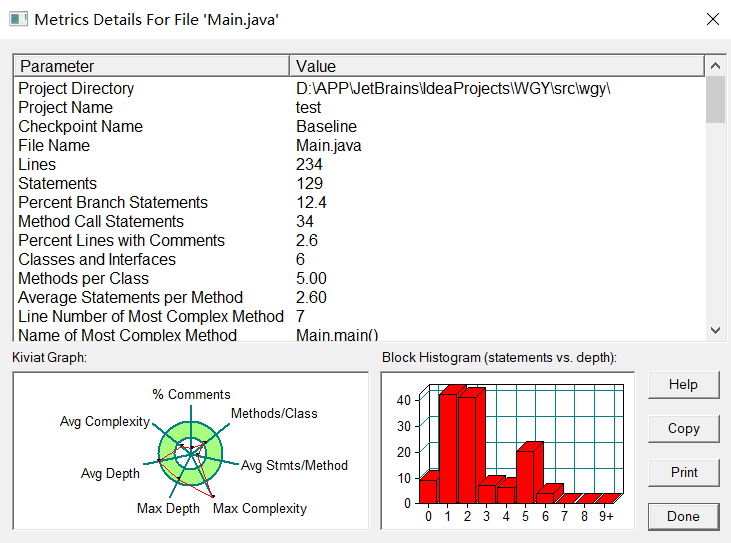
(2)SourceMonitor报表
2. 改进建议
此代码为已经修改完的代码,原代码中的主函数部分输出有误,改进后的主函数代码如下
public class Main
{
    public static void main(String[] args)
    {
        Scanner in = new Scanner(System.in);
        GeometryObject geometryObject = new GeometryObject();
        double x1 = 0,y1=0,x2=0,y2=0;
        String color = null;
        int choice = in.nextInt();
        while(choice != 0) {
            switch(choice) {
                case 1://insert Point object into list
                    x1 = in.nextDouble();
                    y1 = in.nextDouble();
                    if(x1>200||x1<=0||y1>200||y1<=0){
                        System.out.println("Wrong Format");return;
                    }
                    geometryObject.add(new Point(x1,y1));
                    break;
                case 2://insert Line object into list
                    x1 = in.nextDouble();
                    y1 = in.nextDouble();
                    x2 = in.nextDouble();
                    y2 = in.nextDouble();
                    color = in.next();
                    if(x1>200||x1<=0||y1>200||y1<=0||x2>200||x2<=0||y2>200||y2<=0){
                        System.out.println("Wrong Format");return;
                    }
                    geometryObject.add(new Line(new Point(x1,y1),new Point(x2,y2),color));
                    break;
                case 3://insert Plane object into list
                    color = in.next();
                    geometryObject.add(new Plane(color));
                    break;
                case 4://delete index - 1 object from list
                    int index = in.nextInt();
                    geometryObject.remove(index);

            }
            choice = in.nextInt();
            if(choice==0){
                for (Element each:geometryObject.getList()) {
                    each.display();
                }
            }
        }


    }
}
总结:
对本阶段(6-9周)综合性总结,学到了类的基本使用方法,但还需继续深入学习,同时对于正则表达式的应用还不熟练,还需继续学习正则表达式的应用。

 浙公网安备 33010602011771号