
结对编程——随机数四则运算
作业要求:
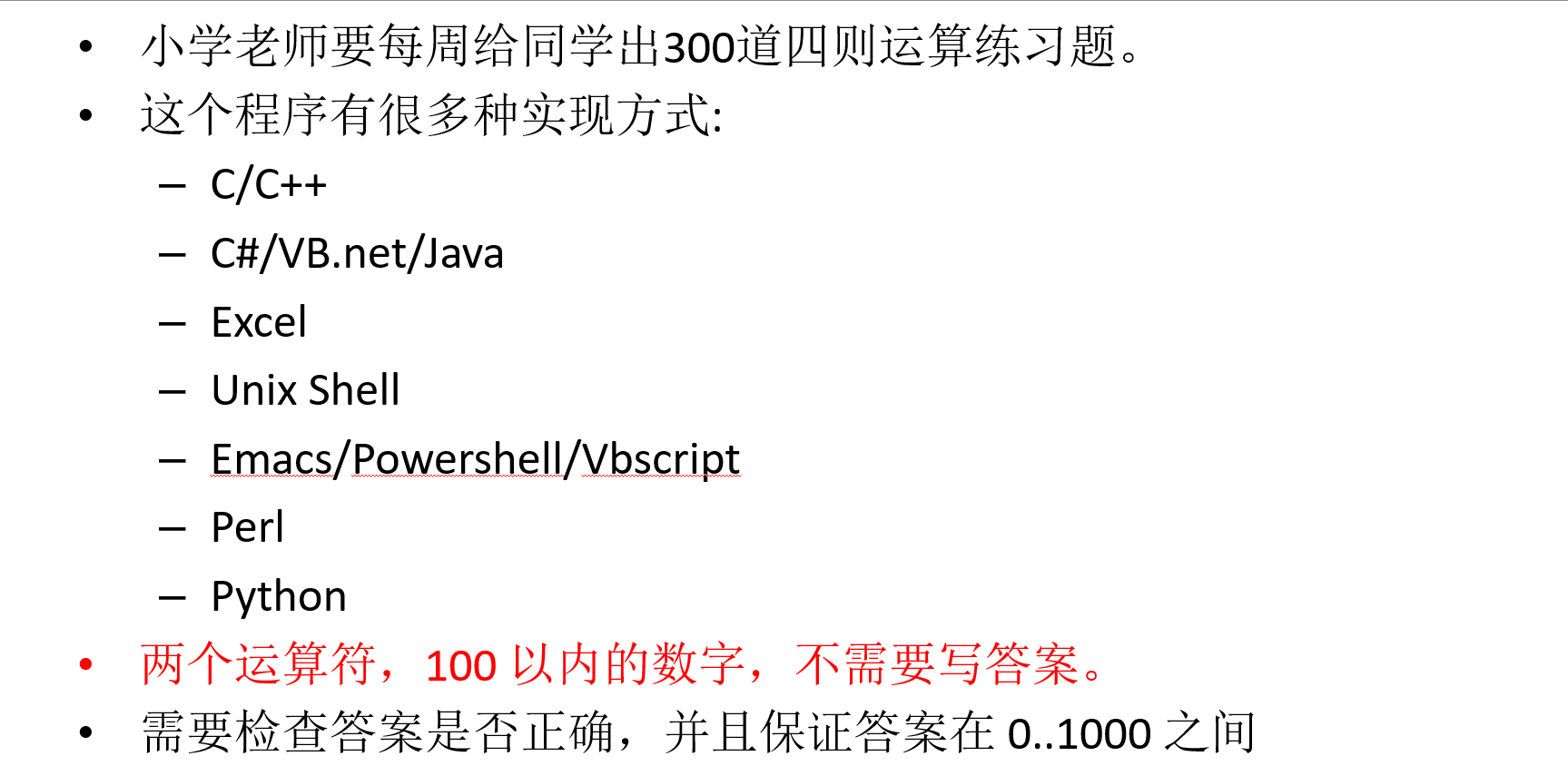
注:本次作业(结对编程)由我(2352228)和学号为2352234的同学结对完成
首先以下为实现随机生成300道1000以内加减乘除计算的代码:
点击查看代码
#include <iostream>
#include <random>
#include <vector>
#include <string>
#include <iomanip>
#include <cmath> // 用于fabs()
using namespace std;

struct Question {
    string expression;
    double answer;
};

// 全局随机引擎(整个程序共用)
static mt19937 e(random_device{}());

Question generateQuestion() {
    uniform_int_distribution<int> num_dist(0, 100);
    uniform_int_distribution<int> op_dist(1, 4); // 1:+, 2:-, 3:*, 4:/

    const int MAX_ATTEMPTS = 100;
    int attempts = 0;

    while (attempts < MAX_ATTEMPTS) {
        int num1 = num_dist(e);
        int num2 = num_dist(e);
        int num3 = num_dist(e);
        int op1 = op_dist(e);
        int op2 = op_dist(e);

        // 计算第一个运算
        double step1;
        char op1_char;
        switch (op1) {
        case 1: op1_char = '+'; step1 = num1 + num2; break;
        case 2: op1_char = '-'; step1 = num1 - num2; break;
        case 3: op1_char = '*'; step1 = num1 * num2; break;
        case 4:
            op1_char = '/';
            if (num2 == 0) num2 = 1; // 避免除零
            step1 = static_cast<double>(num1) / num2;
            break;
        }

        // 计算第二个运算
        double final_answer;
        char op2_char;
        switch (op2) {
        case 1: op2_char = '+'; final_answer = step1 + num3; break;
        case 2: op2_char = '-'; final_answer = step1 - num3; break;
        case 3: op2_char = '*'; final_answer = step1 * num3; break;
        case 4:
            op2_char = '/';
            if (num3 == 0) num3 = 1; // 避免除零
            final_answer = step1 / num3;
            break;
        }

        // 答案必须在0-1000之间
        if (final_answer >= 0 && final_answer <= 1000) {
            string expr = to_string(num1) + " " + op1_char + " "
                + to_string(num2) + " " + op2_char + " "
                + to_string(num3) + " = ";
            return { expr, final_answer };
        }

        attempts++;
    }

    // 保底题目
    return { "10 + 10 + 10 = ", 30 };
}

int main() {
    const int TOTAL_QUESTIONS = 300;
    const int QUESTIONS_PER_LINE = 5;
    const int EXPRESSION_WIDTH = 25;

    // 阶段1:生成所有题目(固定顺序)
    vector<Question> question_bank;
    cout << "生成题目中..." << endl;
    for (int i = 0; i < TOTAL_QUESTIONS; i++) {
        question_bank.push_back(generateQuestion());
    }

    // 阶段2:显示所有题目
    cout << "\n=== 题目列表 ===" << endl;
    for (int i = 0; i < TOTAL_QUESTIONS; i++) {
        cout << left << setw(EXPRESSION_WIDTH) << question_bank[i].expression;
        if ((i + 1) % QUESTIONS_PER_LINE == 0) cout << endl;
    }

    // 阶段3:答题模式(严格按生成顺序)
    cout << "\n=== 答题模式 ===" << endl;
    cout << "提示:请按上方题目顺序作答,输入答案后按回车\n\n";

    int correct_count = 0;
    for (int i = 0; i < TOTAL_QUESTIONS; i++) {
        double user_answer;
        cout << "第" << i + 1 << "题: " << question_bank[i].expression;
        cin >> user_answer;

        // 允许0.01的浮点误差
        if (fabs(user_answer - question_bank[i].answer) < 0.01) {
            cout << "✔ 正确\n";
            correct_count++;
        }
        else {
            cout << "✖ 错误 (正确答案: " << question_bank[i].answer << ")\n";
        }

        // 每10题显示进度
        if ((i + 1) % 10 == 0) {
            cout << "[进度] " << i + 1 << "/300 | 正确率: "
                << correct_count << "/" << i + 1 << " ("
                << (correct_count * 100 / (i + 1)) << "%)\n";
        }
    }

    // 最终结果
    cout << "\n=== 最终结果 ===" << endl;
    cout << "总正确率: " << correct_count << "/" << TOTAL_QUESTIONS << " ("
        << (correct_count * 100 / TOTAL_QUESTIONS) << "%)\n";

    return 0;
}
其次,为完成本次任务,我们途中遇到的问题包括但不限于随机数的生成、数组溢出、输出结果偏离预期、无法判断用户输入正确性等,篇幅有限所以不在赘述。
特色部分:
1.为了能够生成足够随机的0100以内的数字,我们首先尝试了rand()函数并限定范围为0100和1~100(除数不能为0),但测试的过程中发现生成的数字无法满足需求
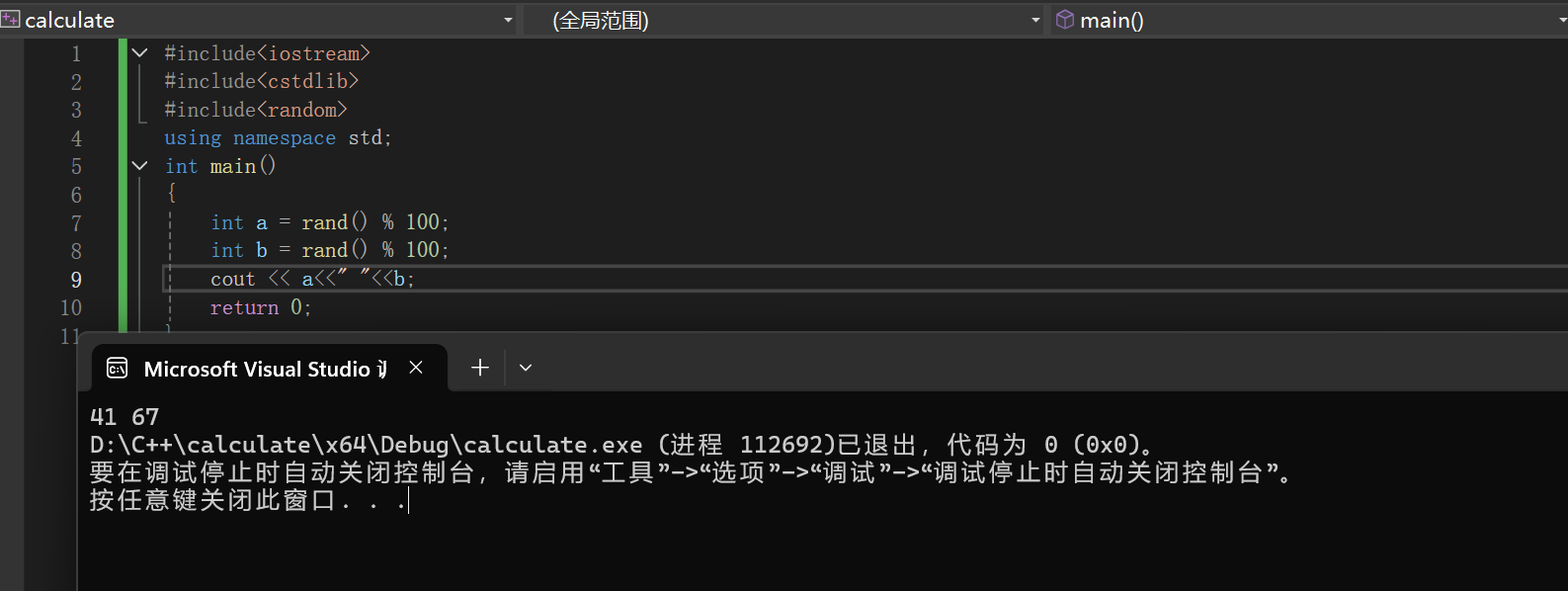
rand()生成的随机数其实存在一定的规律,我们无法避免,所以只好采用更加随机的随机数引擎mt19937

这样就能保证我们生成的数字足够随机且不重复
2.限定答案范围0~1000
点击查看代码
 // 答案必须在0-1000之间
 if (final_answer >= 0 && final_answer <= 1000) {
     string expr = to_string(num1) + " " + op1_char + " "
         + to_string(num2) + " " + op2_char + " "
         + to_string(num3) + " = ";
     return { expr, final_answer };
 }
点击查看代码
const int TOTAL_QUESTIONS = 300;//题目总数
const int QUESTIONS_PER_LINE = 5;//每行5题
const int EXPRESSION_WIDTH = 25;//每个式子所占的长度
4.运行结果展示
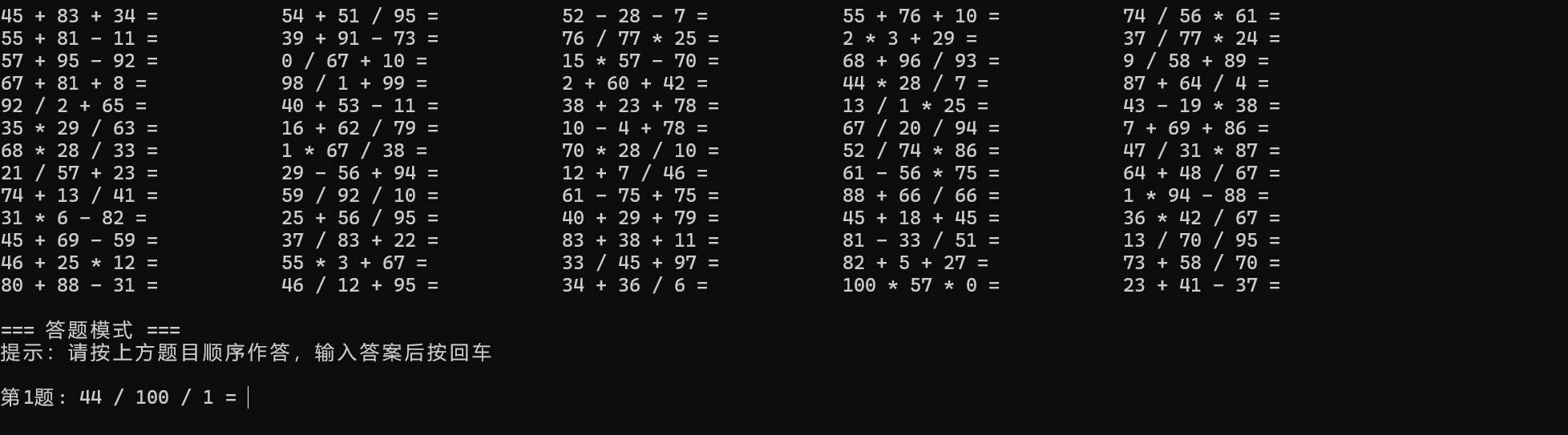
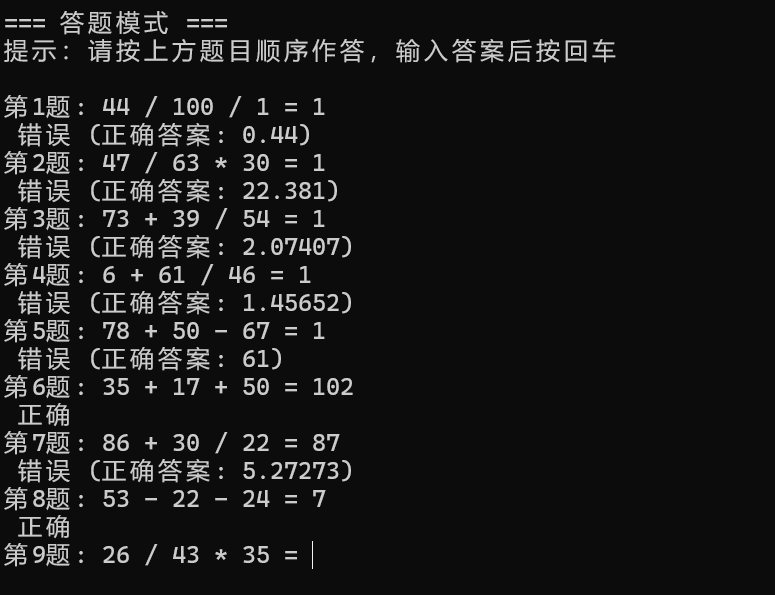
以上就是我们此次结对编程的成果展示

 浙公网安备 33010602011771号