


概念学习笔记
一个对概念学习很好的理解:https://blog.csdn.net/firparks/article/details/50678027
一个经典例子:
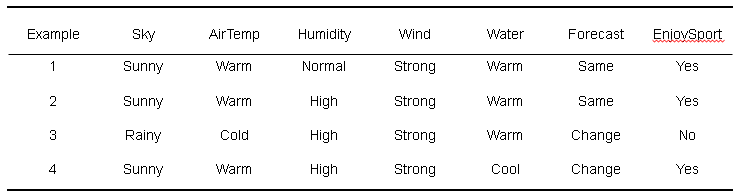
find-s 算法:
 1 def find_s():
 2     x1 = ['sunny', 'warm', 'nurmal', 'strong', 'warm', 'same', 1]
 3     x2 = ['sunny', 'warm', 'high', 'strong', 'warm', 'same', 1]
 4     x3 = ['rainy', 'cold', 'high', 'strong', 'warm', 'change', 0]
 5     x4 = ['sunny', 'warm', 'high', 'strong', 'cool', 'change', 1]
 6
 7     h = [None, None, None, None, None, None]
 8     h1 = ['sunny', 'warm', 'nurmal', 'strong', 'warm', 'same'] //初始化
 9
10     xa = [x1, x2, x3, x4]
11
12     xb = [x1, x2, x4, x3]
13
14     for i in xb:
15         if i[6] == 1:
16             index = 0
17             for j in i[:-1]:
18                 if (h1[index] == None):
19                     h1[index] = j
20                 elif (h1[index] != j):
21                     h1[index] = '?'
22                 index += 1
23         print(h1)
24
25 if __name__ == "__main__":
26     find_s()
候选消除算法:
  1 class Holder:
  2     factors = {}  # Initialize an empty dictionary
  3     attributes = ()  # declaration of dictionaries parameters with an arbitrary length
  4
  5     '''
  6     Constructor of class Holder holding two parameters,
  7     self refers to the instance of the class
  8     '''
  9
 10     def __init__(self, attr):  #
 11         self.attributes = attr
 12         for i in attr:
 13             self.factors[i] = []
 14
 15     def add_values(self, factor, values):
 16         self.factors[factor] = values
 17
 18
 19 class CandidateElimination:
 20     Positive = {}  # Initialize positive empty dictionary
 21     Negative = {}  # Initialize negative empty dictionary
 22
 23     def __init__(self, data, fact):
 24         self.num_factors = len(data[0][0])
 25         self.factors = fact.factors
 26         self.attr = fact.attributes
 27         self.dataset = data
 28
 29         # print self.attr
 30
 31     def run_algorithm(self):
 32         #        print self.dataset
 33         '''
 34         Initialize the specific and general boundaries, and loop the dataset against the algorithm
 35         '''
 36         G = self.initializeG()
 37         S = self.initializeS()
 38
 39         '''
 40         Programmatically populate list in the iterating variable trial_set
 41         '''
 42         count = 0
 43         for trial_set in self.dataset:
 44             if self.is_positive(trial_set):  # if trial set/example consists of positive examples
 45                 G = self.remove_inconsistent_G(G, trial_set[0])  # remove inconsitent data from the general boundary
 46                 S_new = S[:]  # initialize the dictionary with no key-value pair
 47                 print(S_new)
 48                 for s in S:
 49                     if not self.consistent(s, trial_set[0]):
 50                         S_new.remove(s)
 51                         generalization = self.generalize_inconsistent_S(s, trial_set[0])
 52                         generalization = self.get_general(generalization, G)
 53                         if generalization:
 54                             S_new.append(generalization)
 55                     S = S_new[:]
 56                     S = self.remove_more_general(S)
 57
 58                     print(S)
 59             else:  # if it is negative
 60                 S = self.remove_inconsistent_S(S, trial_set[0])  # remove inconsitent data from the specific boundary
 61                 G_new = G[:]  # initialize the dictionary with no key-value pair (dataset can take any value)
 62                 print(G_new)
 63                 for g in G:
 64                     if self.consistent(g, trial_set[0]):
 65                         G_new.remove(g)
 66                         specializations = self.specialize_inconsistent_G(g, trial_set[0])
 67                         specializationss = self.get_specific(specializations, S)
 68                         if specializations != []:
 69                             G_new += specializations
 70                     G = G_new[:]
 71                     print(G)
 72                     G = self.remove_more_specific(G)
 73
 74         print(S)
 75         print(G)
 76
 77     def initializeS(self):
 78         ''' Initialize the specific boundary '''
 79         S = tuple(['-' for factor in range(self.num_factors)])  # 6 constraints in the vector
 80         return [S]
 81
 82     def initializeG(self):
 83         ''' Initialize the general boundary '''
 84         G = tuple(['?' for factor in range(self.num_factors)])  # 6 constraints in the vector
 85         return [G]
 86
 87     def is_positive(self, trial_set):
 88         ''' Check if a given training trial_set is positive '''
 89         if trial_set[1] == 'Y':
 90             return True
 91         elif trial_set[1] == 'N':
 92             return False
 93         else:
 94             raise TypeError("invalid target value")
 95
 96     def is_negative(self, trial_set):
 97         ''' Check if a given training trial_set is negative '''
 98         if trial_set[1] == 'N':
 99             return False
100         elif trial_set[1] == 'Y':
101             return True
102         else:
103             raise TypeError("invalid target value")
104
105     def match_factor(self, value1, value2):
106         ''' Check for the factors values match,
107             necessary while checking the consistency of
108             training trial_set with the hypothesis '''
109         if value1 == '?' or value2 == '?':
110             return True
111         elif value1 == value2:
112             return True
113         return False
114
115     def consistent(self, hypothesis, instance):
116         ''' Check whether the instance is part of the hypothesis '''
117         for i, factor in enumerate(hypothesis):
118             if not self.match_factor(factor, instance[i]):
119                 return False
120         return True
121
122     def remove_inconsistent_G(self, hypotheses, instance):
123         ''' For a positive trial_set, the hypotheses in G
124             inconsistent with it should be removed '''
125         G_new = hypotheses[:]
126         for g in hypotheses:
127             if not self.consistent(g, instance):
128                 G_new.remove(g)
129         return G_new
130
131     def remove_inconsistent_S(self, hypotheses, instance):
132         ''' For a negative trial_set, the hypotheses in S
133             inconsistent with it should be removed '''
134         S_new = hypotheses[:]
135         for s in hypotheses:
136             if self.consistent(s, instance):
137                 S_new.remove(s)
138         return S_new
139
140     def remove_more_general(self, hypotheses):
141         '''  After generalizing S for a positive trial_set, the hypothesis in S
142         general than others in S should be removed '''
143         S_new = hypotheses[:]
144         for old in hypotheses:
145             for new in S_new:
146                 if old != new and self.more_general(new, old):
147                     S_new.remove[new]
148         return S_new
149
150     def remove_more_specific(self, hypotheses):
151         ''' After specializing G for a negative trial_set, the hypothesis in G
152         specific than others in G should be removed '''
153         G_new = hypotheses[:]
154         for old in hypotheses:
155             for new in G_new:
156                 if old != new and self.more_specific(new, old):
157                     G_new.remove[new]
158         return G_new
159
160     def generalize_inconsistent_S(self, hypothesis, instance):
161         ''' When a inconsistent hypothesis for positive trial_set is seen in the specific boundary S,
162             it should be generalized to be consistent with the trial_set ... we will get one hypothesis'''
163         hypo = list(hypothesis)  # convert tuple to list for mutability
164         for i, factor in enumerate(hypo):
165             if factor == '-':
166                 hypo[i] = instance[i]
167             elif not self.match_factor(factor, instance[i]):
168                 hypo[i] = '?'
169         generalization = tuple(hypo)  # convert list back to tuple for immutability
170         return generalization
171
172     def specialize_inconsistent_G(self, hypothesis, instance):
173         ''' When a inconsistent hypothesis for negative trial_set is seen in the general boundary G
174             should be specialized to be consistent with the trial_set.. we will get a set of hypotheses '''
175         specializations = []
176         hypo = list(hypothesis)  # convert tuple to list for mutability
177         for i, factor in enumerate(hypo):
178             if factor == '?':
179                 values = self.factors[self.attr[i]]
180                 for j in values:
181                     if instance[i] != j:
182                         hyp = hypo[:]
183                         hyp[i] = j
184                         hyp = tuple(hyp)  # convert list back to tuple for immutability
185                         specializations.append(hyp)
186         return specializations
187
188     def get_general(self, generalization, G):
189         ''' Checks if there is more general hypothesis in G
190             for a generalization of inconsistent hypothesis in S
191             in case of positive trial_set and returns valid generalization '''
192
193         for g in G:
194             if self.more_general(g, generalization):
195                 return generalization
196         return None
197
198     def get_specific(self, specializations, S):
199         ''' Checks if there is more specific hypothesis in S
200             for each of hypothesis in specializations of an
201             inconsistent hypothesis in G in case of negative trial_set
202             and return the valid specializations'''
203         valid_specializations = []
204         for hypo in specializations:
205             for s in S:
206                 if self.more_specific(s, hypo) or s == self.initializeS()[0]:
207                     valid_specializations.append(hypo)
208         return valid_specializations
209
210     def exists_general(self, hypothesis, G):
211         '''Used to check if there exists a more general hypothesis in
212             general boundary for version space'''
213
214         for g in G:
215             if self.more_general(g, hypothesis):
216                 return True
217         return False
218
219     def exists_specific(self, hypothesis, S):
220         '''Used to check if there exists a more specific hypothesis in
221             general boundary for version space'''
222
223         for s in S:
224             if self.more_specific(s, hypothesis):
225                 return True
226         return False
227
228     def get_version_space(self, specific, general):
229         ''' Given the specific and the general boundary of the
230             version space, evaluate the version space in between '''
231         while get_order(VS):
232             for hypothesis in VS[:]:
233                 hypo = list(hypothesis)  # convert tuple to list for mutability
234                 for i, factor in enumerate(hypo):
235                     if factor != '?':
236                         hyp = hypo[:]
237                         hyp[i] = '?'
238                         if self.exists_general(hyp, general) and self.exists_specific(hyp, specific):
239                             VS.append(tuple(hyp))
240
241         return VS
242
243     def get_order(self, hypothesis):
244         pass
245
246     def more_general(self, hyp1, hyp2):
247         ''' Check whether hyp1 is more general than hyp2 '''
248         hyp = zip(hyp1, hyp2)
249         for i, j in hyp:
250             if i == '?':
251                 continue
252             elif j == '?':
253                 if i != '?':
254                     return False
255             elif i != j:
256                 return False
257             else:
258                 continue
259         return True
260
261     def more_specific(self, hyp1, hyp2):
262         ''' hyp1 more specific than hyp2 is
263             equivalent to hyp2 being more general than hyp1 '''
264         return self.more_general(hyp2, hyp1)
265
266
267 dataset = [(('sunny', 'warm', 'normal', 'strong', 'warm', 'same'), 'Y'),
268            (('sunny', 'warm', 'high', 'strong', 'warm', 'same'), 'Y'),
269            (('rainy', 'cold', 'high', 'strong', 'warm', 'change'), 'N'),
270            (('sunny', 'warm', 'high', 'strong', 'cool', 'change'), 'Y')]
271 attributes = ('Sky', 'Temp', 'Humidity', 'Wind', 'Water', 'Forecast')
272
273 f = Holder(attributes)
274 f.add_values('Sky', ('sunny', 'rainy', 'cloudy'))  # sky can be sunny rainy or cloudy
275 f.add_values('Temp', ('cold', 'warm'))  # Temp can be sunny cold or warm
276 f.add_values('Humidity', ('normal', 'high'))  # Humidity can be normal or high
277 f.add_values('Wind', ('weak', 'strong'))  # wind can be weak or strong
278 f.add_values('Water', ('warm', 'cold'))  # water can be warm or cold
279 f.add_values('Forecast', ('same', 'change'))  # Forecast can be same or change
280 a = CandidateElimination(dataset, f)  # pass the dataset to the algorithm class and call the run algoritm method
281 a.run_algorithm()

 浙公网安备 33010602011771号